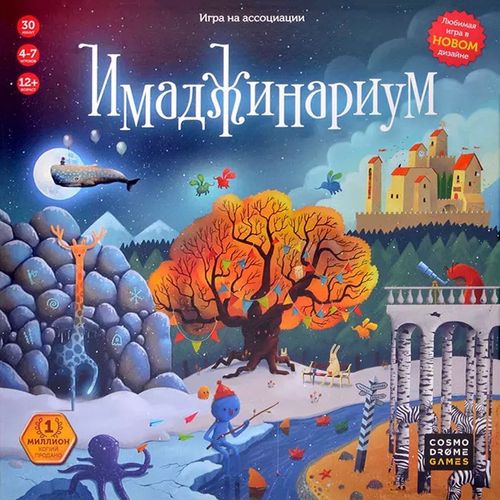
Имаджинариум (Imaginarium)
Имаджинариум (Imaginarium) Rulebook
Table of Contents
Table of Contents
What's in the Box?
- A game board with clouds.
- 98 large cards with slightly crazy pictures.
- 7 differently colored specially trained flying elephants.
- 49 numbered tokens, 7 of each color.
- 5 tokens with a picture of a trash can (throw these away).
Setup
First, prepare the playing deck. Different numbers of players require a different deck size (see the table). Count out the required number of cards and put the extras back in the box.
| Number of players | 4 | 5 | 6 | 7 |
|---|---|---|---|---|
| Number of cards | 96 | 75 | 72 | 98 |
Each player chooses tokens and an elephant of one color. The number of tokens must equal the number of players: for example, if there are five players, you will need tokens numbered 1 through 5.
Place your elephants on the starting cloud on the game board (cloud number one).
Shuffle the deck, deal each player 6 cards, and put the rest of the deck in the middle of the table face down. Now you can begin the game.
Course of the Game
On each turn, one of the players takes the role of the storyteller, who states an association, and this role passes from one player to the next clockwise.
The tokens will help you choose the first storyteller. Choose the tokens of one color, shuffle them, and let each player draw a token. The player who draws the token with the highest number goes first. That said, nothing stops you from using any other method of drawing lots.
The Storyteller's Turn
The storyteller chooses one of their own cards, places it face down in the middle of the table, and states their association with this card. The association can be anything: a word, a sentence, a line of poetry, a well-known quote, or even an arbitrary set of sounds. The storyteller is limited only by their imagination (unless their elephant is standing on one of the special clouds described below).
Players' Answers
The other players each choose, among their own cards, the one that best matches the storyteller's association, and also place it face down on the table. The storyteller shuffles all the cards that were played, including their own, and lays them out in a row face up.
The cards are numbered left to right: first, second, and so on. Where left and right are for you is something you'll have to figure out on your own.
Guessing the Storyteller's Card
Now the players' main task is to guess which of the cards laid out on the table was the storyteller's chosen card. Each player chooses the token with the number of their guess and places it in front of themselves number-side down. You may not choose your own card. The storyteller does not take part in guessing and does not comment on the cards on the table. Once all players have made their decision, they turn their tokens face up and place them on the corresponding cards to make counting easier.
Moving the Elephants
- If every player guesses the storyteller's card, the storyteller's elephant moves back 3 spaces (or to cloud number 1, if it had not yet advanced past the third space), and all other elephants stay in place.
- If no one guesses the storyteller's card, the storyteller's elephant moves back 2 spaces.
- In any other case, the storyteller's elephant and the elephants of the players who correctly guessed their card move forward 3 spaces.
In addition, every player, including the storyteller, moves their elephant forward a number of spaces equal to the number of people who chose their card.
End of the Turn
At the end of the turn, the played cards go to the discard pile, and the players each draw one new card from the deck (once the deck runs out, simply keep playing with the cards remaining in hand). The role of storyteller passes to the next player clockwise.
Worked Example
Placing the elephants. The players' pieces are placed on the starting space.
Choosing the first player. The tokens will help you choose the first storyteller. Choose the tokens of one color, shuffle them, and let each player draw a token. The player who draws the token with the highest number goes first. That said, nothing stops you from using any other method of drawing lots.
Stating the association. The storyteller decides to state an association for the rightmost card. Their association is "The Wizard of Oz." They announce it aloud.
Players' associations. The players each choose one of their cards that, in their opinion, best matches the association "The Wizard of Oz," and place it on the table face down.
Laying out. The storyteller shuffles all the cards that were played, including their own, and lays them out in a row face up. The cards are numbered left to right: first, second, and so on. Where left and right are for you is something you'll have to figure out on your own. In this example, card number one is the one closest to the box.
Voting. Each player chooses the token with the number of their guess and places it in front of themselves number-side down. You may not choose your own card. The storyteller does not take part in guessing.
Revealing the tokens. Once all players have voted, the voting tokens are revealed and laid out for counting up the points.
Scoring and moving the pieces. Three players guessed the storyteller's card, and three more chose other players' cards. Accordingly: the storyteller gets 3 base points plus 3 more points for each player who guessed correctly, for a total of 6. The player who played card number 5 gets 1 point, since that picture was chosen by one person. The player who played card number 6 gets 2 points, since that picture was chosen by two people. The elephants move around the board according to the points scored.
Special Clouds
Some clouds on the game board are marked with special icons. If the storyteller's elephant is standing on one of these clouds, restrictions apply to their association:
- Question mark: The association must be stated in the form of a question.
- Number 4: The association must contain exactly four words.
- Brand icon: The association must be connected to some well-known brand. You don't have to name the brand itself — the association can be based on a slogan, a commercial, and so on. Before the game you may agree on how broadly to interpret the concept of a "brand."
- Television icon: The association must be based on a film (a cartoon, a TV series, a television program).
- Book icon: The association must be stated in the form of a story.
End of the Game
The game ends when the players run out of cards in hand. The winner is the player whose elephant has advanced the furthest. If one of the elephants reaches the last cloud and needs to keep going, that's fine — just send it around for a second lap.
Rule Variations
You can change the rules of "Imaginarium" however you like. For example, we suggest trying the following variations:
- You can end the game when one of the elephants reaches cloud number 39.
- You can use all the cards in the game, and when the deck runs out, shuffle the discard pile to form a new deck. And so on, indefinitely.
- You can introduce permanent restrictions on associations. For example, play an entire game where you only state associations as four-word phrases, or only as stories.
- If more than seven people want to play, you can pair up and play two-to-an-elephant.
Additional Card Sets
After a while you will know the cards in the deck too well and will want something new. In that case, you can buy additional card sets for "Imaginarium," use cards from other games for associations, or even draw the cards yourself. You can find information about additional sets on the game's website: www.imaginarium.sc
For any questions and suggestions about the game, you can also reach out on our website www.imaginarium.sc or write to [email protected]
Have a great game!