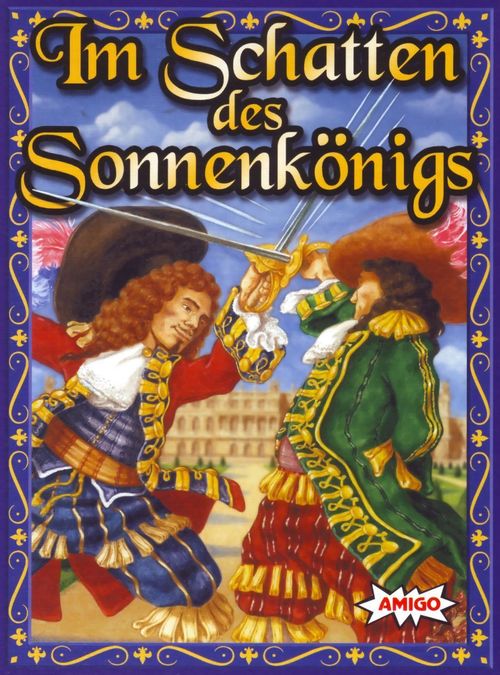
Im Schatten des Sonnenkönigs
Im Schatten des Sonnenkönigs Rulebook
Table of Contents
Table of Contents
- Components
- Setup
- Your Power Area
- Gold and Power Chips
- Turn Sequence
- Phase 1: Check Your Properties
- Majorities
- The Five Properties
- Phase 2: Reveal Cards
- Phase 3: Gold Action
- Special Card: Kardinal Mazarin
- Special Card: Spielschulden (Game Debts)
- Special Card: Ludwig XIV.
- End of the Game
- Auction Cards
- Notes on the Auction Cards
Components
- 67 property cards in five colours
- 7 different auction cards
- 20 gold chips
- 40 power chips
- 6 quick-reference cards
- Special card Kardinal Mazarin (4 copies in the game)
- Special card Spielschulden (game debts) (4 copies in the game)
- Special card Ludwig XIV. (1 copy in the game)
Setup
The special card Ludwig XIV. is set aside at the start.
One player shuffles the cards and deals them clockwise. The number of cards each player receives depends on the number of players. The player to the left of the dealer is the first player. This player receives two cards; after that the cards are dealt around the table as described in the table below. If a player is dealt a special card or an auction card, that card is returned to the draw pile and the player receives a replacement card instead.
| Players | 1st | 2nd | 3rd | 4th | 5th | 6th |
|---|---|---|---|---|---|---|
| 2 | 2 cards | 3 cards | ||||
| 3 | 2 cards | 3 cards | 3 cards | |||
| 4 | 2 cards | 2 cards | 3 cards | 3 cards | ||
| 5 | 2 cards | 2 cards |
Each player lays their cards face up in front of them. Cards of the same colour are placed in one row together (see also "Your Power Area" below).
Each player receives three power chips with the values 1 and 2 and one gold chip. The remaining chips are sorted into power chips and gold chips and placed in the middle of the table as a supply.
The undealt cards are divided into two piles of roughly equal size. The card Ludwig XIV. is inserted into one of these piles, and that pile is shuffled. The two piles are then put back together, with the pile containing Ludwig XIV. on the bottom and the other pile on top.
The cards are placed face down in the middle of the table as the draw pile. During the game a discard pile will form next to the draw pile.
Each player receives one quick-reference card, and then the first player begins their turn.
Your Power Area
Every card a player receives during the game, whether from the draw pile or from an opponent, is placed face up in front of them. This area in front of the player is their power area ("Machtbereich"). No player holds cards in hand. Within the power area, cards are placed in rows, with only one colour in each row.
When a player receives the first card of a colour, they place it on the table in front of them. If they receive another card of the same colour, they place it on top of the first card. Cards placed on top of one another must overlap, so that every card in a row can be seen.
Only the top, fully visible card of a row can be given to an opponent, placed on the discard pile, or exchanged. This is especially important for property cards with a seal. Only visible seals count when the special card Spielschulden is revealed (see also the section on Spielschulden, page 9).
Example illustration from the rulebook: a player's power area with five colour rows and a total of three top cards, each showing one seal.
Gold and Power Chips
Gold chips always have the value 1. Power chips come in two different values. Whenever the rules mention a power chip without further qualification, the power chip with the value 1 is meant. Power chips of different values may be exchanged for one another at any time.
Turn Sequence
Play proceeds clockwise. The player whose turn it is carries out three phases one after another:
- Phase 1: The player checks which properties they have and can use.
- Phase 2: The player must reveal cards from the draw pile and place one of them in their power area.
- Phase 3: The player may carry out one gold action.
After Phase 3, the next player takes their turn.
Phase 1: Check Your Properties
A player has a property if, in Phase 1, they hold the majority of cards of a particular property (colour) in their power area. If they hold the majority in several properties, they may use these properties one after another, in any order.
A player who has no majority in any property moves on to Phase 2 immediately.
Only the player whose turn it is may use the property they hold, and only once, and only in Phase 1. One exception is the property Intrige (Intrigue; see "The Five Properties" below). A player who is not taking their turn cannot use any property.
Note: If, during Phase 1, a player gains a further majority through the use of a property, that majority may also be used in the same phase.
Majorities
Majority with two or three players: A player must have more cards in one property (colour) in their power area than each individual opponent. If several players have the most cards, then no player has a majority.
Illustrations from the rulebook (the printed examples show the players' majorities side by side):
- Two- or three-player example: Achim has the majority in the property Wealth (yellow). Christian has the majority in the property Etiquette (blue). Beate has no majority.
- Four-to-six-player example: Dominique has the majority in the property Combat strength (green). Christian has the majorities in Etiquette (blue) and Combat strength (green). Achim has the majorities in Power (red) and Wealth (yellow). Beate has the majorities in Power (red), Combat strength (green) and Wealth (yellow).
Majority with four to six players: If a player has more cards in one property (colour) in their power area than any other opponent, then they have the sole majority. If several players have the most cards, then all of those players have the majority in that property.
Important: If the number of players drops from four to three, the majority rules for 2–3 players apply.
The Five Properties
Combat strength (green): A player who holds the majority in this property must either take two power chips from one opponent or one power chip each from two opponents. These opponents' chips go back into the supply in the middle of the table.
Warning: If a player must hand over more power chips than they own, they are eliminated from the game immediately. Their cards go to the discard pile and their gold chips go to the supply in the middle of the table. A player should therefore always make sure their supply of power chips does not run low.
Power (red): A player who holds the majority in this property takes one power chip from the supply in the middle.
Wealth (yellow): A player who holds the majority in this property takes one gold chip from the supply in the middle.
Etiquette (blue): A player who has this property may carry out one of the following actions:
- The player exchanges one of the top property cards from their power area for any property card from the discard pile. Before deciding whether to exchange, the player may not look at the discard pile.
- The player places one of their top property cards and one top property card of their choice from an opponent's power area onto the discard pile (see also page 3).
Intrigue (violet): This property cannot be used in Phase 1. Only when a player reveals the special card Kardinal Mazarin from the draw pile does the property Intrigue come into use (see Kardinal Mazarin below).
Note: If several players hold the majority in Intrigue at the moment the card Kardinal Mazarin is revealed, all of those players may use this property. In this case the order begins with the player who revealed the card, and then continues clockwise. Players who do not hold this property are of course not taken into account.
Illustration from the rulebook: Achim announces that he will reveal three cards. After the second card he reveals the special card Spielschulden, then the auction card Einfluss, and only then a third property card. First the effect of Spielschulden is carried out, and then the auction for Einfluss. Afterwards, Achim must choose one property card.
Phase 2: Reveal Cards
The player whose turn it is must reveal one, two or three cards from the draw pile. Before revealing, they must announce aloud how many cards they will reveal. Once the player has revealed the announced number of cards, they must choose one of them and place it face up in their power area. The other cards go to the discard pile.
It may happen that, besides property cards, special cards or auction cards are revealed. In this case the player keeps revealing further cards from the draw pile until they have reached the announced number of revealed property cards. Before a property card can be chosen for the player's power area, the effects of the revealed special or auction cards are carried out first, and then those cards are placed on the discard pile. If several of these cards have been revealed, their effects are carried out in the order in which they were revealed. The effects of the special cards are explained on pages 8 to 10, and those of the auction cards on pages 11 and 12.
Note: The auction card Orden changes this: its owner does not need to announce aloud how many cards they will reveal, and may reveal up to four (instead of three) cards (see the auction card notes below).
Phase 3: Gold Action
If a player has gold chips, they may carry out one of the following gold actions:
- For giving up one gold chip, the player may either take one power chip from an opponent and place it in the supply, or exchange one property card from their own power area with a property card from an opponent's power area.
- For giving up two gold chips, the player may either take a property card from an opponent's power area and place it on the discard pile, or reveal the top card of the draw pile and place it in their own power area. If they reveal a special or auction card, its effect is carried out first, and then a replacement card is drawn. If that replacement is also not a property card, the process is repeated until a property card can be placed in the player's power area.
Note: If several players hold the majority in Intrigue at the same time when the card Kardinal Mazarin is revealed, all of them may use it (see the property Intrigue above).
Special Card: Kardinal Mazarin
When this card is revealed from the draw pile, by whichever player, every player who holds the majority in the property Intrigue (violet) at that moment has two options:
- They reveal the top card of the draw pile and place it in their power area.
- They take two chips of their choice from the supplies in the middle of the table.
If the player decides to take the top card of the draw pile, it may happen that, instead of a property card, they reveal another special or auction card. In this case the effect of that card is carried out first, and then the player draws a replacement card. This is repeated until the player has revealed a property card for their power area.
Special Card: Spielschulden (Game Debts)
When this card is revealed, every player must count the number of their visible seals on the property and auction cards in their power area. Seals in the power area that are covered are not counted. The player with the most visible seals has no game debts. If several players have the most visible seals, for example four, then all of those players have no game debts. Then all players with three or fewer seals have game debts.
A player who has game debts must either place one card from their power area on the discard pile or place two chips of their choice into the supplies in the middle of the table.
If several players have game debts, the order in which they give up cards or chips begins with the player who revealed the card Spielschulden. After that, the players continue clockwise. Players without game debts are of course not taken into account.
Warning: A player who has no visible seals has game debts. Exception: if all players have no visible seals, then nobody has game debts.
Special Card: Ludwig XIV.
When this card is revealed from the draw pile for the first time, every player in the game receives one gold chip.
The discard pile and the draw pile are put together, shuffled, and then divided again into two piles of roughly equal size, as described under Setup. The card Ludwig XIV. is shuffled into one of the two piles. Then both partial piles are put back together again as described under Setup. This card pile is then the draw pile for the rest of the game. The player whose turn it was continues their turn.
End of the Game
The game ends immediately when the card Ludwig XIV. is revealed for the second time. No further action may be carried out.
Warning: If only two players are in the game, the game ends immediately after the card Ludwig XIV. is revealed for the first time.
Each player counts their victory points. Gold chips and power chips with value 1 are worth one point each. Power chips with value 2 and the blue cards, including the auction card Einfluss, are worth two points each. The player with the most victory points wins.
If several players have the same number of points, then among these players the one with more violet cards ranks higher.
The game also ends early in the rare case that all players but one have been eliminated. That one remaining player wins the game.
Auction Cards
Whenever an auction card is revealed from the draw pile, at any phase of the turn, it must be auctioned. Bidding goes clockwise. The auction begins with the player who revealed the auction card. Their opening bid may be any amount; they do not have to start at "1". Each further bid must be higher than the previous one, or a player passes and leaves the auction.
During the auction, players only state their bids. They do not have to pay their bids yet. Only when all players but one have passed does that player win the auction card and pay their last bid.
Payment is made with cards from the power area and/or with chips. One chip counts one auction point; one card in the power area counts two points; and one card in the power area of the same colour as the auction card being auctioned counts three points. If a grey auction card is auctioned, no card is worth three points.
Example of an auction from the rulebook: Achim reveals the blue auction card Einfluss. He must begin the auction, but immediately passes. Beate says "three". Christian says "four". Dominique says "seven". Beate passes. Christian says "eight". Dominique also passes. Christian wins the auction with eight auction points. He pays with a blue card (3 points), a red card (2 points), a gold chip (1 point) and a power chip with value 2 (2 points). Christian places the two cards on the discard pile and the two chips into the supplies in the middle of the table.
If no bid at all is made for an auction card, it goes to the discard pile. A won auction card is placed in the winner's power area. It makes sense to place a coloured auction card next to the row of the same colour. An auction card cannot be taken by an opponent. The player who owns an auction card can use it themselves to pay for a later auction, or to pay game debts.
Notes on the Auction Cards
- Einfluss (Influence): If the owner of this card reveals three property cards of the same colour, they may place either two or one of them in their power area, but not all three cards. If they reveal two cards of the same colour, they may take both.
- Orden (Order): The owner no longer needs to announce aloud how many cards they will reveal. In addition, they may reveal up to four (instead of three) cards.
- Verschwörung (Conspiracy): The owner may carry out this card's function in every turn phase, but only once within their turn.
- Diplomatie (Diplomacy): The owner gives up only one power chip when they are supposed to give up two. They give up no power chip when they are supposed to give up one. This does not apply to the auction card Herrschaft or to a gold action.
- Autorität (Authority): The owner receives two power chips if they also hold the majority in Combat strength.
- Herrschaft (Dominion): The owner takes either three instead of two power chips from one opponent; or two from one opponent and one chip from another opponent; or one chip each from three opponents, if they also hold the majority in Power.
- Pension (Pension): The owner receives two gold chips if they also hold the majority in Wealth. This card is in the game twice. Both cards may be in the possession of one player; then that player may receive up to three gold chips.