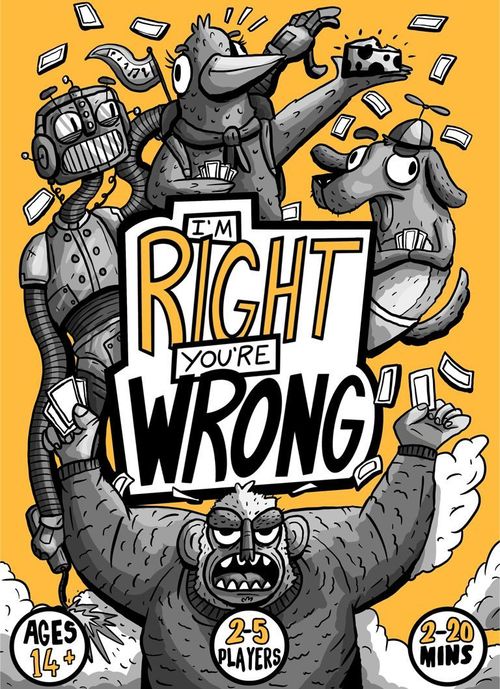
I'm Right You're Wrong
I'm Right You're Wrong Rulebook
Table of Contents
Table of Contents
Basically
Take turns making your choice and dealing with the consequences.
- If you run out of cards, you lose.
- If you can't play any cards, you lose.
- If you break any rules, you lose.
- Last one with cards on hand wins!
Setup
- Shuffle your cards.
- Deal five 5 cards to every player. 3 for shorter games - or - 7 for more strategy.
- Place the rest of the cards facedown in the center.
- First player to compliment another, goes first.
Direction: If you aren't civil enough to agree on a direction, letsay go clockwise for the sake of it.
Game Areas
- Hand: Your cards, and your life line.
- Pile: Your finished cards.
- In Play: Your unfinished cards (reminders).
- Deck: The unused cards to draw from.
- Trap: Place your faced down cards infront until finished.
Turns
Video instructions: rightwronggame.com/how
- Start EVERY turn by drawing a card from the deck to your hand. (If you forget, too bad!)
- YOU MUST PLAY 1 card from your hand - no more, no less. (Your card does not have to match the color or type played before it.)
- Follow the writing on the card (written in 2nd person).
- Attack cards: Play face up in front for everyone to see.
- Highroad cards: Play face up in front for everyone to see.
- Trap cards: Place face up or face-down (according to what's written on the card) infront of you. When an opponent activates it, reveal the card and play it.
- More instructions on back.
- Move all finished cards to the pile. Leave unfinished business in front as reminders.
- Next Player! Keep going until one player is left (with cards or not eliminated).
Don't forget to begin the next turn by drawing a card!
If there are not more cards left in the deck, play the cards in your hand - sudden death.
Terminology
- All = each and every player.
- Blind = without looking at face of cards.
- Deck = unused cards, where you draw from.
- Draw = pick up a card from the deck.
- Disarm = place card to the pile.
- Face up = in play, waiting to be triggered.
- Face down = flipped up and followed after triggered.
- Ignore = don't follow card instructions.
- In play = played but not finished.
- Next opponent = the player who goes after you.
- Opponent = pick any player.
- Pile = used card pile in the center.
- Play = card face up or face down in front until finished.
- Return = place card to bottom of the deck
Cards
Attack - 28x
Mostly not favorable. Play them face up, for everyone to see.
- Self: Return 1 card. Move ANY card from your own hand to the bottom of the deck.
- Self: Return 2 cards. Move ANY two cards from your own hand to the bottom of the deck.
- Self: Blind swap 1 card with an opponent. Without looking at the faces, pick/take a card from any opponent's hand. That opponent will then pick/take 1 from your hand, without looking at the faces.
- Self: Can't play Highroad next turn. For your own next turn, if you play a Highroad you lose. If you are forced into playing one, you also lose.
- Self: Can't play Attack next turn. For your own next turn, if you play a Attack you lose. If you are forced into playing one, you lose.
- Opponent: draw 1 card. Pick a player to immediately draw a card.
- Opponent: draw 1 card and then return 1 card. Allow a player of your choice to swap any card with a new one from the deck.
- Self: Draw 1 card and play it immediately. Immediately draw a card and play that card without adding it to your hand. Good luck.
- Self: Blind return 1 card from opponent's hand. Without looking at faces, choose a card from any one opponent's hand to return to the bottom of the deck.
- Next Opponent: play next card drawn. The next player must immediately play the card drawn at the beginning of turn. Turn over. Next.
- Self: Blind play next opponent's turn. Next turn, after opponent draws (to start turn), without looking, choose a card from opponent's hand to play. If forbidden, they lose. After play, end opponent's turn.
Highroad - 24x
Mostly favorable. Play them face up, for everyone to see.
- Disarm every Trap without triggering any. Move all traps in play to the used pile. No Trap counters this. If no Trap in play, disarm none.
- Self: Disarm 1 Trap without triggering it. Pick any Trap in play, and move it to the pile. If this card was played by blind force, the player gets to choose how it's played. If no Trap in play, disarm is optional. If only your Trap in play, disarm yours.
Trap - 16x
Doesn't have immediate actions; only when triggered. Some are played face down.
- Place face down (or face up according to the card instructions).
- If any opponent plays a card that triggers the trap, follow the card action.
- If you forget to trigger a trap, too bad. Next time.
- Yes, you may peak at your own cards in play.
- You don't have trigger your own trap on your own turn (if you don't want to).
- After the trap is triggered, follow the action before the card played this turn. After the action is followed, into the pile it goes.
- Multiple traps can be triggered at once.
- You may have multiple traps in play.
- In games of 3+ players with multiple traps priority goes opposite of turn direction.
Trap card effects:
- Play face down. Trigger: Next Attack also return 1 card. Next player to play a Attack also returns a card to the bottom of the deck.
- Place face down. Trigger: Next Highroad is ignored. Next Highroad played (that doesn't disarm) is ignored and discarded to the pile.
- Place face up. Trigger: Next Highroad also draws 1 card. Next player to play a Highroad also draws an additional card.
- All: Can't play Trap until this is disarmed. Nobody can play a new Trap until this card is disarmed. Any still in play are still able to trigger.
- Place face down. Trigger: None. This card is merely a trick.
- Place face down. Trigger: Next Trap played is returned. Next new Trap played is immediately ignored and discarded to the pile. This doesn't prevent triggers.
Winning
If you run out of cards, you lose. If you run out of plays, you lose. If you break a rule, you lose.
- Play cards to remove your opponent's hand: Accountable (Opponent: Return 1 card), Control (Self: Blind return 1 card from an opponent's hand).
- Play cards to restrict your opponent's options: Passive (Play face up. All: Can't play Trap until this is disarmed), Negotiate (All: Can't play Attack next turn).
- Play cards to force your opponent to break a rule: Listen (Next Opponent: Play next card drawn), Empathize (Self: Blind play next opponent's turn).
- Or you can wait for your opponents to shoot themselves in the foot. Attack cards that work this way include the card with "Self: Draw 1 card and play it immediately" (card name cut off on the page), Annoy (Self: Can't play Highroad next turn), Dig (Self: Can't play Attack next turn), and Fight (Self: Return 2 cards).
The Twist
Don't sweat it if your hand sucks. There is a good chance your opponent's hand isn't too hot either. Just try to hang on.
There are more bad cards than good cards. Sometimes, simply choosing your least worst option is the key to success.
Don't just play all your good cards or you're a sitting duck for restricting plays. It's good to keep your options open.