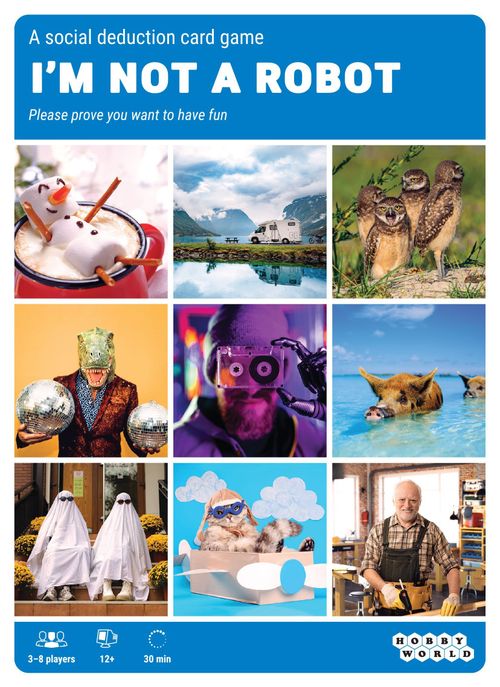
I'm Not a Robot
I'm Not a Robot Rulebook
Table of Contents
Table of Contents
Game Overview
The game is played over 6 rounds. Each round all players undergo a test to find out who's the Robot. To do so, they get 9 Images. All players with the Human Role cards know which Image is the correct one, while the person playing as Robot tries to guess it by the other players' associations. However, to imitate a Human, they must name their association, too.
If the Robot gets the Image right, they immediately win the round. If they decide to play safe and remain undisclosed, the Answer card is shown, and all the players explain their associations. Then the players vote on who's the Robot.
The Human team wins if they manage to detect the Robot (or decide that there's been a glitch in the system and there's no Robot at all). The Robot wins if the majority votes against somebody else.
Players score victory points for winning a round. At the end of the 6th round the player with the most in total wins.
Game Components
3–8 players · Age 12+ · 30 min
- 72 double-sided Image cards
- 90 Role cards:
- 81 Human cards numbered 1 to 9 (9 sets of 8 cards with white backs and 1 card with a blue back for each number)
- 9 Robot cards ("404")
- 9 tokens numbered 1 to 9
- 9 smaller bags for the Role cards
- Bigger bags for remaining components
- 8 pencils
- 1 record sheet pad (50 double-sided sheets)
Game Setup
Decks Preparation (Before the First Game)
Take all Role cards and separate the cards with white backs from the cards with blue backs. Then take 9 cards with blue backs, and place each of them one next to the other face-up. Then take all the cards with white backs and sort them the following way: divide Human cards (numbered 1 to 9) by each corresponding number and place them on the cards with blue backs. Put the Robot cards (labeled 404) aside for now.
When you have 9 different stacks (9 same-numbered cards each), place 1 Robot card face-up onto each one of them. Now you're all set!
Put each deck into a smaller bag for Role cards. Be careful! The numbers on Human cards are not supposed to be visible.
Setup for Each Round
Step 1 is done once, before the first round. Steps 2 to 8 are repeated at the start of every round.
- Each player takes a blank record sheet and a pencil, and writes their name in the field in the upper part of the sheet. Leave the field blank — this field is for the final scoring at the end of the game.
- Place 9 Image cards in the middle of the table any side up, so that they form a 3x3 square (leave some space between the rows).
- Below each card, place a numbered token white side up, arranging the numbers in ascending order, as shown in the picture.
- Take time to examine the Images. Players may take any Image to have a closer look, then put it back in the exactly same place.
- Shuffle the bags with the Role decks and randomly pick one of them.
- Take the deck out of the bag, then put the top card with a blue back aside face down without looking at it. This is the Answer card.
- Draw a number of cards equal to the number of players plus 1 more card from the bottom of the deck and put aside without looking at them. Put the rest of the deck back into the bag.
- Shuffle the cards with white backs and deal them to the players face down, one to each player. Place the remaining card face down next to the Answer card — this is the Server card. It can turn out to be the Robot card and in that case there is no Robot among the players (must have been a glitch in the system!)
How to Play
The game is played over 6 rounds. Each round consists of 7 phases:
- Role assignment
- Creating associations
- Robot's guess
- Discussion
- Voting
- Scoring
- Preparing for the next round
1. Role Assignment
Each player looks at their card without revealing it to the others. If their card has a number on it (1 to 9), they play as a Human and must detect the Robot. The number on their card shows the correct answer's number (i.e. the number of the Image under which there's a token with the corresponding number).
If a player got the card with the 404-code on it, they play as the Robot, and must get the correct Image right or do whatever it takes to remain undisclosed.
2. Creating Associations
Each player (including the Robot) must think of one word associated with the correct Image. The players may name the associations in any order — whoever is ready may feel free to be the first. When a player names an association, each player (including themselves) must write it down in the topmost blank line of the current round's area. The associations must be written in the order they were made by the players. This way you will make up the current round's association list.
If several players name their associations at the same time and it's not clear who is first, resolve the situation by playing a short game (for example, rock-paper-scissors).
Try to make other players believe that you're Human while creating the association. However, if you are indeed Human and your association is too obvious, the Robot will almost certainly be able to get the answer right and win. However, if your association is too vague the other players may think that you are the Robot!
What should the Robot do? Since the Robot doesn't know the correct answer, they should carefully consider other players' associations and think of something similar. They can also find a word that could be attributed to most of the Images. However, even if their association doesn't have anything to do with the correct Image, a smart Robot can think of a clever explanation of their choice during the phase 4 ("Discussion") or hope that some Humans will pass the test worse than they did. Usually, the sooner the Robot names their association, the less suspicion they arouse; but at the same time they will get less clues about the correct answer!
Association Rules
- An association must always consist of one word.
- An association must be a noun, a verb, an adjective or an adverb.
- An association must relate to the contents of an Image, not to its number or placement on the table.
- You can't repeat associations named during the current or previous rounds.
3. Robot's Guess
When players are done with the Association phase, the player who was the first to name their association asks if the Robot wants to reveal itself. They do so even if they themselves are the Robot. Now the Robot has two options:
-
Reveal themselves and try to guess the answer. The Robot reveals their Role card, confirming they're the Robot. Then they choose the Image that they assume is correct (they have 30 seconds to think their answer over) and make a guess. After that the Answer card is revealed and if the Robot was right, they win; if not, the Human team wins. In either case, go to phase 6.
It makes sense to unmask yourself if you're sure of your answer or your association is so specific, that if you got the Image wrong, you might not be able to explain yourself.
-
Remain undisclosed. Wait for 5 seconds: if the Robot stays silent, go to phase 4.
4. Discussion
Reveal the Answer card. Turn the token with the corresponding number blue side up so that the Robot knows which Image is the correct one.
Now the players explain why they came up with their associations in the same order they named those (see the current round's association list). After that the players have a few minutes to ask clarifying questions, voice their assumptions and try to find out others' theories about the Robot's identity.
5. Voting
Each player circles the number of an association they assume is created by the Robot.
If all associations seem logical and related to the Image, there could have been a glitch in the system and there's no Robot among the players (i.e. the Robot card was received by the Server). Players who think this is the case circle #9 (the glitch symbol) at the bottom of their association list.
When all players are ready, they take turns revealing who they vote against. The player who gets the most votes reveals their Role card. In case of a tie, the tied player who made their associations later (their association is lower in the list) reveals their Role card. If the majority votes against the Server card, reveal it. In case of a tie between a player and the Server, reveal the Server card.
If the revealed card is a Human card, it means the Robot has fooled everybody — and they win the round. Otherwise, the Human team wins the round.
6. Scoring
Reveal all Role cards. Tally the victory points you've scored and write the number down into the corresponding field at the bottom of the current round's area.
If you're a Human:
- Score 1 victory point, if the Human team wins (either if the Robot card gets revealed during the Voting phase, or the Robot chooses the wrong Image during the Robot's Guess phase);
- AND
- Score 1 victory point for voting against the person with the Robot card (even if the Robot wins).
If you're the Robot:
- Score 3 victory points for getting the Image right;
- OR
- Score 2 victory points for remaining undisclosed after voting.
7. Preparing for the Next Round
Put the Role cards into a bag the same way as during the preparation for the game: the Answer card with a blue back must be at the bottom of the deck, the Human cards with white backs must be in the middle, and the Robot card must be on top. Place the deck back into the bag and put it back to the other bags.
If there are more rounds to play, put the 9 Image cards back into the box and complete the game setup (steps 2 to 8). Leave the numbered tokens on the table (turn the blue token white side up).
Game End
The game ends after the 6th round is played. Tally all victory points scored throughout the game and write the number down into the field in the upper right corner of your sheet. The player that has scored the most victory points wins. In case of a tie, the winner is the tied player who has scored exactly 2 for a round more often. If there's still a tie, all tied players share the victory.
Game Variants
Rise of the Machines. During the game setup put aside the number of Role cards equal to the number of players, and don't put aside the Server card. This way there will always be the Robot among the players.
Defragmentation. You can play a shorter or longer game session (with less or more rounds respectively).
Round Example
Peter, Stacy, Grace, and Paul start to play. Grace is the Robot, and the rest of them are Humans (they know that Image #5 is the correct one).
Stacy comes up with an association first and says "Yellow". This word can relate to most Images, so she managed to avoid giving the Robot any useful information. Peter wants to be the next, and his association is "Clothes". And yet again, it matches several Images! Grace decides to chime in before Paul, so that everybody thinks she knows the correct answer. Having examined the Images, she thinks that Stacy's and Peter's associations relate to Images #1, 5, 7, 8, and 9 best. Having decided to cover as many of them as she can, Grace comes up with a risky association: "Water". If one of the bottom cards is the correct one, she will easily explain her association. However, if any other card turns out to be the right one, she will have to think of some really smooth explanation!
Finally, Paul comes up with an association, too, and says "Smell". Everybody writes it down and it's time for Stacy to ask if the Robot is ready to name the correct Image. Paul's association has narrowed Grace's choice down to two cards: #5 and #8. She isn't sure which one fits better, so she decides not to take the risk. The Discussion phase begins.
Stacy reveals the Answer card — it's the Image #5! Then she explains her association: "The flowers on the Image are yellow, and since there are many yellow objects on other cards, my word should have confused the Robot completely".
Then it's Peter's turn to explain his association. "The most conspicuous about this man is his medieval costume. Other cards are depicting people wearing clothes, too, and the Image #8 is all about clothing, so this association should have led the Robot astray".
While creating her association, Grace had #5 in mind, but opted for the word that didn't really cover this Image. However, now she doesn't lose her bearings: "Quite obvious… The man looks just like a hydrant! The bottom three cards can all be associated with water, so I wanted the Robot to think one of them is the correct answer".
Paul explains his association thus: "The person on the Image #5 is smelling a flower, and the lady on the Image #8 is withstanding a bad smell of dirty clothes".
Now it's time for voting. Grace decides to vote against Paul, because he gave his association the last, and that's why someone else could think he's the Robot. Stacy thinks that every association relates to the correct answer, so she circles number 9 on her sheet (there's no Robot). Peter thinks Grace came up with her clumsy explanation under the wire and votes against her. Paul considers Stacy's association too suspicious because it fits almost every Image. Besides, she named it first in order to avoid suspicion — so Paul votes against her.
Thus, there's a tie — Paul, Grace, Stacy, and the Server got one vote each. In every situation where there's a tie between players and the Server, the Server card is the one to be revealed. In this case, it is a Human card showing #3!
Since the majority hasn't detected the Robot, Grace wins the round and scores 2 victory points. Nevertheless, Peter also scores 1 victory point, because he voted against Grace. Stacy and Paul don't score this round.