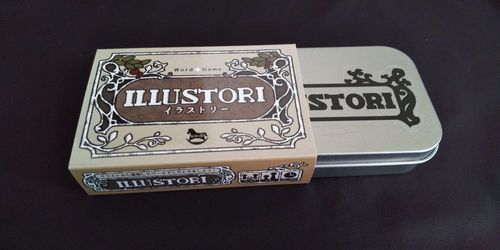
イラストリー (Illustori)
イラストリー (Illustori) Rulebook
Table of Contents
Table of Contents
Overview
"Illustori" (イラストリー) is a word chain game where you name artwork cards. The artwork name that the turn player chooses can be a sentence, a quote, an onomatopoeia, or anything. All it needs for chaining is the agreement from the other players.
The language option is important. Please choose a language that all players can understand.
- Players: 3-6
- Age: 5+
- Play time: 10-30 minutes
- Contents: 60 illustration cards, 1 instruction sheet (Japanese, English), tin storage box with sleeve
Game Rules
- The first player can choose any word or phrase that represents their card, but the other players get to vote to accept or reject it.
- No player's cards are reduced by this action.
- On each player's turn, they play one of the following actions:
- Select a card and give it a name that chains from the last artwork name.
- Select one or more cards and swap them.
- If a player chained the artwork name, all players discuss whether the name matches the artwork or not. After that, everyone (excluding the turn player) votes on whether they agree the naming fits.
- If at least half of the players agreed, the word chain succeeded! The next player should chain an artwork name from the succeeded one.
- If fewer than half of the players agreed, the word chain failed. The turn player discards the played card and draws a new card. The next player should continue chaining from the previous artwork name.
- Once someone places all their cards, that will be the last round. The game ends once the player who decided the first artwork name has finished their turn. All players who placed all their cards win the game!
Word Chain Rules in English
These are the original rules for BGA, which are easier than the ones in the game's manual.
- Say the artwork name's first and last letter using the alphabet.
- The next artwork name should start with the previous artwork name's last two letters.
- Example: Moon. The next name starts with "o" or "n".
- If you play with a prohibition rule, the next artwork name should start with the previous artwork name's last letter only.
- The player (rarely!) who names an artwork using a word that ends with "xx" gets a penalty. They discard the played card and draw a new card from the stack.
Reverse Word Chain Rules in English
- Say the artwork name's first and last letter using the alphabet.
- The next artwork name should end with the previous artwork name's first letter.
- Example: Moon. The next name ends with "m".
- There are no penalty rules.
Reverse Word Chain Rules in German
Most of the rules are similar to the ones in English.
- Say the artwork name's first and last letter using the German alphabet (which includes umlaut letters and Eszett).
- The next artwork name should end with the previous artwork name's first letter.
- Example: Monat. The next name ends with "m".
- Umlauts and Eszett have alternatives.
- "ä" can be replaced with "a".
- "ü" can be replaced with "u".
- "ö" can be replaced with "o".
- "ß" can be replaced with "s".
- The player who names an artwork using a word that starts with "q", "x", or "z" gets a penalty. They discard the played card and draw a new card from the stack.
Word Chain Rules in Japanese
- Say the word's first and last letter using Katakana or Hiragana.
- The next artwork name should start with the last letter of the last artwork name.
- Example: つきよ. The next name starts with "よ".
- Some letters have alternatives.
- Example 1: ばしゃ. The next name starts with "や".
- Example 2: やかた. The next name starts with "た" or "だ".
- Example 3: ラッパ. The next name starts with "は", "ば", or "ぱ".
- If the last letter of the artwork name was a chōonpu, the very last letter becomes the starting letter.
- Example: ピッチャー. The next name starts with "や".
- The player who names an artwork using a word that ends with "ん" gets a penalty. They discard the played card and draw a new card from the stack.
Optional Rules for Prohibitions
These rules are recommended for ranked matches.
Prohibiting to Repeat the Same Letter
- The player gets a penalty if they call an artwork name that starts and ends with the same letter.
- Example: Antarctica. Antarctica starts and ends with "a".
- In English, the next artwork name should start with the previous artwork name's last letter.
Prohibiting to End & Start Past Chaining Letters
- The player gets a penalty if they call an artwork name that starts or ends with a letter that has already been used to chain.
- Example: New apple → Evening → Gown (miss!) — Gown ends with "n", which has already been used.
- If all players skip or fail to chain an artwork name, the prohibited letters are cleared.
- If all letters become prohibited, the prohibited letters are cleared too.
- In English, the next artwork name should start with the previous artwork name's last letter.
Tips
- There are no limitations on chaining words.
- Any "one word" answers and full sentences (example: "He thinks about today's examination") are accepted only if half or more of the players vote to agree.
- Vote based on whether you think the naming is OK or not.
Variant: High-Tempo Rules
These are the playtest rules from Vorspiel Autumn 2019 — you can play at a slightly faster tempo than the standard rules.
- Players: 3-6
- Play time: 5-15 minutes
- Age: 5+
Most of the rules are the same as standard. Only the following parts differ.
Starting hand. Deal 4 cards instead.
On your turn. Do one of the following two things:
- Chain a word. Chain a word from an illustration, same as in the standard rules.
- Exchange one card from your hand. Discard one card from your hand and draw one from the draw pile. You may also attempt to chain a word with the card you just drew.
Variant: Illustori Solitaire Rules
A word-chain ruleset you can play solo. It also works with multiple players. Good for playing with young children, or for practicing the standard rules.
- Players: 1+
- Play time: 10-30 minutes
- Age: 4+
Preparing the cards. Shuffle the cards well and place 4 of them face up on the table (the Illustration Row) so the illustrations are visible. Place the remaining cards face down in the center of the table as the draw pile.
Preparing the word chain. Flip over the top card of the draw pile and place it next to the draw pile (the Word Chain Area). Then decide on a first word associated with that card's illustration.
Flow of play. Do one of the following two things:
- Chain a word. Choose one of the 4 cards in the Illustration Row and give it a word that chains, in shiritori fashion, from the word attached to the illustration currently in the Word Chain Area. The illustration card you named moves to the Word Chain Area; draw one card from the draw pile to refill the Illustration Row. If the word you say ends in "ん", take that card as a minus-score card instead, then draw one card from the draw pile to refill the row.
- Exchange a card. Choose one of the 4 cards in the Illustration Row and take it as a minus-score card. Then draw one card from the draw pile to refill the Illustration Row.
When the draw pile runs out. Once the draw pile is empty, stop refilling the Illustration Row and keep playing until the Illustration Row itself is empty.
End condition. The game ends when both the draw pile and the Illustration Row are empty. The number of cards you have taken as minus-score cards (via "Exchange a Card", or by ending a word chain in "ん") is your score when you clear the game. The fewer cards in your score, the higher you score.
Supplementary rules.
- The shiritori rules for words ending in a dakuten (゛) or a small kana such as 「ゃ」 or 「ゅ」 are the same as in the standard rules.
- Reducing the Illustration Row from 4 cards to 3 raises the difficulty. Increasing it to 5 cards makes chaining easier, which may suit play with young children.
- When playing with multiple people, you can compete on a first-to-chain basis rather than turn order, or take a majority vote as in the standard rules.
Variant: English Rules v1.1
A ruleset that makes chaining words easier than the English rules in the printed manual.
- Players: 3-6
- Play time: 10-30 minutes
- Age: 6+
The basic rules are unchanged from the manual's rules. Only the way you chain words is different.
Chain a word. Chain using a word that begins with either of the last two letters of the word attached to the illustration in the Word Chain Area.
Example: Moon → the next name starts with "o" or "n".