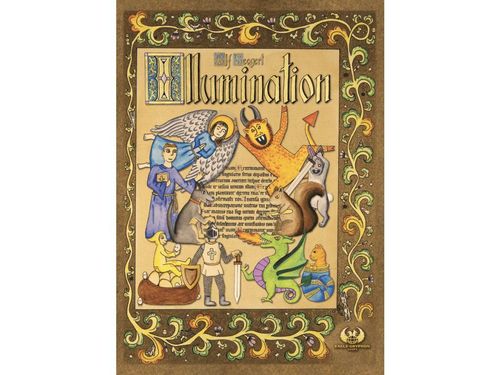
Illumination
Illumination Rulebook
Table of Contents
Table of Contents
Components
- Rulebook
- Monastery Mat
- 3 Books (large double-sided mats)
- 2 Player Mats (double-sided)
- 2 Reference Placards
- 24 Scriptorium Cards
- 4 Battle Cards
- 1 Battle Card Aid
- 8 Crusade Cards
- 48 Ritual Tokens (12 each of Wine, Bread, Bell, & Candle)
- 72 Illumination Tiles (64 Faction tiles & 8 Two-Coin tiles)
- 3 Drollery Tiles (double-sided)
- 14 Coins (7 white & 7 black)
- 32 Wooden Markers (16 white & 16 black)
- Wooden Abbot Pawn
- 1 Six-Sided Die (for solo game)
Setup
- The player who intones the word "Illumination" in the more compelling plainsong chant chooses which side to play: Reverent (white components) or Irreverent (black components). In subsequent games the losing player chooses which side to play. Give each player their matching Player mat, Scriptorium cards, Illumination tiles, Markers, and Reference placard. See Solo Setup if you are playing solitaire.
- Set up the Monastery mat (A) and place the Abbot (B) on any blank station (a space not showing a Ritual symbol). Place the Battle cards and Battle card aid (C), Ritual tokens (D) and Books (E) as shown in the example setup below. (Books may be placed with either side up and in any order.)
- Place 1 purple Drollery tile in each Book, on any text space agreed upon by both players, NOT on a Quill space. We recommend placing Drolleries on text surrounded by multiple Quills.
Each player should prepare as follows:
- Place your Player mat (F) in front of you centered on the 3 Books.
- Each player has a personal supply (G) of 7 Coins. The Reverent player places 1 coin and the Irreverent player places 5 coins on the coin spaces displayed on their Player mats. Place your supply of Markers (H) next to your Coin supply.
- Thoroughly mix all of your Illumination tiles facedown to randomize them properly and, without looking at them, place the tiles in facedown stacks of 3 for a total of 12 stacks (I). These will be referred to as "tiles" throughout the rules.
- Take 3 of the stacks to fill the archway spaces on your Player mat. Starting with the top row, flip over 1 stack and place 1 tile in each archway space from left to right without changing the order in the stack. Then do the same for the middle and the bottom rows. (You are NOT free to place the tiles as you want. You must place them in order from the stacks.)
- Shuffle your deck of Scriptorium cards to create a facedown deck (J) next to your Player mat. Draw 1 Scriptorium card and add it to your hand facedown (K) next to your Player mat. Keep these cards secret from your opponent!
- Take 1 Crusade card (L) at random and return the rest to the box. You may look at it but keep it secret next to you.
- The Reverent player always begins the game!
Example Setup — A. Monastery mat. B. Abbot Pawn. C. Battle Cards and Battle Card Aid. D. Ritual Tokens. E. Books (each with 1 Drollery tile). F. Player Mat with Starting Coins and Tiles. G. Coin Supply. H. Markers. I. Illumination Tile Supply (stacks of 3). J. Scriptorium Deck. K. Starting Scriptorium Card. L. Crusade Card.
Books I, II, and III are based on each player's perspective from left to right. Book I for the Reverent player will be Book III for the Irreverent player and vice versa. Book II will always be in the middle.
Overview and Basic Game Rules
Each turn, players create illuminations in three Books by placing one full row or column of tiles of their choice from their Player mat. With careful placement, players collect Coins that allow them to perform special actions or purchase Scriptorium cards. By placing tiles next to others of matching color, players collect Ritual tokens to score points at the Ritual stations in the Monastery when they are occupied by the Abbot.
As tiles are placed in Books, conflicts are set in motion: Angels wrestle with Demons, Knights skirmish with Dragons, Monks contend with Rabbits, and Dogs struggle with Squirrels. These conflicts are resolved only when they are bounded on all sides. Then, the player with more tiles on their side wins the Bounded Battle, flips the losing side's tiles facedown, and places their Marker on the matching Battle card.
When the game ends, players score points for the Rituals recorded on the Monastery mat and 1 point for each of their faceup Illumination tiles in each Book. Players also score points for placing more Markers on Battle cards and for defeated factions that match their Crusade card. The player with more points wins!
The Turn
Turn Summary: Pass or Play
If you PASS you no longer play. If you PLAY, perform these steps in order (the Reverent player plays first):
- Choose a row or column of tiles (I, II, or III) on your Player mat. Move the 3 selected tiles to the illuminated margins of the selected Book (Book I, II, or III as you read from left to right).
- Place each tile in the active Book in any order you choose. Collect Coins and Ritual tokens and place your Markers on the Monastery mat as permitted. Resolve Bounded Battles as they are created. You may also spend Coins and use Scriptorium cards to perform special actions whenever you want on your turn.
- Refill. Choose one stack of Illumination tiles at random and flip the full stack faceup. Refill the empty archways on your Player mat in order from left to right or top to bottom as you deplete the stack. You may NOT change the order of the tiles in the stack as you place them.
Example — The Reverent player selects the second row of tiles to place into Book II, placing the Knight and Monk on the margin for now and gaining 2 Coins for the Two-Coin tile.
Play Turn Details
1. CHOOSE ONE ROW OR COLUMN OF ILLUMINATION TILES (I, II, OR III across or down).
Move these three tiles onto the illuminated margins of the Book determined by your choice of column or row. Books are always numbered relative to each player's perspective: I = left, II = middle, III = right.
2. PLACE THE TILES IN THE CORRESPONDING BOOK.
You may freely choose the order in which you place the tiles. Book spaces consist of Quills and text. Each tile must be placed on a Quill in the determined Book. You may not place a tile on text.
Tiles that show Coins are NOT moved onto Books. Instead, you gain 2 Coins and return the tile to the box. You may immediately use these Coins (for example, to buy a Scriptorium Card) or place them on your Player mat for future use.
If you are unable to place a tile in a Book because there are no open Quills, you are assigned to tend sheep! The tile is placed facedown in your Sheep Pen on your Player mat. As a penalty, each tile in your Sheep Pen will deduct 1 point from your score at the end of the game. This is the only way a tile ever goes into your Sheep Pen.
You may collect and spend Coins, Scriptorium cards, and Ritual tokens in any order as you place your tiles.
Collecting Coins and Ritual Tokens
By carefully placing Illumination tiles in Books, players collect Coins and Ritual tokens to place on their Player mat.
IMPORTANT: If you do not have room on your Player mat to collect an item, you may still collect it! You only discard down to 7 Coins and/or Ritual tokens at the very end of your turn.
- A. If you place a tile on a Quill of the same color, collect 1 Coin.
- B. If you place a tile orthogonally adjacent to another tile of the same color already in play, collect 1 Ritual token of that color.
Orthogonally adjacent means the tiles are "edge to edge" and not diagonally adjacent. Throughout the rules, "adjacent" will always mean "orthogonally and not diagonally adjacent."
If you connect to multiple adjacent tiles of matching color, collect 1 tile for each connection. (Red = Wine; Yellow = Candle; Silver = Bell; White = Bread.)
- C. Purple Drollery tiles are WILD. If you place a tile adjacent to a purple Drollery tile, you automatically collect 1 Ritual token matching the color of the played tile.
Spend Coins or Ritual Tokens for Benefits
You may spend as many Coins or Ritual tokens as you like on your turn at any time. If you will have more than 7 of these items on your Player mat, be sure to spend what you can during your turn so that you don't have to discard any at the end of your turn.
You may IMMEDIATELY spend any Coins or Ritual tokens you collect during your turn or you may save them for later.
You may freely spend Ritual tokens as Coins (1 Ritual token = 1 Coin), but NOT the other way around!
Spend one or more Coins to:
- Move an active tile (one on a Book's illuminated margins but not yet placed – NOT a tile already placed in a Book) to a different Book, spending one Coin per Book away. (Note: it takes 2 Coins to move a tile from Book I to Book III and vice versa.) Tile placement is done as normal.
- Move the Abbot one station on the Monastery mat in any direction for each Coin spent. (Note: empty stations and Ritual stations each count as one point of movement.)
Spend Two Coins to:
- Draw a Scriptorium card. You may use it immediately or save it for later.
Spend a set of Ritual tokens (3, 4, or 5 of a kind) to:
- Place your Marker on an unclaimed Ritual score space on the Monastery mat. To do so, the Abbot must be on the matching Ritual station. Cover the Ritual symbols to leave the point value showing (2, 4, or 7).
IMPORTANT: Whenever you place a Marker on the Monastery mat, your OPPONENT draws a Scriptorium card as a Consolation bonus.
Other Turn Actions
Play Scriptorium Cards
You may play as many Scriptorium cards as you like during your turn to perform the special actions listed, including cards you have just purchased. You can create very powerful combinations with clever card play! See Scriptorium Cards for details.
Resolve Bounded Battles
Immediately resolve any conflicts that become Bounded Battles before continuing with the rest of your turn. See Resolving Bounded Battles.
Once a Book has been Completed, it is Closed!
If you complete a Book by placing a tile on its last open Quill, place a Marker on the corresponding space on the Monastery mat and claim 1 Ritual token of your choice. You may use it immediately or save it for a later turn. Remember: your opponent draws a Scriptorium card as a Consolation bonus!
Tiles may no longer be moved to, from, or within a closed Book. Tiles may still be played on this Book's illuminated margins, but may never be placed in it. This means you can still play tiles from rows or columns for closed Books. However, these tiles must either be moved to another Book spending the requisite Coins or placed in the Sheep Pen for end game scoring (-1 point for each tile).
Remember: Players may hold more than 7 Ritual tokens and Coins at any time other than at the end of their turn!
Ending Your Turn
- Make sure all Bounded Battles have been resolved.
- Discard any Coins and/or Ritual tokens in excess of the 7 provided spaces on your Player mat. The non-active player is not affected!
- Check for End of Game. If all three Books have been completed or if both players have passed, the game ends immediately at the end of the current turn. See End of Game below.
- Refill. Choose one facedown stack of tiles at random and flip it faceup. Refill the empty archways on your Player mat in order left-to-right or top-to-bottom, starting with the top token of the flipped stack. (You may NOT freely choose where to assign tiles.) Note: In the rare situation where the game is not over and you don't have any tiles left to refill your arches, continue play with whatever tiles you have remaining.
- If the game has not ended, the other player now takes their turn.
Example: Rituals — The Reverent player has collected 4 Wine Ritual tokens and wants to turn them in for points on the Monastery mat. The Abbot pawn is currently on the Candle station, so the player spends 2 Coins to move the Abbot to the Wine Ritual station, then turns in the 4 Wine Ritual tokens, claiming that set on the Monastery board with a white marker. Each set can be claimed by only one player. If either player wants to perform a Wine ritual later on, it must be with 3 or 5 Wine tokens.
Passing
At the beginning of your turn, if you choose to Pass instead of Playing, you do nothing this turn or for the rest of the game until end of game scoring. This is usually done to avoid gaining penalty tiles for the Sheep Pen.
Your opponent may continue taking turns as long as they are able to do so. If they take an action that results in a Consolation bonus, you still collect the bonus as usual.
End Of Game
The game is over at the END of the turn when either both players have passed or all Books have been completed (in other words, all Quills have been covered in all three Books). When the game ends, proceed to Final Scoring.
Resolving Bounded Battles
Determination
Each time you place a tile, check for any conflicts between opposing factions to determine if they have become a Bounded Battle. A Bounded Battle should be resolved immediately.
- A conflict consists of a series of adjacent tiles made entirely out of two factions that oppose one another. Remember: diagonal connections do NOT count as adjacent.
- There are four possible conflicts between factions that are depicted on the Reference placard and Battle cards: Angels vs. Demons, Knights vs. Dragons, Monks vs. Rabbits, & Dogs vs. Squirrels.
- Faction tiles in a conflict may connect to one another in any combination and in any direction so long as they are adjacent and uninterrupted. For example, "Angel, Angel, Demon" or "Knight, Dragon, Knight" or "Monk, Monk, Monk, Rabbit, Rabbit" in any configuration all constitute a conflict.
- Faction tiles that are NOT in conflict will NOT participate in conflicts. In fact, these tiles are crucial for creating boundaries around conflicts. For example, if an Angel has a Rabbit next to it, these two tiles are not in conflict. However, the Rabbit now forms a boundary for any conflict between Angels & Demons.
- Conflicts become Bounded Battles once they are surrounded on all edges by adjacent tiles that are not in conflict, by the border of the Book, or by text spaces. More simply stated, a conflict becomes a Bounded Battle when there are no empty Quill spaces adjacent to the faction tiles in conflict.
- VERY IMPORTANT: it is NOT enough for one faction in a conflict to surround the opposing faction as it is still possible for players to place reinforcements into the conflict! A Bounded Battle is only resolved when ALL members of the conflict have been bounded off on ALL adjacent sides.
Example: Resolving Bounded Battles — The highlighted adjacent tiles are in conflict with one another. Knights are in conflict with Dragons. However, this conflict is NOT yet resolved because it is unbounded. There are still open adjacent Quills around it. Once the tiles in conflict are bounded — all adjacent spaces around these tiles are filled with text or with tiles of another faction not in conflict with Knights or Dragons (tiles on the edges of the Book do not need to be bounded on that edge) — this battle must be resolved: 3 Dragons vs. 2 Knights. Dragons are the victor! The winning player places a Marker on the matching Battle card and flips over the 2 Knight tiles. The losing player collects 1 Coin for each flipped tile as a Consolation Bonus. 2 Knights = 2 Coins.
Resolution
Once you have determined a conflict has become a Bounded Battle, count the total number of faction tiles in conflict on each side. The faction with more tiles wins the Bounded Battle and performs the following steps in order:
- The WINNING player flips all losing faction tiles facedown in place (making them out of play) and places ONE Marker on the matching Battle card. Facedown tiles will score zero points for their owner at the end of the game.
- The LOSING player collects Coins equal to the number of tiles flipped as a Consolation bonus. This happens even if all spaces are full on their Player mat as the 7-item limit is only enforced for the active player at the end of their turn. For example, in a Bounded Battle between 4 Dogs and 5 Squirrels, the Squirrels are the victor. The player controlling Squirrels places a Marker on the Dogs vs. Squirrels Battle card and flips the 4 Dog tiles facedown. Then the player controlling Dogs collects 4 Coins.
Resolving Ties
If players tie in a Bounded Battle, there is no winner — at least not yet! These tiles remain in place and might even participate in a future Bounded Battle if the Book remains incomplete and conditions in it change (for example, through the use of a Scriptorium card that allows you to place a tile on text).
Remember: once a Book has been completed, it may no longer be changed in any way. Any ties in a completed Book will stay tied for the remainder of the game.
Final Scoring
Rewards
- Monastery mat: score the points indicated by the halos (2/4/7) for each of your Markers on the Ritual sets for Candles, Bells, Wine, and Bread.
- Battle Cards: Award 5 points to the player with more Markers on each Battle card. If players tie, no one scores the card.
- Books: score 1 point for each faceup tile that belongs to you in each Book. Purple Drolleries in Books do not score any points for players.
- Crusade Cards: remove and flip over the defeated faction tiles on all of the Books. Score 1/3/6/10 points if you have defeated 1/2/3/4+ of the faction tiles indicated on your Crusade card. For example, if you defeated 3 Rabbits for the Rabbits Crusade card, you score 6 points. You would score 10 points if you defeated 4 (or more).
Penalties
- Sheep Pen: lose 1 point for each tile in your Sheep Pen.
Total each player's score. The player with more points has demonstrated a great mastery of illumination, wins the game, and becomes the new master of the Scriptorium! If players are tied, the player who won more Battle cards wins. If still tied, the player with the greater combined total of Coins, Ritual tokens, and Scriptorium cards wins. If players still tie, they share the victory.
Example: Scoring — The game is over and the Irreverent player (black markers) adds up their score. On the Monastery mat, they have Markers on ritual sets totaling 15 points (2 + 7 + 2 + 2 + 2). On the Battle Cards they have more Markers on two of the cards, gaining 10 points. (The Monks vs. Rabbits card is tied so neither player will score that card.) On Book I in this example, the Irreverent player still has 7 faceup tiles for 7 more points. The other Books (not pictured) also had 12 Irreverent faceup tiles for a total of 19 points in this category. The Irreverent player's Crusade card was for Knights, and they were able to flip over 3 Knights for 6 points. Finally, they have 2 tiles in their Sheep Pen, losing 2 points. Their total score is 15 + 10 + 19 + 6 - 2 = 48.
Scriptorium Cards
Each player's deck contains twelve Scriptorium cards – two of each card listed below. Players begin with 1 Scriptorium card in their hand and may draw additional cards by spending two Coins per card (no limit). Players also draw 1 Scriptorium card whenever their opponent places a Marker on the Monastery mat.
Whenever you play an available card from your hand, read its action out loud, perform its action, and discard the card faceup next to the deck. You may play as many cards as you wish on your turn, including any that have just been purchased. If your deck runs out, shuffle your discards to create a new draw deck.
Here are details for each type of Scriptorium card. Cards are titled with their Latin name, followed by the English translation:
- MOTUS (Motion): move one of your tiles that has already been placed in a Book to a new open Quill in ANY Book OR move the Abbot to any station on the Monastery mat. If you move a tile, collect benefits as usual for placing a tile. Motus is a clever way to change the field of battle unexpectedly!
- MUTATIO (Transformation): exchange any two tiles on your Player mat. You may NOT use this card to exchange tiles in Books. This card is best played immediately before you select a row or column of tiles on your turn.
- EXILIUM (Banishment): choose one of your opponent's tiles in a Book. They must move it to the Book of your choice. They collect benefits as usual for placing a tile. You may choose any open Book when playing this card, including the Book holding the tile. The player owning the tile moves it to any open Quill they want in the selected Book (but not the space it came from).
- PORTICUS (Archway): exchange ALL tiles on any two rows or columns of your Player mat. Maintain the existing order of tiles in the exchanged rows or columns. This card is best played immediately before you select a row or column of tiles on your turn.
- SCRIPTUM (Script): when placing tiles this turn, you may place one of them on text instead of on a Quill. Scriptum is a sneaky way to add a tile to a tied Bounded Battle to resolve it in your favor!
- RITUS (Ritual): gain 1 Ritual token of your choice from the supply.
Solo Play Rules
The Mystic Monk
Alas! The Abbot has found an unsettling new favorite in the Monastery, and it isn't you! It's the Mystic Monk, well-known for his bold use of gold leaf – and for ingesting the most precious poisonous pigments used for illuminating manuscripts! Now you know why the arsenic has gone missing so many times....
The Mystic Monk earns favors by performing righteous Rituals and challenges the normal routine in the Scriptorium by transforming the art of illumination in the Monastery. If you can't best his artful efforts, the Abbot will expel you from the Order for your prideful challenge!
Additional Solo Components
- 1 Six-sided die
- The reverse side of each Player mat includes a special Mystic Monk mat.
Difficulty Level
- 1 Marker = Postulant (easy)
- 2 Markers = Novice (moderate)
- 3 Markers = Initiate (demanding)
- 4 Markers = Master (daunting)
If you are new to Illumination or are playing against the Mystic Monk for the first time, place 1 or 2 Markers. If you're an experienced player of the game, use 3 or 4 Markers. To make the game even more challenging, use 5 or more Markers total (all tiles must have at least 1 Marker and none may have more than 2).
Setup
- The solo player (henceforth, "you") sets up the game according to regular setup rules and chooses to play Reverent or Irreverent. You receive all regular components in that side's color.
- The Mystic Monk is your challenger. Flip the opposing Player mat to show the Mystic Monk side faceup. Place it on the opposite side of the play area facing in your direction.
- The only components used by the Mystic Monk are the Illumination tiles and Markers. All other components for the Mystic Monk's side are returned to the box (Coins, Scriptorium cards, and Crusade cards).
- Place four Markers on the Mystic Monk's mat in his color at the very bottom of each of the four Ritual columns. Mix the Mystic Monk's tiles facedown and create 12 facedown stacks of 3 tiles. Then fill the 9 archways on his mat using 3 of the facedown stacks as usual.
- Assign 1-4 Markers in the Mystic Monk's color to the Battle cards based on the desired difficulty, one Marker per Battle card at most. The more Markers you assign, the more challenging the game will be.
- Play begins with the Reverent Player as usual.
Gameplay
On your turn, all actions are performed exactly as they would be in a regular game. See Scriptorium Cards below for special rules for card play.
On the Mystic Monk's turn, he will always PLAY instead of PASS as long as there is at least one open Quill left available in any Book.
On the Mystic Monk's turn, perform ALL of the following actions (in order):
- ROLL the die and place it beside the Mystic Monk's mat adjacent to the matching row or column indicated by the die number (1, 2, 3 for the columns and 4, 5, 6 for the rows).
- Advance Markers one space forward on the Mystic Monk's mat for each color of tile in this row or column. If Markers reach one or more Ritual symbols at the top of the column, then the Mystic Monk will perform the matching Ritual for it following the steps below. Proceed left-to-right if there is more than one Ritual to be performed. a. Return the Marker to the bottom of the column and then continue advancing it if more tiles in that color remain to be counted. b. Move the Abbot to the matching Ritual station on the Monastery mat. c. Place a Marker for the Mystic Monk on the most valuable set remaining for this Ritual. d. You claim a Scriptorium card as a Consolation bonus as usual! The Mystic Monk never uses cards. If a tile shows Coins, the Mystic Monk doesn't advance a Marker for it. These tiles will be used for other effects as described below.
Example — For example, if two yellow tiles and one red tile are in the indicated row, advance the Marker in the yellow column (Candles) two spaces and the Marker in the red column (Wine, not pictured) one space. Return the Marker for Candles to the bottom of its column. In this example, this causes the Mystic Monk to complete a Candle Ritual. The Abbot moves directly to the Candle station on the Monastery mat, and the Monk places a Marker on the most valuable Candle set still available on the mat.
- STACK all three tiles from the matched row or column and place the stack on the illuminated margins of the Book with the matching row or column number (according to the die roll). The left-most or highest-positioned tile goes on top of the stack, with the others beneath in order. Book numbers are based on your perspective, Book I on the left, Book II in the middle, and Book III on the right.
- Place the Mystic Monk's tiles one at a time, proceeding top-to-bottom in the stack of tiles to be assigned. When you examine Quills in a Book, do so by moving left-to-right and then top-to-bottom in exactly the same way you would read a regular book. When "adjacent" is used below, it means orthogonally adjacent – diagonal spaces are NOT adjacent.
Determine where to place tiles by following these steps:
a. Search for this tile's ENEMIES (that is, a faction tile in conflict with this tile's faction). Place the tile on the first open Quill adjacent to that tile's ENEMY (if any). For example, if you are placing a Dragon tile and a Knight is in play in the Book, it would go in the first available Quill adjacent to that Knight. If you place the tile, return to the beginning of Step 4.
b. Search for this tile's MATCHES. If there is no Quill available next to an enemy in the Book, place the tile on the first open Quill adjacent to a MATCHING tile (ignoring color). For example, if you are placing a Dragon tile and there is a Dragon already in play in the indicated Book, the tile would go in the first available Quill adjacent to that Dragon. If you place the tile, return to the beginning of Step 4.
c. If there is still no matching tile in that Book, then proceed to the next-highest numbered Book and repeat steps a and b in that Book. (If you just finished searching Book III, proceed to Book I.)
d. Continue until you have examined all three Books.
If none of the Books has an enemy or matching tile: Return to the Book originally indicated and place the tile on the first Quill matching the color of the tile. If no such Quill is available, continue from Book to Book searching for a Quill of matching color.
If there are no color-matching Quills in any of the Books, place the tile in the first open Quill in the original Book. If there are no Quills remaining in any of the Books, then the tile is discarded without penalty.
Example: Mystic Monk — In the two examples below, the Mystic Monk is attempting to place a Red Dragon tile. In this example, although the Dog tile belongs to the opposing player, it is ignored because it does not belong to the Dragon's enemy faction (Knights). As the Mystic Monk cannot place tiles on text, the first open Quill adjacent to an enemy faction is the one directly above the yellow Knight. If there were no Knights on the selected Book, the Mystic Monk looks for matching tiles, in this case other Dragons. The Mystic Monk ignores the Demon tile, and places the tile to the left of the silver Dragon.
When placing tiles for the Mystic Monk, note these considerations:
- If a tile shows Coins on it, it means the Mystic Monk will apply precious gold leaf to the next tile he places. Do not place the Coin tile yet as it will go beneath the next tile you place for the Mystic Monk (even if not until the next turn).
- A Coin tile beneath a faction tile will count as +1 faction tile for Bounded Battles and for +1 point at the end of the game if it is still faceup. If two or more tiles with Coins occur in a row, apply all of them to the next faction tile placed. If no more tiles are placed, these Coin tiles are simply discarded.
- Resolve Bounded Battles as they happen, according to standard rules by flipping defeated tiles and marking Battle cards as appropriate. You claim Coins as compensation for your tiles flipped in battle as usual. The Mystic Monk never gains Coins.
- Place a Marker for any Books completed by the Mystic Monk on the Monastery mat, (if any). The Mystic Monk scores 5 points for completing a Book (instead of claiming a Ritual token.) You claim a Scriptorium card as Consolation as usual.
- REFILL the Mystic Monk's mat with tiles and end his turn.
Remember to claim a Scriptorium card each time the Mystic Monk places a Marker on the Monastery mat!
Scriptorium Cards
All Scriptorium cards follow standard rules, with this exception:
- EXILIUM: When you remove a tile belonging to the Mystic Monk, send it to any active Book of your choice. The Mystic Monk must now place this tile in that Book – and only that Book – using his standard placement rules.
Final Scoring
The Mystic Monk scores points as usual for the Monastery mat, Battle cards, and faceup tiles in Books, with these additional bonuses:
- The Mystic Monk scores 5 points for each Book completed.
- The Mystic Monk scores 1 point for each Coin tile (gold leaf) in play beneath a faceup tile.
- The Mystic Monk scores the Crusade bonus for the faction for which he has defeated the most tiles (1/3/6/10).
The Mystic Monk has no Sheep Pen and suffers no penalties for discarded tiles. As the Abbot's favorite and most auspicious acolyte, he always wins tied games.
If you defeat The Mystic Monk, consider increasing the challenge for future games by adding one or more additional Markers in his color on the Battle cards. If you are roundly defeated by the Mystic Monk, consider using fewer of his Markers on Battle cards.
Frequently Asked Questions
Q: What do I do if I run out of Markers in my supply? A: Remove an equal number of Markers belonging to each player from one or more Battle cards, maintaining the existing power-balance on the card.
Q: If my opponent places a Marker on a Battle card, do I draw a free Scriptorium card? A: No. You only draw a free Scriptorium card when your opponent places a Marker on the Monastery mat.
Q: May I play a Scriptorium card immediately after purchasing one and may I play as many as I'd like? A: Yes and yes.
Q: If I defeat more than 4 faction tiles matching my Crusade card, do I collect additional points? A: No. 10 points is the maximum score you can earn on a Crusade card.
Q: Is there a hand limit on Scriptorium cards? A: No.
Q: May I combine a Scriptum card with another card action, for example, Motus? A: No. You may only apply a Scriptum card to a tile selected this turn that is still awaiting placement.
Q: If I complete a Book on the final turn of the game, can I still cash in Ritual tokens for points at the Monastery? A: Yes. It's only at the very end of the turn where endgame conditions apply.
Q: May I choose not to put an active tile in an unfinished Book and place it in my Sheep Pen instead? A: No. You MUST place any active tile in the Book to which it has been assigned. The only way to put a tile in your Sheep Pen is if the assigned Book has been closed.
Q: May I move an active tile to a closed Book, and then put it in my Sheep Pen? A: No. You cannot move any tiles from any Book to a closed Book.
Q: If I am permitted to claim a Ritual token or Coin but the supply is depleted, what do I do? A: In the unlikely event that the supply of Ritual tokens runs out, claim a Coin instead. If your personal supply of 7 Coins ever runs out, you collect nothing. Of course, you may freely spend coins to return them to your personal supply.
Q: If I place a tile adjacent to two or more tiles already in play — all of the same color — do I collect extra Ritual tokens? A: Yes. You collect 1 Ritual token for each orthogonally adjacent tile with the matching color.
Solo Game Player Aid
The Mystic Monk performs ALL of the following actions (in order) on his turn:
- ROLL the die to determine which row or column of Illumination tiles are taken.
- ADVANCE MARKERS on the Ritual columns for each color of tile taken. If any Markers reach the Ritual symbol at the top of the column, the Mystic Monk performs the matching Ritual: a. Return the Marker to the bottom of the column and then continue advancing if necessary. b. Move the Abbot to the matching Ritual station on the Monastery mat. c. Place a Mystic Monk Marker on the most valuable set remaining for this Ritual. d. You claim a Scriptorium card as a Consolation bonus as usual!
- STACK all three tiles from the matched row or column on the illuminated margins of the selected Book.
- Determine where to PLACE EACH TILE by following these steps until you find an available Quill: a. Search for a Quill adjacent to this tile's ENEMIES. b. Search for a Quill adjacent to this tile's MATCHES. c. Proceed to the next Book in number order and repeat steps a and b. Continue until you have examined all three Books. d. If none of the books has an enemy or matching tile, return to the original Book and search for a Quill MATCHING THE COLOR of the tile. e. Proceed to the next Book in number order in search of a Quill of matching color. Continue until you have examined all three Books. f. If still no match is found, return to the original Book and place the tile in the FIRST OPEN QUILL. If the original Book is full, proceed to the next Book until a Quill is found. g. If there are no Quills remaining in any of the Books, then the tiles are discarded without penalty.
COINS: If a tile shows Coins on it, it will go underneath the next tile you place for the Mystic Monk (even if not until the next turn). A Coin tile beneath a faction tile counts as +1 faction tile for Bounded Battles and for +1 point at the end of the game if it is still faceup. Two or more Coin tiles can be placed beneath a faction tile and each will provide +1 for all purposes.
- PLACE A MARKER for any Books completed by the Mystic Monk on the Monastery mat. He does not get a Ritual tile. You claim a Scriptorium card as Consolation as usual.
- REFILL the Mystic Monk's mat with tiles and end his turn.
At game end, the Mystic Monk scores points as usual for the Monastery mat, Battle cards, and faceup tiles in Books, with these additional bonuses:
- 5 points for each Book completed.
- 1 point for each Coin tile (gold leaf) in play beneath a faceup tile.
- The Crusade bonus for the faction for which he has defeated the most tiles (1/3/6/10).
The Mystic Monk suffers no penalties for discarded tiles and he always wins tied games.