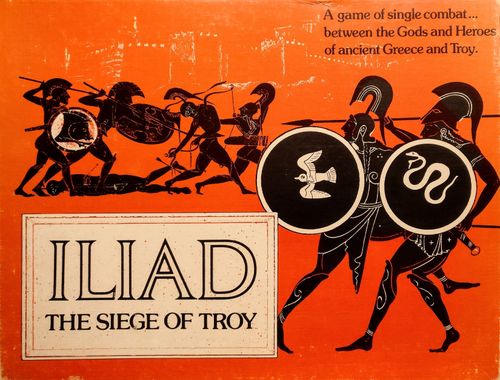
Iliad: The Siege of Troy
Iliad: The Siege of Troy Rulebook
Table of Contents
Table of Contents
The Map
The map represents the plain of Troy as, according to archaeological research, it should have been in the Mycenaean period. On it are shown the sea, the Greek camp with the ships drawn up on the shore and the wall built to protect them, the rivers Scamander and Simoeis, hilly areas and mountains, and the citadel of Troy. A square grid, necessary for setting up movement (see below), is printed on the map.
Playing Pieces
The pieces with which the game is played: the main pieces represent the heroes who fought for the conquest and the defence of Troy. The blue ones are Greeks; the orange ones are Trojans. On each is printed the hero's name, the city over which he reigned, and a value in points from one to nine. Some pieces bear the letter "A" in place of the value: these are the archers, who have special rules for the way they fight (as will be seen later).
Setup
Lay the map out on a table. The Trojan player sits behind the citadel; the Greek player sits behind the sea. Then place all the pieces of both armies on the map as follows:
- Trojans: on all the squares that cover the citadel and on the squares adjacent to it.
- Greeks: on all the squares of land, sea, or mixed land and sea (counting half land and half sea) to the right of the Scamander, and on the line of land squares immediately in front of them. On the first day the Greeks do not yet have the wall, as the calendar indicates.
Pieces may never be stacked on top of one another. Remember that Achilles, once placed, will not move until the fourth day, so it is important to place him where he will not obstruct the other pieces.
When these operations are finished, the real game begins.
How to Play
The first move belongs to the Greeks; the second (the response) belongs to the Trojans.
The move of the first player is divided into three phases:
- The hour of the day corresponding to that move is crossed off the calendar.
- The pieces are moved (as in the movement section), setting up any clashes and duels.
- The archers' shots, the combats and the duels are resolved (see the combat and archers sections).
Then it is the other player's turn to repeat the three phases, in the same order, as the response move. During one player's move, no piece of the other player may be moved.
The Calendar
The calendar indicates the succession of hours during the four days the game lasts, and at which hours events occur according to the Homeric poem.
Observing it, we find first of all the influence of the gods. It was decisive at some moments for the supremacy of one side over the other. In the game this influence is represented, in certain hours, by an advantage: the value of the pieces with value 1 is doubled, both in the move and in the response made in that hour.
Another determining element is the abstention of Achilles from the battle, caused by the quarrel between Achilles and Agamemnon at the beginning of the Iliad. Therefore Achilles remains on the square where he was placed at the start of the game until the first move of the fourth day, unless he is attacked before that by someone (foot soldier or archer), in which case he is automatically put into play. Only if all the other pieces were eliminated while he abstained would he no longer be able to enter the game, and the Greeks would lose.
In the night between the second and third day, Ulysses and Diomedes make an incursion into the Trojan camp and kill the Thracians. So from the third day the Thracian pieces no longer appear, whether they were removed by the clashes of previous days or had already been eliminated before.
Until the building of the wall, the Greeks have no fixed fortifications to protect their ships, even if the ships are already drawn on the map from the start. From the construction of the wall onward, the Greeks no longer leave from the seashore, but from the squares contained within the wall, chosen by the Greek player.
In the hours indicated for a duel, all movements stop. The two duellists are brought into contact at any point on the map, if possible between the two armies, regardless of the distance separating them. The duel is fought and, after it is finished, the surviving pieces are returned to their places. The next move then resumes normally. Obviously, if at the declaration of the duel one of the two duellists were already dead or wounded, the move is simply considered a free move.
The Night Between Days
Since in those times warriors did not fight during the night but withdrew to their tents or homes, after the last hour of a day all the pieces return to their starting positions and move from there in the next move.
By the magical ability of the doctors of the time, and also with the help of the gods, during each night the players may recover part of the pieces fallen during the previous day, to the extent of two thirds of the points lost, calculated rounding up. The player chooses which type of pieces to recover. Example: if pieces with a total value of 16 points were lost, two thirds (rounded up) will be recovered, that is 12 points.
Object of the Game
The Greek goal is to occupy Troy, bringing into its interior SIMULTANEOUSLY at least 5 pieces of any kind, or to eliminate all the Trojans before the end of a day.
The Trojan goal is to eliminate all the Greeks, or to burn at least 5 ships or more, by overlapping 5 pieces SIMULTANEOUSLY.
Translator's note: the printed sheet says "entro la fine di una giornata" (before the end of a day) without naming the day; it is transcribed as printed.
In case of a tie at the end of the fourth day, victory goes to the Trojans, since the Greeks are the invaders and must win by force to reach their goal.
More than two players may take part in the game, dividing the armies, with each player acting separately from his allies.
Movement
Movement factor. Each piece has a set number of squares it may traverse in each move: six squares for pieces with value 1, and ten squares for pieces with a value greater than 1.
General rules.
- In any move you may move all the pieces in play (unlike chess, where only one piece moves per turn).
- You may move any piece in any direction, even zigzag, as long as it does not exceed its movement factor (the number of traversable squares it may cover in each move).
- You are not obliged to move every piece; you may also choose not to move any.
- Pieces may not be moved over or through enemy or friendly pieces, nor be stacked.
- Movement factors are not transferable from one piece to another, nor can they be accumulated from one move to the next.
The die is used only to resolve combat. It has no influence on movement.
Special rules: terrain and movement.
- Sea (mare): never passable, except on squares that are half land and half sea.
- Rivers (fiumi): to cross a river, a piece must stop on the squares the river runs through, even if its movement could have taken it further. It resumes in the next move, beyond the river, with normal movement.
- Mountains (monti): movement onto them costs two movement points per mountain square. (If only one point remains on the last square, the piece cannot advance into it.)
- Walls and fortifications (muri e fortificazioni): these slow movement like rivers. In addition, a defender with value 1 inside the wall has its value doubled, and so does an attacker who manages to penetrate it.
Combat
General Rules
Regardless of the strategic position occupied, the piece that attacks another piece, even if it is in a defensive position, is called the attacker. The piece that suffers the attack is the defender.
To attack a piece, a player moves one of his own pieces into a square controlled by the enemy. Squares controlled by a piece are the squares adjacent to it in the perpendicular direction only, never diagonal (see Figure 1). Controlled squares are not passable, except to attack that piece, stopping where control is first established.
It is, however, permitted to pass through controlled squares if the piece controlling them is already attacked by an enemy at another point.
One may not place a piece adjacent to an enemy without attacking it, unless the enemy is behind a wall, which eliminates the control zones crossed by the wall itself.
Several pieces may attack one enemy piece, adding their values together in that case (Figure 2). But all of them are lost if the enemy then wins the combat.
A piece may attack an enemy from squares also controlled by a second enemy, provided that this second enemy is already engaged in other combats at the same time (Figure 3).
The figures on the printed sheet (Figures 1 to 3) show the control zones and attacks described above; they are not reproduced here.
Special Rules
There are two kinds of combat: the duel and the open-field battle (scontro in campo aperto, "bataille rangée" in the French column).
Duel. A duel applies only to heroes with a value greater than 1. It is the only way for such heroes to fight each other, and it is always individual (one against one). One attacks in the manner already described, by placing one's hero on squares controlled by an enemy hero. The duel may be voluntary, during the free moves, or it may be imposed by the calendar.
To determine the outcome, given the number of actions in a duel of that era (throwing the spear, throwing stones, and fighting with swords), the player rolls the die three times, alternately, during the same move. The result is given by the difference between the individual throws, plus the value of the individual pieces, according to the following table:
| Throw | Difference | Result |
|---|---|---|
| 1st throw | 1-2 | No effect |
| 1st throw | 3-4 | Wounded |
| 1st throw | 5-6 | Dead |
| 2nd throw | 1-2-3 | No effect |
| 2nd throw | 4-5-6 | Wounded |
| 3rd throw | 1-2 | No effect |
| 3rd throw | 3-4 | Wounded |
| 3rd throw | 5-6 | Dead |
If a hero is wounded from the first or the second throw, the duel continues to the end, but with the die throws halved.
Example (duel): Menelaus (value 4) against Antimachus (value 3).
- First throw: Menelaus rolls 3, so 4 + 3 = 7. Antimachus rolls 5, so 3 + 5 = 8. Difference 1: no effect.
- Second throw: Menelaus rolls 6, so 4 + 6 = 10. Antimachus rolls 2, so 3 + 2 = 5. Difference 5: Antimachus is wounded.
- Third throw: Menelaus rolls 5, so 4 + 5 = 9. Antimachus rolls 3, which is halved to 1.5 because he was already wounded, so 3 + 1.5 = 4.5. The difference is 4.5, greater than 4, so Antimachus is killed.
Once the duel is resolved, the dead are removed from the game, and the wounded are immediately taken back behind their own starting lines, where they stay until the first move of the next morning. If a wounded hero is attacked in his own camp, he defends without moving, and the die values are halved. Players should therefore remember that it is important to place wounded heroes well within their own camp, after the duels.
Open-Field Battle
The open-field battle (scontro in campo aperto) is the way pieces with value 1 fight each other, or fight heroes. Heroes also use it when they fight against pieces of value 1, and in that case they may be helped by other pieces of value 1.
The attacker is placed on squares adjacent to the enemy. The outcome is given by a single die roll per player, added to the value of the piece. If there is more than one piece, the values of all the pieces are added together. This covers putting several pieces against one, or attacking several pieces with one (Figure 4). The player whose total of pieces plus die is higher immediately eliminates the enemy or enemies. No wounded are provided for in this type of combat.
Archers
There is a third type of combat, exclusive to archers (unless they fight normally with value 1). The archers' pieces are placed within three squares in a straight line from the chosen target, which may be any piece, and the die is rolled.
- If the die shows 6, the target is killed.
- If the die shows 5, the target is wounded.
- If the die shows less than 5, the shot has no effect.
This applies even against targets behind other pieces or behind a wall. Arrow fire always takes place before the other combats (Figure 5).