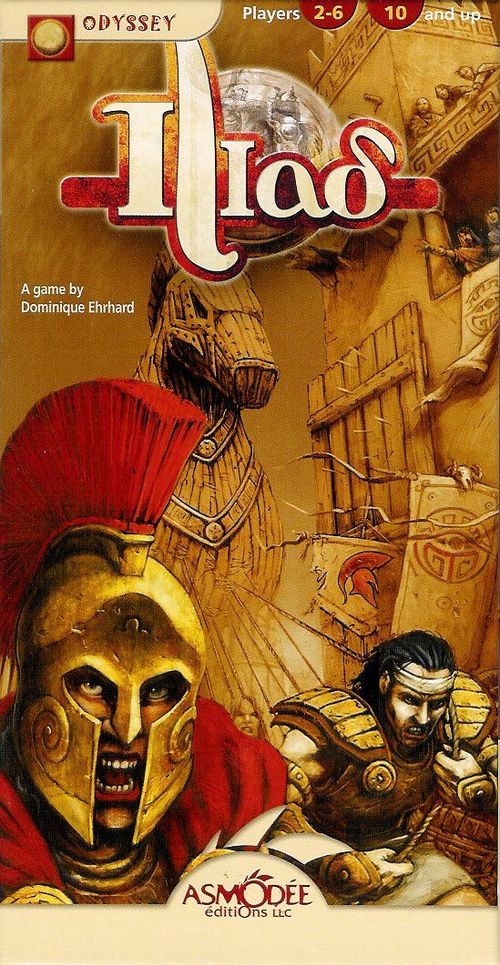
Iliad (2006)
Iliad (2006) Rulebook
Table of Contents
Table of Contents
Contents
- Game instructions (plus two play aids).
- 3 victory tiles (Agamemnon, Athena, Poseidon).
- 110 cards in the following distribution:
- 21 Victory cards (Trireme, City, and Helen),
- 6 Hero cards,
- 8 Oracle cards (Thanatos and Gorgon),
- 75 Army cards (Hoplites, Archers, Elephant, Chariot, Catapult, Ballista, Harrow, and Trojan Horse).
Game overview
The players, embodying brave Greek heroes, set out to besiege Troy in order to liberate the beautiful Helen. The winner is the first player to reach 12 victory points.
The game proceeds through several successive sieges, during which Victory cards are brought into play. Each player places cards in front of herself to build an army or to weaken the armies of her adversaries. At the end of the siege, the players who amassed the most powerful armies take a Victory card of their choice. All the cards forming their armies, which are sitting in front of the players, are discarded. However, they keep the cards that they still have in their hands. Each player receives three new Army cards; new Victory cards are brought into play, and a new siege starts.
Game setup
- With 2 players, the rules are slightly different and are explained at the end of these instructions.
- With 3 players, set aside the Hero cards of value 4, 5, and 6.
- With 4 players, set aside the Hero cards of value 5 and 6.
- With 5 players, set aside the Hero card of value 6.
- With 6 players, play in teams, as indicated in the end of these instructions.
Shuffle the Army cards and deal 12 to each player. Each player takes these cards into her hand without showing them to her opponents. Form a deck with the remaining cards, and place it in the middle of the table to constitute the draw deck.
Shuffle the Victory cards, form a deck and place it beside the deck of Army cards. Make a similar deck with the Oracle cards. Place the Agamemnon, Athena, and Poseidon tiles beside these decks. Place all the Hero cards face-up beside each other, near the other decks.
At the beginning of each siege, turn over an Oracle card and the Victory cards which will be awarded to the winners of the siege. These cards are placed face-up beside each other, in the middle of the table.
- With 3 players, turn over one Oracle card and one Victory card.
- With 4 players, turn over one Oracle card and two Victory cards.
- With 5 players, turn over one Oracle card and three Victory cards.
The Oracle card revealed at the beginning of the siege determines the way the siege unfolds.
Thanatos Card
If the Oracle card is a Thanatos card, the siege ends when the players are done playing cards. When a player decides to pass her turn, she will not be able to take part in this siege any longer. She immediately adds to her army the highest-value Hero still available (the value of this Hero will be added to the value of her army at the end of the siege).
The siege ends when all players have passed their turn. The player who has the strongest army takes one Victory card of her choice, as well as the Agamemnon tile. With 4 players, the player whose army is next-strongest takes the second Victory card. With 5 players, the player whose army is next-strongest takes the third Victory card. The player whose army is weakest must take the Thanatos card. This card subtracts from the player's total victory points.
Gorgon Card
If the Oracle card revealed at the beginning of the siege is a Gorgon card, victory will go to the player whose army, at the beginning of her turn, has a higher total value than that of the other players. "At the beginning of her turn" means "before she places a card in front of her or attacks another player".
The winner of the siege — and only the winner — receives a Victory card as well as the Agamemnon tile.
The players who pass their turn — and thereby stop participating in the siege — do not receive a Hero. As soon as a player passes, she immediately discards all Army cards sitting in front of her.
In this very fast and violent type of siege, the players cannot play the Trojan Horse card.
The Gorgon card is discarded at the end of the siege. The Victory cards that were not awarded remain in place; add only one new Victory card at the beginning of the next siege.
Siege flow
For the first siege, the youngest player plays first. For subsequent sieges, the player with the Agamemnon tile plays first. Each player then plays in turn, clockwise.
On her turn, a player can take precisely one of the following actions:
- Take a card from her hand and place it face-up in front of herself on the table.
- Attack an opponent with one of the cards sitting in front of her.
- Pass her turn.
She can execute only one of these actions, after which play goes to the player to her left.
Place a card from her hand onto the table
The cards are always placed in such a way as to be visible to all players.
If the Oracle card is a Gorgon, one cannot place the Trojan Horse card.
Chariot, Elephant, Ballista, Catapult, Harrow, and Trojan Horse cards are always placed by themselves — not stacked. They are simply placed beside those already lying in front of the player.
The player can place her Hoplites cards in several ways in front of herself: either separately (beside each other), or by stacking them on Hoplites cards placed earlier, in order to form a Phalanx, or on an Elephant or Trojan Horse placed earlier. The value of the cards of a Phalanx must always be decreasing, with the strongest placed first and the weakest placed last. The value of a Phalanx is equal to the sum of the points of the different Hoplites which form the Phalanx, multiplied by the number of cards which compose it.
Calculation of the power of a Phalanx: in the illustrated example, the phalanx on the left is worth 12 points (4+2, times 2); the one on the right-hand side, 24 (4+3+1, times 3).
Archers cards can be placed separately or on an Elephant or Trojan Horse. The value of the Hoplites and/or Archers cards sitting on an Elephant is doubled. One can place a maximum of two cards on an Elephant.
Hoplites and/or Archers cards are placed face-down on a Trojan Horse card. These cards are revealed only at the end of the siege.
Once a card is placed on the table, whether it is isolated or part of a group, it may no longer be moved.
To avoid weighing down the rules, the values and the advantages of the various cards and groups of cards are detailed in the glossary.
Attacking an opponent's army
Instead of adding a card to her army, the player can use one of the cards already sitting in front of her to eliminate a card from one of her opponents. Except for the Chariot cards, a player can never directly use a card from her hand to attack an opponent. She can use only one card, which she placed in front of herself during an earlier turn.
On the left side of each card, the cards which it can eliminate are shown in red circles.
Hoplites, Elephant, Harrow, and Trojan Horse cards can never be used to attack another player.
A Chariot or Archers card eliminates an opposing Archers card or Hoplites card. It can be a solitary Hoplites card or the Hoplites card having the lowest value (the last one placed) in a Phalanx.
A player cannot use a Chariot to attack an army equipped with a Harrow.
A player can never directly attack a card sitting on an Elephant or a Trojan Horse.
An Archers card sitting on an Elephant can eliminate the Hoplites card having the strongest value (the first one placed) in a Phalanx.
A Catapult eliminates a Ballista, a Harrow, a Catapult, or Trojan Horse of an opponent.
A Ballista eliminates an opposing Elephant or Chariot.
The card used by the player for attacking is discarded, as well as the attacked card.
To avoid weighing down the rules, the way to attack each card is detailed in the glossary.
Passing her turn
A player can decide to pass her turn, i.e. not place a card and not attack another player.
If the Oracle card is a Thanatos card, she takes the highest-value Hero card still available, and adds it to the cards lying in front of her. The value of this Hero will be added to the value of her army. She must place the Hero by itself: she can place it neither in a Phalanx, nor on an Elephant, nor on a Trojan Horse.
A player who passes her turn is neither able to place nor use any more cards thereafter during this same siege. The other players continue to play normally, each in their turn. If only one player remains, that player can continue to place or use cards for as long as she wishes.
A player who passed her turn nevertheless takes part in the calculation at the end of the siege, and can be the winner if she has more points in her army than the others. A player who passed her turn can still be attacked by the other players. On the other hand, her Hero can never be eliminated.
If the Oracle card is a Gorgon card, the players who pass their turn do not receive a Hero: they immediately discard all Army cards lying in front of them and do not participate further in this siege.
End of the siege
Sieges provoked by a Gorgon end as soon as one player, at the beginning of her turn, has an army stronger than the other players. "At the beginning of her turn" means "before she places a card or uses a card to attack an opponent". This player takes one Victory card of her choice, as well as the Agamemnon tile. The other players do not receive a Victory card. The Victory cards that were not awarded remain in place for the following siege. The Gorgon card is discarded.
Sieges launched by a Thanatos card end when all players have passed their turn, and thus have a Hero lying in front of them.
The players who have cards sitting on their Trojan Horse turn them face-up and add them to their army. These cards can be placed by themselves, added to Phalanxes, or placed on an Elephant.
Each player adds up the value of the cards that form her army. The player with the highest value takes one of the Victory cards (her choice) and places it face-up in front of herself. She also takes the Agamemnon tile (it is worth 1 victory point). With each new siege, the Agamemnon tile changes owner and is granted to the player whose army is strongest.
The following players, in the descending order of the values of their armies, take one of the remaining Victory cards, until there are no more Victory cards remaining for this siege. In the event of a tie, the tied player with the higher-value Hero takes the Victory card.
The player whose army is weakest takes the Thanatos card. In the event of a tie, the tied player with the lower-value Hero must take the Thanatos card.
Awarding the Athena and Poseidon tiles
The player whose total value of City cards is highest immediately takes the Athena tile (it is worth 2 victory points). The Athena tile is awarded as soon as the player collects the City card which gives her the majority. In the event of a tie, it remains the property of the player who currently has it. It changes player only when a player has more City points than the player who currently possesses the tile.
In the same way, the Poseidon tile (value: 2 victory points) is awarded immediately to the majority player in Triremes.
The points of the Victory cards are independent of those of the Army cards or Heroes. They are not added to the value of the armies during subsequent sieges. In the same way, the points of the Heroes are only added to the value of the armies, and are not added to the victory points.
New siege
Each player returns her Hero card. All the Hero cards are set on the table beside the Victory cards.
All players discard the Army cards lying before them. They keep the cards which they still have in hand.
Each player receives 3 new Army cards. The players who have more than 12 cards in hand must discard until they have 12 cards in their hands.
If the draw deck is exhausted, make a new one from the shuffled discards.
Place a new Oracle card and new Victory cards (three for 5 players, two for 4 players, only one for 3 players) on the table. If the Oracle card of the preceding siege was a Gorgon card, only one Victory card is added.
The player who has the Agamemnon tile plays first. Play continues clockwise.
Negotiations between players
The players are free to discuss, to negotiate between themselves, or to make whatever promises they want. However, giving or exchanging Army and/or Victory cards is forbidden.
End of the game
As soon as the total value of a player's Victory cards (including the Agamemnon, Athena, and Poseidon tiles, and subtracting the points of the Thanatos cards) reaches or exceeds 12 points, this player wins the game. This victory is immediate, and occurs at the moment when the player collects her Victory card, even if there are still Victory cards to be collected by the other players.
If the deck of Oracle cards is exhausted without a player reaching 12 points, the winner is the player who has the most victory points. In the event of a tie, the tied players receive three new Army cards, which they add to the cards remaining in their hands, and start a new siege of the Gorgon type without bringing any new Victory cards into play. Only the tied players take part in this siege. The player who wins during this final siege wins the game. The player who has the Agamemnon tile begins the siege: if none of the tied players have the Agamemnon tile, the player who had the Hero of the highest value during the previous siege starts.
Play with 2
The rules for two players are exactly the same as for the basic game, but without using the Oracle cards and the Hero cards.
At the beginning of each siege, turn over two Victory cards.
A player who passes can still play thereafter during the same siege. She can pass several turns, as long as her opponent continues to play. The siege stops as soon as the two players pass their turn one after the other.
The player who has the strongest Army takes the Victory card of her choice. In the event of a tie, the loser is the last player to have passed her turn. The loser does not collect a Victory card.
The second Victory card remains in place, and a new one is added. Each player receives three new cards and a new siege starts.
The winner is the first player to have 15 victory points.
Play in teams for 4 or 6 players
A completely enthralling alternative consists of playing in teams. The rules are exactly the same as for the basic game. Each player plays with her own army and tallies the total of her army individually. The Victory cards, as well as the Agamemnon, Athena, and Poseidon tiles are also awarded individually to each player of the team. The difference is that to determine the winning team, tally the total victory points of both partners for each team.
With 4 players
The game is played in two teams of two. The members of the same team face each other. Set aside the 5 and 6 Hero cards. Deal 12 Army cards to each player. At the beginning of each siege, turn over an Oracle card and two Victory cards. At the end of each siege, deal 3 new Army cards to each player. No player can have more than 12 cards in hand. The first team to obtain or exceed 15 victory points wins the game.
With 6 players
The game is played in three teams of two. The members of the same team are spread evenly around the table (a player of team A, then a player of team B, then a player of team C, a player of team A, then B, then C).
Deal 10 Army cards to each player.
At the beginning of each siege, turn over one Oracle card and three Victory cards. At the end of each siege, deal 3 new Army cards to each player.
No player can have more than 10 cards in hand.
The first team to obtain or exceed 15 victory points wins the game.
Glossary
Archers
Archers cards can be placed by themselves, or on an Elephant, or on a Trojan Horse.
By using an Archers card, the player can attack another Archers card, an isolated Hoplites card, or the weakest Hoplites card of a Phalanx (the last one placed, the one on top of the Phalanx).
An Archers card cannot attack an Archers card or a Hoplites card sitting on an Elephant, nor the cards placed on a Trojan Horse.
An Archers card can attack a Hoplites card even if the latter has a higher value than the Archers card.
An Archers card placed on an Elephant can eliminate an Archers card or an isolated Hoplites card, but also the strongest Hoplites card of a Phalanx (the first one placed, the one at the bottom of the Phalanx).
The player discards her Archers card (even if it is placed on an Elephant) as well as the targeted opposing card.
Archers cards can be eliminated by an opposing Archers card or Chariot, unless they are on an Elephant or on a Trojan Horse card.
Archers cards placed on a Trojan Horse are revealed at the end of the siege and placed by themselves beside the other cards, or placed on an Elephant.
Archers cards still lying in front of a player at the end of a siege are worth 1 point if they are on their own, or 2 points if they are on an Elephant.
Ballista
Ballistas are always placed by themselves in front of the players.
By using a Ballista placed in front of her, the player can eliminate an Elephant card or a Chariot card placed in front of another player. The player discards her Ballista card as well as the targeted opposing card.
The cards placed on the Elephant are not eliminated, but placed by themselves beside the player's other cards. The player cannot integrate the cards that have "fallen" from the Elephant onto another Elephant, onto the Trojan Horse, or into a Phalanx. On the other hand, a player can later add a card onto a Hoplites card that "fell" from an Elephant, and thereby form a new Phalanx.
Ballista cards are eliminated only by an opposing Catapult. Ballista cards score no points in the tally at the end of the siege.
Catapult
Catapults are always placed by themselves in front of the players.
By using a Catapult placed in front of her, the player can eliminate another Catapult card, a Harrow card, a Ballista card, or a Trojan Horse card belonging to another player. The player discards her Catapult card as well as the targeted opposing card.
The cards placed on the Trojan Horse are not eliminated, but placed by themselves beside the player's other cards. The player cannot integrate the cards that have "fallen" from the Trojan Horse onto an Elephant, onto another Trojan Horse, or into a Phalanx. On the other hand, a player can later add a card onto a Hoplites card that "fell" from the Trojan Horse, and thereby form a new Phalanx.
Catapult cards are eliminated only by an opposing Catapult. Catapult cards score no points in the tally at the end of the siege.
Chariot
Chariot cards are always placed by themselves in front of the players. Players can also use Chariot cards from their hand to attack another player. It is the only card that can be used to attack without having been placed in front of the player beforehand.
By playing a Chariot card placed in front of her or directly from her hand, the player eliminates an Archers card or an isolated Hoplites card, or the weakest Hoplites card of a Phalanx (the last one placed, the one on top of the Phalanx). The Chariot card as well as the targeted card are discarded.
A player can never attack another player with a Chariot card if that player has a Harrow card placed in front of her. On the other hand, a player who has a Harrow card in front of her can use a Chariot to attack another player.
A Chariot can never attack cards placed on an Elephant or on the Trojan Horse.
A Chariot can attack a Hoplites card even if the latter has a higher value than the Chariot.
Chariot cards are eliminated only by an opposing Ballista. Chariot cards still lying in front of a player at the end of a siege are worth 3 points.
Trojan Horse
If the Oracle card is a Gorgon, no player may place a Trojan Horse card.
Trojan Horse cards are always placed by themselves in front of the players. Players can add Hoplites and/or Archers cards onto a Trojan Horse previously placed in front of them. These cards are placed face-down, and will be revealed only at the end of the siege. A player can add as many cards as she wishes onto a Trojan Horse.
A player can have several Trojan Horse cards in front of her. A Trojan Horse card can never be placed underneath a Hoplites card or an Archers card already on the table.
Hoplites and Archers cards can no longer be moved or used by the player, and remain on the Trojan Horse card until the end of the siege, unless the Trojan Horse is eliminated by an opposing player.
The cards placed on a Trojan Horse cannot be eliminated directly. If an opponent destroys the Trojan Horse, all the cards placed on the Trojan Horse are turned face-up and placed by themselves in front of the player. The cards that have thus "fallen" from the Trojan Horse cannot be placed on an Elephant, on another Trojan Horse, or added to a Phalanx.
At the end of the siege, the players who have cards on their Trojan Horse turn them face-up and add them to their army. These cards can be placed by themselves, added to Phalanxes, or placed on an Elephant.
Trojan Horse cards are eliminated only by an opposing Catapult. Trojan Horse cards score no points in themselves in the tally at the end of the siege.
Elephant
Elephant cards are always placed by themselves in front of the players.
Hoplites and Archers cards can be placed on an Elephant card. To be able to place a card on an Elephant, that Elephant must already be on the table. The value of Hoplites or Archers cards placed on an Elephant is doubled. A player can place at most two cards — Hoplites or Archers — on the same Elephant. The cards are placed slightly offset on the Elephant card, so that their value can be seen. An Elephant card can never be placed underneath a Hoplites card or an Archers card already on the table.
During an attack, an Archers card placed on an Elephant can eliminate the strongest card of a Phalanx instead of the weakest one.
Example: an Archers of 1 and a Hoplites of 1 on an Elephant are worth 4 in total (1+1, times 2).
Hoplites and Archers cards placed on an Elephant can no longer be moved by the player, and remain on the Elephant card until the end of the siege, unless the Elephant is eliminated by an opposing player. Cards placed on an Elephant cannot be attacked by an opponent. On the other hand, the Elephant can be eliminated by a Ballista card. In that case the cards placed on the Elephant "fall" to the ground without being eliminated, and remain on the table as if they had been placed by themselves.
A player can have several Elephant cards in her army. Elephant cards are eliminated only by an opposing Ballista. Elephant cards score no points in themselves in the tally at the end of the siege, but they double the value of the Hoplites and Archers cards placed on them.
Hero
At the beginning of a siege, the Hero cards are placed in the middle of the table beside the Victory cards. If the siege is triggered by a Thanatos card, a player who passes her turn adds to the cards in front of her the Hero card of the highest value still available. She must place the Hero by itself: she can place it neither on a Phalanx, nor on an Elephant, nor on a Trojan Horse.
If the siege is triggered by a Gorgon card, the players who pass do not receive a Hero.
In the event of a tie between the army values of two or more players, the player who has the Hero of the highest value takes the Victory card.
In the event of a tie for the weakest army, the player who has the Hero of the lowest value must take the Thanatos card.
A Hero can never be attacked or eliminated by an opponent.
All the Hero cards are returned by the players after the Victory cards have been distributed, and are placed back on the table. The value of a Hero is added to the value of its owner's army at the end of the siege.
Harrow
Harrow cards are always placed by themselves in front of the players.
A player can never attack another player with a Chariot card if that player has a Harrow card placed in front of her. On the other hand, a player who has a Harrow card placed in front of her can use a Chariot to attack another player.
Harrow cards are eliminated only by an opposing Catapult. Harrow cards score no points in the tally at the end of the siege.
Hoplites
Hoplites cards can be placed by themselves, or on an Elephant or a Trojan Horse, but they can also be stacked on one another to form a Phalanx. The value of a Phalanx is equal to the sum of the points of the different Hoplites cards which form it, multiplied by the number of cards which compose it.
The value of the cards of a Phalanx is decreasing, from the strongest placed first to the weakest placed last.
Hoplites cards can never be used to attack opposing cards.
Hoplites cards placed on a Trojan Horse are revealed at the end of the siege. They are then placed by themselves beside the other cards, placed on an Elephant, added to an existing Phalanx, or stacked to form a new Phalanx.
A Phalanx is formed of a set of Hoplites cards that follow one another in decreasing order of value. The new Hoplites card added is placed on the previous card of the Phalanx, slightly offset downwards. The value of the new Hoplites card must be lower than that of the last card of the Phalanx, but it does not have to be lower by exactly one (there can be "jumps" in the value of the cards). Once placed on a Phalanx, a Hoplites card can no longer be moved. Nor is it possible to add Hoplites cards by "inserting" them between Hoplites cards already placed.
The value of a Phalanx is equal to the sum of the points of the different Hoplites cards which form it, multiplied by the number of cards which compose the Phalanx. If a Phalanx is attacked by a Chariot or an Archers card, it is always the last card of the Phalanx (the one with the lowest value) which is eliminated, unless the Archers card is placed on an Elephant. In that case, the Archers card eliminates the highest-value card composing the Phalanx.
Isolated Hoplites cards score the value indicated on the card: this value is doubled if they are on an Elephant. Hoplites cards can be eliminated by an opposing Archers card or Chariot card, unless they are on an Elephant or on a Trojan Horse.
Victory
Victory cards are what is at stake in each siege. 3 new Victory cards are placed in the middle of the table at the beginning of each siege when playing with five players, 2 with four players, and only one with three players. If the previous siege was triggered by a Gorgon, only one Victory card is added at the beginning of the following siege.
The player whose army is the strongest at the end of a siege takes one of the Victory cards in play; the following players do the same until all the Victory cards put into play during that siege have been awarded — except in the case of a siege caused by a Gorgon, where only the victorious player takes a Victory card.
As soon as the total value of the Victory cards collected by a player is greater than or equal to 12, the game stops and that player immediately wins the game.
There are three sorts of Victory cards: the Beautiful Helen, the Triremes, and the Cities. The Helen card has no particular function: it simply brings 5 victory points to its owner.