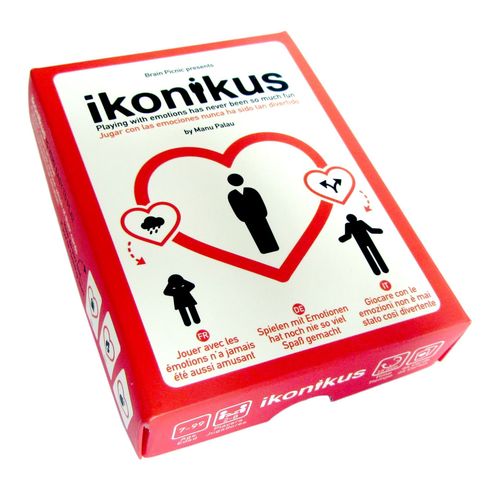
Ikonikus
Ikonikus Rulebook
Table of Contents
Table of Contents
Components
- 110 symbol cards
- 5 blank cards: players may draw their own invented symbols on these and add them to the other symbol cards
- 5 cards with sample questions
Setup
Shuffle the symbol cards and deal 5 cards to each player. Players do not show their cards to their rivals. Place the remaining cards in a face-down stack (back side up) in the middle of the table.
Gameplay
-
The oldest player starts the game. They ask the other players a question beginning with: HOW DO I FEEL WHEN… – and then state any situation, real or invented.
If a player has trouble coming up with a question, they may use the sample question cards. They may read one of them or, inspired by it, invent a different question. A player may freely change the sample questions. Some of them concern, for example, work – students and pupils can therefore adapt them to the realities of their school or studies.
-
The other players choose one card from the five they hold – the one that, in their opinion, best fits the question asked. They place it face down (back side up) in the middle of the table, so that the other players cannot see the symbol on the card.
Note! The player who asked the question does not play a card! Their cards stay face down on the table.
Example:
Player A: "How do I feel when I am late for a date?"
Players B, C and D each place one face-down card in the middle of the table.
-
The player who asked the question takes the cards played by the other players (without checking them!) and shuffles them so that nobody knows who chose which card. Then they reveal the cards and interpret the symbols on them.
Example: Player A reveals three cards with the interpretations "I'll get stood up…", "There will be a storm…" and "We are going to break up…".
-
The player who asked the question chooses one card – the one that best expresses their emotions. The owner of that card takes it and places it on the table in front of themselves – this means they have scored a point! The other players do not score any points. The cards they played are returned to the box.
-
The players each take one new card from the stack, so that again they have 5 cards in hand.
-
The next round begins:
- this time the question will be asked by the player sitting to the left of the player who asked the question in the previous round,
End of the Game
The game ends when one player scores 3 points (that is, when 3 cards lie in front of them on the table). That player is the winner.
Note! The players may adjust the length of the game to their needs by agreeing, before the start, how many points they are playing to.
Variant
The game proceeds according to the rules described above, with one difference: the players play not one but two cards – cards that allow the player asking the question to connect them and create a short story.
Example:
Question: "How did I feel when I met my love?"
Card 1: "I felt a magical attraction." Card 2: "I knew right away that we fit each other perfectly."
Commentary for Parents and Teachers
"A Game of Emotions" is an excellent opportunity to develop communication skills, shape empathy, and learn the words for emotions and feelings. Below are a few ideas that may help parents and teachers introduce children to naming emotions and sharing them. Especially in a group of young people who do not know each other well, these ideas can make it easier to come up with questions during the game.
Naming Emotions
To help children match pictures with emotions and feelings, it is worth starting with a "warm-up". In clockwise order, the players each give one answer to the question: How can I feel? Answers may not be repeated. The game lasts until one of the players cannot think of a state a person may be in.
For older children a harder variant can be introduced: the players give answers beginning with consecutive letters of the alphabet (the first player must name a state beginning with A, the second with B, and so on). A list of sample answers follows.
I can feel: carefree, safe, helpless, willing, alert, curious, unsteady, proud, energetic, hungry, blooming, light, comfortable, nervous, tense, unwilling, shy, indifferent, enchanted, brave, indignant, lonely, cheerful, friendly, self-confident, overwhelmed, on edge, joyful, touched, disappointed, shaken, sleepy, fulfilled, embarrassed, weak, calm, guilty, furious, agitated, frightened, exhausted, grateful, free, moved, confused, crushed, surprised, jealous, intrigued, in love, stressed, inspired, relaxed, astonished, satisfied.
Cause of Emotion
Another way to introduce children to the game is to invent the events that lie behind a given emotional category. That is, the answer to the question: What recently made me feel proud, guilty, or moved…? Players can also be asked to point to the cards that connect with these states or events.
Associations: Symbols – Emotions
An activity that makes the game easier for children is an emotional association game: a player draws any card, and the others name the feelings they associate with the symbol shown on it. Examples:
- To be in an explosive mood…
- To feel self-confident, responsible, in control…
- To be "in pieces"…
- To be cold-hearted, to feel one's blood freezing in one's veins…
- To feel wonderful, like a fish in water…