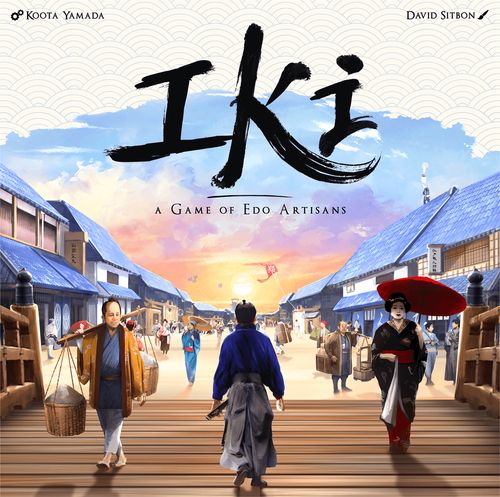
IKI
IKI Rulebook
Table of Contents
Table of Contents
Goal of the Game
Live an entire year in Edo and try to become the best Edokko, the "child of Edo", by participating in the well-being and the prosperity of Edo and its citizens. Hire characters with various skills, make them work in the main street of Nihonbashi and increase their experience until it's time for them to retire.
The winner is the player with the most IKI, a philosophical concept of the Edo period representing the ideal way of living a civic life.
- IKI scored during the game is represented by the score-during-game symbol.
- IKI scored at the end of the game is represented by the score-at-end symbol.
Game Components
Boards
- 1 double-sided main board and 4 double-sided player boards (2 players and 3-4 players).
Cards
- 4 starting Character cards
- 56 Character cards (14 cards for each season)
- 10 Building cards
Wooden parts
- 4 Oyakata meeples
- 4 Ikizama meeples
- 16 Kobun meeples
- 4 score markers
- 4 Firefighting markers
- 20 Wood
- 30 Rice
- 1 Calendar marker
Tokens & tiles
- 36 "1 mon" coins
- 20 "4 mons" coins
- 12 Koban tokens (gold coins)
- 8 Fish tokens (2 per season)
- 8 Pipe tokens (2 per season)
- 8 Tobacco Pouch tokens (2 per season)
- 4 "30/60" IKI tokens (1 per player)
- 28 Sandal tokens
- 4 Fire tiles
- 5 Special tokens: Move +1, Avoid a Fire (x2), Joker, Hire -1
Other
- 1 score pad
- 2 rulebooks (English, French)
- 2 player games: 1 Sun & 1 Moon token, 12 Blocking tiles
Publisher note: we decided to call "rice" the straw-colored bags (komedawara) used during the Edo period. They contained approximately 60 kg of rice.
Setup
General setup
- Place the board at the center of the table, on the side that matches the number of players.
- Place the Calendar token on the 1st space of the Calendar: this is the first month of the year. Each round corresponds to a month. According to the traditional Japanese calendar, months 1-3 represent Spring, months 4-6 represent Summer, months 7-9 represent Autumn and months 10-12 represent Winter. The 13th month represents New Year's Day.
- Place a number of "30/60 IKI" tokens equal to the number of players at the end of the IKI track.
- Shuffle the 4 Fire tiles, make a stack face down and place them on their corresponding space.
- Sort the Fish, Pipe and Tobacco Pouches tokens per season (Spring, Summer, Autumn, Winter). Then, place all the Spring tokens face up on their corresponding spaces. Take the Summer, Autumn and Winter tokens and place them face down on their corresponding spaces of the Calendar.
- Randomly pick 6 Building cards among the 10 and place them close to the game area. Remaining Building cards are returned to the box: they will not be used for this game.
- Place mons, sandals, rice, wood, Kobans and special tokens next to the play area: they are called the reserve.
- Sort the Character cards per season (Spring, Summer, Autumn, Winter) to form 4 decks of cards. Place them next to the main board.
Player setup
- Each player chooses a color and takes the components from this color: 1 player board placed on the side corresponding to the number of players, 1 Ikizama meeple, 1 Oyakata meeple, 4 Kobun meeples, 2 markers (Score and Firefighting power).
- Then, each player takes 1 Sandal token, 1 Rice token and 8 mons (the currency used during the Edo era). Place the Sandal token, your Ikizama meeple and your 4 Kobun meeples on the matching spaces of your player board. Other tokens are placed next to you.
- The last player who visited Japan will be the first player for the 1st round. If no player has visited Japan, randomly choose a first player. Each player places their Oyakata on a dotted space of the starting area.
- Each player places their Firefighting marker on the space "0" of the Firefighting track. The first player's marker is placed on top, then the player to their left places theirs under it, going clockwise until the last player's marker is placed at the bottom of the stack.
- Each player places their score marker on the space "0" of the IKI track. Should a player reach a score over 30 (or 60) IKI, they take (or flip) a "30/60 IKI" token as a reminder. IKI cannot be negative.
- Take the 4 Starting Character cards and place them close to the play area: in counterclockwise order, each player selects a card, then places it in the outer space of the Nagaya of their choice. They also place a Kobun on the first Experience space of the card, at the bottom of the card. When playing with 2 or 3 players, non-selected cards are returned to the box: they will not be used for this game.
Resources (mons, rice, sandals and Kobans) are not limited.
For 2-player games adjustments, look at the "Rules for 2 players" section.
Main Concepts of IKI
- Oyakata meeple: it represents the character you play in IKI. Each month, your Oyakata moves in the main street of Nihonbashi to do business with the shop where they stop and with one of the characters working in a stall.
- Ikizama meeple: players choose how many spaces their Oyakata will move with their Ikizama meeple. Order in which they are placed determines the resolution order for the main phase of the game: the Action phase.
- Kobun meeples (x4): they represent the Edo citizens you employ. When you hire a Character or when you build a Building, place one of your available Kobuns on the card to indicate you control it. Kobuns placed on Character cards may gain experience until they retire, therefore being available again. At the end of each season, players must feed Kobuns on their Character cards, and must also protect them from fires that will break out 3 times during the game.
- Firefighting marker: it is used to check your Firefighting level when a fire breaks out, but also determines the turn order for the placement of the Ikizama meeples during the "Way of Life" phase.
Experience
The experience track on the right side of each Character card indicates the Salary generated by the Character during Payday, depending on their Experience Level. The Salary of this character is the one right above the Kobun placed on the card. Some cards like the Puppeteer or the Glassblower have a shorter experience track.
Experience can be gained in 3 different ways:
- An opponent uses the skill of your character.
- When your Oyakata completes a turn in the Main Street.
- Some characters' skill increases the Experience of one of your characters.
Each time a character gains Experience, the Kobun is moved one space up. When the Kobun reaches the last space, it means the character is now retired: take the Character card, place it in the corresponding column of your player board (that matches the color of the card) and take back your Kobun. Retired characters do not need rice during Payday, but provide their maximum Salary, indicated in the circle at the top right of the card.
IMPORTANT: Some characters whose Salary is indicated in a red circle grant players a Special token, but only when the character retires. (See Appendix 1).
Character card
- Hiring cost in mons.
- Firefighting power: when you hire this character, move your Firefighting marker up one space on the Firefighting track.
- Character's occupation (see Appendix 1 for characters abilities).
- Skill: what the character provides you with if activated during the Action phase.
- Type: Street Peddler / Artisan / Special / Master Craftsman / Shop Seller.
- Experience level: most characters start at level 1, but a few start at level 2.
- Salary: the owner of the card receives this on Payday.
There are 3 types of skill:
- You get resources, Firefighting Power or IKI for free.
- In exchange for resources, you get an ability, resources or IKI.
- Special actions or abilities.
Building card
- Construction cost.
- Name of the Building (see Appendix 2 for Buildings abilities and scorings).
- Kobun space.
- Ongoing ability for the owner of the Building, if any.
- IKI scored at the end of the game.
Payday & Salary
At the end of each season (at the end of months 3, 6, 9 and 12) Payday occurs: each player collects the Salary of all their characters (retired or not). For characters on the game board, it corresponds to the space immediately above the Kobun. For retired characters, it corresponds to the circled space at the top right of the card.
Tokens
- Mon: 1 mon and 4 mons coins are inspired by coins used during the Edo period.
- Koban: Inspired by Edo period oval gold coins, Kobans are used to build some Buildings.
- Sandal: You may spend Sandals to increase the number of movements of your Oyakata and to do business with characters.
- Rice: During Payday, each player must spend one rice for each of their hired characters on the game board. Rice is also used to do business with characters.
- Wood: Wood is used to build Buildings and to do business with characters.
- Fish: Two fishes can be purchased each season: their cost is indicated on the token. The kind of fish changes every season: shira-uo (whitebaits) in spring, katsuo (bonito) in summer, suzuki (sea bass) in autumn and tai (sea bream) in winter.
- Pipe: Two pipes can be purchased each season: their cost is indicated on the token. See Appendix 3 for Pipes abilities.
- Tobacco Pouch: Two tobacco pouches can be purchased each season: their cost and their IKI value are indicated on the token. See Appendix 3 for Tobacco Pouches abilities.
- Fire tiles: at the end of months 5, 8 and 11, a Fire tile is randomly picked to determine the starting point of the Fire.
Board terminology
- Nagaya: Four Nagayas are adjacent to the main street. Each Nagaya is formed of 4 spaces to place Character and Building cards. Each Nagaya forms a group and the four corner spaces that cost 2 additional mons to place a card on it form together a 5th group.
- Stall: each space behind a shop is called a stall.
- Shop: a shop corresponds to the action that can be taken by an Oyakata when it stops on the corresponding space of the main street.
How to Play
A game of IKI lasts 13 rounds: the 12 first rounds correspond to the 12 months of the year (which is divided in 4 seasons) and are played alike. The 13th round represents New Year's Day and is played differently.
Each month is divided in 3 phases, summarized on the player boards:
- Phase A – "Way of Life": players take position on the Ikizama track in the order determined by the Firefighting power track.
- Phase B – "Actions": players 1) gain income or hire a character 2) move their Oyakata and do business in the main street, then 3) take back their Ikizama meeple.
- Phase C – "Event" depends on the month:
- Payday is resolved at the end of months 3, 6, 9 and 12 (i.e., at the end of each season).
- A fire breaks out at the end of months 5, 8 and 11.
During phases B and C, players will have the opportunity to increase their IKI, symbolized by the score track.
Revealing Character cards
At the beginning of each month, reveal the first 4 Character cards from the deck of the current season and place them next to the main board, close to the Character cards from previous months. At the beginning of the game, play with the Spring cards. Then, you will play with the Summer cards, the Autumn cards and finally the Winter cards.
Phase A – Way of Life: place your Ikizama meeple on the Ikizama track
During that phase, players decide how many spaces their Oyakata will move in the main street, which determines the turn order for the next phase (Actions).
In month 1, players take turns clockwise, beginning with the starting player. This is represented by the stack of players markers on the Firefighting track. From month 2 on, players take turns in descending order of firefighting power: the player with their marker on top plays their turn first, etc. Should several players' markers be in the same space, the player whose marker is on top plays first.
When your turn comes, place your Ikizama meeple on an available space of the Ikizama track. An available space is a space with no Ikizama meeple (or no blocking tile in a 2-player game) on it. The number on the spaces indicates the turn order for the next phase (Actions) and the number of spaces your Oyakata will move. There are 5 spaces on the Ikizama track: 1-4, 1, 2, 3 and 4.
Once all players have placed their Ikizama meeple, phase B starts.
Example: Anaïs has the highest Firefighting power, so she places her Ikizama meeple first. Then, David places his Ikizama meeple because his Firefighting marker is on top of Dominique's, who plays last.
Phase B – Actions: moving the Oyakata and doing business
Players take their turn in the order given by the Ikizama track, starting with the player whose Ikizama meeple is on the rightmost space.
In the case a player placed their Ikizama meeple on the leftmost space (1-4), they play this phase first but must directly perform phase B2. Therefore, they cannot hire a character nor gain income, but gain 1 mon as compensation. This player moves their Oyakata from 1 to 4 spaces and may spend Sandals if they want to move more than 4 spaces.
B1 — Income or Hiring
Choose one:
- Income: Gain 4 mons from the reserve.
- Hiring: choose an available Character card close to the main board and pay (in mons) the cost indicated in the top left of the card. Place the Character card on an empty space of the main board and place one of your unused Kobuns at the bottom of the experience track.
- Remember to pay the extra cost of the space (1 or 2 mons), if any.
- If there are 1 or 2 mons on the card you hire, take them: you may use them to pay the card.
IMPORTANT: if you do not have enough mons, nor an unused Kobun or if there is no space available on the main board, you cannot hire: you must choose Income.
Example: Anaïs hires the Monk. She takes the mon that was on it, then spends 4 mons. Thanks to the hiring bonus, she moves her marker up one space on the Firefighting track. She chooses to place the Monk on this available corner space of the main board which requires to spend 2 additional mons. Finally, she places one of her available Kobuns on the lowest space of the Monk's experience track.
B2 — Moving Oyakata and doing business
Resolve this phase in this order:
Moving:
Move your Oyakata in the main street (following arrows) the exact number of spaces indicated by your Ikizama meeple (see Phase A above).
- You may increase the number of movements of your Oyakata by spending one sandal for each additional move. Sandals do not allow to reduce the number of movements, only to increase it. Once spent, return the sandals to the bank.
- Your Oyakata may stop on a space with one or several opposing Oyakatas.
IMPORTANT: When your Oyakata passes the Crossroads by completing a turn in the Main Street, increase by one the experience of all your characters: move up all your Kobuns. If this triggers their retirement, take back your Kobun, remove the card from the Nagaya and place it in the corresponding column of your player board. This step is resolved during the movement of your Oyakata, but before doing business.
Doing Business:
Once your Oyakata has completed their movement, you may do business with the shop you stopped at and/or with one of the two characters sitting in the stalls, if any. You may do business in any order with the shop and one of the cards, or with neither. If you do business with another player's character, this character increases their experience after business is done by moving up one space their Kobun on the card. Should this character retire, their owner takes back their Kobun, which becomes immediately available.
IMPORTANT: if you do business with one of your characters, its experience level is not increased.
Example: Anaïs chose the "move 1 space" of the Ikizama track. She moves her Oyakata one space as indicated on the Ikizama track, then she spends 1 sandal to move an additional space. Since her Oyakata crossed the Crossroads, all her characters increase their experience by one: her Monk and her Cloth Dyer, who immediately retires. Then, she performs the action of the Main Street (Rice Shop), then activates the Boiled Egg Peddler to gain 1 rice: as this character is controlled by Dominique, his Kobun's experience is increased by one.
B3 — End of turn
Once their turn is over, players take back their Ikizama meeple and place it on their player board.
Phase C – Event
During that phase, first resolve the Event, if any.
Months 1, 2, 4, 7, and 10: Place 1 mon from the bank on each remaining Character card next to the main board. Then, move the Calendar marker to the next month.
Months 3, 6, 9 and 12: Payday
At the end of months 3, 6 and 9, resolve these steps:
- Remove from the game all remaining Fish, Pipe and Tobacco Pouch tokens and replace them by the corresponding tokens from the next season.
- Remove from the game all the unhired Character cards from the current season. If there were mons on the cards, they are returned to the reserve. From next month on, you will use the Character cards from the next season.
At the end of month 12, resolve these steps:
- Remove from the game all the Winter cards.
- All the Winter Fish, Pipe and Tobacco tokens remain on the board: players will have the opportunity to purchase them during New Year's Day.
- Each player takes back their Oyakata meeple and places it next to their player board.
Then, resolve these steps in order:
-
Salary: Players collect salary from each of their Character cards on the board, depending on their level of experience, and from each of their retired characters. This may be mons, IKI or resources. Retired character's salary is always the topmost salary on the card.
-
Nagaya Harmony Bonus: There are 5 groups of card spaces on the main board: 4 Nagayas separated by the streets and the 4 corner spaces that cost 2 additional mons: cards on these corner spaces belong to 2 groups. For each group with at least 2 characters of the same type (regardless of who controls them), each player multiplies the number of their Kobuns by the number of cards of the same color in that group. Players score that value in IKI. IMPORTANT: characters in the corner spaces may score twice, as they belong to two groups at the same time.
-
Food payment: Each player must spend 1 rice for each of their characters on the main board. Retired characters do not have to be fed, nor Kobuns on Building cards. If you have rice in stock, you must feed your characters. Should a player not have enough rice, they remove from the main board characters of their choice they cannot feed. Character cards are removed from the game, then the player takes back their Kobun.
IMPORTANT: should a character with a Firefighting power hiring bonus leave the game (not fed or killed by a fire), its controller Firefighting marker remains where it stands.
Example (Payday salary): Dominique receives salary from his characters: 1 mon and 1 sandal from the retired Cotton Peddler, 3 IKI from the Seamstress and 3 mons from the Soba Stand who are still in play.
Example (Nagaya Harmony): In one Nagaya, Dominique controls two Artisans: as they are both of the same type, Dominique scores 2x2 = 4 IKI. In another Nagaya, Anaïs controls a Peddler: as it is alone in the Nagaya, she does not score any IKI. In another Nagaya, Anaïs controls a Shop Seller and an Artisan: as they are not of the same type, she does not score any IKI. In one Nagaya, David and Dominique both control a Master Craftsman: they respectively score 1x2 = 2 IKI. Anaïs, who controls an Artisan, does not score any IKI. In the fifth Nagaya, Dominique controls an Artisan and Anaïs controls 2 of them: Dominique scores 1x3 = 3 IKI and Anaïs scores 2x3 = 6 IKI.
Example (Food payment): David controls 3 characters and has 2 rice in stock. He must feed 2 characters and remove from the game the third one. He chooses to remove from the game the Yamabushi, then takes back his Kobun and returns it to his player board.
Move the Calendar marker to the next month.
Months 5, 8 and 11: Fire
At the end of months 5, 8 and 11, a fire breaks out. The strength of the fire depends on the month and is indicated on the calendar: 5, 8 and 10.
The player with the most firefighting power shuffles the 4 Fire tiles and draws one. The tile determines which of the 4 Nagayas the fire affects. A fire always starts on the edge of the main board and progresses to the middle until it is stopped or until it reaches the crossroads where it automatically dies out.
If a Fire breaks out in a stall with no character in it, it spreads out to the next stall reducing its strength by 1, until it reaches a stall with a character in it or until it reaches the end of the Nagaya and stops automatically.
The Fire tile shows: the Fire starting point, the Fire strength modifier, and the End of a Nagaya.
If a Fire breaks out in a stall with a character in it:
- If the owner of the Character card has sufficient Firefighting power (equal or higher than the strength of the Fire), then this player stops the Fire, and the Fire phase is over.
- If the owner of the Character card does not have sufficient Firefighting power (lower than the power of the Fire), the character is killed in the Fire: its owner removes the card from the game and takes back their Kobun. The Fire then spreads to the next stall, reducing its strength by one. Then, check again if there is a Character card or not, etc. The strength of the Fire is reduced by one each time it's spread to a new stall.
IMPORTANT: after the Fire is resolved, shuffle the Fire tile with the other ones and return the stack to its dedicated space of the main board.
Example: At the end of the 5th month, a fire of strength 5 breaks out. The Fire tile drawn shows a Nagaya. Dominique must stop it because he is the owner of the character in the first space threatened by the fire. Since his Firefighting power is too low, he cannot stop it and his character is removed from the game. He returns his Kobun to his player board. The fire spreads out to the next space with a strength lowered by 1. As there is no one here, the fire spreads out to the next space with a strength lowered by 2: David must stop it now. Since his Firefighting power is 3, he stops the fire, therefore saving Anaïs character from being killed.
Then, place 1 mon from the bank on each remaining Character card next to the main board. Then, move the Calendar marker to the next month.
13th round: New Year's Day
New Year's Day is played differently:
- Once all players have taken back their Oyakata, players simply take turns in descending order of Firefighting power, the player with the most Firefighting power playing first.
- Directly place your Oyakata on any space in the main street: you may do business with the shop and/or one character, as usual. Should you do business with an opponent's character, that character increases their experience, and may still get retired.
- Once the last player has played their turn, the game ends and players tally their final score.
Example: Anaïs plays New Year's Day first as she is the most advanced on the Firefighting track. Then, it will be David's turn and finally Dominique's. Anaïs places her Oyakata on the Construction Site and performs this action: she spends 1 Koban and 1 wood to build the Inn by placing one of her available Kobuns on it. Then, she activates her Kabuki Actor to gain 3 IKI.
End of the Game and Scoring
Once the New Year's Day round is over, the game ends: players take back their Character cards that are still on the main board and place them in the matching columns of their player board. Then, players add the following IKI to their current score:
Score track: Report on the score pad IKI gained by each player during the game.
Characters Variety: Depending on how many different Character types you hired, score IKI. IMPORTANT: Buildings are not a character type. Once retired, the Puppeteer may be of the type of your choice: determine which type he is now.
- 1 type: 1 IKI
- 2 types: 4 IKI
- 3 types: 9 IKI
- 4 types: 16 IKI
- 5 types: 25 IKI
Fish: Depending on different seasons' fishes you have, score IKI:
- 1 fish: 3 IKI
- 2 fishes: 6 IKI
- 3 fishes: 10 IKI
- 4 fishes: 15 IKI
If you bought the most expensive fish of a given season, add their value to your total (1 or 7 IKI each). Hence, the maximum IKI a player can score by buying Fish is 15+1+7+1+7 = 31 IKI.
Tobacco Pouches: Score your Tobacco Pouches as indicated on the tokens. If you own at least one Pipe, IKI from your Tobacco Pouches are doubled. Pipes effects and Tobacco scorings are detailed in Appendix 3.
Buildings: Add the IKI value of your Buildings. Building scorings are detailed in Appendix 2.
Resources: The following resources are worth IKI:
- Koban: 3 IKI
- Wood: 1 IKI
- 4 mons: 1 IKI
- Rice and Sandals are worth nothing.
The player with the most IKI wins the game. In case of a tie, the player with the highest Firefighting power wins the game. If there is still a tie, the tied player with their Firefighting power marker highest on the stack wins the game.
Example: Anaïs scored 28 IKI during the game = 28 IKI. She hired 3 different types of characters, but thanks to the Puppeteer she has 4 types of characters = 16 IKI. She purchased Fish from 3 different seasons, including the spring Fish that scores 1 extra IKI and the summer Fish that scores 7 extra IKI: 10+8 = 18 IKI. She bought two Tobacco Pouches: a Tobacco Pouch that scores 1 IKI for each character of the type she hired the most (3 IKI) and another one that scores 5 IKI, for a 8 IKI Tobacco total score. As she bought a Pipe, this doubles her Tobacco score = 16 IKI. She built the Restaurant, which scores as much as Fish = 18 IKI. She has 5 remaining mons and 1 remaining Koban = 4 IKI. Anaïs total score is 28+16+18+16+18+4 = 100 IKI.
Shop Actions
There are 8 Shop actions in IKI. All Shop actions may be chosen once per player each month. Multiple players may take the same Shop action during the same month.
- Sandal shop: Spend 2 mons to gain 2 sandals from the reserve.
- Rice shop: Spend 3 mons to gain 2 rice from the reserve.
- Fire tower: Increase your Firefighting power by 1. Move up your marker on the Firefight track. If there is another marker on the target space, place your marker on top. Should a player's Firefighting power already be at its maximum (10th space) and that player increases it again, their marker is placed at the top of the stack (in the case several players reached the 10th space of the track).
- Tobacco shop: Choose one: purchase 1 Pipe / purchase 1 Tobacco Pouch / purchase 1 Pipe and 1 Tobacco from the current season. Spend mons indicated on the tokens and place the Pipe and/or the Tobacco Pouch on the matching spaces of your player board. IMPORTANT: Pipes abilities are resolved immediately, while Tobacco Pouches are worth IKI at the end of the game.
- Pawn shop: Choose one: spend 1 rice to gain 4 mons / spend 1 sandal to gain 4 mons from the reserve.
- Construction site: Choose one: spend 1 mon to gain 1 rice / spend 1 mon to build a Building.
- Fish market: Choose a Fish token from the current season. Spend mons indicated on the token and place the Fish token on the leftmost available space of your player board. You cannot buy more than one fish each season.
- Exchange shop: Choose one: spend 6 mons to gain a Koban / spend 10 mons to gain 2 Kobans / gain 2 mons from the reserve.
Building a Building
To build a Building, you must spend the resources indicated on the Building card and have an available Kobun to place on it. Place the card and your Kobun on an available Nagaya space of the board. If you choose one of the corner houses, pay 2 additional mon, as usual. Your Kobun remains on the card until the end of the game unless the Building is destroyed by a fire. In that case, take back your Kobun and remove the Building card from the game.
IMPORTANT: A Building cannot be activated with an Oyakata. Buildings are worth IKI at the end of the game and some of them (Farmhouse, Fire Watchtower, Imperial Villa) grant their owner an ongoing ability. During Payday, a Kobun on a Building does not have to be fed.
Example: David spends 1 Koban and 1 wood to build the Inn, then places one of his available Kobuns on it.
Rules for 2 Players
Setup
During setup, add these steps:
- Play with the 2-player side of the main board and with the 2-player player boards.
- Use the 12 blocking tiles: shuffle them to form a face down stack that you place next to the main board.
- Randomly distribute the Sun token to a player and the Moon token to the other player.
- The player with the Sun is the first player for the first month.
Main board
- Each Nagaya is composed of 3 stalls instead of 4.
- The central stall of each Nagaya is special: a character in this stall may be activated from any of the 2 adjacent shops in the Main Street.
- There is no 5th Nagaya during the Nagayas Harmony Bonus step.
- The strength of each Fire is reduced by one in comparison to a 3 and 4-player game. The strength of each Fire is indicated on the Calendar, as usual.
Blocking tiles
Before revealing 4 characters from the current season, reveal a Blocking tile and place it on the corresponding space of the Ikizama track. Players cannot place their Ikizama meeple on that space during that phase. At the end of the month, discard the Blocking tile.
Example: After this Blocking tile was discarded at the end of the previous month, players reveal this one for the current month: they cannot place their Ikizama meeple on the "4" space.
Neutral characters
At the end of each month except New Year's Day, a player (Sun on odd months, Moon on even months) places a Character card from the card row on an available space of the board, if able.
- If there is no space available on the board, remove the Character card from the game instead.
- Return any mons that were on the card and return them to the bank.
- This card does not belong to any player, no Kobun is placed on it and the player does not pay the additional mon if the card is placed at the center space of a Nagaya.
- A neutral character is automatically killed if a Fire reaches their space.
Example: It's Moon player's turn to place a neutral character on the board. They decide to place the Kabuki Actor on this space: the mon on the card is discarded and there is no additional cost to pay for neutral characters.
Activating neutral characters
During their Action phase, players may do business with a neutral character, but it is then discarded after doing so. On Payday, a neutral character card counts towards Nagayas Harmony Bonus.
Example: Anaïs activates the Kabuki Actor and scores 3 IKI. As it is a neutral character, it is removed from the game directly after being activated.
Appendix 1 – Characters
Character types: Street Peddler (x17) / Artisan (x15) / Special (x12) / Master Craftsman (x9) / Shop Seller (x7).
Starting (x4)
Boiled-Egg Peddler
- Skill: Gain 1 rice.
- Experience: Gain 1 mon -> 1 rice -> 1 rice.
Cotton Peddler
- Skill: Gain 1 mon and 1 sandal.
- Experience: Gain 1 sandal -> 1 sandal -> 1 mon and 1 sandal.
Eyeglass Peddler
- Skill: Gain 2 mons.
- Experience: Gain 1 mon -> 2 mons -> 2 mons.
Salt Peddler
- Skill: Gain 1 rice.
- Experience: Gain 1 mon -> 2 mons -> 1 rice.
Spring (x14)
Book Lender
- Skill: Gain 1 mon and 1 sandal.
- Experience: Gain 1 mon -> 2 mons -> 2 mons.
Sake Peddler
- Skill: Gain 1 rice.
- Experience: Gain 1 sandal -> 1 rice -> 1 rice.
Soap Bubble Man
- Skill: Gain 1 wood.
- Experience: Gain 1 sandal -> 1 sandal -> 1 wood.
Dice Maker
- Hiring bonus: Move your marker one space up the Firefighting track.
- Skill: Spend 1 mon to gain 1 wood.
- Experience: Gain 1 IKI -> 2 IKI -> 3 IKI.
Sandal Maker
- Hiring bonus: Move your marker one space up the Firefighting track.
- Skill: Spend 2 mons to gain 2 sandals.
- Experience: Gain 1 IKI -> 2 IKI -> 3 IKI.
Seamstress
- Skill: Spend 1 mon to increase the experience of one of your Kobuns by one.
- Experience: Gain 0 IKI -> 2 IKI -> 3 IKI.
Ukiyoe Artist
- Skill: Spend 1 IKI to gain 4 mons. Your IKI cannot be negative.
- Experience: Gain 0 IKI -> 1 IKI -> 4 IKI.
Monk
- Hiring bonus: Move your marker one space up the Firefighting track.
- Skill: Move your marker one space up the Firefighting track.
- Retired: When this character retires, take and place it on your player board. From now on, recruiting characters costs you 1 mon less.
Carpenter
- Hiring bonus: Move your marker one space up the Firefighting track.
- Skill: Build a Building by spending 1 wood less.
- Experience: Gain 2 IKI and 1 mon -> 2 IKI and 1 mon -> 3 IKI and 2 mons.
Kite Maker
- Skill: Swap the position of any 2 Character cards on the board. The Kobuns stay on the cards and their experience level does not change. You do not need to pay mons to swap a card to a space with an additional cost.
- Experience: Gain 1 IKI and 1 mon -> 2 IKI and 1 mon -> 3 IKI and 2 mons.
Cloth Dyer
- Skill: Spend 2 mons to gain 4 IKI.
- Experience: Gain 2 mons -> 3 mons -> 3 mons.
Soba Stand
- Skill: Spend 2 mons to gain 2 rice.
- Experience: Gain 2 mons -> 3 mons -> 3 mons.
Summer (x14)
Dumpling Peddler
- Skill: Gain 1 rice.
- Experience: Gain 1 rice -> 1 rice -> 1 rice.
Used Clothes Peddler
- Skill: Gain 1 wood.
- Experience: Gain 1 sandal -> 1 sandal -> 1 wood.
Water Peddler
- Skill: Gain 1 mon and 1 sandal.
- Experience: Gain 1 sandal -> 1 sandal -> 2 sandals.
Watermelon Peddler
- Skill: Gain 1 rice.
- Experience: Gain 1 sandal -> 1 rice -> 1 rice.
Engraver
- Hiring bonus: Move your marker one space up the Firefighting track.
- Skill: Spend 3 mons to gain 2 wood.
- Experience: Gain 0 IKI -> 2 IKI -> 3 IKI.
Lantern Maker
- Hiring bonus: Move your marker one space up the Firefighting track.
- Skill: Spend 1 IKI to gain 4 mons. Your IKI cannot be negative.
- Experience: Gain 1 IKI -> 2 IKI -> 4 IKI.
Umbrella Maker
- Hiring bonus: Move your marker one space up the Firefighting track.
- Skill: Spend 1 mon to increase the experience of one of your Kobuns by one.
- Experience: Gain 1 IKI -> 3 IKI -> 4 IKI.
Day Laborer
- Hiring bonus: Move your marker two spaces up the Firefighting track.
- Skill: Move your marker one space up the Firefighting track.
- Experience: Lose 2 IKI -> 1 IKI -> 0 IKI.
Firefighter
- Hiring bonus: Move your marker two spaces up the Firefighting track.
- Skill: Move your marker one space up the Firefighting track.
- Experience: Gain 1 IKI -> 2 IKI -> 4 IKI.
Plasterer
- Hiring bonus: Move your marker one space up the Firefighting track.
- Skill: Build a Building by spending 1 wood less.
- Experience: Gain 2 IKI and 1 mon -> 3 IKI and 1 mon -> 4 IKI and 2 mons.
Eel Stand
- Skill: Spend 2 mons to gain 2 rice.
- Experience: Gain 2 mons -> 3 mons -> 4 mons.
Greengrocer
- Skill: Spend 2 mons to gain 1 rice and 1 wood.
- Experience: Gain 1 mon -> 3 mons -> 4 mons.
Printer
- Hiring bonus: Move your marker one space up the Firefighting track.
- Skill: Spend 1 mon to increase the experience of one of your Kobuns by one.
- Experience: Gain 2 IKI -> 3 IKI -> 5 IKI.
Shamisen Player
- Skill: Spend 1 wood to gain 3 mons and 2 IKI.
- Experience: Gain 2 IKI -> 3 IKI.
Autumn (x14)
Firewood Peddler
- Skill: Gain 1 wood.
- Experience: Gain 1 sandal -> 1 wood -> 2 wood.
Fish Peddler
- Skill: Gain 1 rice and 1 sandal.
- Experience: Gain 1 rice -> 1 rice -> 1 rice.
Mask Seller
- Skill: Gain 1 wood.
- Experience: Gain 1 sandal -> 1 wood -> 1 wood.
Shrine Maiden
- Hiring bonus: Move your marker one space up the Firefighting track.
- Skill: Move your marker one space up the Firefighting track.
- Retired: When this character retires, take and place it on this character. Once per game, you may discard this token to avoid one of your characters to be killed by a Fire. Then, the fire continues to spread.
Ox Cart
- Hiring bonus: Move your marker one space up the Firefighting track.
- Skill: Gain 1 sandal.
- Retired: When this character retires, take and place it on your player board. From now on, you may move your Oyakata one additional space during the Action phase.
Yamabushi
- Skill: Move your marker one space up the Firefighting track.
- Retired: When this character retires, take and place it on this character. Once per game, you may discard this token to avoid one of your characters to be killed by a Fire. Then, the fire continues to spread.
Clocksmith
- Hiring bonus: Move your marker one space up the Firefighting track.
- Skill: Spend 3 mons to gain 2 wood.
- Experience: Gain 2 IKI -> 3 IKI -> 5 IKI.
Hairdresser
- Skill: Spend 2 mons to gain 4 IKI.
- Experience: Gain 3 IKI -> 4 IKI -> 5 IKI.
Construction Worker
- Hiring bonus: Move your marker one space up the Firefighting track.
- Skill: Move your marker one space up the Firefighting track.
- Experience: Gain 1 IKI -> 3 IKI -> 5 IKI.
Puppeteer
- Skill: Gain 3 mons.
- Retired: When the Puppeteer retires, take and place it on the Puppeteer. At the end of the game, choose which type the Puppeteer is: this may make you move him to the column of your choice on your player board.
Tatsumi Geisha
- Hiring bonus: Move your marker one space up the Firefighting track.
- Skill: Move your marker one space up the Firefighting track and gain 1 IKI.
- Experience: Gain 3 IKI -> 5 IKI -> 7 IKI.
Puppet Maker
- Hiring bonus: Move your marker one space up the Firefighting track.
- Skill: Swap the position of any 2 Character cards on the board. The Kobuns stay on the cards and their experience level does not change. You do not need to pay mons to swap a card to a space with an additional cost.
- Experience: Gain 2 IKI and 1 mon -> 4 IKI and 1 mon -> 5 IKI and 2 mons.
Tatami Maker
- Hiring bonus: Move your marker one space up the Firefighting track.
- Skill: Build a Building by spending 1 wood less.
- Experience: Gain 3 IKI and 1 mon -> 4 IKI and 1 mon -> 6 IKI and 2 mons.
Fireworks Maker
- Skill: Gain 4 IKI. Your opponents gain 2 mons.
- Experience: Gain 1 IKI and 1 mon -> 3 IKI and 1 mon -> 4 IKI and 2 mons.
Winter (x14)
Charcoal Peddler
- Skill: Gain 1 wood and 1 sandal.
- Experience: Gain 1 wood -> 1 wood and 1 sandal -> 1 wood and 1 sandal.
Chili Peddler
- Skill: Gain 1 rice and 1 sandal.
- Experience: Gain 1 rice -> 1 rice -> 2 rice.
Trumpet Candy Peddlers
- Skill: Gain 1 rice and 1 IKI.
- Experience: Gain 1 rice -> 1 rice -> 2 rice.
Candy Maker
- Hiring bonus: Move your marker one space up the Firefighting track.
- Skill: Spend 1 rice to gain 5 IKI.
- Experience: Gain 4 IKI -> 5 IKI.
Folding Fan Maker
- Skill: Spend 1 mon to increase the experience of one of your Kobuns by one.
- Experience: Gain 3 IKI -> 6 IKI.
Glassblower
- Skill: Spend 2 sandals to gain 6 IKI.
- Experience: Gain 3 IKI -> 6 IKI.
Writing Brush Maker
- Skill: Spend 1 wood, 1 rice and 1 sandal to gain 9 IKI.
- Experience: Gain 4 IKI -> 6 IKI.
Kabuki Actor
- Hiring bonus: Move your marker one space up the Firefighting track.
- Skill: Gain 3 IKI.
- Experience: Gain 6 IKI -> 7 IKI -> 9 IKI.
Samurai
- Hiring bonus: Move your marker one space up the Firefighting track.
- Skill: Spend 1 Koban to gain 9 IKI.
- Experience: Gain 5 IKI -> 7 IKI.
Sumo Wrestler
- Hiring bonus: Move your marker two spaces up the Firefighting track.
- Skill: Move your marker one space up the Firefighting track.
- Experience: Gain 4 IKI -> 4 IKI -> 7 IKI.
Buddhist Sculptor
- Hiring bonus: Move your marker one space up the Firefighting track.
- Skill: Spend 1 wood to gain 5 IKI.
- Experience: Gain 4 IKI and 1 mon -> 6 IKI and 2 mons.
Karuta Maker
- Skill: Gain 4 IKI. Your opponents gain 2 mons.
- Experience: Gain 3 IKI and 2 mons -> 6 IKI and 2 mons.
Stone Cutter
- Hiring bonus: Move your marker one space up the Firefighting track.
- Skill: Build a Building by spending 1 Koban less.
- Experience: Gain 4 IKI and 2 mons -> 7 IKI and 2 mons.
Incense Shop
- Skill: Spend 3 mons to gain 5 IKI.
- Experience: Gain 4 mons -> 5 mons.
Sushi Stand
- Skill: Spend 2 mons to gain 2 rice.
- Experience: Gain 3 mons -> 4 mons -> 5 mons.
Tempura Stand
- Skill: Spend 2 mons to gain 2 rice.
- Experience: Gain 4 mons -> 3 mons -> 4 mons.
(Note: Sushi Stand and Tempura Stand are Shop Seller characters that appear across the Winter and other seasonal decks.)
Appendix 2 – Buildings (x10)
Farmhouse
- Endgame scoring: Gain 2 IKI.
- Ongoing ability: At the end of each season, gain 2 IKI for each Kobun you fed.
Fire Watchtower
- Endgame scoring: Gain 3 IKI.
- Ongoing ability: When you recruit a Character with a Hiring bonus that makes you move your marker up the Firefighting track, gain 3 IKI.
Imperial Villa
- Endgame scoring: Gain 4 IKI.
- Ongoing ability: At the end of each season, gain 2 mons for each character of the type you recruited the most (including your retired characters, if any).
Inn
- Endgame scoring: Gain 12 IKI.
Kabuki Theater
- Endgame scoring: Gain 26 IKI.
Merchant House
- Endgame scoring: Gain 3 IKI for each sandal you own at the end of the game (max. 30 IKI).
Restaurant
- Endgame scoring: Score as much IKI as the total value of your Fishes. (see paragraph in End of the game and scoring section).
Shrine
- Endgame scoring: Gain 22 IKI.
Storehouse
- Endgame scoring: Gain 4 IKI for each rice you own at the end of the game (max. 32 IKI).
Well
- Endgame scoring: Gain 2 IKI for each space you reached on the Firefighting track.
Appendix 3 – Tokens
Pipes (x8)
Spring:
- Immediate effect: Move your marker one space up the Firefighting track.
- Immediate effect: Move your marker one space up the Firefighting track.
Summer:
- Immediate effect: Gain 1 rice.
- Immediate effect: Gain 2 sandals.
Autumn:
- Immediate effect: Move your marker one space up the Firefighting track.
- Immediate effect: Move your marker two spaces up the Firefighting track.
Winter:
- Immediate effect: Increase the experience of one of your Kobun by one.
- Immediate effect: Gain 1 Koban.
Tobacco Pouches (x8)
IMPORTANT: IKI from your Tobacco Pouches is doubled if you purchased at least one Pipe.
Spring:
- At the end of the game, score 2 IKI.
- At the end of the game, score 3 IKI.
Summer:
- At the end of the game, score 4 IKI.
- At the end of the game, score 1 IKI for each two spaces you reached on the Firefighting track.
Autumn:
- At the end of the game, score 1 IKI for each different character type you hired.
- At the end of the game, score 1 IKI for each character of the type you hired the most.
Winter:
- At the end of the game, score 5 IKI.
- At the end of the game, score 1 IKI for each remaining 4 mons.
Fish (x8)
- Spring: This fish earns you 1 additional IKI at the end of the game for Fish scoring and for the Restaurant scoring.
- Summer: This fish earns you 7 additional IKI at the end of the game for Fish scoring and for the Restaurant scoring.
- Autumn: This fish earns you 1 additional IKI at the end of the game for Fish scoring and for the Restaurant scoring.
- Winter: This fish earns you 7 additional IKI at the end of the game for Fish scoring and for the Restaurant scoring.
Special Tokens (x5)
- Move +1: You may move your Oyakata one additional space during the Action phase.
- Hire -1: Recruiting characters costs you 1 mon less.
- Avoid a Fire (x2): Once per game, you may discard this token to avoid one of your characters to be killed by a Fire. Then, the fire continues to spread.
- Joker: Place this token on the Puppeteer. At the end of the game, choose which type the Puppeteer is: this may make you move him to the column of your choice on your player board.