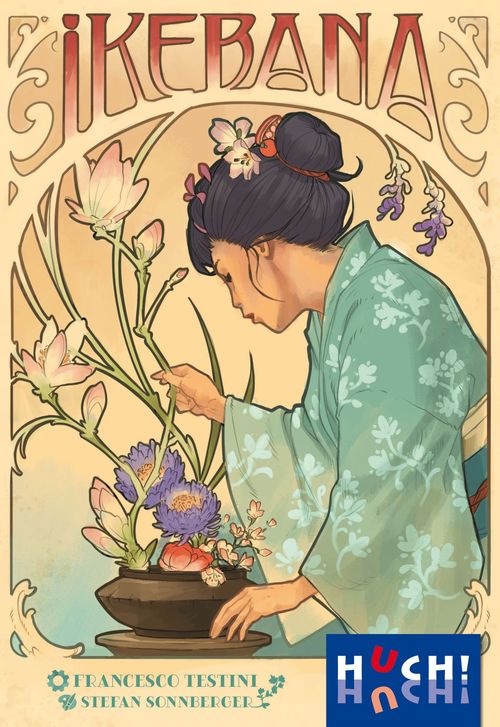
Ikebana
Ikebana Rulebook
Table of Contents
Table of Contents
Components
- 72 Flower cards in 6 colors
- 17 Utsuwa (vase) cards
- 14 Balance cards
- 20 Ikebana tokens
- 1 Last Round card
Set-up
- Shuffle the 72 Flower cards. Create the Flowers deck in the following way: count out 15 cards and place them face down on the table, in a stack. Place the Last Round card face down on top of the stack and finally place the remaining Flower cards on top of them;
- Draw the first 4 cards from the Flowers deck to create a line of face up cards, which will be called from now on "market", just next to the Flowers deck;
- Each player draws 4 cards from the Flowers deck, to hold secret in their hand;
- Players leave enough free space on the table in front of them (from now on "personal area") to play sets of cards during the game;
- Create a stack with the 17 Utsuwa cards and place it on one side of the table;
- Shuffle the 14 Balance cards and reveal 4 of them on the opposite side of the market. Place 2 Ikebana tokens on top of each Balance card, keeping visible the icons on the cards;
- Keep the remaining Balance cards and Ikebana tokens in easy reach of all players;
- The player sitting closer to the east is the first player.
Game turn
The game is played in clockwise order, starting with the first player. First, if there are 3 or more cards of the same color in the market, the current player may decide to change as many cards as they wish: discard the unwanted cards face up in a discard pile and reveal new cards from the Flowers deck so that there are again 4 cards in the market. Then the current player performs the following steps in order:
- Exchange 1 card with the market (optional);
- Play 1 or 2 cards in the personal area;
- Complete compositions (optional);
- Refill hand to 4 cards.
1. Exchange 1 card with the market (optional)
The current player may exchange 1 card from their hand with 1 card in the market.
2. Play 1 or 2 cards in the personal area
The aim of the game is to create sets (from now on compositions) of cards in one's own area, arranging the cards in a fan style and trying, if possible, to follow the indications given by the Balance cards. The cards must be played according to the following rules:
- The current player plays 1 or 2 cards from their hand to start or extend compositions. The cards can be played on the same composition or on different compositions;
- There is no limit to the number of compositions a player can start;
- A card must always be played at the beginning or at the end of a composition, it can never be played in the middle of other cards;
- In each of the compositions, numbers must be in ascending order. The numbers need not to be consecutive and repeated numbers are allowed.
Example: Michele would like to add 2 cards to his composition which currently only contains the purple 3 and the blue 6. He exchanges the yellow 7 in his hand with the purple 1 in the market (step 1). Then he plays from his hand the purple 1 to the left of the composition and the red 6 to the right (step 2).
3. Complete compositions (optional)
The current player may now complete any number of compositions they wish. By doing so they will get Harmony points at the end of the game based on the characteristics of the compositions. In order to complete a composition, there are 2 golden rules to follow:
- A composition must be made up by at least 4 cards;
- At least 1 card must have been added in the current turn.
Some Flower cards show a Leaf icon on top left, under the color icon. Take an Utsuwa card from the stack and place it below the composition, flipping it to the correct side according to the number of Leaf icons in the composition:
- From 0 to 2 Leaf icons: simple utsuwa side (+2 Harmony points)
- 3 or more Leaf icons: luxury utsuwa side (+5 Harmony points)
After adding the Utsuwa card, check if the composition has fulfilled 1 or more Balance cards. If so, take 1 Ikebana token from each fulfilled Balance card and place it on top of the Utsuwa card. They will score additional Harmony points at the end of the game. Finally, if a Balance card has no more Ikebana tokens remaining, discard it back in the box, reveal a new Balance card and place 2 new Ikebana tokens on top of it.
Reminder: a composition can only receive 1 Ikebana token from each Balance card. During the following turns it will not be possible to add cards or tokens to the completed compositions.
Example: In a subsequent turn Michele manages to add the red 7 and the pink 8 to the right of the composition (step 1). This composition complies with the 2 golden rules: it is made up of at least 4 cards and at least 1 card has been added during the current turn.
Michele then decides to complete it. He takes an Utsuwa card from the stack and places it below the composition (step 2). The card is flipped to its "simple utsuwa" side because there are only 2 Leaf icons in the composition. With only 1 Leaf icon more Michele would have flipped the Utsuwa card to the luxury side.
Finally, the Balance cards are checked. The composition satisfies the "2 different color pairs" Balance card, drawn during the set-up. An Ikebana token is then taken from the Balance card and placed on the utsuwa (step 3).
4. Refill hand to 4 cards
The current player draws cards from the Flowers deck to refill their hand back to 4 cards.
End of the game
When a player draws the Last Round card, they replace it with another one drawn from the deck. Players complete the current round so that each player has played the same number of turns. Finally, an additional special round is performed.
Special round
During the special round players follow the usual rules, with only two changes:
- Players can play any number of cards from their hand;
- At the end of their turn, players do not refill their hand.
Final scoring
Players obtain the following Harmony points:
- Each completed composition assigns a number of Harmony points equal to the value of the Utsuwa card (+2 or +5 points according to the utsuwa type), plus a number of Harmony points based on the Ikebana tokens placed on the composition: +3, +5 or +6 points if there are 1, 2 or 3+ Ikebana tokens respectively.
Uncompleted compositions do not score any points.
The player with the most Harmony points is the winner. In case of a tie, the victory goes to the player who completed the most valuable composition. In case of a further tie, the victory goes to the player with the most Ikebana tokens. If the tie persists, then the victory is shared.
Quote in the rulebook: "Ikebana is not just about sticking flowers into a vase: it is about the love and need of an artist to create beautiful forms. Ikebana is not just about the flowers, it is about the person who arranges them." (Sofu Teshigahara, founder of the Sogetsu School)
Scoring example
Michele obtains the following points:
- 5 Harmony points for the composition that fulfilled the "2 different color pairs" Balance card (1);
- 2 Harmony points for the composition that did not fulfill any Balance card (2);
- 10 Harmony points for the composition that fulfilled at the same time the "2 alternating colors" and the "All odd numbers" Balance cards (3).
Michele does not get any Harmony points for his uncompleted composition (4).
Michele scores a total of 17 Harmony points and wins the game against his sister Viola.
Balance cards
| ID | Card effect | Explanation |
|---|---|---|
| 1 | 2 alternate colors | This composition can also have an odd number of cards, provided it respects the alternation of colors. |
| 2 | Symmetrical colors | This composition is required to have the same color sequence when read one way or the other. |
| 3 | 4 or more of the same color | In this composition there must be at least 4 flowers of the same color, adjacent or not. Other flowers can be added. |
| 4 | 3 adjacent of the same color | This composition requires exactly 3 adjacent flowers of the same color. Other flowers can be added. |
| 5 | 2 different color pairs | This composition requires 2 different color pairs. Within a pair, the cards must be adjacent. Other flowers can be added. |
| 6 | Only blue and pink | All the cards must be of blue or pink color, other colors are not allowed. There must be at least 1 card per color. |
| 7 |
Turn summary
At the beginning of the turn, if there are 3 or more cards of the same color in the market, players can change as many cards as they wish. Then they perform the following steps:
- Exchange 1 card with the market (optional);
- Play 1 or 2 cards in the personal area;
- Complete compositions (optional);
- Refill hand to 4 cards.
When a player draws the Last Round card, they replace it with another one drawn from the Flowers deck. Players complete the current round so that each player has played the same number of turns. Finally, an additional special round is performed:
- Players can play any number of cards from their hand;
- At the end of their turn, players do not refill their hand.