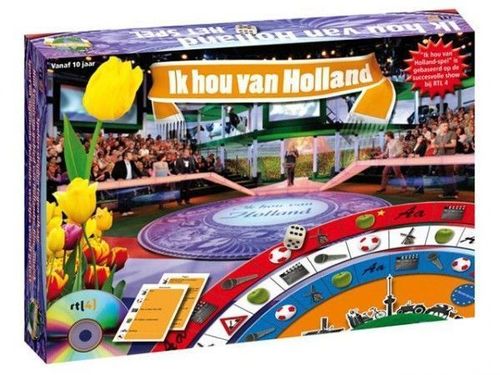
Ik Hou van Holland Spel
Ik Hou van Holland Spel Rulebook
Table of Contents
Table of Contents
Contents
- 165 task cards
- Bell
- Game board with the map of the Netherlands
- Final wheel on the back of the game board
- 90 old-Dutch guilder banknotes
- Free app with music tasks
Download the app for free from the app store under the name 'ihvh - muziekopdrachten'.
Goal of the Game
Earn the most guilders during the rounds by being cleverer and faster with your team than the other team!
Setup
Preparation
Make two teams with the same number of players: team ORANGE and team RED-WHITE-BLUE. Place the bell, the game board, a pen and paper (provide these yourselves, they are not in the box) on the table by the teams. Keep a (phone with a) stopwatch within reach.
The Quizmaster
If there is an odd number of players, one of the players can be the quizmaster and read out all the tasks. If there is no fixed quizmaster, team members can take turns in this role.
The Task Cards
Make 9 stacks of 18 cards by putting together the cards with the same symbol.
The symbols are on the back of the task cards: ball, umbrella, cheese, cow, plate, clog, post (paaltje), windmill and tulips. 3 birthday-game cards are left over.
Randomly choose 1 stack of 18 cards with the same symbol to play with now. The other 8 stacks are for another time and may go back in the box.
The stack consists of 18 cards:
- 14 task cards
- 4 final cards
Place the stack face down on the table, making sure the 4 final cards are at the bottom. Place the orange and red-white-blue cards alternately on the stack.
The flag on the back of each task card, orange or red-white-blue, shows which team reads out the task. Which team carries out the task depends on the small flag on the front of the card. In a few cases both teams play a task at the same time. If there is a fixed quizmaster, that person always reads out the tasks.
Card layout (printed diagram): the labels on the example task card are: Category (Categorie), Task (Opdracht), Answer (Antwoord, in orange), the guilders to be won (De te winnen guldens), the team that must carry out the task (Het team dat de opdracht moet uitvoeren) and the team that reads the task aloud (Het team dat de opdracht voorleest). The diagram also marks a small icon with the numbers 1 and 2 labelled "who goes first?" (wie mag eerst?).
The Prize Money
Lay the old-Dutch guilder banknotes out on the table, sorted into 7 piles next to each other. Each task card shows how much money the teams can earn.
The Music Tasks
Use the app on a smartphone to play the music tasks. Download the app for free from the app store under the name 'ihvh - muziekopdrachten'. The quizmaster operates the phone during the task.
Playing a Turn
The quizmaster (or one player from the team with the same colour as the back of the top card) takes the top task card and reads the task aloud. If you are playing this task for the first time, read the explanation in these rules that belongs to this task.
In the upper right corner of the card is the flag of the team that must carry out the task. At the bottom right you can see what you need. Then the quizmaster asks the question on the card and the named team carries out the task. The player who is quizmaster does not play this task.
If the team carries out the task correctly, it earns the number of guilders shown on the task card. The quizmaster places the task card on a discard pile after playing it.
Winning
The team that has earned the most guilders after playing the 14 task cards and the 4 final cards wins the game!
Tip
The game can be supplemented with the separately sold Verjaardagsspel (birthday game) of Ik hou van Holland or the Verjaardagsspel app. If you also have that game, you can put one or more task cards from the Verjaardagsspel into the stack you are going to use.
Now the game can begin!
Category Rules
Woordenboekspel (Dictionary Game)
The quizmaster reads the word in black from the card. The meaning in orange may not be read aloud. The quizmaster's teammates (with an independent quizmaster, this is the team with the colour on the back of the task card) and the quizmaster himself write down what they expect the other team thinks the word means, and give the slips to the quizmaster. All meanings (including the correct meaning from the task card) are now read aloud by the quizmaster. The other team guesses which meaning is correct.
Maskerspel (Disguise Game)
The quizmaster reads the question and the four names from top to bottom of the question card. The players of the team that must carry out the task put the four people in the correct order. They may discuss it.
Boodschappenspel (Message Game)
The quizmaster reads out the 24 messages once. Both teams must memorise the messages. The quizmaster chooses, in turn, a player from each team who names a message from the list. On a wrong answer or no answer, that player is out of the game. The team of the player who is last remaining wins.
Nieuwe rijtjes (New Lists)
The quizmaster asks the question and designates a team to state how many of these top 10 answers they can name. Now the other team may state whether it can go beyond the number just named, and if so, by how many. The bidding continues until one of the teams no longer thinks the other team can outdo it. Set the stopwatch to one minute. The team that made the highest bid may name the list immediately: one by one the players give an answer (or pass) until all promised answers have been named or time is up.
Muziekopdrachten (Music Tasks)
This category is played with the free app. Start the app and enter the number shown on the task card. The quizmaster reads aloud the question on the task card. When the bell is pressed, the quizmaster immediately pauses the music. The team that presses the bell first may give the answer. The quizmaster then checks the card to see whether the answer is correct. If the answer is wrong, the quizmaster starts the music again and both teams may guess again.
The music task types are:
- Guess the record (Raad de plaat)
- 2 songs mixed together (2 liedjes door elkaar)
- Distorted song (Vervormd lied)
- Recognise the melody (Herken de melodie)
- Sing the next line (Zing de volgende zin)
De finale: Hoger, lager (The Final: Higher, Lower)
Team 1 deliberates and comes up with an estimate. After naming this estimate, team 2 deliberates on whether the answer will be more or less.
The team that gave the correct answer may spin the wheel. If you spin a red segment, you lose money. If you spin a white or blue segment, you earn money. If you spin the orange segment, your money is halved.
Have fun playing!
Extra Information During Play
Hollandse basiskennis (Dutch Basic Knowledge)
The quizmaster chooses a player from the team to answer the question and reads out an easy or a difficult question. This player gives the answer. The quizmaster does this until all four questions of the question card have been played. Of course, children get an easy question.
Spreekwoord uitbeelden (Act Out the Proverb)
The quizmaster silently reads the proverb and its meaning. He sets the stopwatch to 2 minutes and begins acting out the proverb and/or its meaning. The team that presses the bell within 2 minutes and guesses the proverb wins.
Het nieuwe kaaswerpen (The New Cheese Throwing)
The quizmaster writes the first place name, including the dashes, exactly on paper. Note: only write the word in black. Both teams may guess which place name is meant by pressing the bell. If the place name is wrong, both teams may try again until the place name is guessed. If the place name is correct, that team may point to where the place is in the Netherlands by naming the correct number on the map of the Netherlands (on the game board). If the location is not correct, the other team may try once more to point to the correct location. Repeat this for the second and third place names on the question card.
Woorden en namen raden (Guessing Words and Names)
The quizmaster chooses a player from the team that must carry out the task, who silently reads a word or name on the card. The quizmaster sets the timer to 1 minute. The player then describes the word, name or concept to their teammates, without saying any part of this word, name or concept. They may not gesture. The other teammates try to guess as many words and/or names as possible within 1 minute.