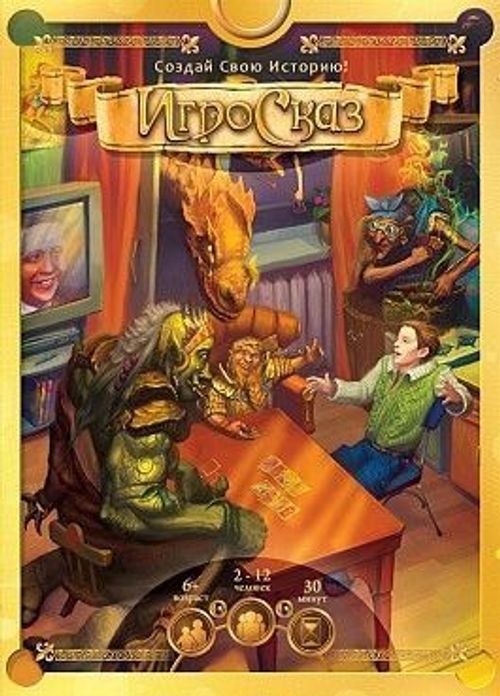
Игросказ
Игросказ Rulebook
Table of Contents
Table of Contents
Essence of the Game
Players tell an engrossing story together: a fairy tale, a modern story or a science-fiction story, whatever they like. This is not a competition but a joint creative effort: each player decides where the plot turns, and what happens around the corner!
The goal of the game is to create a bright and beautiful story and to get maximum enjoyment by following its heroes from beginning to end. The game does have a winner, though: the best storyteller is the one who collects the most applause (see below).
The story is built from cards that show the most important elements: characters, places, events and so on. Each storyteller weaves cards into the tale, contributing to the development of the plot, and tries to steer the game toward the ending that they hold in their hand.
You can tell not only fairy tales and legends, but also detective stories, space fiction or love stories. Simply interpret the cards with fairy-tale characters through the logic of the chosen genre: for example, the card "Weapon" stands for a pistol or a blaster rather than a sword or a spear, and so on.
Setup
Each player is dealt several story cards and one ending card. The fewer players there are, the more story cards each of them receives:
| Number of players | 2 | 3 | 4 | 5 | 6+ |
|---|---|---|---|---|---|
| Story cards for each player | 9 | 8 | 7 | 6 | 5 |
| Ending card for each player | Always one card |
Players do not show their cards to anyone (especially their ending card).
Someone starts the story. It can be the youngest or the oldest player, the one whose first name starts closest to the beginning of the alphabet, the one who rolls highest on the dice, or the one with the longest hair; choose however you like. Starting first means setting the tone of the future story, and a lot depends on it.
Game Flow
The first storyteller begins the story. When they mark the key elements of the plot, they lay story cards on the table. For example, saying "Once upon a time there lived a brother and a sister", they may lay the card "Brother/Sister". Continuing the tale with the phrase "And they were born with a magical gift", they lay the card "Magical Abilities".
A storyteller may lay one card per phrase of the plot. They may not lay cards all at once; they must tell the story gradually. For example, they may say "One country was ruled by a foolish king who adored singing penguins", but they may not lay two cards at this point, "King" and "Bird"; they may choose only one of them.
A player tries to tell the story in their own way, so as to lay out all the cards they hold and then bring the tale to its ending.
But when the storyteller mentions something shown on a card held by another player, that player has the right to interrupt the story by laying this card down, and become the storyteller themselves. For example, if the first player says "This gift allowed them to talk to any animal", a player who holds the card "Beast" or "Magical Gift" may lay it and continue the story in their own way.
Card Types
Story cards come in five kinds:
- Characters – heroes or creatures, the actors of the story. A king, a firebird, a wanderer, a knight, and so on.
- Objects – important objects that appear in the plot. Poison, a tree, a spell and so on. An object is not necessarily a material thing: fire or a passage can be objects.
- Places – places that are mentioned in the story. A palace, a forest, a swamp, a cave and so on.
- Events – major events: a quarrel, a battle, love, a loss and so on.
- States – a way to describe any object of the story: to characterise a thing, a character, a place or an event. Happy, dangerous, mysterious and so on.
There is also a special type of card: the interrupt card. It allows you to interrupt the storyteller and continue the story yourself. Each interrupt card is also a story card: it is printed with words such as "Island" or "Casket", so you can always use it as a story card if you wish. How an interrupt is played is described below.
Finally, there are ending cards. These are simple: at the start of the game each player receives one such card and tries to bring the tale to their version of the ending. There are happy and unhappy endings, so players often want completely opposite conclusions to the story, which makes the struggle sharper.
The rulebook illustrates two ending cards: "And They Lived Happily Ever After" and "The Prince and the Princess Remained Toads Forever".
The rulebook's illustrations also show the story card "Nobleman" (a king, prince, duke and so on) and the story card "Gift".
Plot
The storyteller lays cards as they tell the story. But how fitting and how beautiful is the way they do it? Do the events in their tale have nothing to do with each other, just so the author can lay out their cards faster? Or does the story hang together logically and engagingly, with every card having its place?
For example, a player holds the cards "Fairy", "Spell", "Flower", "Knight" and, say, "Blindness", and the ending of the story is: "They joined hands and went into their house to live there a long, happy life." The player tries to tell this story:
"Once there was a fairy; she sat down on a flower, but its pollen blinded her, so she uttered a spell of healing, was cured, and a passing knight fell in love with her, so they joined hands and went into their house to live there a long, happy life, and that's it, I won!!"
Frankly, this is not the best story. It has nothing interesting or unusual in it; it is illogical and silly. The other players protest, and by vote they strip the storyteller of the right to vote and return all the cards they laid out back into their hand. Holding the same cards, one could have told, for example, this story:
"An old and childless king finally had a son. The king rejoiced, for the son could continue the dynasty and conquer even more kingdoms! But a frightened baron, whose lands were not far away, decided to prevent this and begged the fairies of the enchanted forest to bewitch the infant. The fairies sent blindness upon the boy, in the hope that he would not grow up to be a warrior. But one fairy took pity on the boy and left his mother a black flower, saying: 'The time will come when this flower will help your son...'
The enraged king exiled the blind boy and his mother to the swamps... where an old knight lived, who took pity on the boy and said to his mother: 'I will teach your son to live and fight in complete darkness. But when he grows up, he will overthrow the king.'
So began the upbringing of the Blind Knight."
The same 3-4 cards can be arranged into dozens of different plots. What matters is that the tale is logical, interesting and consistent.
How many cards are returned to a player's hand in each particular case is decided by a vote. But, of course, only the cards that the player has just laid out may be returned, and only those that, in the opinion of the others, do not fit the development of the story.
Building the Plot
Cards must fit into the story organically. They may be laid no more often than one card per phrase, and no less often than one card per three phrases. That is, if a player goes too long without using cards and tells the tale without them, they may be interrupted: they take one penalty card, and the turn passes to the next player.
Cards in the singular may, if desired, be used in the plural (not a wolf but a pack of wolves; not a robber but a gang, and so on).
The storyteller is not limited to their cards and may tell the story about anything. For example, holding a "fairy" and a "flower", they may well introduce a werewolf, a magical sword or a queen. What matters is that it makes sense, fits the part of the story already told, and does not contradict the cards already laid out. For example, a storyteller may not say "And then the knight saw a dragon" if it has already been said that the knight is blind and cannot see.
Players may reject any illogical turn of the plot simply by voting against it. If most players are against it, the storyteller must take back the card they laid out and draw one more card from the deck, and the turn passes to the next player.
The rulebook presents the following rules as small diagrams:
One phrase: no more than one card. Lay no more than one card per phrase.
Three phrases: no fewer than one card. Lay at least one card every three phrases.
One phrase: storyteller's card and interrupting player's card. The storyteller's card and the interrupting player's card are each laid for one phrase.
How many cards to draw. The storyteller draws one card when the turn passes on. A player draws two cards after an unsuccessful attempt to interrupt the storyteller.
Turn Transfer
The turn is passed around the circle, clockwise, or it is seized:
- The turn is seized when a player lays a card with something the storyteller mentioned in the story, or when a player uses an interrupt card.
- The turn is passed around the circle when players dispute the plot twist, when the storyteller pauses for more than 5-10 seconds, or when the storyteller says nonsense and damages the story.
Interruption
There are two ways to take over the story.
Passing the turn around the circle. This can be done if the storyteller mentions in their story something that you hold in your hand. For example, the storyteller says: "In the morning the king was brought the news that his wife had given birth to twins", and you hold the card "Child". You may say "Interrupt!" and lay the card on the table. The storyteller then draws one card from the deck, and the turn passes to you.
As you have understood, the words do not need to match exactly. For example, the storyteller may say "And a son was born to him" or "a wonderful baby": in both cases you may interrupt with the card "Child".
But you may not lay this card in response to the phrase "The king had a daughter", because the daughter may already be grown up. Until the storyteller has said how old the daughter is, an attempt to lay the card "Child" may turn out to be incorrect.
If an attempt to interrupt is judged unsuccessful by the other players, you take your card back and draw two additional cards from the deck, and the turn stays with the storyteller.
If the interruption succeeds, the right to tell the story passes to you, and the interrupted player draws one card from the deck.
Seizing the turn. If you have a special interrupt card, you may try to interrupt the storyteller at the moment they lay some card. But the interrupt must be of the same type as the card laid: if the storyteller lays a character, you may interrupt it only with a character-type interrupt, and not with an "object", "event" and so on.
If this happens, you say "Interrupt!" and lay your interrupt card. Then the most interesting part: you offer your own version of the event that is currently being discussed. All the players vote on whose version to accept: the storyteller's or yours.
For example, the storyteller says: "And then the brother saw that a monster lay in the crypt" and lays the card "Monster". You interrupt it with the card "Interrupt – Character" and say: "No, he saw that his sister, who had vanished many years ago, lay in the crypt, and still languishes there under a curse." The other players decide by vote which version is more interesting.
If the votes are tied, or the storyteller has more votes, you put your interrupt card at the bottom of the deck and draw two penalty cards, and the turn stays with the storyteller. If you win, the turn passes to you (and the former storyteller draws the card).
The rulebook's diagram of this process shows the interrupting player, the storyteller, the cards laid out on the table, the card deck, and the turn passing clockwise around the circle. The interrupt is shown as a line from the storyteller to the interrupting player.
Applause
Each card laid symbolises a particular turn of the plot. If the players like it, each of them may reward the storyteller with an applause chip, taken from the common pile of chips. The reward may be 1 or 2 applause: 1 is praise for an interesting and good story, and 2 is admiration for the best ideas and solutions. Each time, you decide for yourself whether to give the storyteller 1 applause, 2 applause, or none, and the opinions of other players should not pressure you.
Finally, the storyteller who brings the tale to its ending receives 5 applause. If two or more players have an equal number of applause, the one among them who laid the ending card wins.
At the end of the game everyone looks at how much applause each player has, and the winner receives the ceremonial title of "Best Storyteller".
Every story you tell will be unique. The best of them can be photographed or recorded. Who knows, perhaps together you will invent a tale that enters the ranks of golden classics? Or you may come up with a popular comic book.
Example of Play
Ivan, Danila, Lena and Petya decided to play Igroskaz.
Petya: I am the fattest, so I start first!
The others laugh, but agree.
Petya: In a very distant kingdom [lays the card "Kingdom"] there lived an old woman who had no one close to her. But one day a blacksmith [lays the card "Master"] came to her and said: "Let me make you an iron son, who will help you with everything! Because you are already quite old..."
Lena: Interrupt! [lays the card "Old Person"] The woman rejoiced, but said: "Let my son be iron, but he must have a kind heart..." And a month later the blacksmith brought her a boy [lays the card "Child"], who was made entirely of iron... Only in his chest there was a cage, in which a little tit lived!
Danila: Stop, I interrupt [lays the card "Bird"]. While the tit sat in the cage, the iron boy was kind and obedient. He helped the old woman with the housework and worked as a porter at the market. But as soon as the cage was left empty, the boy became cruel and wicked...
Lena: Lovely! I give you 1 applause.
Ivan: Aha, my turn [lays the card "Evil"]. Once, the iron boy brought boxes of goods to the shop and was about to leave, but he heard the shopkeeper's daughters whispering behind a curtain: "Tomorrow the minstrel Lyutik will come to town..." [lays the card "Minstrel"]. In short, the girls wanted...
Petya: Dull, I have a different version [lays the card "Interrupt – Character"]: one night, an utterly black cat crept into the house. He served a witch, who wanted to seize the iron boy, because without the bird in his chest he was a wonderful servant! The cat opened the cage and ate the tit... What do you think of this twist?
Lena and Danila decide which version to vote for, and both support Petya's version. Lena even gives him 1 applause. Petya continues his story.
Do you want to know what happened next to the iron boy, who had a tit in a cage instead of a heart? Invent it yourselves!