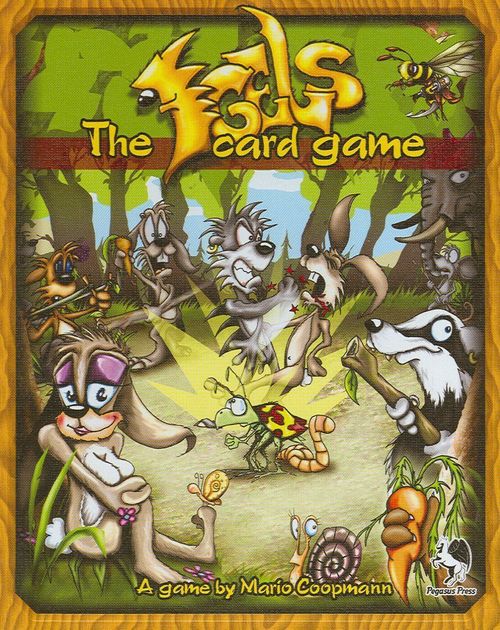
Igels: Das Kartenspiel
Igels: Das Kartenspiel Rulebook
Table of Contents
Table of Contents
Components
- Number of players: 3-4
- Age: 10 years +
- Playing time: ca. 60 minutes
- Contents: 168 game cards (32 Animal Character Cards, 32 Food Cards, 104 Support Cards), 1 game marker, these rules
In the case of rules questions or other problems, the owner of the game always has the final word! Have fun!
Goal of the Game
Once a player has captured the last of the 32 Food Cards, the game is over. After counting the spoils whoever has gathered the most Food Points wins the game.
Basic Terms
- Support Cards = Battle and Event Cards
- Forest = those Food Cards placed face down on the table
- General Draw Pile = those Battle and Event Cards not yet in play
- Species Draw Pile = those Animal Character Cards not yet in play
- Garbage Dump = all discarded cards are placed here
- Pool = all Animal Character Cards already in play are placed here
- SAP = Small Animal Power
- Total SAP = the total sum of the SAP of all animals participating in a battle, plus the values of Battle Cards played
- Opponent = players participating in a specific battle
Preparation
All 32 Food Cards are shuffled and placed face down in the center of the gaming table. This pile of cards represents the Forest. For a shorter game, reduce the number of Food Cards before beginning to play.
Next, all Support Cards are thoroughly shuffled and placed face down next to the Forest to serve as a general Draw Pile. Each player then decides which Species he wants to lead to victory. If the players cannot agree, the Species are distributed by lot. All four Species Draw Piles are then shuffled and placed next to the general Draw Pile.
The owner of the game becomes the first starting player. He deals five Support Cards face down to each player to form their starting hands. Each player also takes the top card of his Species of choice from the respective Species Draw Pile and places it face up in front of him into his Pool.
Now It's Time to Start …
One game turn of Igels consists of four phases. Each player, starting with the starting player and then passing clockwise, participates in each phase, or each action, before the next phase or action starts.
The Phases of a Game Turn:
- Build-Up
- Battle
- Grabbing the Swag
- Organization
1st Phase: Build-Up
Each Build-Up phase (but see the above remarks concerning the very first one) begins with the role of starting player being passed to the next player in a clockwise direction. The starting player initiates all phases.
At the beginning of each game turn, each player may draw two new cards of his choice. For instance, he may draw a character of his chosen Species from the Species Draw Pile and one card from the general Draw Pile. However, he may also choose two cards from the general Draw Pile, or two characters from the Species Draw Pile, ignoring the second pile.
Cards from the Species Draw Pile are always placed face up into the player's Pool. Support Cards from the general Draw Pile are always added to the player's hand without showing them to the other players.
Summary box:
- Change of starting player
- Each player draws a total of two cards from the Draw Piles in any combination
2nd Phase: Battle
After the Build-Up phase has taken care of fresh supplies, the battle for the ever.important food begins! The animals now all meet on the huge Forest Clearing to find out who of them has the strongest claim. To emerge victorious, a player needs to muster the highest Small Animal Power (SAP) of all the combatants. SAP is calculated by adding all Animal Character Cards (plus their special abilities) and all Combat Cards in play. However, there are many incidents that may influence a battle via Event Cards, as will learn a soon…
Taking part in a battle is optional; a player may decide to sit out a battle, to conserve valuable power.
Taking Part in a Battle
Once a player decides to join a battle, he nominates one Animal Character to act as a leader for this game turn in the thick of things. The player pulls this Animal Character from his Pool and places it face up next to the edge of the Forest. The starting player goes first and then the other players, in any order they like, place their leaders.
Each player's main combatant may be supported by other Characters from the same species (hangers-on), provided they are already active and waiting in the Pool. If a player decides to commit more fighters to the fray, he pulls them from this Pool and places them next to the leader. The SAP of the hangers-on is added to the leader's SAP.
Important: Only the leader's special ability (as per the text on the card) may be applied to a given battle; all other combatants only add their SAP, but never any special abilities. The only exceptions are Finee, Ronn, and Trunkee. The special abilities of Ronn and Trunkee are always considered active once they have joined a battle. Finee's special ability may be used at any time as long as the Character is in play.
Again, the starting player begins, with the other players placing their hangers-on in any order they like. Once the players have finished committing hangers-on to the battle, they may call for support. From this point on, no more hangers-on may be committed to this particular battle. The combined SAP of the leader and the hangers-on adds up to form the Initial SAP.
Summary box:
- Determine combatants
- Starting player begins, and then clockwise …
- Place 1 card face up to form the Pool close to the edge of the Forest (leader) or decide to sit this battle out.
- Pull other Animal Characters face up from Pool (hangers-on).
- Number of Animal Characters taking part in battle is unlimited.
- Pass once you do not want to commit any more Animal to the battle.
- Once everybody has passed …
- Call for support
- Starting player begins, and then clockwise …
- Place Support Cards face down next to the combatants.
- Number of cards up to the players.
- Pass once you no longer want to play any Support Cards.
- Reveal Support Cards
- Resolve special abilities – in order of Initial SAP
- Resolve events – in order of Initial SAP
- Determine Total SAP – Total SAP = SAP of Animal Characters + SAP of Battle Cards +/- special ability
- Resolve events – in order of Initial SAP
- Highest Total SAP wins battle, unless special ability or Event Card says otherwise
- Call for support
Support
Once a player has assembled his troops, he may place Battle Cards and/or Event Cards next to his Animal Characters, face down. It is up to the player how many cards he wants to play. The players take turns in playing Support Cards, until all of them have passed once.
Now the time has come to turn these cards over. The SAP provided by the Battle cards placed next to the Animal Characters is added to the Initial SAP, resulting in each player's Total SAP for this battle turn. Once all cards have been revealed, the ensuing total may only be modified by a leader's special ability (for instance, the NinjaSquirrel may raise its SAP to 9 once per game), or by an Event Card that is either already in play, or that is being played now. As regards timing, special abilities go first and Event Cards second, both in order from highest Initial SAP to lowest. The player with the highest Total SAP wins the battle, unless a special ability or an Event Card says differently.
Voluntarily Sitting the Battle Out
If you think it tactically sound, or if you do not have much faith in your current hand, you may decide to sit this turn's battle out and conserve your Animals' power. Thus, you let your opponents have the field and watch the battle for the "Forest Buffet" from the sidelines.
Important: Whenever game text on a card mentions "opponents," this always refers only to player participating in the battle, but never to players sitting this battle out!
3rd Phase: Grabbing the Swag
Only the player who wins a game turn by having the highest Total SAP may grab the swag, unless an Event Card says otherwise. He takes two Food Cards from the Forest and places them face up next to his Pool. Some Animal Characters may draw more than two Food Cards after a victorious battle, as per the game text on the respective card. In addition, Event Cards may increase or decrease the spoils. Event Cards may even now be played by any player.
If the remaining number of Food Cards is not sufficient, the victorious player takes those cards that are left and the game ends immediately.
Special Case: The Draw
If a battle ends in a draw, each player involved may take one Food Card from the Forest. If, toward the end of the game, there are not enough Food Cards in the Forest to reward all players involved in the draw, no player gets a Food Card.
Summary box:
- Winner of battle takes two Food Cards from the Forest.
- Number may be modified by special abilities and/or Event Cards.
- Captured Food Cards are placed face up next to the Pool.
- Special case: draw
4th Phase: Organization
The game ends immediately when there are no more Food Cards in the Forest. The game is then concluded by the Final Tally (see below).
Battle and Event Cards that were played go straight to the Garbage Dump after a battle. Characters – at least those that weren't run over on the Forest Road or died from a stroke – usually go back to the Pool and sleep for one game turn (i.e., they are turned face down and have to miss one turn). Each player then wakes up (activates) those animals that went to sleep last turn.
Once all Food Cards have been gathered, the Final Tally starts immediately. Otherwise, each player performs the following actions:
- Reveal face down cards in the Pool
- Put Support Cards played on the Garbage Dump
- Place Animal Characters played in Phase 2 face down into the Pool
- Optional: place 2 cards from hand onto the Garbage Dump and draw 1 card from the general Draw Pile
Of course, there are some cards that may simply not be used by certain species (for instance, The Hedgehog Lair is of no use to anyone but hedgehogs). There are also cards that players may deem to be useless at a particular point in the game. At the end of a turn, you may trade two such useless cards for one card from the general Draw Pile. The two useless cards move to the Garbage Dump. You may do this only once per round.
Continue with phase 1.
End of the Game – The Final Tally
The game ends as soon as all Food Cards have been gathered from the Forest. Once the last Food Card has been drawn, no more Event Cards may be played. Now the players total their accumulated Food Points, subtract any penalties incurred from Event Cards, and add any bonus points provided by food especially suitable for his animals. The player who comes up with the highest Food Point total wins the game.
Summary box (The Final Tally):
- Once the last Food Card has been drawn
- Add all Food Points as seen on your accumulated Food Cards.
- Add bonus points gained for species-specific food.
- Subtract penalties incurred from Event Cards.
- Highest total wins
Types of Cards
As mentioned earlier, each player has the Characters of his chosen species at his disposal in his Species Draw Pile. Cards drawn from this pile go into the player's Pool. Once there, they are either ready for battle, or they sleep.
Igels uses these types of cards:
Battle Cards (66)
Battle Cards are marked by red borders. These cards allow players to increase the SAP values of their Animal Characters in play (the value printed onto the sign in the upper right corner of a card). The value of the Battle Card is added to the combined value of the Animal Characters' SAP, resulting in the Total SAP. Some Battle Cards have special functions, These are explained in detail on the cards' game texts.
Bound Battle Cards
Some Battle Cards become "bound" to an Animal Character. This means that the Battle Card is not put onto the Garbage Dump after the battle, but is instead placed beneath the Animal Character to stay there and permanently increase its SAP. The Character does not need to be designated as a leader for this increase to work. The game texts on the respective cards indicate which Battle Card may be bound to which Animal Character. For instance, the Junkie Needle permanently increase the Junkie Hegdehog's SAP by 1 once bound to it.
Event Cards (38)
A tan card border, coupled with an exclamation mark printed onto the sign in the upper left corner of the card, indicate an Event Card. Event Cards may be played at any time, at least as long as playing them makes some kind of sense. The game text on each Event Card describes the effect(s) this card has on another card, an in-game situation, or an Animal Character. If an opponent interfere with your strategy by playing an Event Card on you, your only defense is a corresponding counter card.
Event Cards may be played by players not participating in a battle. However, playing them still needs to make sense: If you do not participate in the battle at all, you may not win it by simply playing an Event Card! However, you may turn the battle into a draw for all players involved by playing an Event Card. Of course, the other players may also play Event Cards against players not involved in a battle.
Take this example: Tommy plays a Thieving Magpie, hoping to steal Andy's Picnic Remains. Andy, however, plays the Duckweed for defense, thwarting the attempted theft. Tommy fails to steal the food, and Andy gets to keep the Picnic Remains.
Food Cards (32)
Food Cards are marked by green card borders. They are the end-all and be-all of this game. Together, they form the Forest, placed in the center of the playing table. Food Cards vary in the amount of Food Points they grant (cf. the number printed onto the sign in the upper left corner of each Food Card). You will find these Food Cards in the game:
- 5 x Nuts
- 5 x Worm
- 5 x Turnips
- 5 x Berries
- 2 x Picnic Remains
- 4 x Fresh Grass
- 4 x Lush Leaf
- 2 x Bug
Food Cards are placed face up next to the acquiring player's Pool. However, they are not yet secured. You need the help of certain Event Cards (such as The Squirrel's Nest or The Hedgehog Lair) to secure up to three Food Cards. If Finee is in play, her player may even secure up to five Food Cards. Securing your food is important, for other Event Cards, such as Thieving Magpie or Stash Found!, allow your opponents to steal your food from right under your nose!
Some Food Cards provide a bonus to a specific species (such as Nuts for squirrels), but not to the others. Such bonus points are indicated in the card texts.
Animal Character Cards (32)
Igels uses four Species of animals: hedgehogs, rabbits, squirrels, and mice. Species are indicated by tan card borders. In addition, each Species has their own distinctive card back with a coat-of-arms of their own. Each animal's SAP is printed onto the sign in the upper left corner of the card; the higher this number, the better the Animal Character will be able to whomp others. Next to all Animal Characters have either a special ability or some other peculiarity, which is indicated in the game text printed on the card and may be used according to situation. As always with Igels, bear this rule in mind: if the game text on the card contradicts the text of these rules, the text on the card takes preference!
Animal Characters Ready for Battle
Battle-ready Animal Characters wait face up in a player's Pool and may be sent into battle as either leaders or hangers-on at any time.
Sleeping Animal Characters
Whenever an animal has fought for one turn, it needs to rest afterwards. The card is turned over to sleep for one turn, face down. It may not be sent into battle before it has rested for an entire turn.
And then there are Animal Characters that were killed, either through use of their own special ability or by means of an Event Card:
Dead Animal Characters
Dead Animal Characters are placed onto the Garbage Dump, where they rot for the rest of the game. Exception: The Event Card Fairy Godmother may be used to bring a dead Animal Character back to life.
Special Animal Characters
Vegetarians
An Animal Character that is marked as a Vegetarian in its game text may not gather any Worms or Bugs from the Forest after being victorious as a leader in battle. The controlling player needs to put all Worms and Bugs drawn back into the Forest, without being allowed to draw replacement cards.
Animal Characters with One-Shot Special Abilities
Some Animal Characters have special abilities that may be used only once per game. If such an Animal Character enters the fray as a leader, it is up to the controlling player to decide whether or not the animal's special ability is used. He does not need to decide prior to the battle, but may do so even after the Total SAP of all opponents involved in that particular battle has been determined. However, even then one of the other players may react by playing an Event Card…
After a one-shot special ability has been used, we recommend that you somehow mark the respective Animal Character. Affixing a paper clip to the card works best. Then again, you may also use nuts, glass beads, dice, or whatever else you like.