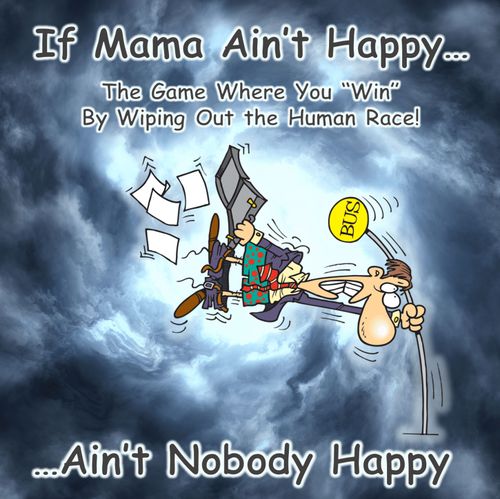
If Mama Ain't Happy...
Official rulebook: Litigious Games · PDF
If Mama Ain't Happy... Rulebook
Table of Contents
Table of Contents
The Basic Idea
Each player starts with a population of 100 troublesome humans. The first player to reduce their population of the vexing creatures to zero by playing Disaster cards against themselves wins.
But wait, your opponents can counter the effects of your Disasters by playing Reaction cards of their own. If your human population gets out of control and exceeds 200, you're out of the game.
Setup
Assemble the game board. At a minimum, each player will need access to an overpopulation counter and a counter that corresponds to the color of their game piece which they should place on Start Here on the matching counter.
Shuffle the deck several times before dealing 5 cards to each player. Place the remaining deck face down, you'll draw from it throughout the game.
On Your Turn
You may make up to two "plays" during your turn. Each "play" consists of one or more cards (more on this later) which you either play against your own human populace or your opponent's.
You may decide to make one or two "plays" or choose to discard one card and draw a replacement in place of each "play". You may also decide to do nothing on your turn, but this would prevent you from drawing any new cards. At the end of your turn, draw your hand back up to 5 cards. If, for some reason, you end up with 5 or more cards at the end of your turn, you don't get to draw. Tough luck.
Card Types
Disasters
Disasters are Mother Nature's weapon of choice. Play Disasters in front of you to reduce your population of pesky bipeds. Make sure to keep your Disasters separate (see Card Management) since your opponents can Discard, Weaken or even Steal them (see Reactions for more info on this).
Some Disasters have Special Instructions that allow you to magnify their strength when combined with other Disasters already in front of you. Others allow you to discard Reactions played against you. Foiling your opponent's well laid plans is always good fun! Do it as often as possible.
Reactions
Play Reactions by placing them in front of an opponent of your choice. These cards help their humans counteract Mother Nature's attempts to wipe them out.
Reactions marked with the Discard symbol (a card with a minus sign) allow you to Discard one of your opponent's Disasters. Some Reactions specify which Disasters(s) can be Discarded while others allow you to Discard any Disaster of a certain type.
Like Disasters, some Reactions have Special Instructions that allow you to Trade or Steal a Disaster from your opponents while others have prolonged effects that prevent your opponents from playing certain types of Disasters. Still others magnify their strength when combined with other cards already in front of your opponents. Playing these cards is both cruel and entertaining. Don't miss your chance to do so!
Compound Disasters/Reactions
Disasters and Reactions marked with the Compound symbol (a card with a plus sign) in the lower left corner allow you to play specific Disasters or Reactions from your hand in conjunction with the original card. You don't have to have the additional cards in order to play the original card. Playing a compound Disaster or Reaction by combining cards is entirely optional.
THIS IS IMPORTANT, SO PAY ATTENTION! Cards combined in this manner count as a single "play". Cards played in this manner are also "sticky" and stay together for the remainder of the game and are treated as a single item from that point forward – even if discarded for some reason. You can't create compound Disasters/Reactions with cards that have already been played. Why? BECAUSE I SAID SO! Besides, there's no benefit to that brand of idiocy. SO DON'T DO IT!
Modifiers
Modifiers Strengthen or Weaken the effects of a Disaster. Positive Modifiers weaken the effects of a Disaster while negative Modifiers strengthen their effects. Don't bother with grammar when using Modifiers. It is perfectly acceptable to have a Category 5 Hurricane or Ginormous Puddles! or Category 5 Puddles! for that matter.
Modifiers may be played in conjunction with cards from your hand. In which case, any cards combined in this manner count as a single "play". Modifiers may also be played to modify Disasters already in front of you or your opponents. In this situation, each Modifier you play will count as a single "play". Each time a Modifier is played, the affected player must update their score by moving their game piece accordingly.
Modifiers are "sticky". When a Modifier is played on a Disaster, it becomes attached to it. So, if you lose the Disaster card, the Modifier goes with it, including any other Modifiers that may already be "stuck" to it. This stickiness persists throughout the game, even if the whole mess ends up in the discard pile. There are, however, a few cards that can override this stickiness and allow you to Discard or Steal Modifiers.
There's no limit to the number of Modifiers that may be played on a particular Disaster. It's perfectly acceptable to have Torrential, Gale-Force Gravity or a Miniature, Itsy-Bitsy, Teens-Weensy Hurricane or Itsy-Bitsy, Gale-Force Gravity for that matter. BUT BEWARE! Your opponents can Steal your Modifiers and/or the Disasters they're associated with, so you may want to spread them around.
Specials
Many Specials can be played at any time – ANY TIME! Do you hear me! These cards often do not count as a "play" during your turn and can be played during another opponent's turn. Replace any Special immediately after playing it by drawing a card from the top of the draw deck. Some Specials allow you to negate the effects of the last play or reverse its effects. Others allow you to draw additional cards, take an additional "play" or prevent an opponent from making a "play".
There aren't many of these, but they can be game changers. So, if you get one, use it wisely.
Icons
The card-type icons used in the rules are:
- Weather Disaster (a cloud with rain)
- Natural Disaster (a meteor or rock shower)
- Reaction (a trash can)
- Modifier (a blue plus-and-minus sign)
- Special (a curved return arrow)
READ THE #^$@#! CARD:
These rules describe the basics of If Mama Ain't Happy… If there is a dispute between a card or cards and these rules, the cards win.
Scoring
Your score will be constantly changing throughout the game. Typically, this will be straight forward as you deduct the effects of Disasters you've played from your score or add the effects of Reactions played on you by your opponents. But there are a few situations that require a bit more explanation.
There are a number of Reactions which allow an opponent to Steal, Trade or Discard Disasters you have already played. For example, if your opponent plays a Check the Forecast Reaction against you, they can discard one of your Weather Disasters. Let's say you just played Thunderstorm for -10 which your opponent, happily discards. As a result, your score will increase by +30 (+20 for the Check the Forecast Reaction and +10 (minus -10) for the loss of the Thunderstorm Disaster).
You can split the effects of this type of play to make scoring easier. In the example above, you would move your game piece +20 for the effect of the Check the Forecast Reaction. Then another +10 for the loss of the Thunderstorm Disaster that was so rudely discarded by your sadistic opponent.
Card Management
That's right! You read that correctly. You have to manage your cards. Otherwise, the game will degenerate into anarchy. Anarchy! I tell you! Place Disasters you play against yourself and Reactions played against you in front of you. Remember to keep your individual "plays" separate so the Disasters can be Discarded, Traded or Stolen without a big argument breaking out each time this happens.
Only a few Reactions require this kind of treatment. Most can be simply piled up in front of you. However, there are a few cards with persistent effects. These must be placed in a prominent place in front of you so that all other players can see them. Reactions that magnify their effect when combined with other Reactions should also be set aside from the general Reaction pile.
Strategy
By now, you've probably realized that the Disasters you play in front of you may not stay there for long. So, put some thought into when and how you play your Disasters.
At first, you may be tempted to hold on to your more severe Disasters until you're within striking distance of winning the game. This is certainly a strategy, but if you wait too long to make your move, you'll spend the whole game waiting for an opportunity that may never come.
Also, keep in mind that your opponents will gleefully discard or even steal your big, game winning move if they happen to have the right cards when you finally decide to deliver your coup de grace. Better not to put all your eggs in one basket, if you want my advice (which you must because you're still reading this).
Winning
The first player to annihilate their human population wins! Well sort of… Even after you've played the winning card, your opponents can strike back and Cancel or Steal your final play.
If you're able to do this to a fellow player – I highly recommend it! Its entertainment value cannot be overstated.
If, by chance, you happen to run out of cards before a player has reduced their human population to zero, play continues until each player (including the one that drew the last card from the draw pile) completes one last turn with whatever they have left in their hand. At this point, the player with the lowest human population wins.