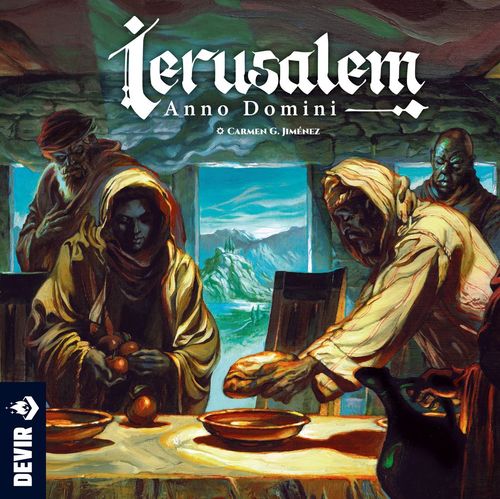
Ierusalem: Anno Domini
Ierusalem: Anno Domini Rulebook
Table of Contents
Table of Contents
- Introduction to the Game
- The Goal of the Game
- Game Components
- Setting Up the Game
- Playing the Game
- Victory Points
- The Cards
- Follower Actions
- The Player Board
- The Main Board
- Consummatum Est · End of the Game
- Two Player Games
- Plea for Barabbas · Solitaire Mode
- Solitaire Campaign: The Road to Jerusalem
- The Parables
- I · Bonum Samaritanum (Lc 10,30_37) — The Parable of the Good Samaritan
- II · Seminator (Mc 4,1_9) — The Parable of the Sower
- III · Thesauro Abscondito (Mt 13,44) — The Parable of the Hidden Treasure
- IV · Nuptiarum Invitatus (Lc 14,7_10) — The Parable of the Great Banquet
- V · Prodigus Filio (Lc 15,11_32) — The Parable of the Prodigal Son
- VI · Sinapis (Mc 4,30_32) — The Parable of the Mustard Seed
- VII · Perditus Ovis (Lc 15,3_6) — The Parable of the Lost Sheep
Introduction to the Game
In Ierusalem, Anno Domini, each player represents one of the communities of followers of Jesus of Nazareth who have come to Jerusalem from the nearby towns and villages. They seek to join the gathering in the location of the Last Supper and sit as close as possible to Jesus and his apostles. In the game, this is done by playing cards and managing your resources.
It should be pointed out that, according to the accounts of the evangelists, Jesus and his apostles were joined by a number of people during the Last Supper. It has been suggested that some of them were in the same room and others surrounding the house, since it was just a few days after Jesus entered Jerusalem surrounded by crowds, and many of his followers went to the Cenacle on Mount Zion to celebrate Passover, the most important of Jewish holidays.
The Goal of the Game
Jesus sent Peter and John, saying, "Go and make preparations for us to eat the Passover." "Where do you want us to prepare for it?" they asked. He replied, "As you enter the city, a man carrying a jar of water will meet you. Follow him to the house that he enters, and say to the owner of the house, 'The Teacher asks: Where is the guest room, where I may eat the Passover with my disciples?' He will show you a large room upstairs, all furnished. Make preparations there." — Lc 22,7_12
Your goal is to get as many of your Followers as you can to the Last Supper. You want to get them as close to the Apostles and Jesus himself as you can, since this will give you more Victory Points (we call them "VP") at the end of the game.
The most important thing about this game is the cards and how you use them. Each card has a symbol which matches one of five key Locations around Jerusalem. As you play cards, you will make sets of these symbols which will allow you to lead the Apostles to the Table. You will need to be careful about how you play your cards and use the various Resources you can collect, as this will affect how close your Followers can get to the Table.
A Note for Lay People
If this is the first time you are playing a modern board game, these rules may seem a little intimidating. Don't worry, we are here to help you.
First of all, even before reading the rules, we recommend you visit our website at www.devirgames.com/ierusalem and watch the tutorial video that will give you a general overview of the game. Once you have done that, you can read the rules and see in detail how the game works. That way, when the various elements are presented, they will already be familiar to you.
Number of Players
These rules assume you are playing a game with 3 or 4 players. 2-player and solitaire games have some special rules, which are explained in those sections (page 22 and 24).
Game Components
- 1 Main board
- 4 player boards
- This rulebook
- 4 Illumination tiles (1 per player)
- 4 Blocked Warehouse tiles (1 per player)
- 3 Blocked Location tiles: (1 for the Desert, 1 for the Mountain, and 1 for the Lake.)
- 32 Favor markers (8 per player)
- 28 Parable tiles (4 tiles each of 7 different types)
- 50 Offering counters
- 15 Location Symbol tiles
- 60 Denarii coins (money: 10 worth 5 each, 20 worth 3 each, 30 worth 1 each)
- 7 Sanhedrin's Judgment tiles
- 8 additional Sanhedrin's Judgment tiles (for the solitaire mode)
- 1 deck of 10 Starting cards per player
- 1 deck of 23 Mahane cards
- 1 deck of 10 33 A.D. cards
- 1 deck of 10 additional Starting cards per player (for 2-player games or the solitaire mode)
- 1 deck of 25 Barabbas cards (for the solitaire mode)
- 1 Jesus tile
- 12 Apostle markers in 4 colors (orange (3), purple (4), white (4), and silver (1))
- 60 Followers, in 4 different colors (15 of each color)
- 4 Help cards for 3- or 4-player games
- 2 Help cards for 1- or 2-player games
- 30 Stone tokens
- 30 Bread tokens
- 30 Fish tokens
- 4 Score markers (1 per player)
- 1 Sanhedrin marker
- 4 Favors Fulfilled markers (1 per player)
The Main Board and the Player Board
The areas of the main board are explained in detail starting on page 14:
- Market
- Desert
- Mountain
- Lake
- Temple
- Mahane Cards
- The Last Supper
- Parables stacks
- The Sanhedrin Assembly
- Victory Point Track
- Starting area for the Apostles
- Favors and 33 A.D. cards
The areas of the player board are explained in detail starting on page 12:
- Illumination Area
- Reminders
- 3 spaces to play cards
- Camp and Warehouse
- Parables
Setting Up the Game
Then the mother of Zebedee's sons came to Jesus with her sons and, kneeling down, asked a favor from him. "What is it you want?" he asked. She said, "Grant that one of these two sons of mine may sit at your right and the other at your left in your kingdom. — Mt 20,20_21
Prepare the main board by following these steps
- Put the main board in the middle of the table, with the side for 3- or 4-player games face-up.
- If there are 3 players, use the Blocked Location tiles to cover 2 spaces in the Desert, Mountain, and Lake Locations on the main board: These spaces are not used during the game. If there are any other number of players, simply return all the Blocked Location tiles to the game box.
- Place the Jesus tile at the center of the Table for the Last Supper. Place the 12 Apostles in their starting area of the main board, each in a space of the same color.
- If there are 3 players, place Followers of the color you are not going to use in the Last Supper spaces as shown in the image (green in this example).
- Determine which Location Symbols you will need to Visit the Apostles. If this is your first game, we recommend that you use the symbols that are printed on the board (if you do, return the Location Symbol tiles to the box). Otherwise, mix up the Location Symbol tiles and place 1 face up on each set of symbols on the main board.
- Find the 3 Mahane cards with the Friendly Follower icon and put them back in the box (they are used only in 2-player and solitaire games). Shuffle the other 20 cards face down and place the deck on the Mahane space of the main board. Then, turn over the first 2 Mahane cards and place them next to the deck.
- Shuffle the 33 A.D. cards and place them on the 33 A.D. space of the main board.
- Collect all 7 Sanhedrin's Judgment tiles and remove the one with the 2-player icon and put it back in the box. Mix the other 6 tiles and place them face down randomly in the Sanhedrin spaces on the main board. Turn them over and leave them face-up. Place the Sanhedrin marker at the bottom of its track.
- Separate the Parable tiles into stacks by type—the "type" is the title on the tile: I. Bonum Samaritanum, II. Seminator, III. Thesauro Abscondito, etc. In each stack, arrange the tiles in descending order so the highest value is on top of the stack and the 0 is at the bottom. If there are 3 players, remove the 3-point tile from each stack and return them to the box. Place each stack in the matching space of the main board.
- To one side of the main board, create a common supply with the Denarii, Resources (Stones, Bread, and Fish), and the Offering counters.
Individual Preparation
Each player prepares their own playing pieces by following these steps:
- Choose a color and take the player board, Followers, deck of 10 Starting cards, Score marker, and 8 Favor markers of your color. Shuffle your Starting cards and place them to the left of your player board in a face-down deck. Keep your Favor markers next to your player board with the Favor side face-up and the Location symbol face-down.
- Take an Illumination tile and place it in the matching space of your player board.
- Take a Blocked Warehouse tile and place it on the bottom spaces of your Warehouse (on your player board).
- Place your Score marker by the Victory Point Track that runs along the outside of the main board. Place your Favors Fulfilled marker in the first space of the Favor Track.
- Take 1 Stone, 1 Bread, 1 Fish, and 1 Offering from the supply and put them in the empty spaces of your Warehouse.
- Put 1 of your Followers in one of the available corner spaces of the Last Supper that has the corner icon.
- Put 4 of your Followers on the main board: 1 in the Desert, 1 on the Mountain, and 1 on the Lake, and the fourth in any Location you choose. Place the rest of your Followers in your Warehouse/Camp.
- Finally, determine who will be the starting player: the one who most recently did someone else a favor will be the first player and takes 4 Denarii from the supply, keeping them near their player board. The second player, to their left, takes 5 Denarii, the third takes 6 Denarii, and the fourth takes 7 Denarii. Then, the first player places their Score marker on the "1" space of the Victory Point Track, the second player on space "2", the third on space "3", and the fourth on space "4".
If you cannot agree on who was the last person to do a favor for someone else, shuffle and deal the Help cards face-down. Whoever has the card with the first player symbol will be the first player. Each player takes a Help card to assist them during the game.
Finally, each player draws 5 cards from their own deck (to the left of their player board) for their starting hand. Now you are ready to start the game!
Playing the Game
Whoever can be trusted with very little can also be trusted with much, and whoever is dishonest with very little will also be dishonest with much. — Lc 16,10_12
The game is played in turns, starting with the first player and going to the left. On your turn, you will follow these steps in order. After you have completed all 4 steps, your turn ends and the player to your left begins their turn. Here are the steps of your turn in more detail:
- Play a card from your hand
- Visit an Apostle
- Purchase a Mahane card
- Refill your hand of cards
1 · Play a Card from Your Hand
You begin your turn by playing 1 card from your hand and placing it in any of the 3 spaces on your player board. You may play your card in a space that already has cards in it, simply place the card on top but pushed down slightly so you can see the Location Symbol on the card below it.
After you play your card, carry out the actions shown on that card in this order:
1 · Location Action: Take an action at the Location shown on your card. Each Location allows you to take a different action - see Locations on page 14.
2 · Follower Action(s): You may use some or all of the Follower Actions shown on the card—see Follower Actions on page 10. If there is more than 1 Follower Action shown, you must use them (or not) in the order they appear on the card, from left to right. You do not have to use any of the Follower Actions if you cannot or do not want to.
Illumination. Once per game, you may choose not to play a card on your turn and use your Illumination tile instead—see The Illumination Area on page 12.
2 · Visit an Apostle
After you finish taking the actions on your card, if you have a complete set of Location symbols on your player board, you may visit 1 of the Apostles. Then you will receive their appreciation. This is explained in more detail in The Apostles section on page 17.
3 · Purchase a Mahane Card
In this step, you may choose to purchase 1 Mahane card by paying 2 Denarii to the supply and adding the card to your hand. You can choose to draw the top card from the Mahane deck without seeing it first, or you can take either of the 2 face-up Mahane cards on the main board. If you take a face-up card, you must immediately replace it by revealing the top card from the deck.
4 · Refill Your Hand of Cards
Finally, to end your turn, draw cards from your own deck until you have a total of 5 cards in your hand. If you already have 5 cards, do not draw any cards. If you have more than 5 cards in your hand, you must discard cards of your choice until you have only 5 cards again. When you discard Starter cards, always place them in your own discard pile to the right of your player board. If you discard a Mahane card or 33 A.D. card, place it on the bottom of the matching deck.
If you cannot draw enough cards because your deck has run out, take the cards in your discard pile, shuffle them, and create a new face-down draw deck. Then, continue drawing cards until your hand is full.
After you refill your hand, your turn is complete and the next player to your left starts their turn.
Too Many Cards or Resources?
During your turn, or even another player's turn, it is possible that you will have more Resources than you can fit in your Warehouse and/or more than 5 cards in your hand. That's okay! You can still use those extra cards and Resources. It is only at the end of your own turn that you are limited by what you can hold. Only at that point do you have to choose which excess cards to discard or excess Resources to discard from your Warehouse.
Victory Points
You can earn Victory Points (called "VP" for short) in a variety of ways during the game. The player who earns the most VP will be the winner. There are 3 main types of VP, which you can tell apart by their color and the shape around the number: Instant, Apostle, and End of Game points.
Instant Points
The orange symbol means that you receive VP immediately when you take that action. This can happen if you move the Sanhedrin marker forward, Visit an orange Apostle, move your Favors Fulfilled marker forward, or gain Parable tiles. Whenever you receive Instant Points, move your Score marker forward that many spaces on the Victory Point Track right away.
Apostle Points
All cards show a number of Apostle Points, in the green symbol. These points are not awarded when you play the card. Instead, you earn those points only when you have the right combination of cards to Visit an Apostle (see page 17). When you Visit, you earn the points shown on those cards: Advance your Score marker on the Victory Point Track that many spaces.
End of Game Points
Points in a purple symbol are awarded only at the very end of the game (see page 20). You earn these points for the Parable tiles you have collected, the Followers you have at the Last Supper, the Offering counters in your Warehouse, and your Illumination tile if you still have it. Record these points on the Victory Points Track also.
The Cards
There are 3 types of cards in the game: the Starting cards, the Mahane cards, and the 33 A.D. cards. All of them are used to perform actions and to complete Apostle sets. They all share these common traits:
- A Location
- Card Type (Mahane, 33 A.D. or Starting)
- Apostle VP (These are obtained when a set of 3 cards is gathered that allows you to Visit an Apostle—See The Apostles, page 17).
- An Illustration
- Follower Action(s)
Starting Cards
These cards match the colors used by each player. All players start with an identical deck of Starting cards that have the same combination of Locations and Follower Actions. When you discard them, place it in your personal discard pile to the right of your player board.
33 A.D. Cards
These cards are gained by taking a Do a Favor action (see page 11) or the Place a Friendly Follower action in 1- and 2-player games (see page 22), as well as by playing certain Mahane cards. When you gain a 33 A.D. card, add it to your hand. When you discard it, return it to the bottom of the 33 A.D. deck. Each of these cards allows you to perform up to 3 Follower Actions instead of just 1.
Mahane Cards
You may purchase Mahane cards during Step 3 of your turn at a cost of 2 Denarii, and only 1 may be bought each turn. It is also possible to get them through the Follower Actions on some cards. Any time you gain a Mahane card, add it to your hand. When you discard it, return it to the bottom of the Mahane deck. Each of these cards allows you to perform up to 2 Follower Actions instead of just 1.
Follower Actions
A dispute also arose among them as to which of them was considered to be greatest. — Lc 22,24_25
Each card shows 1 or more Follower Actions in addition to a Location. Follower Actions are also shown on the main board and your player board. Let's look at how each Follower Action works:
Listen to a Parable
There are 7 types of Parable tiles in the game. You can tell the "type" by its number and title: "I. Bonum Samaritanum", "II. Seminator", "III. Thesauro Abscondito", etc.
When you Listen to a Parable, take the top tile from the Parable stack with the lowest number you do not already have (so, you must take a I. Bonum Samaritanum tile first, then a II. Seminator, and so on). You cannot have more than 1 Parable tile of each type.
Also, in order to take a Parable tile, you must have at least as many of your Followers in spaces at the Last Supper as the number on that Parable tile.
Example: The blue player plays a card that allows them to perform a Listen to a Parable action. Since blue already has Parables I and II, they would have to take the top tile from stack number III (Thesauro Abscondito). However, blue is unable to perform the action because they only have 2 Followers in Last Supper spaces. Blue must add another Follower before they can Listen to a Parable again.
When you gain a Parable tile, you immediately get the VP shown in the top right corner. Then, place it in the Parables area of your player board, in the first empty space from the left. If that space shows any reward, you get it immediately.
At the end of the game, players will get additional Victory Points based on the number of Parable tiles that they have collected (see page 20).
Go to the Last Supper
This action lets you move 1 of your Followers to the Last Supper area of the main board. Choose an empty Last Supper space. You must pay the Resources shown next to the column and row that your chosen space is in. In the case of the head and bottom and corner spaces, the cost is just 2 Fish. Then, move 1 of your Followers from the Location where you have the most Followers (your choice if tied) to the chosen space. If there is a reward in that space, you must choose to accept it or decline it when you place your Follower. Players cannot decline the use of Meeting of the Sanhedrin icons, as those are not rewards.
Then, if you wish, you may place an Offering in your Warehouse for free.
Example: The yellow player has 3 Followers in the Desert, 1 on the Mountain, and none at the Lake. They pay 1 Bread and 1 Fish to place 1 yellow Follower in this space, then they take a Follower from the Desert. After moving them to the Last Supper, they may immediately perform the Redistribute action that is printed in the chosen space and add an Offering counter to their Warehouse.
Be Invited to the Last Supper
This is carried out in the same way as the Go to the Last Supper action, but you do not have to pay any Resources to place your Follower.
Do a Favor
You can gain a 33 A.D. card by giving a Favor marker to another player. In order to Do a Favor, follow these 4 steps in order:
- Choose 1 of your Favor markers you have available and give it to any player of your choice.
- The player who receives your Favor immediately gains the benefit shown on that Favor marker, if possible. If they can't, simply skip this step and go directly to Step 3. The benefits of the Favor markers are:
- Receive 2 Denarii
- Receive 1 Stone, 1 Bread, and 1 Fish
- Receive 2 Bread
- Receive 2 Stone
- Receive 2 Fish
- Perform the Call a Follower action
- Perform the Mahane action
- Perform the Listen to a Parable action
- The player who receives your Favor then places it next to their player board with the Location symbol showing. During any later turn, they may use that symbol to complete a set so they can Visit an Apostle (see The Apostles, page 17).
- Finally, you receive your reward: Draw a 33 A.D. card and add it to your hand. Then, move your Favors Fulfilled marker 1 space forward on the Favor Track. If there is any reward showing in that space, including VPs, you receive them immediately (see The Favor Track, page 16).
Call a Follower
You may move 1 Follower from the Camp on your player board to any empty space in the Desert, Mountain, or Lake for free. You may not have more than 3 Followers in the same Location at a time.
Change Places
You may move 1 of your Followers that is in a Last Supper space to any other empty Last Supper space without paying the cost of the new space. If the new space has a reward, you may accept it or decline it as normal unless it is a Meeting of the Sanhedrin action, which is compulsory.
Go to the Market or Temple
This action allows you to activate the Market or the Temple, depending on what is shown on the card. The rules for the Market and the Temple are explained on pages 14-15.
Receive Denarii
Take a number of Denarii from the common supply equal to the number of coins indicated, or pay a number of Denarii to the common supply equal to the number of coins indicated.
Obtain Stone, Bread, or Fish
You gain 1 Stone, 1 Bread, or 1 Fish, depending on which icon appears on the card.
Redistribute
Remove all of the cards you have in the 3 spaces of your player board, then put them back in those spaces in any order you choose. In addition, you may discard up to 3 of those cards, if you wish. If you can complete an Apostle set after reorganizing your cards, you may use it to Visit an Apostle during that part of your turn. (Remember that you may only Visit an Apostle once per turn—see The Apostles, page 17.)
Meeting of the Sanhedrin
Move the Sanhedrin marker 1 space forward on its track.
Draw Mahane Card
You may take 1 Mahane card and add it to your hand: either 1 of the 2 face-up cards on the main board or the top card from the deck. Either way, the card is free. If you take a face-up card, replace it with a new card from the deck.
Using this action does not stop you from buying a Mahane card during Step 3 of your turn.
Draw 33 A.D. Card
You may draw a 33 A.D. card and add it to your hand.
The Player Board
Soon afterwards he went on through cities and villages, proclaiming and bringing the good news of the kingdom of God. The twelve were with him, as well as some women who had been cured of evil spirits and infirmities: Mary, called Magdalene, from whom seven demons had gone out, and Joanna, the wife of Herod's steward Chuza, and Susanna, and many others, who provided for them out of their resources. — Lc 8,1_3
Your player board is used to help you manage your playing pieces. You will always keep your deck of Starter cards to the left of your player board and will have your own discard pile to the right. Near your player board, in full view of the others, you will keep your Denarii and Favor markers.
The player board is split up into the following areas:
1 · The Illumination Area
Your Illumination tile stays in this space until you use it. You can only use your Illumination tile once during the entire game, during Step 1 of your turn instead of playing a card.
You can use your Illumination tile to get 1 of the 4 Appreciation rewards offered by the Apostles without placing any of them at the Table for the Last Supper. After use, your Illumination tile is removed from the game.
If you do not use your Illumination tile, you are awarded 5 VP at the end of the game. In addition, this tile is used as a tie-breaker if you are tied for the most VP.
2 · Reminders
- Every time that a player places a Follower in a Last Supper space, that player may place an Offering in their Warehouse.
- Every time that a player performs the Do a Favor action (see page 11), that player draws a 33 A.D. card.
3 · 3 Spaces to Play Cards
As you play cards, you will place them in these 3 spaces. Each space can hold as many cards as you wish, but you cannot change the order of your cards (unless you take a Redistribute action—see page 11). If you can play a complete set of cards in the same space and in the right order, you may use them to Visit an Apostle (and move them to a seat at the Table—see The Apostles, page 17).
After you use a set of cards to Visit an Apostle, the cards in that set are removed from your player board. Starting cards are placed face-up in your discard pile. Mahane and 33 A.D. cards are placed at the bottom of their respective decks in any order. Any Favor markers used to complete the set are removed from the game.
Favor Markers
During the game, you will probably receive Favor markers from the other players when they take the Do a Favor action (see page 11). Once you have "collected" the Favor, you may use the counters to complete an Apostle set, replacing 1 or more cards.
Example: The player plays (and uses) a Lake card below the Mountain card on their player board. Since they have a Favor marker available with the Temple symbol, they are able to complete a set (Mountain - Temple - Lake) which allows them to place a white Apostle. After the Apostle is placed at the Table, the player scores the Apostle points, discards the 2 cards and removes the Favor marker from the game.
4 · Camp and Warehouse
This area of your player board represents the Camp where your Followers have gathered at the start of the game. You will move them from here to the different Locations while waiting to be called to supper with Jesus and his Apostles. It is also your Warehouse, where you will store the Resources you need to support your Followers, as well as any Offering counters you collect.
The spaces in this area of your player board are limited. As you send Followers to the Locations, you will free up spaces in your Warehouse that can then be used to hold Resources and Offerings. If you advance to the second space of the Favor Track, you will free up additional Warehouse space by removing the Blocked Warehouse tile.
Offering Counters
Offerings are goods that the community would like to give to Jesus and those closest to him. You will earn rewards for any Offering counters you have collected. Every time you send a Follower from any Location to the Last Supper, you may place 1 Offering counter in an empty space of your Warehouse. If you do, the Offering will occupy that space until the end of the game. If you do not place the Offering, the space will still be available to store Resources. The decision on whether or not to place an Offering counter must be made immediately after placing the Follower in the Last Supper space, and there is no way to change your mind and reverse the decision once it has been made.
Players get 1 victory point at the end of the game for each Offering counter in their Warehouse.
5 · Parables
Throughout the game, you can Listen to Parables that enrich your sense of belonging and give you food for thought. Every time you gain a Parable tile (see page 10), place it in this area of your player board, in the first empty space from the left. If there is a benefit shown in that space, you receive it immediately.
The Main Board
When he had finished speaking, he said to Simon, 'Put out into the deep water and let down your nets for a catch.' Simon answered, 'Master, we have worked all night long but have caught nothing. Yet if you say so, I will let down the nets.' When they had done this, they caught so many fish that their nets were beginning to break. — Lc 5,5_7
1 · Victory Point Track
This track runs along the outside edge of the board. If a player scores more than 100 points, they will flip their Score marker as a reminder of the points already scored.
2 · The Locations
The cards are related to the 5 Locations on the main board: the Market, the Desert, the Mountain, the Lake, and the Temple. Every time a player plays a card, they can activate the Location that matches that card. The effects of each Location are as follows:
Market
Judah and the land of Israel traded with you; they exchanged for your merchandise wheat from Minnith, millet, honey, oil, and balm. — Ez 27,17
If you activate the Market, you may exchange Resources for Denarii and vice versa, as many times as you choose. The prices for the Resources are fixed: Stones are bought or sold for 2 Denarii each, Bread for 3 Denarii, and Fish for 4 Denarii (these prices are printed on the board as a reminder). Exchanges at the Market are always made with the common supply.
Alternatively, at the Market you may buy a Mahane card for Denarii, as long as you have not made any sales or purchases of Resources that turn. You may still, if you so desire, purchase another Mahane card for 2 Denarii during Step 3 of your turn.
Example: The red player plays a Market card and sells 2 Bread tokens, getting 6 Denarii for them. Red then also decides to buy a Fish token, and pays 4 Denarii for it.
Desert / Mountain / Lake
But now more than ever the word about Jesus spread abroad; many crowds would gather to hear him and to be cured of their diseases. But he would withdraw to deserted places and pray. — Lc 5,15_16
You can get Resources from these Locations: Stones can be found in the Desert, Bread at the Mountain, and Fish in the Lake. When you activate one of these Locations, you get as many Resources of that type as the number of Followers you have in that Location at that moment.
You may never have more than 3 Followers in each Location at a time.
Example: After playing the Mountain card, the player gets 2 Bread tokens, since they have 2 Followers in that Location.
Temple
The blind and the lame came to him at the temple, and he healed them. — Mt 21,14
Activating the Temple allows a player to send Followers from their Camp to the Desert, the Mountain, and/or the Lake.
You may move as many Followers as you wish from your Camp to empty spaces in the Desert, Mountain, and/or Lake, as long as you have the Denarii to pay for them. The amount of Denarii you must pay for each Follower you move depends on the destination:
- Desert: 1 Denarius
- Mountain: 2 Denarii
- Lake: 3 Denarii
Pay the required coins to the common supply. Remember that you cannot have more than 3 Followers in each Location.
If all of the spaces in the Location you want to move to are full, you may still move a Follower there by removing 1 Follower belonging to any other player and placing your Follower in the now-empty space. If you do, you must pay the Denarii cost to that player and pay 1 additional Denarius to the common supply. The Follower you remove is returned to its owner's Camp. If there aren't any available spaces, the player will have to accomodate the Follower by the end of their next turn, discarding resource tokens if necessary.
3 · Mahane Deck
Mahane is the name of the main market in Jerusalem. Players may purchase these cards during Step 3 of their turn (see page 8).
4 · Favors Track and the Space for the 33 A.D. Cards
You move your marker up this track each time you use the Do a Favor action (see page 11). When you do, you immediately gain the VP shown and receive any reward that is printed in the space you move into (if any). You also draw a 33 A.D. card. The rewards that may appear on the Favors Track are:
- You remove your Blocked Warehouse tile from your player board: you now have additional space in your Warehouse.
- You receive 2 Denarii from the common supply.
5 · Stacks of Parables
That same day Jesus went out of the house and sat by the lake. Such large crowds gathered around him that he got into a boat and sat in it, while all the people stood on the shore. — Mt 13,1_2
This is the area where the stacks of Parable tiles are placed. When players perform the Listen to a Parable action (see page 10), they are given the top tile from one of these stacks.
6 · The Last Supper
When the hour came, Jesus and his apostles reclined at the table. And he said to them, "I have eagerly desired to eat this Passover with you before I suffer! For I tell you, I will not eat it again until it finds fulfillment in the kingdom of God." — Lc 22,14_16
Each time you perform a Go to the Last Supper or Be Invited to the Last Supper action, you will place a Follower in an empty space in this part of the main board (see page 14), after paying any costs required. If that space has a reward on it, you receive it immediately.
The Apostles have their own reserved "seats" at the Table in the Last Supper area. You will move them to these seats when you Visit an Apostle (see page 17). The location of your Followers in the Last Supper area and the Apostles located closest to them will determine how many VP you get at the end of the game for those Followers (see page 21).
7 · Starting Area for the Apostles
This is the area where the Apostles are placed at the start of the game, each in their own color. They wait here until they are brought to the Table for the Last Supper. This area also shows the 3 columns for the Apostle sets, which are explained below.
8 · Apostle Sets
These columns show the Location symbols you need to complete a set on your player board in order to Visit an Apostle. In some games, you will use the Location Symbols that are printed on the board (such as your first few games). Or, you can cover those symbols with randomly placed Location Symbol tiles so you will have a different combination for each game.
The way you complete Apostle sets is explained below.
9 · The Apostles
Jesus went up on a mountainside and called to him those he wanted, and they came to him. He appointed twelve that they might be with him and that he might send them out to preach and to have authority to drive out demons. These are the twelve he appointed: Simon (to whom he gave the name Peter), James son of Zebedee and his brother John (to them he gave the name Boanerges, which means "sons of thunder"), Andrew, Philip, Bartholomew, Matthew, Thomas, James son of Alphaeus, Thaddaeus, Simon the Zealot and Judas Iscariot, who betrayed him. — Mc 3,13_19
Jesus chose a group of people to listen to and then preach his message. He called them "fishers of men." They were his first followers, his friends, and those who sat at his table during the Last Supper. Placing these Apostles in the seats at the Table for the Last Supper is a fundamental part of the game.
At the beginning of the game, the Apostles are not at the Table. They are found in their starting area on the main board. They are divided into 4 colors: purple (4), orange (3), white (4) and silver (1). In order to move an Apostle to the Table, you will need to "Visit" them. In order to Visit an Apostle, you must first complete a set of 3 Location symbols by playing cards during your turns. There is a different set of symbols for each color, made up of a combination of 3 Location symbols, as shown on the main board.
Every time you play a card, you will place it on your player board in 1 of the 3 spaces there. Always play the cards slightly spread out so you can see all of the Location symbols on those cards. In order to complete a set and Visit an Apostle, you must have exactly three cards with the same Location symbols as shown on the main board, in exactly the same order. If you have cards in the same space that do not match the symbols in the set, you cannot complete the set and Visit an Apostle—so be careful about where you place your cards!
Fortunately, you can use Favor markers to help you complete your set of symbols: Each Favor marker you receive from another player will show a Location symbol. You can use this symbol instead of a single card when making a set that needs that symbol. The Favor marker is automatically placed in the correct order for your set.
Example: In the first card space, we see a set that has been correctly completed with 3 cards. In the second space, we see a set that can be correctly completed with 2 cards and 1 Favor marker. In the third space, we see a set that is not completed correctly because it includes cards that do not make up part of the set.
10 · Visiting an Apostle
If you have a complete set of Location symbols in a space on your player board, you can Visit an Apostle during Step 2 of your turn. You do not have to use your set of symbols immediately: You can leave the completed set on your player board and use it in any following turn. However, you can only ever Visit an Apostle once per turn.
When you Visit an Apostle, you must follow these steps in order:
- A. Place the Apostle at the Table
- B. Earn the Appreciation of the Apostle
- C. Score Apostle Points
- D. Clean Up Your Player Board
- E. Seating All of the Apostles
A · Place the Apostle at the Table
Each set of symbols is linked to a different color of Apostle. Take an Apostle that matches that color from their starting area and place it in any empty seat at the Table for the Last Supper. Once an Apostle has been seated, he cannot move again for the rest of the game. When the last Apostle is seated at the Table, the game enters its final phase (see End of the Game, page 20).
Example: The player has completed this set of cards, which allows them to place an orange Apostle in an empty seat at the Table.
B · Earn the Appreciation of the Apostle
Depending on the color of the Apostle that is seated, the Apostle gives his "Appreciation" to the player in the form of a reward, as described below:
Purple Apostle. You may immediately perform a Be Invited to the Last Supper action (see page 10).
Orange Apostle. You immediately award VP for the spaces behind where the Apostle is seated. All of the Followers that are behind that Apostle, regardless of what color they are, immediately earn VP for their players (see Followers at the Last Supper on page 21 for details).
Example: When the orange Apostle is seated in this space at the Table, VP are awarded: The red player gets 5 + 4 VP for their 2 Followers; the blue player receives 3 VP; and the yellow player gets 5 VP.
White Apostle. You may immediately switch positions between 1 of your own Followers at the Last Supper and another player's Follower, without having to pay the cost for the new space. Neither of you receive any reward for the placement of your Follower in the new space.
Example: The yellow player places a white Apostle and then switches their own Follower with a blue Follower.
Judas. After he had said this, Jesus was troubled in spirit and testified, "Very truly I tell you, one of you is going to betray me." — Jn 13,21
The silver Apostle piece represents Judas. Judas requires the same set of Location symbols as the orange Apostles, and can be seated at the Table in the same way. If you seat Judas, you gain 5 Denarii from the common supply.
At the end of the game, any Followers behind Judas will receive a VP penalty (see Followers at the Last Supper, page 20).
C · Score Apostle Points
Once the Apostle is seated and his Appreciation awarded, the player earns VP equal to the Apostle Points shown on the cards used in the set.
Example: The blue player was able to complete an orange Apostle set, by using 2 cards with the Temple and Desert Location symbols and a Favor marker with the Market symbol. That grants them 4 Apostle points (on top of the 4 points just obtained due to the Appreciation of that Apostle).
D · Clean Up Your Player Board
After completing these steps, you must discard the cards used in the Apostle set. Starter cards are placed face-up in your discard pile, and may be used again after you reshuffle your deck. Mahane and 33 A.D. cards are single-use only, so after using them for a set, you must place them at the bottom of the corresponding deck. Any Favor markers you used are removed from the game.
If all of the Apostles of a color have been seated at the Table, players can continue to complete Apostle sets for that color, playing the cards and even receiving the Apostle Points; but they no longer receive the Appreciation reward for the Apostle or move an Apostle to the Table.
E · Seating All of the Apostles
If all of the Apostles have been seated at the Table for the Last Supper, the following special rules take effect. This will accelerate the end of the game:
- Any Illumination tiles that have not been used up to that point cannot be used for the rest of the game.
- All of the Sanhedrin's Judgment tiles that are still on the Sanhedrin Track are removed from the game.
- At the beginning of each player's turn, the Sanhedrin marker automatically moves forward 1 space. Additionally, the Sanhedrin marker will continue to move forward normally each time a Follower Action shows a Sanhedrin symbol.
11 · The Sanhedrin Assembly
They took Jesus to the high priest, and all the chief priests, the elders and the teachers of the law came together. The chief priests and the whole Sanhedrin were looking for evidence against Jesus so that they could put him to death, but they did not find any. Many testified falsely against him, but their statements did not agree. — Mc 14,53_56
The Sanhedrin, or "High Council of the Jews," was the supreme Jewish tribunal. It dates from the 2nd Century B.C. and continued to exist until 70 A.D. It was made up of 71 members and was presided over by a high priest. All of its members belonged to the priestly elite and nobility. During the reign of the Romans, which began in 63 B.C. The Roman Empire took away the Sanhedrin's power to decide the life or death of those who were presented before them. Any sentences imposed by the Sanhedrin that included capital punishment had to be approved by the Roman Procurator (magistrate), as was the case with Jesus. It is for this reason that, after being condemned to death by the Sanhedrin, Jesus was brought before Pontius Pilate.
As Jesus' influence in Jerusalem grew, the patience of the council of the Sanhedrin ran out. To show this, the Sanhedrin marker moves along its track, and when it reaches the end of its path it means that Jesus has been condemned to die on the cross, and the game has come to an end (see End of the Game, page 20).
When any player, because of an action by their Followers, causes the Sanhedrin marker to move into a space that contains a Sanhedrin's Judgment tile, that tile is immediately applied. Each player must individually count up the VP they receive when that tile is activated. The player who caused the marker to move into that space gets the full VP that are granted by the tile, while the other players will get only half of the VP that is granted to them (rounding down where needed). After the tile has been scored, it is removed from the game. The different Sanhedrin's Judgment tiles have different effects:
Sanhedrin's Judgment Tiles
- Players get 1 VP for each Parable tile that they have in the Parables area of their player board.
- Players get 1 VP for each Offering they have in their Warehouse.
- Players get 1 VP for each Stone, Bread, and Fish they have in their Warehouse.
- Players get 1 VP for each of their own Followers that they have in the Desert, Mountain, and Lake Locations.
- Players get 1 VP for each Favor they have done (this can easily be counted by adding up the spaces they have moved on the Favors Track).
- Players get 1 VP for each of their own Followers that they have in the Last Supper area.
- This tile is only used in 2-player games. Players get 1 VP for each Friendly Follower they have in their supply.
Consummatum Est · End of the Game
Then one of the Twelve—the one called Judas Iscariot—went to the chief priests and asked, "What are you willing to give me if I deliver him over to you?" So they counted out for him thirty pieces of silver. — Mt 26,14_15
The game automatically ends at the moment that the Sanhedrin marker reaches the last space on its track and Jesus is condemned to death. This can happen in 2 ways:
- If the Sanhedrin marker moves normally during the game until it reaches the end of the track.
- If a player places their last Follower in a space at the Last Supper (meaning all the Followers of that player's color are at the Last Supper), then the Sanhedrin marker is automatically moved to the last space of its track.
Also: Remember that if all the Apostles are seated at the Table for the Last Supper, the end of the game is hastened because the Sanhedrin marker is automatically moved 1 space forward at the beginning of each new turn (see Seating All of the Apostles, page 19).
As soon as the Sanhedrin marker reaches the last space of its track, the game is over and the end of game VP are awarded. Players get end of game victory points for the following:
- Parable tiles collected
- Followers at the Last Supper
- Offerings
- Illumination tiles
1 · Parable Tiles Collected
In addition to the immediate VP a player earned when they acquired each Parable during the game, at the end of the game they also get additional points depending on the total number of Parables they have on their player board as shown in the following table:
| Parable tiles | 1 | 2 | 3 | 4 | 5 | 6 | 7 |
|---|---|---|---|---|---|---|---|
| VP | 1 | 3 | 6 | 10 | 13 | 15 | 18 |
2 · Followers at the Last Supper
Each Follower in a space in the Last Supper area awards VP based on who they are seated behind. The closer a Follower is to Jesus or one of the Apostles, the more VP they are worth.
Note that neither Jesus nor the Apostles award any VP to any player. The numbers on the markers are a reminder of the points awarded to the spaces behind their seat at the Table. It is the Followers placed behind Jesus and the Apostles that earn VP. Remember that the Followers in the corners also generate VP for their players based on the color of the Apostle that is adjacent to them (or subtracts VP in the case of Judas). For clarity sake, you can lay down the Apostles after scoring each of them.
These points are awarded as follows:
Jesus. While the charismatic presence of Jesus could fill the whole hall, for the purposes of the game, it takes up only 4 seats. Each Follower who is in a space right behind any of those seats awards 7 VP to that player. The next Follower in that line (the one who is separated by 1 space from Jesus) awards 6 VP. The next (2 spaces away) awards 5 VP, and the last (3 spaces away) awards 4 VP.
Apostles (except for Judas). Each Follower who is right behind an Apostle will award VP to their player depending on that Apostle's color: Each Follower right behind a purple Apostle awards 4 VP; each Follower right behind an orange Apostle awards 5 VP; and each Follower right behind a white Apostle awards 6 VP. Based on those starting points, each Follower awards 1 VP less for each space that they are separated from the Apostle in their row.
Judas. A Follower who is right behind Judas takes away 5 VP from that player. The next Follower (1 space away from Judas) takes away 4 VP, and the last (2 spaces away) takes away 3 VP.
Remember that the Followers in the corners also generate VP for their players based on the color of the Apostle that is adjacent to them (or subtracts VP in the case of Judas).
Example: In the case of the orange Apostle, the yellow Follower gives 5 VP to its player, the blue gives 4 VP, and the red one gives 3 VP. The red Follower in the corner gives another 5 VP to its player—Followers at the corners are also scored. In the case of the white Apostle, the red Follower gives 6 VP to the red player, the blue one gives 5 VP, and the yellow one gives 4 VP. Judas takes 5 VP away from the blue player and 4 VP from the yellow player. Finally, the Followers who are in the four spaces behind Jesus give their players 7, 6, 5, and 4 VP respectively.
3 · Offerings
Players get 1 VP for each Offering counter that they have in their Warehouse.
4 · Illumination Tiles
Players who still have their Illumination tile on their player board receive 5 VP each.
The player who has the highest score wins the game. If there is a tie, the one who still has their Illumination tile on their player board (among those who are tied) wins. If there is still a tie, the winner is the one among those still tied who did more Favors during the game. If there is still a tie at that point, then the tied players share the victory.
Two Player Games
2-player games have some changes to the rules that are used for 3- or 4-player games. These changes are listed below:
Preparation for a 2-Player Game
Main board. Lay out the main board with the side marked for 1 or 2 players face up.
Favor markers. Take the Favor Fulfilled markers and put them back in the box: they are not used in 2-player games.
Mahane cards. Take the Mahane cards deck and separate those which have the Friendly Follower symbol in their bottom right corner. Return the other cards to the box.
Sanhedrin's Judgment tiles. Use the Sanhedrin's Judgment tiles, including the one that has the 2-player icon on it, but removing the one with the Do a Favor icon. Mix them face-down and then randomly place them in the Sanhedrin spaces on the main board. Then, turn them over so that they are face up. Put the tile that you did not place on the board back in the box. Place the Sanhedrin marker at the bottom of its track.
Parable tiles. Take the Parable tiles worth 2 VP and 3 VP and put them back in the box. Only use the Parable tiles worth 0 VP and 1 VP in 2-player games.
Friendly Followers. Place Followers of the 2 colors that you are not going to use in the Last Supper so that it matches the arrangement in the figure (it makes no difference which color each Follower is). These are Friendly Followers who can benefit both players.
Starting cards. The normal Starting card decks are not used. Instead, each player uses one of the special 2-player decks of 10 Starting cards.
Followers starting in Locations. Instead of placing a total of 4 Followers spread over the Desert, the Mountain, and the Lake, each player places 2 Followers in each of the Locations: 2 in the Desert, 2 in the Mountain, and 2 in the Lake.
Friendly Followers
Friendly Followers are Followers from other communities that collaborate with both players. They are represented by using 15 pieces in colors other than those used by the players. During game setup, they are placed in Last Supper spaces as shown above. Players can gain Friendly Followers and place them in a special supply next to their player board, so that they can be used to gain Victory Points later.
Scoring Groups of Friendly Followers
During the game, Friendly Followers will gradually group together by color in the Last Supper area. A group of Friendly Followers is made up of all the Followers of the same color who are adjacent to each other orthogonally (meaning horizontally and vertically, but not diagonally). When any game action indicates that a player can score a group of Friendly Followers, that player will get 1 VP for each Friendly Follower of the same color that is in that group.
Example: The player gets 5 VP when scoring this group of Friendly Followers.
Placing Followers in the Last Supper Area
In a 2-player game, when you place a Follower in the Last Supper (using a Go to the Last Supper or Be Invited to the Last Supper action), you have a choice: You may place them in an empty space following the normal rules OR place them in a space that holds a Friendly Follower. If you do, take that Friendly Follower and place them by your player board. But you do not get any reward that is printed in that space.
Example: The red player sends a Follower to this space, first taking the Friendly Follower who is already in the space and putting it next to their own player board.
Additional Follower Actions
The following Follower Actions are exclusive to 2-player games:
Place a Friendly Follower. You may place a Friendly Follower that you have in your own reserve in an empty space of the Last Supper - you don't have to pay the cost of that space. If you place it orthogonally (vertically or horizontally) adjacent to 1 or more Friendly Followers of the same color, you immediately score this group of Friendly Followers as explained in the section above.
Example: Continuing from the example above, the red player plays a card and decides to place the Friendly Follower in the indicated space. This way, red gets 4 VP from scoring this group of Friendly Followers.
Move a Friendly Follower. You may move a Friendly Follower of any color that is located in a Last Supper space, placing it in any other empty space of the Last Supper. If it is placed orthogonally adjacent to 1 or more other Friendly Followers of the same color, you immediately score this group of Friendly Followers as explained above.
Favors
In 2-player games, no VP are given for doing Favors since the Favor markers are not used.
Plea for Barabbas · Solitaire Mode
So when the crowd had gathered, Pilate asked them, "Which one do you want me to release to you: Barabbas, or Jesus who is called the Messiah?" But the chief priests and the elders persuaded the crowds to ask for Barabbas and to put Jesus to death. Pilate said to them, "Then what shall I do with Jesus who is called Christ?" They all said, "Crucify Him!" Then he released Barabbas for them; but after having Jesus scourged, he handed Him over to be crucified. — Mt 27,16_26
Player Against Barabbas
When playing a game in solitaire mode, a single player faces off against Barabbas, who is awaiting sentencing for his crimes when Jesus is arrested. Barabbas knows the Sanhedrin's intentions and their obsession with Jesus, and seeks to take advantage of the situation to get a pardon. The actions and decisions of Barabbas during the game are controlled by the game itself.
Throughout the following solitaire mode rules, when reference is made to "the player," we are talking about you (the human player), and when reference is made to "Barabbas," we are talking about your adversary, who is controlled by the game.
Preparation for the Solitaire Mode
Solitaire games are set up the same as 3-or 4-player games, except for these changes:
Main board. Lay out the main board with the side marked for 1 or 2 players face up.
Favor markers. Take the Favor markers and put them back in the box, since they are not used in solitaire mode.
Location Symbol tiles. Take the Location Symbol tiles for the Apostle sets and put them back in the box, since they are not used in solitaire mode. Instead, you will play with the Location symbols that are printed on the board.
Mahane cards. Take the Mahane cards deck and separate those which have the Friendly Follower symbol in their bottom right corner. Return the other cards to the box.
Sanhedrin's Judgement tiles. Find the 8 special Sanhedrin's Judgement tiles for solitaire games (bearing the solitaire icon). Mix them up face-down and then randomly place 6 of them in the Sanhedrin spaces on the main board. Do not turn them over. They will be revealed as the Sanhedrin marker reaches each of them.
Parable tiles. Collect the Parable tiles worth 2 VP and 3 VP and put them back in the box. Only use the Parable tiles worth 0 VP and 1 VP in solitaire games.
Followers of Barabbas. Choose 1 of the player colors that you are not using for yourself to be the Followers of Barabbas.
Barabbas card deck. Take the deck of 25 Barabbas cards, shuffle them, and place them somewhere within easy reach. Barabbas does not need a player board since he does not use Resources or coins. During the game, you will only need a space to reveal the cards from his deck and to place the Parable tiles that he collects.
Friendly Followers at the Last Supper. Place the Followers of the 2 player colors that you are not yet using in the Last Supper spaces indicated in the figure. It makes no difference which color each Follower is, but note which color you use for each of the white and black Followers in the figure. These are the Friendly Followers who can benefit you and can also benefit Barabbas. Friendly Followers in solitaire games follow the same rules as in 2-player games—see page 22.
Starting card decks. The standard Starting card decks are not used. Instead, create a special deck of 20 cards by mixing together the 2 decks of 2-player Starting cards.
Followers starting in Locations. Instead of placing a total of 4 Followers spread over the Desert, the Mountain, and the Lake, place 2 of your own Followers and 2 Followers of Barabbas in each of the Locations: 2 in the Desert, 2 in the Mountain, and 2 in the Lake.
Starting resources. Place 1 Stone, 1 Bread, 1 Fish, and 1 Offering in the empty spaces of your Warehouse. Finally, take 6 Denarii from the common reserve.
The Game Turn
Barabbas plays first, drawing and resolving a card from his deck. Once the card is fully resolved, Barabbas' turn ends and you carry out your own turn as normal. From that point on, the turns of Barabbas and yourself continue alternating until the end of the game.
The Barabbas cards are resolved from top to bottom, as follows:
- Barabbas gets 1 VP for each of his Followers in the Desert and in the Lake.
- Barabbas gets 1 VP for each of his Followers in the Mountain and in the Lake.
- Barabbas gets 1 VP for each of his Followers in the Desert and in the Mountain.
- Place 2 Followers of Barabbas, 1 in each of the 2 Locations where he has the least Followers. If there is a tie between several Locations when placing these Followers, placing in the Desert has priority over any other tied Location and the Mountain has priority over the Lake. Also, as usual, the maximum number of Followers of Barabbas that can be in any Location is 3 (just like players).
- If the Location where Barabbas must place a Follower is full, remove 1 of your Followers to make space for his, but he does not need to pay any Denarii to do so. The Follower who is removed is returned to your Camp.
- Barabbas gets 1 VP for each Resource that you have in your Warehouse.
- Take 1 Follower of Barabbas from whichever Location has the most (if there are Locations tied for the most, the order is always Desert, Mountain, and then Lake) and place it in the first empty space that is in the indicated row of the Last Supper, starting from the direction marked by the arrow. Barabbas does not need to pay any Resources to do this. If the Follower is placed in a space that has a reward, that reward is ignored, unless they are Listen to a Parable or Meeting of the Sanhedrin actions.
- Take the first Friendly Follower that is in the indicated row of the Last Supper starting from the direction marked by the arrow and place it in the first empty space orthogonally (vertically or horizontally) adjacent to another Follower of the same color in the direction of the arrow. Then, Barabbas scores the group of Followers that was just increased.
- After placing his Follower, Barabbas takes the next Parable tile according to the normal rules, as long as he has enough Followers at the Last Supper (see Listen to a Parable, Page 10).
- Barabbas scores the largest group of Followers of the indicated color (black or white) present at the Last Supper at that moment. Then move the Sanhedrin marker 1 space forward on its track. If the marker reaches a space that contains a Sanhedrin's Judgement tile, turn over the tile and apply its effect.
The standard Sanhedrin's Judgment tiles are not used in solitaire mode, but rather special tiles that have the following effects:
- Remove all of your Followers and all Friendly Followers from the indicated spaces of the Last Supper. The Followers of Barabbas are not affected. Your Followers are returned to your Camp, while the Friendly Followers are returned to the game box. Then, place an Apostle of the indicated color in the first empty seat at the Table as shown on the tile. If there are no more Apostles of that color, none are placed.
Clarifications on the Placement of Followers with Barabbas Cards
The Barabbas cards tell you which of the spaces in the Last Supper to place his Followers in. You should pay attention to the grid shape of the spaces to see whether they are placed above or below the Table.
When a Barabbas card tells you to place a Friendly Follower in the Last Supper, look for the first empty space in the indicated row, working in the direction shown by the arrow. If there is no empty space in that row, look in the row just below and in the same direction. If this brings you to the lowest row of the Last Supper and there is still no empty space, go up to the first row of spaces and continue the process until you find an empty space.
Solitaire Campaign: The Road to Jerusalem
This variation allows you to play a solitaire "campaign": a series of solitaire games in which the difficulty increases every time a game is won. To be victorious in this campaign, you will have to lead your followers from Nazareth to Jerusalem. To do so, you will have to overcome a total of 6 challenges set in the different towns that Jesus and his disciples passed through before reaching the Jewish capital.
In order to advance from one town to the next, you must win the game against Barabbas and achieve a score of 150 VP or more. If the challenge is not overcome on your first attempt, it is possible to play again, but keeping any Parable tiles that you collected during the first game. If you are still unable to beat the challenge on your second try, then you lose the accumulated Parable tiles and must start over with nothing in that same town (but with experience, which counts for something).
Each town after the first is a little more difficult than the one before it, and all the additional difficulties from each town are cumulative: they remain in place for all the later games. So, for example, if you start a game in Jericho, you must apply the difficulties imposed by Cana, Samaria, Emmaus, and Jericho itself (Nazareth, the first town, does not have any extra difficulty).
The extra difficulties of the different towns are as follows:
- Nazareth: There is no additional difficulty. The game is played normally as explained in the solitaire rules. You must beat Barabbas and achieve 150 or more VP.
- Cana: Instead of playing with the Location symbols that are printed on the board, use the Location Symbol tiles as you would when playing a 2-, 3-, or 4-player game.
- Samaria: At the end of the game, Barabbas gets +1 VP for each of his Followers in a space at the Last Supper.
- Emmaus: Start the game without any Resources in your Warehouse.
- Jericho: Do not place 1 of your followers in the corner spaces of the Last Supper at the beginning of the game, and do not start the game with an Offering counter in your Warehouse.
- Bethany: Do not place any of your Followers in the Desert, the Mountain, or the Lake at the beginning of the game.
- Jerusalem: When setting up the game, the Parable tiles that are worth 1 VP are replaced by those that are worth 3 VP. Place them at the top of their respective stacks. The tiles on the bottom of each stack are those that are worth 0 VP.
The Parables
I · Bonum Samaritanum (Lc 10,30_37) — The Parable of the Good Samaritan
A man was going down from Jerusalem to Jericho, when he was attacked by robbers. They stripped him of his clothes, beat him and went away, leaving him half dead. A priest happened to be going down the same road, and when he saw the man, he passed by on the other side. So too, a Levite, when he came to the place and saw him, passed by on the other side. But a Samaritan, as he traveled, came where the man was; and when he saw him, he took pity on him. He went to him and bandaged his wounds, pouring on oil and wine. Then he put the man on his own donkey, brought him to an inn and took care of him. The next day he took out two denarii and gave them to the innkeeper. 'Look after him,' he said, 'and when I return, I will reimburse you for any extra expense you may have.'
"Which of these three do you think was a neighbor to the man who fell into the hands of robbers?" The expert in the law replied, "The one who had mercy on him." Jesus told him, "Go and do likewise."
II · Seminator (Mc 4,1_9) — The Parable of the Sower
Again Jesus began to teach by the lake. The crowd that gathered around him was so large that he got into a boat and sat in it out on the lake, while all the people were along the shore at the water's edge. He taught them many things by parables, and in his teaching said: "Listen! A farmer went out to sow his seed. As he was scattering the seed, some fell along the path, and the birds came and ate it up. Some fell on rocky places, where it did not have much soil. It sprang up quickly, because the soil was shallow. But when the sun came up, the plants were scorched, and they withered because they had no roots. Other seeds fell among thorns, which grew up and choked the plants, so that they did not bear grain. Still other seeds fell on good soil. It came up, grew and produced a crop, some multiplying thirty, some sixty, some a hundred times."
III · Thesauro Abscondito (Mt 13,44) — The Parable of the Hidden Treasure
"The kingdom of heaven is like treasure hidden in a field. When a man found it, he hid it again, and then in his joy went and sold all he had and bought that field."
IV · Nuptiarum Invitatus (Lc 14,7_10) — The Parable of the Great Banquet
He told them a parable: "When you are invited by someone to a wedding banquet, do not sit down at the place of honor, in case someone more distinguished than you has been invited by your host; and the host who invited both of you may come and say to you, "Give this person your place", and then in disgrace you would start to take the lowest place. But when you are invited, go and sit down at the lowest place, so that when your host comes, he may say to you, "Friend, move up higher"; then you will be honored in the presence of all who sit at the table with you."
V · Prodigus Filio (Lc 15,11_32) — The Parable of the Prodigal Son
Jesus continued: "There was a man who had two sons. The younger one said to his father, 'Father, give me my share of the estate.' So he divided his property between them. Not long after that, the younger son got together all he had, set off for a distant country and there squandered his wealth in wild living. After he had spent everything, there was a severe famine in that whole country, and he began to be in need. So he went and hired himself out to a citizen of that country, who sent him to his fields to feed pigs. He longed to fill his stomach with the pods that the pigs were eating, but no one gave him anything.
"When he came to his senses, he said, 'How many of my father's hired servants have food to spare, and here I am starving to death! I will set out and go back to my father and say to him: Father, I have sinned against heaven and against you. I am no longer worthy to be called your son; make me like one of your hired servants.'
"So he got up and went to his father. But while he was still a long way off, his father saw him and was filled with compassion for him; he ran to his son, threw his arms around him and kissed him. The son said to him, 'Father, I have sinned against heaven and against you. I am no longer worthy to be called your son.' But the father said to his servants, 'Quick! Bring the best robe and put it on him. Put a ring on his finger and sandals on his feet. Bring the fattened calf and kill it.
"'Let's have a feast and celebrate. For this son of mine was dead and is alive again; he was lost and is found.' So they began to celebrate."
VI · Sinapis (Mc 4,30_32) — The Parable of the Mustard Seed
Again he said, "What shall we say the kingdom of God is like, or what parable shall we use to describe it?
"It is like a mustard seed, which is the smallest of all seeds on earth. Yet when planted, it grows and becomes the largest of all garden plants, with such big branches that the birds can perch in its shade."
VII · Perditus Ovis (Lc 15,3_6) — The Parable of the Lost Sheep
So he told them this parable: "Which one of you, having a hundred sheep and losing one of them, does not leave the ninety-nine in the wilderness and go after the one that is lost until he finds it? When he has found it, he lays it on his shoulders and rejoices. And when he comes home, he calls together his friends and neighbors, saying to them, 'Rejoice with me, for I have found my sheep that was lost.'"