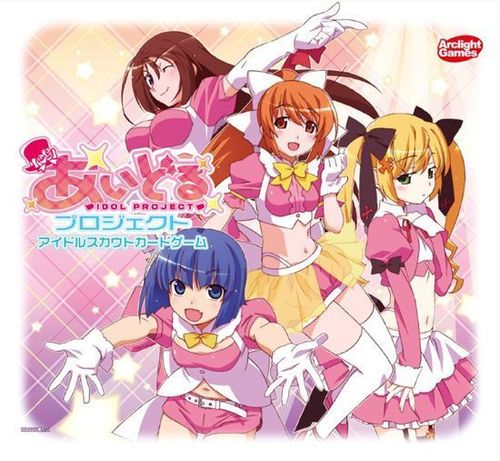
Idol Project
Idol Project Rulebook
Table of Contents
Table of Contents
1. Components
This game consists of the following components:
- 114 playing cards:
- 25 Idol cards
- 6 Event cards
- 16 Studio cards
- 16 Staff (team) cards
- 16 Fame cards
- 25 Work cards
- 5 Turn Order cards
- 5 Reference cards
- 24 Stock Action cards
- 85 banknotes (AG):
- 20 notes of 10 AG
- 15 notes of 50 AG
- 35 notes of 100 AG
- 15 notes of 500 AG
- 1 Bank
- 1 rulebook
2. Cards
2.1 Idol Cards
Idol cards are the heart of the game. Each card represents a pop idol.
- Name: the name of the idol.
- VP: Victory Points.
- Cost: the amount of money the player must pay each turn to keep this Idol in their company.
- Preferences: the Idol will join the company that best matches her preferences. The second preference is only used in case of a tie on the first.
- Skills: the Idol's skills. There are four types of skill, each represented by an icon: Singing (microphone), Appearance (bra), Dancing (shoes) and Acting (clapperboard).
- Special ability: the effect the Idol has on the company. Some Idols can influence the companies they belong to positively or negatively. For example, Hikari Kagawa lowers the company's Fame by 1.
- Flavour text: has no influence on the game.
2.2 Event Cards
Events and accidents happen, and players must deal with them. These cards are shuffled in with the Idol cards.
- Name: the name of the event.
- Effect: what happens when this card is drawn. If an Event is drawn at the start of a turn, it is resolved immediately.
2.3 Work Cards
Work cards show the various jobs that idols can do.
- Name: the name of the job.
- VP: the number of victory points the job is worth.
- Seal (cachet): the sum the company receives for completing the job.
- Required skills: the total skill needed for your Idol(s) to do the job. If you have several Idols, you may add their skill totals by having them work together.
2.4 Dome Concert Cards
Dome Concert cards are a special kind of Work card. They are not shuffled in with the other Work cards: they are dealt, one to each player, at the start of the game. The objectives for the 5 Dome Concert cards vary. When a player succeeds in organising their concert, the game ends and points are counted.
Some Dome Concert cards have a specific icon (with no background, shown in white) in the required-skills section. Its icons are only counted in 3-player games, because in that game the Dome Concert is a little harder to achieve.
Each Dome Concert card has a starting bonus shown at the bottom left of the card. When these cards are dealt, each player receives the corresponding bonus.
2.5 Studio Cards
These cards represent the studio equipment your company owns.
- Name: Equipment, or Luxury Equipment.
- Cost: the purchase price.
- Gain: how much this card increases the value of your company's studio.
2.6 Staff Cards
These cards represent the staff of your company.
- Name: Team Member, or Team Leader.
- Cost: the price to hire this person.
- Gain: how much the value of your staff increases thanks to this card.
2.7 Fame Cards
These cards represent the level of notoriety of your company, which is raised by advertising.
- Name: Magazine Advertising, or TV Advertising.
- Cost: how much this advertising costs.
- Gain: how much your company's Fame increases thanks to this card.
2.8 Stock Action Cards
Stock Actions bring you a little money each round. You may have as many as you like, but you may only buy one per turn. When you sell your Actions, you must sell all of them.
2.9 Turn Order Cards
The order in which the players will play is auctioned at the start of each turn. These cards are used to keep track of the turn order.
2.10 Reference Cards
One side of each Reference card is a reminder of the phases of a game turn. The other side is opaque, because players keep their money hidden under this card for the whole game.
3. Setup
Setting up the game consists of placing the various cards in piles in the middle of the table, so that everyone can reach them. Each player should have enough room in front of them to place many cards, since the company will grow throughout the game and these cards must remain visible at all times. The area in which a player keeps their cards and money is called the "Office" (Bureau).
Idol Pile
Shuffle all Idol cards and all Event cards together into a single pile, and place it face down in the middle of the table. This is the Idol pile. Turn over the first card. If it is an Event card, put it back into the pile and shuffle again. Repeat until the revealed card is an Idol card, then place this Idol card on top of the pile.
Studio, Staff and Fame Piles
Shuffle the Studio, Staff and Fame cards separately, and place them face down next to one another. They form the Studio, Staff and Fame piles.
Work Pile
Shuffle all Work cards, except the Dome Concert cards, and place them face down on the table. They form the Work pile.
Action Cards, Money and Turn Order Cards
Keep the Action cards together. Sort the banknotes by value, and keep the Turn Order cards easily accessible. You will of course use as many Turn Order cards as there are players.
Starting Supplies
Each player receives 1,000 AG and a Reference card, to hide their money.
Then shuffle the Dome Concert cards and deal one to each player. With fewer than five players, card 53 is not used; in a three-player game there will be one more Dome Concert card. Put these cards back in the box. Every Dome Concert card (except card 53) has a starting bonus shown at the bottom left, which may be an Equipment card, a Staff member or a magazine advertisement, or else 500 AG. Make sure each player receives their starting bonus at the beginning of the game.
Translator's note: the source says "Put these cards back in the box" directly after the Dome Concert distribution; it is transcribed as printed.
4. Course of the Game
The game consists of a number of rounds (manches) that repeat until the game ends. Each round is made up of eight phases, which are resolved in order. For more detail, see "Details of the Phases" (section 6) later in these rules.
4.1 Round Preparation
New Studio, Staff and Fame cards are drawn, as well as a new Work card. The Idol pile is resolved.
4.2 Income
Each player receives 300 AG, plus any extras due to their Actions.
4.3 Selling Actions
Players decide whether or not to sell their Actions.
4.4 Turn Order Auction
The turn order is auctioned.
4.5 Activity
In turn order, players carry out their activity: buy an Action card or not, and then take one company action.
4.6 Idol Employment
The current Idol joins the company that suits her best.
4.7 Idol Salaries
All players pay the salaries of their Idols.
4.8 Transfer
In turn order, players may transfer or move their Idols.
5. End of the Game and Victory
If one of the players manages to organise a concert at the Dome during the activity phase, the game ends immediately. The game also ends when the Studio, Staff, Fame or Work piles are exhausted.
When the game ends, each player totals the victory points (VP) they have. The player with the most VP wins. If there is still a tie, money is the tie-breaker.
6. Details of the Phases
6.1 Round Preparation
Studio, Staff and Fame piles: Turn over the first card of each pile and place it beside the pile. These are the cards available for this round. If there are cards left over from the previous round, place them face down at the bottom of the pile.
Work pile: Draw the first three cards of the pile and line them up beside the pile. These are the jobs available for this round. If there are cards left over from the previous round, turn them face down and place them at random at the bottom of the pile.
Action cards: Place as many Action cards as there are players minus one (3 cards with 4 players, and so on). If Action cards from the previous round remain, return them to the pile.
Idol pile: Take the top card, which is face up, and place it beside the pile. This is the Idol available for this round, the one who will be employed during the employment phase. Then turn over the next card on top of the Idol pile and place it on the pile; this is the Idol who will be available for the next round. If the revealed card is an Event card, resolve the Event immediately, then return the card to the box (it is removed from the game). Reveal the card on top of the Idol pile again, and repeat this for as long as you reveal Event cards. When you reveal an Idol card, place it face up on top of the Idol pile so that all players can see it; this may prepare the next round.
6.2 Income
Each player receives 300 AG from the Bank for each Action they own. The Bank's money is considered to be unlimited.
Translator's note: section 4.2 describes the income as "300 AG plus the extras due to their Actions", while section 6.2 gives it as "300 AG for each Action owned". Both are transcribed as printed.
6.3 Selling Actions
On the first turn no one owns any Actions, so this step is skipped. Respecting the turn order cards, players decide whether to sell their Action(s) or not. A player who decides to sell must sell all of their Action cards; they cannot sell only some of them. The more Action cards a player has, the higher the price per card rises (see table below). Sold Action cards are returned to the central play area.
- Selling 1 Action: 200 AG
- Selling 2-3 Actions: 250 AG per card
- Selling 4-5 Actions: 300 AG per card
- Selling 6 Actions: 350 AG per card
6.4 Turn Order Auction
The Turn Order cards are gathered, and the turn order for the next round is auctioned. These auctions are a crucial point of the game.
The player who was first in the previous round starts the auction. For the first round, play rock-paper-scissors to determine who starts the bidding.
The first bid must be at least 10 AG. Then, in clockwise order, each player may raise the bid by at least 10 AG or pass. To raise, a player must have enough money to do so. Bidding continues until all players but one have passed.
A player who passes takes the highest-numbered Turn Order card among the remaining cards. They pay nothing, even if they bid before passing.
Players who obtain cards 4 or 5 receive a consolation prize of 50 AG from the Bank.
The last player pays their bid to the Bank and obtains the remaining card, 1. The money paid to the Bank represents the sum the company spends to be everywhere at once and, above all, to be first at key moments. This player will play first during the activity phase, and will also have two company actions to perform.
6.5 Activity
In turn order, players choose their activity. The first player will have many options, whereas the last player will generally have none.
Buying an Action card or not: First, the player may buy one Action card, if any remain. There is no limit to the number of Action cards a player may own, but only one Action card may be bought per round. Since the number of available Action cards equals the number of players minus one, often no Action cards remain for the last player. It may even happen that no Action cards are available at all (this is intentional, to limit their number).
Company action: After buying an Action (or not), the player may take one of the following four actions:
- Invest in a Studio, Staff or Fame card.
- Prevent investments.
- Send Idols to work.
- Earn money (not available to the first player).
1) Invest in a Studio, Staff or Fame card: The player may buy one of these three investments and add it to their company. The money required is paid to the Bank. There is no limit to the number of cards of each kind a player may have. However, no new card is drawn to replace the one purchased, which means that the third, fourth and fifth players generally cannot invest any more.
2) Prevent investments: If the player does not have enough money to invest, but wants to prevent the other players from investing, they may simply put one of these cards at the bottom of its pile, face down.
3) Send Idols to work: If a player owns one or more Idols whose combined skills are equal to or greater than those required by any Work card, they may win that Work card and place it in their "Office". The Work card earns the player VP, and also a small sum of money from the Bank.
If a player has enough Idols to organise their concert at the Dome, this is the moment they must do it. If this happens, the game ends immediately, and the VP of each player are counted.
4) Earn money: If you are short of money and have no other options, you can always carry out the standard work of a Studio, and so earn money. This earns you 200 AG. Attention: the player holding Turn Order card number 1 cannot choose this option; more is expected of them.
First player's bonus activity: As indicated earlier, after buying at most one Action, the first player may carry out two company activities (one of options 1 to 3). They are not allowed to choose the fourth option (earn money), but they may carry out the same activity twice (except for sending Idols to work, which can only be carried out once).
6.6 Idol Employment
This is the moment during which the current Idol is employed.
1) Reveal the identity of the masked Idol: If a player has a "masked Idol", that player may now choose whether or not to reveal its identity. If they do, they may take one of the Idols in an opponent's office, or take the Idol of the current round, or the Idol on top of the Idol pile (intended for the next round). The masked Idol is then returned to the game box.
If the player chooses the Idol on top of the Idol pile, draw a new card to replace it (if it is an Event card, resolve it immediately, then draw a new Idol card). If they choose the Idol of this round, the phase ends directly, without going on to step 2.
2) Which company will the Idol join? Check the first preference of the Idol. All players add up the values they have in that preference. If one player has a sum higher than the others, they obtain the Idol. If there is a tie, look at the second preference of the Idol. The Idol goes to the tied player with the highest sum in the second preference. If there is still a tie after the second preference, the Idol loses all her illusions about this world and leaves. She will have been nothing more than a shooting star (put her back under the Idol pile).
6.7 Salaries
All players must now pay the Bank the money needed to keep their Idols. Players must pay if they are able to. Players cannot sell Actions at this point in the game.
If a player does not have enough money to pay all of their Idols, they must first pay everything they can (all the money they have). Then they check how many Idols they could not pay for. They shuffle their Idols, lay them face down, and the player to their left draws as many as the number they could not pay for. The player loses those Idols, and they are put back under the Idol pile.
6.8 Transfer
In turn order, players may now choose to fire one or more of their Idols, or to offer them to other players. To fire an Idol, the player must pay her salary to the Bank again, then put the Idol back under the Idol pile.
When a player fires an Idol, another player who wants that Idol may take it by transfer. The player who receives it must pay its salary to the player who transfers it, as transfer compensation. If several players want the Idol, the player may freely choose to whom they transfer it. If nobody wants it, the Idol cannot be transferred, but she can still be fired (if the player has the means to do so).
7. Tips and Optional Rules
Bidding for turn order is really important, but do not get carried away. Hanging back and saving your money turns out to be an important tactic. Coming second in the turn order is generally the most economical choice. Try to guess your opponents' intentions in order to be the last to pass.
In the base game, the victory points of the Dome Concert have been developed so that the player who succeeds in the concert is close to victory. For a tighter game, try lowering the VP awarded for the Dome Concert to 10, or even to 8.
8. Playing in English or French
The vast majority of the cards in Idol Project are based on symbols, with only the card title in Japanese. The six Event cards carry Japanese text that is needed for play, and very few Idols have a special ability.
The three categories of Idol preference can be fairly easily remembered, and all of these cards are visible to all players. This game can therefore be played without sticking anything onto the cards, just with a help sheet. To refer more simply to the six Event cards, and for the names and effects of all the Idols, see the separate help sheet provided with the game, titled "Card text" (Texte des cartes). That sheet is transcribed below as "Card Text Reference".
Card Text Reference
Transcribed from the "Card text" sheet (Texte des cartes), which the game asks players to keep accessible to all players during a game. Flavour quotations are omitted.
Event Cards
- No. 26, Action Collapse (Chute des Actions): Actions drop. Each player must return one of their Action cards to the Action pile.
- No. 27, Forced Concert (Concert forcé): A concert takes place despite a violent typhoon. The company (or companies) with the best Equipment receive 300 AG.
- No. 28, Scandal (Scandale): An Idol has just been caught with her boyfriend or girlfriend. The company (or companies) with the most Idols must choose one of them to discard.
- No. 29, Beauty Contest (Concours de beauté): An Idol wins a beauty contest. The company (or companies) with the highest Fame receive 300 AG.
- No. 30, Lucky Job (Un travail chanceux): An easy and well-paid job. The company (or companies) with the most Staff receive 300 AG.
- No. 31, Idol Transfer (Transfert d'Idole): A talent scout is lying in wait. The player with the fewest Idols (Turn Order card decides ties) takes one Idol from another player.
Idol Cards
Each entry gives the first preference, the second preference, and the special ability where there is one. "Aucune"/"aucun" in the source means none.
- No. 1 Akane Hirata: first Fame + Equipment; second Fame. Salary: free if you own No. 18.
- No. 2 Atsuko Ushiroda: first Fame + Staff; second Fame.
- No. 3 Hikari Kagawa: first Fame + Equipment; second Fame. Ability: Fame -1; 1 VP.
- No. 4 Mirei Utsumi: first Fame + Staff; second Fame.
- No. 5 Yuuki Utanohara: first Fame; second: none.
- No. 6 Sekai Tabata: first Equipment + Staff; second Equipment.
- No. 7 Matsuri Amano: first Equipment + Fame; second Equipment.
- No. 8 Masago Nakano: first "+ Staff" (the first item is not legible in the source); second Equipment. Ability: 1 VP.
- No. 9 Nanami Mizushiro: first "+ Fame" (the first item is not legible in the source); second Equipment.
- No. 10 Mami Kadoya: first Equipment; second none. Ability: Equipment -1.
- No. 11 Erika Sawai: first Staff; second none. Ability: Staff -1.
- No. 12 Mar Jeanette: first Staff + Equipment; second Staff.
- No. 13 Yukari Sonomura: first Staff + Fame; second Staff. Ability: 1 VP.
The first item of the first preference for Nos. 8 and 9 is not legible in the source sheet; it is transcribed as shown and should be checked against the physical card.