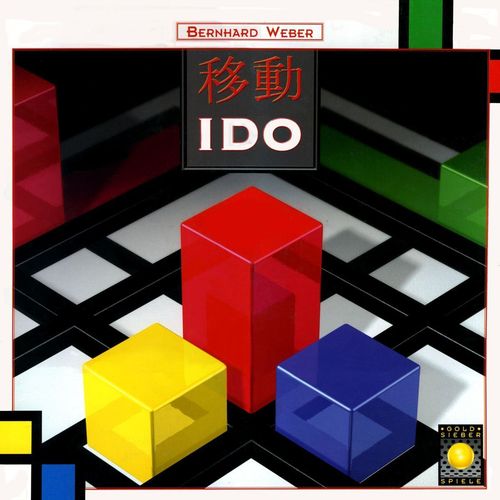
Ido
Ido Rulebook
Table of Contents
Table of Contents
Contents
- 1 game board
- 1 frame
- 12 large blocks in 4 colors
- 12 small blocks in 4 colors
- 1 rule booklet
Before you start
Before the first game, carefully stick the adhesive feet to the bottom of the board and the frame as shown on the special insert.
The game board
The game board has the static part of the playing field, as well as the start and target areas in the 4 colors. The starting place for each player is in the lower right corner, from their perspective, of the board. Blocks move onto the board across their starting line and over the border of the playing field. Each player's target area is the like-colored area diagonally on the opposite corner. Blocks moved over the target area of their color have successfully crossed the board.
The playing field is the board with the frame laid on it. The shifting playing field is home to spaces in four shapes:
- Small squares are the size and shape of one side of the small block.
- Rectangles are the size and shape of any long side of the large block.
- L-spaces are the size of three sides of a small block, shaped in an "L".
- Large squares are the size of four sides of a small block.
When the frame is shifted, the spaces on the playing field change.
Preparation
- Place the board in the middle of the table. Each player selects a color and sits down at the table so that he sits before the starting space of his color.
- Place the frame, centered on the board, as shown in the top figure above.
- Each player takes 3 large and 3 small blocks of his color and places them next to the board near his starting space as his supply.
When just two are playing, they start in opposite corners, playing red and yellow or blue and green.
Play flow
The players decide who will move first; play after that continues clockwise around the table. On a player's turn, he may do one of the following:
a. Start a block, or
b. move blocks, or
c. move the frame.
When a player has completed his turn, the player on his left takes his. If a player cannot move, he must pass this turn.
Block size and space size
Small blocks may only be moved through or into small squares. Only one block may occupy a small square.
Large blocks are always played in their upright orientation and may only be moved through or into rectangles. One or two blocks of any size and belonging to any player may occupy a rectangle. When a player moves a large block onto an empty rectangle, the player must position it exactly in a half of the field.
Blocks may not be moved to or through large squares or L-spaces.
Start a block
The player places one of his blocks on a space adjacent to his starting space. He may place a small block on a small square or a large block on a rectangle, if there is room.
Note: When the framework is in the center position on the playing field, only the small can be started. One popular early move is to move the frame, thus opening the possibility to start a large block on the next turn.
Move blocks
The player may move his blocks as many spaces, as he has blocks on the playing field at the beginning of his turn. The size of the blocks on the playing field does not affect the count: small and large blocks each count the same. Blocks in a player's supply or already past the target are not counted.
Players may move blocks only horizontally or vertically, never diagonally. Repeated direction changes, however, are allowed during a player's turn.
A player may move any of his blocks on the playing field that he wants as long as the total move does not exceed the number of spaces he is allowed. Thus, a player may move one stone his entire allotted amount or several stones smaller distances. Here again, the size of the block does not affect the counting; moving a large block one space counts the same as moving a small block one space. A player need not use all of his allotted moves if he cannot or chooses not to.
Example: If the player has three blocks on the playing field, he may move any of them three spaces, move all three blocks one space each, or move one one space and another two spaces.
Players may move blocks only over spaces which match the size of the blocks: small blocks over small squares and large blocks over rectangles. Blocks may be moved through filled spaces, but, of course, may not land in such spaces. They do count as spaces for movement. Blocks, of course, may not be stacked.
When a player succeeds in moving one or more blocks across his target space, the blocks are placed behind the target space next to the board. The number of spaces a player may move is not affected on the turn the blocks cross the target space. Of course, they will not count on the next turn as being on the playing field.
Example: A player begins his turn with 5 blocks on the playing field. He moves one block two spaces, moving it across the target space. The block is placed next to the board and the player may now moves his other blocks a total of three spaces.
Shifting the frame
Instead of starting a block or moving blocks, a player may choose to shift the frame. The player shifts the frame horizontally or vertically by the width of a small square. The frame may be never be shifted onto start or target spaces.
Shifting the frame changes the geometry of the playing field.
Often, shifting the frame will move blocks within the playing field and may even shift them off of the playing field.
- When a block is shifted onto its target space, it is treated the same as if it had been moved across the target space.
- When a block is shifted off the playing field in any other place, it is returned to the player's supply.
Note: Blocks may be shifted onto spaces where they could not be moved. That is acceptable and has no affect on the blocks later movements. The blocks may remain on such spaces until they are moved normally. When they are moved, they must, of course, follow the normal rules for movement, based on their size.
The shifting the frame action may never be done by two successive players. Thus, if the player before you moved the frame, you may not. Only the player after you may shift it. This may lead to a player having no move. When the frame is again moved, it may be shifted in any legal way, including back to the position it was in before the previous shift.
Note: When playing with two players, a player is also not allowed to shift the frame on two of his consecutive turns.
Game end and variants
The first player to succeed in having four blocks (of any mix of sizes) cross his target space wins the game. The game ends immediately.
Players who want a shorter or longer game can agree to ending the game when three or five blocks have crossed the target space. The players can also agree that the blocks must cross the target space in a certain order based on their size (e.g. large - small - large - small). If a block crosses the target space out of order, it is returned to the player's supply. If several blocks are shifted across the target space at the same time, the owning player may choose the order they cross.