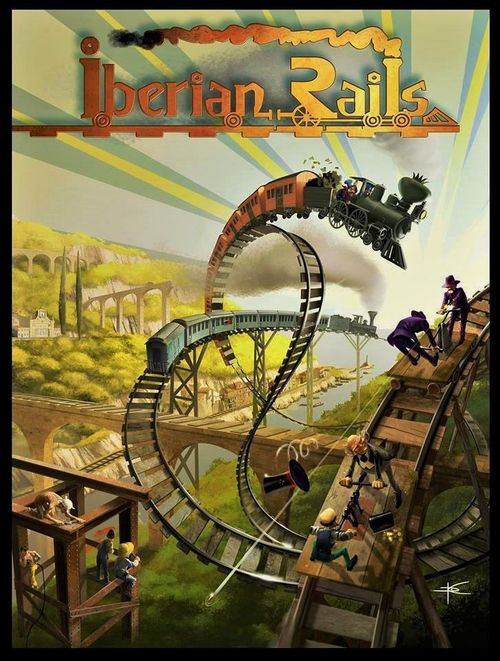
Iberian Rails
Iberian Rails Rulebook
Table of Contents
Table of Contents
Game Components
- 1 double-sided game board
- A map comprising different types of hexes: normal city hexes, tourism city hexes, and non-city hexes. Some of the city hexes are also starting hexes for the railroad companies. The non-city hexes may be developed into hotel hexes during the game (through the Hotelier's special ability).
- Treasuries of railroad companies, each serving as a cash reserve and a share reserve for holding the corresponding company's money and shares, respectively.
- 27 shares
- 6 cubes in the six company colors
- 126 tracks (train meeples) in the six company colors
- 15 character cards
- 15 character boards
- 5 player markers in the five player colors (black, purple, pink, orange, and white)
- A payout table for marking current share values of different railroad companies.
- 40 hotel tiles in the five player colors
- 5 player screens in the five player colors
- Money, in denominations of 1 peseta, 5 pesetas, 10 pesetas, 50 pesetas, and 100 pesetas.
Iberian Peninsula map:
| Railroad Company | Start Hex |
|---|---|
| Gaudi Ruell (yellow) | Barcelona |
| Ride with Cervantes (brown) | Valladolid |
| Flamencomotion (blue) | Cordoba |
| Viajero Surrealista (green) | Lleida |
| Galicia Express (red) | Ourense |
| Naranja Steel (gray) | Valencia |
Setup
- Place the game board at the center of a table.
- The shares of the railroad companies are placed in corresponding share reserves on the game board.
- A track (train meeple) from each of the railroad companies is placed on the corresponding starting city hex, according to the table above.
- Place the cube of each railroad company in the first row of the payout table, in the corresponding space (Gaudi Ruell in the first column, Galicia Express and Naranja Steel in the second column, Flamencomotion and Viajero Surrealista in the third column, and Ride with Cervantes in the fourth column).
- The remaining tracks of the railroad companies are placed to a side of the game board.
- Each player takes a player screen of his player color, a player marker of his player color, and 8 hotel tiles of his player color.
- The money is placed to a side of the game board, making up a bank. Each player takes from the bank the following amount of pesetas, depending on the number of players: 2 players, 120 pesetas; 3 players, 80 pesetas; 4 players, 60 pesetas; 5 players, 50 pesetas. The money of the players is hidden behind the players' respective player screens.
- Select the characters to be used in the game according to the following table. The number in a cell indicates the number of characters to be selected from the group of characters at the top of the column. For the first couple of games, we recommend using the non-italicized characters.
| Number of Players | Total Characters | Hotelier, Mafioso, Inspector | Engineer, Ghost, Construction Mech, Auctioneer, Phileas Fogg, Don Quixote | Banker, Bureaucrat, Venture Capitalist, Nephew, Tax Collector |
|---|---|---|---|---|
| 2 | 6 | 2 | 2 | 2 |
| 3 | 7 | 3 | 2 | 2 |
| 4 | 8 | 3 | 3 | 2 |
| 5 | 9 | 3 | 3 | 3 (replace Bureaucrat with Worker) |
When playing with Don Quixote, each player takes a 1-peseta coin and places it in front of their player screen. This coin serves as a Don Quixote marker instead of 1 peseta.
Take the character boards of the selected characters, shuffle and lay them out side by side in a random order, forming a character row. The left-most character board is the front of the character row, and the right-most character board is the rear of the character row.
Place the character cards of the selected characters on the corresponding character boards.
To Start the Game
Each railroad company in turn auctions off a share in the following order: yellow, brown, blue, green, red, and gray.
The player who last rode on a train must make a bid for a yellow share (the bid can be 0 pesetas), and proceeding clock-wise, each player either makes a higher bid or passes. Players who have passed cannot further bid on the current share being auctioned. Bidding continues until all players but one has passed.
The player with the highest bid pays the amount bid to the yellow railroad company (placing the coins in the yellow railroad company's cash reserve), takes the yellow share, and places it upright in front of him.
The player who won the bid for a share starts the bid for the next share, which is auctioned in the same manner as above.
Flow of Play
The flow of play for each round is as follows, in order:
- Players choose new characters, respectively
- Yellow (Gaudi Ruell) takes an action
- Brown (Ride with Cervantes) takes an action
- Blue (Flamencomotion) takes an action
- Green (Viajero Surrealista) takes an action
- Red (Galicia Express) takes an action
- Gray (Naranja Steel) takes an action
In Iberian Rails, players don't have action turns; railroad companies do. On a company's turn, the CEO of that company decides what the company does. The player with the most number of shares of a railroad company is the CEO of said railroad company. In case of a tie, the original CEO retains control (i.e. in order to become the new CEO of a railroad company, a player must hold an amount of shares exceeding the amount of shares held by the current CEO).
Choosing a Character
In the first round of the game, the CEO of the brown railroad company (Ride with Cervantes) chooses any character from the character row by taking the corresponding character card, and placing his player marker on the corresponding character board. Proceeding clock-wise, each player chooses from the remaining characters in the same manner.
From the second round onwards, the manner of choosing a new character is as follows. Starting from the front of the character row, for each character board with a player marker on it, the corresponding player (1) places his character card back onto said character board, (2) takes back his player marker, and then (3) chooses a new character from the character row (cannot be the character he just put back) by taking the character card of the new character. This continues, from the front of the character row to the rear of the character row, until all players have taken back their player markers and chosen new characters. After all players have each chosen a new character, they (4) place their player markers on the corresponding character boards (i.e. matching the new character cards they have chosen for the round).
Example: The Orange Player places his character card from the previous round back onto the corresponding character board (1), and takes back his player marker (2). He then chooses a new character (3).
Moving toward the rear of the character row, the next player marker is pink, so the Pink Player does the same as above: return his character card (1), take his player marker (2), and choose a new character (3).
After all players have removed their player markers and chosen a new character, they place their player markers back onto the character row, on the respective character boards (matching their new respective characters) (4).
A Company's Action
For its action, a railroad company must perform one of the following three actions, if able. If and only if a railroad company is unable to do any of the following actions, the railroad company passes.
Build Track(s) (company pays bank)
To perform this action, the CEO takes money from the cash reserve of the railroad company and pays it to the bank, in order to lay down track(s) onto map hex(es). Each railroad company can build only one track per hex, and all tracks of a railroad company must stay connected (i.e. be adjacent to another track of the same railroad company). Each hex can hold at most two tracks total (from two different companies).
The maximum number of track(s) which can be laid down in a turn by a railroad company, and the costs for putting down these tracks depend on the character which the CEO of said company has chosen for the current round. For example, if the CEO of the yellow railroad company chose the Hotelier for the current round, he can control the yellow railroad company to build 1, 2, 3, 4, or 5 tracks respectively for 10, 20, 40, 60 and 90 pesetas. This money is paid by the acting railroad company to the bank.
Occupation Fee (company pays another company)
Additionally, for each track laid down in a hex already occupied by another railroad company, the acting railroad company must pay 10 pesetas to the railroad company occupying the hex (hereafter referred to as the Occupation Fee). If the company does not have enough money to do so, it cannot lay track in said hex.
Hotel Bonus (bank pays player)
Furthermore, upon laying a railroad company's track into a hotel hex, immediately count the number of tourism city hexes (gold colored cities) said railroad company is connected to (i.e. gold colored city hex holding one of said railroad company's tracks), and the bank immediately pays that number times 10 in pesetas to the owner of said hotel.
Example: The Blue company lays down a track into a Pink Player's Hotel. Immediately count the number of tourism city hexes the Blue company is connected to (two). The bank pays the Pink Player 20 pesetas.
NOTE: if a railroad company does not have sufficient money for building any track, or if the character chosen by the CEO cannot build track (e.g. The Nephew), then the railroad company cannot choose the Build Track action.
Share Value Increase
As a railroad company extends its network, it may connect to more cities (i.e. each time one of its tracks is placed into a city hex). The company marker on the payout table is adjusted accordingly (i.e. the value of a railroad company's shares depends on the number of cities—normal AND tourism cities—the railroad company is connected to).
Open Auction and Payout
In order to perform this action, the railroad company must have at least one share remaining in its share reserve, and its CEO's character for the round must have the ability to carry out an open auction.
Open Auction
To perform this action, the CEO puts out a (company-owned) share from the railroad company's share reserve and makes a bid for it (the bid can be 0 pesetas). Proceeding clock-wise, each player either makes a higher bid or passes. Players who have passed cannot further bid on the current share being auctioned. Bidding continues until all players but one has passed.
The player with the highest bid pays the amount bid to the railroad company (placing the coins into the railroad company's cash reserve, not to the CEO of said company), and takes the share.
Share Acquisition and Payout (bank pays players and company)
If said player holds more share(s) of that railroad company than any other player, he places the newly acquired share (and any share(s) of that railroad company he already owns) upright, indicating that he is the CEO of the railroad company. If this results in a change of CEO for said railroad company, the former CEO turns his shares of said railroad company sideways. Otherwise, the player with the highest bid places his newly acquired share sideways, indicating that he is not the CEO of the railroad company (even if he is tied for most shares for that railroad company).
Then each share of said railroad company pays out according to its current value, as indicated by the payout table. Specifically, for each share of said railroad company that a player holds (all players, not just the CEO), the bank pays the player the value of the share; additionally, for each share in the railroad company's share reserve (shares still owned by said railroad company), the bank pays the railroad company the value of the share.
Closed Auction and Payout
In order to perform this action, the railroad company must have at least one share remaining in its share reserve, and its CEO's character for the round must have the ability to carry out a closed auction.
Closed Auction
To perform this action, the CEO puts out a (company-owned) share from the railroad company's share reserve, and every player holds a secret amount of money in his fist. Then, all players reveal their secret bids simultaneously.
The player with the highest bid pays the amount bid to the CEO. In case of a tie, the player closest to the CEO in clock-wise order wins the bid, with the CEO winning all tiebreaks. In case a player would pay himself in a closed auction, he pays that amount to the bank instead (i.e. when the CEO himself, or a player holding a closed auction as a Mafioso, wins the closed auction).
Share Acquisition and Payout
Then, said player acquires the share, and the bank pays out in the same manner described above (i.e. same as a Share Acquisition and Payout after an Open Auction).
New Round
After the gray railroad company has taken its action, play proceeds to the next round, wherein players choose new characters, and the railroad companies take actions in turn.
End of the Game
When four of the railroad companies have no share in their share reserves, or if one of the railroad companies has connected to 12 cities, the game will end after the current round (i.e. after the gray railroad company has taken its action).
After the game has ended, each share held by a player pays out twice its value (as indicated by the payout table). As during the game, the players collect these payouts from the bank. The player with the most pesetas wins. In case of a tie, the player owning the fewest share(s) wins. In case of a further tie, the player holding the character card closer to the rear of the character row wins.