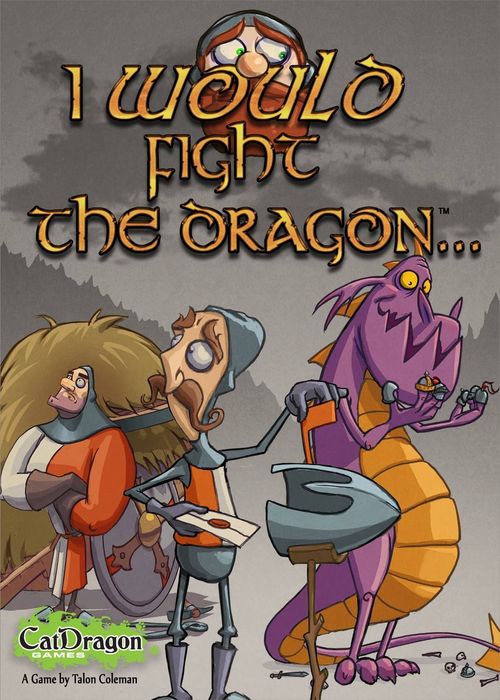
I Would Fight The Dragon...
I Would Fight The Dragon... Rulebook
Table of Contents
Table of Contents
Setup
I Would Fight the Dragon... consists of a deck of 50 cards, enough to equip up to eight fearless fools...er...knights to go dragon-slaying.
For each player sort out one full set of dragon-fighting gear. That's one Horse, as well as a Weapon, Shield, Helmet, and suit of Armor. Or, as dragons refer to it all: tableware.
Once you've done that, add one extra set of gear for 2–5 players or two extra sets for 6–8 players. For example, for a seven-player game, you would have 45 cards total: seven players x 5 cards each plus two extra sets of five cards. (If you have that many players, it's actually easier to just remove the one set of gear you don't need.)
Then, because you aren't entirely ready to go haring off on another of the king's mad quests, shuffle all that gear together into one big Equipment Stack. Deal four cards to every player (See! There is no way you are ready with only four pieces of gear!) and place the rest of the Stack as a draw pile within easy reach of all players.
Then choose someone to be the first knight—doesn't really matter how. Make it the poor sap who was last to be ready at the table.
That's it. You are ready to begin!
(Setup illustration, labelled: Armor, Helmet, Horse, Shield, Weapon.)
Object
If you are in a hurry to achieve fame and fortune (and by "fortune" we mean "having your portrait on the castle wall for dying a brave and honorable death"), then your objective is to place one of each gear type in front of you as fast as you can. We are certain your companion knights will help you along.
However, if you want to survive the day by not becoming a knightly flambé, your objective is slightly less…noble.
Your goal is to help the other knights find their gear before they help you find yours, and then point them on their way to certain doom—uh, dragon-fighting glory! Every round, you will offer up your own excuse as to why you aren't yet ready to go poke the angry dragon…and while everyone commiserates with you and drinks another round of ale to celebrate all the knights whose bones now decorate the dragon's lair, you stuff some gear into your "friend's" pack. They, in turn, do the same to the next knight, and so on, until the gear simply cannot be hidden any longer.
Getting called out means having to admit you do have a critical piece of gear (or maybe more than one!) in your pack. The "winner" is the knight who is forced to assemble all five pieces of gear first. The survivors can toast in his memory.
How to Play
With four cards in everyone's hand and the Equipment Stack in the middle of the assembled knights, you are ready to begin.
The first knight starts "The Pack" by placing a card from their hand face down on the table and making their first excuse. For example:
"I would fight that dragon…if only my armor was back from the smithy…"
In other words, the player is claiming they do not have an Armor card in their hand. Meanwhile, they may be slipping Armor—or something else they feel needs to be hidden away—into The Pack, foisting that gear onto their fellow knights.
The Pack is then shoved to the player on their left. The second knight, the player being given The Pack, has two choices. They can either call the first knight a coward, challenging that The Pack must contain a suit of Armor, or, more likely at this early stage, they can accept that no knight would besmirch themself with such a falsehood.
Assuming they accept the first knight's word, second knight then offers their own perfectly sound excuse as to why they are also not quite ready to fight that dragon as they add a second facedown card to The Pack. Both cards are then shoved to the left, toward the third knight.
The third knight follows suit, offering their own excuse, laying a card onto the growing pile of gear, and pushing The Pack onto the fourth knight, who has got to be feeling that he got the raw end of this deal.
Because by this time, no matter what this player says (after they add their own card to The Pack), there is a pretty good chance that what he claims to be missing is in that stack of four cards. Knight number four tries to bluff it anyway.
"I will fight that dragon…er…just as soon as I find...a sword…?"
The next knight isn't going to let that one go by, and declares the fourth knight a "coward."
With the challenge made, The Pack is turned face up for all to see. (Exception: see Stiff Upper Lip below.) If The Pack contains the item which the current player claimed they were missing (a Sword, if you recall), then the player is declared a scoundrel and forced to claim it.
"Ahem! Isn't that your sword?"
The fourth knight picks up the Sword and places it face up in front of them. That player may no longer lie about missing that particular piece of gear.
Now if the Sword had indeed been missing from the pack, a very relieved fourth knight would have the upper hand, having been proven brave and forthright and very much not a coward at all. (Whew!) The player can then give any one card from The Pack or from their hand to the knight who challenged them (in this case, the fifth knight).
"You see! I have no sword! But isn't this…your horse?"
Leaving aside how the fifth knight's Horse even fit into The Pack, fifth knight accepts the Horse and places it face up. Fifth knight may never again lie about possessing a Horse while that card remains in front of him.
This particular round is over. Starting with the knight to the left of whomever was forced to accept a card, all knights draw one card from the Equipment Stack until each player has a full hand of four cards again. (As available gear runs low, the scoundrel may not be able to draw back up to a full hand of cards. In fact, eventually, there may be several knights running low on hidden gear. Ah, well.)
Gear cards not claimed from The Pack go into a face-down discard pile. If the Equipment Stack empties, shuffle the discard and create a new Stack.
"Knave and fool! You try to deceive us? You can redeem yourself only by leaving us now to fight the dragon!"
For his failure, the scoundrel who was caught lying (or the knight who failed his challenge) must then start the next round of excuses by placing a single card from their hand on the table, starting The Pack again, and shoving it toward the next knight to the left.
Play continues in this fashion, with knights adding more and more gear into The Pack and occasionally getting caught. As long as no single knight has the requisite five pieces of gear face-up in front of them, the excuses (and The Pack) start right back up.
Remember: only the knight to your left may call you a coward. Once they accept your forthright and truthful bearing, no one else may challenge you.
Stiff Upper Lip
Occasionally, a knight being called out by their neighbor can try to force the issue by climbing on their high horse and upping the stakes.
"You dare challenge me, sirrah?!"
The knight is effectively doubling down on their claim to lack the very critical and (currently) hard-to-find piece of gear. If a knight speaks up in such a manner and is proven correct, then they may either force two pieces of gear on the accusing knight or (even better) the accused player may give one piece of their own face-up gear to the offensive knave for doubting the sincerity of a dutiful knight pledged to the king's service.
Faced with such a position, the accusing knight may, with all due humility, back down and accept that they may have overstepped their boundaries…this time. Play continues as if the knight had never called their boon companion a coward.
However. If the knight who lied and then got huffy about it is proven to be a deceitful jackal after all, the challenger may force two pieces of gear on the liar. Either piece may come from The Pack or the accuser's hand (but not a face-up card!).
"I do challenge thee! And the horse thou rode in on! In fact, there is your horse now. And here is a shield to cover thy bared rump."
Victory or Death
Play continues until one knight is finally forced to accept his fifth piece of dragon-fighting equipment. And, with as much enthusiasm as they are able to muster, the knight rides off to fight the dragon.
Everyone else at the table should give the player a hearty cheer.
After all, it could've been you.