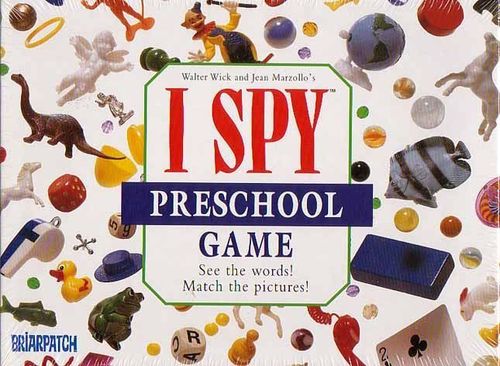
I Spy Preschool Game
I Spy Preschool Game Rulebook
Table of Contents
Table of Contents
Object of the Game
Players match riddles with pictures. When all the pairs are completed, everyone wins! Beginners "read" the pictures; advanced players read the words. Five versions of play are suggested for children at different levels of skill and experience.
Getting Ready to Play
Before punching out the pieces, read the cards in the order that they are found, so that the child will hear the rhymes. You'll notice that the cards form rhyming pairs, indicated by a matching colored bar on the left.
Jean Marzollo says, "Hearing rhymes is an important skill for preschoolers; research shows the ability to hear them is a prerequisite for reading."
1. Beginners' Matching Game
Punch out the cards. Select both halves of one pair and say, for example, "I spy a shovel and a big rubber duck." Of the other card, say "Can you find the same duck and shovel in this picture, too?" Let the player link the two cards together and say, "These two cards go together, like this." Show that the riddle will not link with any other picture, saying, "These two cards do not go together. You can tell because the pictures don't match and the tab doesn't link." The cards are self-correcting: each pair is uniquely cut so that only the correct match will link.
Now try it with a choice of three matches. Put three picture halves in front of the child, for example, the spoon, the rubber duck and the butterfly. Hold up and read one riddle half and ask the child which is the correct picture that matches the riddle. Try it the other way around, showing one picture with a choice of three riddles, one of which is the correct one.
2. Listening and Matching Game
If you are the game leader (an adult or older child), distribute the picture cards equally among the players, keeping the riddle cards in a stack. If there are any picture cards left over, keep them face up in front of you. The other players can help you find the matches to these left-over cards.
Hold up one riddle card at a time so that everyone can see it and say for example, "I spy a shovel and a big rubber duck. Who has the match to this card?" The player with the matching card takes it and links the pair together. Play continues until all the pairs are matched. Everyone wins!
Young children are developing social skills. This game provides them the opportunity to show respect for their playmates by taking turns and playing fairly.
3. Rhyming Matching Game
Set all picture halves aside. They are not used in this game. Match up the cards that rhyme (Example: "I spy a sheep and a kitty cat; I spy a shoe and a cowboy hat.") and read them aloud. Deal out one half of each pair to the players, keeping the other half for yourself. Read a riddle aloud. The player who has the rest of the rhyme reads or repeats it aloud and claims the card. Play continues until all the rhymes have been matched. (The colored bar on the left of each card will be the same color.) Everyone wins!
Jean Marzollo says, "Some children read the words, some "read" the pictures, and some do a combination of both. In all cases, they are helped by remembering and anticipating the rhythmic pattern and rhyming sound."
4. Reading and Matching Game
(This version can be played without a game leader once players are familiar with the game.) Distribute the picture cards equally among the players. In this version of play, it's okay if one or more players has an extra card. Place the riddle cards face up in the middle of the table. On your turn choose one riddle card from the pile and say the riddle, "I spy a sheep and a kitty cat." If it is a match for one of your picture cards, link the two cards together and keep the matched pair; if not, return the card you chose to the pile. The turn passes to the next player. Play continues until all players have completed their matching pairs. Everyone wins!
5. Memory Matching Game
Place all cards face down in the middle of the table. Mix them well and arrange them in rows. On your turn, choose two cards and turn them face up so that all players can see them. If they are a riddle and picture that match, you may keep them and take another turn. If not, place them face down on the table in the same position. Watch carefully as other players turn over cards so that you will remember where the matching cards are when it's your turn again. (HINT: When playing with beginners, start with fewer cards.) The player with the most matching pairs wins.
Children at ages three to six are good at memory activities. Games such as this help them to reinforce memory skills and offer them the opportunity to learn tactical and strategic thinking.