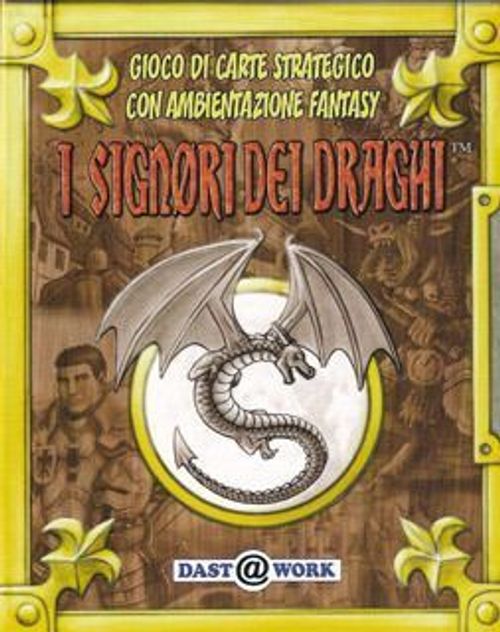
I Signori dei Draghi
I Signori dei Draghi Rulebook
Table of Contents
Table of Contents
Introduction
I Signori dei Draghi is a strategic, fantasy-style card game played between two opposing teams.
The game is set in the elven region of Mysthras. The official currency of Mysthras is the iros.
Each team may consist of two to four players, seated around the table in alternating order ("team A player – team B player – team A player – team B player" in the case of two teams of two players).
Note: it is theoretically possible to practise by playing one against one, but playing in teams (2 vs 2, 3 vs 3 or 4 vs 4) is strongly recommended.
Contents of the box
- 166 game cards
- 8 castle cards
- 22 plunder cards
- 8 markets
- This rulebook
Objective of the Game
The objective of the game is to win the match against the opposing team.
Winning a game
The result of a game is decided by the following rules.
- Each team starts the game with 50,000 Iros (the currency of Mysthras).
- A team's Iros decrease as a result of defeats suffered in combat and of any purchases, sharings (Share) or supports (Support) made by players of that same team.
- The team that is left with 0 (zero) Iros loses the game.
Getting Started
Setting up the game
- The players of the two teams sit around the table alternately (team A player – team B player – team A player – team B player ...).
- One player from among all the players is chosen as the cashier. The cashier takes paper and a pen and prepares a sheet like the one shown below, with one column for team A and one for team B.
- Each player places a market in front of them.
- For the first game, the dealer is chosen by one of the usual methods (counting or rolling dice). For later games, the dealer role passes counter-clockwise.
- The cards are dealt counter-clockwise.
- The dealer shuffles the castle cards and deals one to each player. Each player places the castle card they receive face up next to their market.
- The dealer shuffles the plunder cards and places them in the centre of the table.
- The dealer shuffles the game cards and deals 9 to each player, placing the remaining ones in the centre of the table next to the plunder cards.
- Each player chooses 4 of their 9 game cards and places them face up in their own market (see Market, page 9). The remaining five cards form the player's hand.
- When all players have 5 game cards in hand and 4 face up in their respective markets, the game begins (see Phases of Play, page 24).
Important: Players of the same team may not advise each other and may not ask questions of the other players in order to decide their team strategy or their personal strategy. Players must carry out the team strategy only by playing.
Before explaining how turns work, it is essential to understand the terminology of the game, the meaning of the symbols on the game cards, the battlefield, the market and the characteristics of the cards.
Terminology
Game terms
Discard pile: Cards that are discarded, destroyed, sacrificed, etc. are sent face up to the discard pile, which is shared and forms in the centre of the table.
Discard: Send a card from your hand to the discard pile.
Destroy / Sacrifice: Send a card from the battlefield to the discard pile.
Place: Send a card from your hand to the battlefield. In general this term is used for artifacts, roles and castles.
Summon: Send a card from your hand to the battlefield. In general this term is used for creatures.
Cast: Show the card to the other players by placing it face up on your battlefield, use its effects, and then send it directly to the discard pile. In general this term is used for spells, equipment spells, anti-magic, blessings and curses with a single, immediate effect.
Market terms
Buy: Take a card from any market and put it into your hand, paying its listed value.
Exchange: Swap a card from your hand with a card placed in your own market. (Remember that this can only be done in the final phase of your turn.)
Symbols on Game Cards
The symbols described in this section appear only on some game cards. Cards that carry these symbols have special functions, described below. The symbols are shown both to the left of the card name and in the text of the card itself.
-
Share (Condivisione): During your turn, paying the price of the card, you may pass it from your hand to the battlefield of a teammate.
-
Instant (Istantanea): The card may be played at any time in the game, including during the turns (and therefore also during the combat phases) of other players (for example, to come to the aid of your teammates).
-
Final (Finale): Until the end of the turn in which a final card is played, no one may cast Spells, Equipment Spells, Anti-magic, Blessings or Curses (not even instant ones).
Note: If a player mistakenly casts a spell, an equipment spell, an anti-magic, a blessing or a curse in the turn in which a final card was played, the card cast by mistake is sent to the discard pile and its effects do not apply.
-
Support (Supporto) (this symbol appears only on creatures): By paying the value shown on the card, the creatures on your battlefield may be passed, in attack position, to the battlefield of a teammate, provided they are suitable for the level of that teammate's role (see Role, page 14). All creatures have the Support ability (see Creature, page 18).
Battlefield
Each player has their own battlefield. The battlefield is the area of the table next to the player's market where that player summons or places their cards.
A player's battlefield may contain:
- One castle card, given to the player by the dealer at the start of the game (see Castle Card, page 12).
- An unlimited number of creatures (see Creature, page 18).
- One role, with possibly some blessings placed behind it to raise its level (see Role, page 14).
- One artifact (see Artifact, page 23).
After the setup phase, and before the first turn, each player has in front of them only their market (with the four cards placed during setup) and their castle card.
Diagram 1: Battlefield at the start of play (only the market and the castle card are present).
After a few turns, a player will be in a situation like the one shown in Diagram 2. It is not certain that a player will have a role, an artifact or blessings that raise the level; this depends on the cards drawn and played from hand. It is also possible that someone has bought one or more cards from their own market, so some may be missing.
Diagram 2: A battlefield with face-up creatures, a face-down creature (in defence position), an artifact, a role, and a blessing that brings the role to level 2.
Market
The market consists of four spaces, on which cards are placed at the start of the game and afterwards face-up game cards.
Every game card has a value printed at the bottom right: the cost of the card.
Cards for sale in the market: The game cards placed in the four market spaces are for sale. They take no part in the game in any way, as they are inactive cards that can only be bought (from any market) or exchanged (only with the player's own market, and only at the end of a turn).
Buying one or more cards from the market
In the main phase 1 and in the main phase 2 (see Phases of Play, page 24) of their turn, each player may buy game cards from their own market or from the market of any other player, subtracting the cost of the card from the Iros of their own team. During the first round, cards may not be bought from markets.
Example:
- Team A: 50,000 Iros – Team B: 35,000 Iros.
- A player of team A buys from any market a card worth 3,000 Iros.
- Result: Team A 47,000 Iros – Team B 35,000 Iros.
When a player buys a card from any market (including their own), they place it among the cards in their hand. A purchased card may be played at any moment (even immediately) when it is allowed to be played. The owner of a market is obliged to sell the card to any player who intends to buy it.
Remember:
- No player may buy cards during the first round of the game.
- A player may buy cards only in main phase 1 and main phase 2 of their turn.
- A player may not buy cards during the combat phase, nor during the final phase of their own turn.
Exchanging cards between hand and own market
Each player has the option of exchanging the cards in their hand with those in their own market, only and exclusively in the final phase of their turn. Cards may not be exchanged with the markets of other players.
Example:
- Step 1: Player A is in the final phase (see Final Phase, page 30) of their turn.
- Step 2: Player A decides to exchange one or more cards from their hand with one or more cards in their market.
- Step 3: For each card that player A takes into their hand from their market, they must place one card from their hand into the market.
Remember: Exchanging cards can only be done with your own market, and it is free. However, cards exchanged cannot be played in the same turn in which they were taken back into hand. For this reason, exchanging can only be done in the final phase of your turn.
Note: In the final phase of each of their turns, a player may keep a limit of five cards in hand. If they have more game cards in hand, they must necessarily fill any empty spaces in their market before being able to discard the excess cards and then pass the turn.
Cards
There are three types of cards in the game:
- Castle cards
- Plunder cards
- Game cards
Important: If this rulebook contradicts what is written on a game card, the rules to follow are those printed on the card.
Castle card
Castle cards are distributed at random, one per player, at the start of the game. Those left over are returned to the game box. Each castle card has a value from a minimum of 4 to a maximum of 6. This value is the defensive strength (it does not count as attack strength) with which each player begins the game. The strength of the castle card remains constant for the entire duration of the game, and it is added to the total strength of the player's army only in the defensive role.
Example 1: Castle value 6. No creature on the player's battlefield. Total defence strength: 6. Attack strength: 0.
Example 2: Castle value 5. One creature on the player's battlefield with strength 3. Total defence strength: 8. Attack strength: 3.
Plunder card
Plunder cards are placed face down in the centre of the table at the start of the game. At the end of each combat phase (see Combat Phase, page 26), the winner draws one. Each plunder card lists the consequences of the battle for the winner and for the loser.
Example 1: Player A (of team A) attacks player B (of team B). Player B wins the combat:
- Player B draws the plunder card, reads the "winner" section and applies its content.
- Player A reads the "loser" section of the same plunder card and applies its content.
The Iros gained by player B must be added to the Iros of team B, and likewise the Iros lost by player A must be subtracted from the Iros of team A. The Iros are subtracted or added on the sheet prepared at point 2 of the game setup.
Game card
Game cards are in turn divided into 8 sub-categories. The sub-categories are named at the top, just below the name of the card, and are represented by the symbol placed at the top left:
- Role (Ruolo)
- Creature (Creatura)
- Spell (Incantesimo)
- Equipment spell (Magia equipaggiamento)
- Anti-magic (Antimagia)
- Blessing (Benedizione)
- Curse (Maledizione)
- Artifact (Artefatto)
(The sub-category symbol and the card name are shown in the card diagram on page 13 of the printed rulebook.)
Role
There are 5 roles: Elf, Warrior, Priest, Summoner and Dwarf.
Each player may deploy only one role on their battlefield.
A role grants the abilities listed on the card itself.
Until a role is placed on the battlefield, the player is at level 0 with no abilities. When a role is placed on the battlefield, the player becomes a level 1 character ("L1", shown at the top left of the card), with the abilities corresponding to that level.
The level of the player's role may increase through the use of some blessings, and may decrease because of some curses cast by opponents. In the example in the printed rulebook, the Dwarf is level 2 thanks to the blessing "Spirito Divino" (Divine Spirit), which makes him so. At this point the Dwarf may use the abilities corresponding to level 2 shown in the text of the card.
Important: You may not raise the level of your role by more than once per turn.
If behind the blessing "Spirito Divino" one were to play the blessing "Spirito Glorioso" (Glorious Spirit), the role would become level 3, acquiring the corresponding abilities.
Downgrading: If, for example, because of a curse, a level 2 role is downgraded by an opponent, the blessing "Spirito Divino" is sent to the discard pile, and the role returns to level 1.
A level 1 role that suffers a downgrade returns to level 0 (the role card is sent to the discard pile), so the player must then manage to place a new role card on their battlefield.
If you have a level 1 role on your battlefield, you may choose to replace it with one you have in hand, discarding a card. For clarity, the procedure is described below in three steps:
- Step 1: Discard a card from your hand.
- Step 2: Destroy the role on your battlefield, and destroy all creature cards of level 1 that you can no longer keep (see Creature, page 18).
- Step 3: Play the new role from your hand.
Remember: You may change your role on your own only if it is at level 1, and you may not raise the level of your role by more than once per turn.
Role specifics
Elf: The elf's characteristic is that they draw more cards than the others. At level 1, at the start of the turn, 3 cards are drawn instead of 2, but the elf must discard one card of their choice from among those just drawn before taking the rest into hand. At level 2, the elf may keep all three cards drawn at the start of the turn in hand, without having to discard one. At level 3, in addition to drawing and keeping the 3 cards at the start of the turn, the elf may keep 7 cards in hand at the end of the turn, instead of 5.
Warrior: The warrior is the role designed for attack. At level 1, the warrior's army gains 10 bonus points that are added to the total attack strength. At level 2, the warrior's army gains 15 total offensive bonus points. At level 3, the warrior's army gains 25 total offensive bonus points. The warrior's bonus applies only in attack, so it is not counted when you are attacked (that is, when you are defending).
Priest: The priest is the role designed for defence. At level 1, the priest's army gains 10 bonus points of defence that are added to the total defence strength. At level 2, the priest's army gains 15 total defensive bonus points. At level 3, the priest's army gains 25 total defensive bonus points. The priest's bonus applies only in defence, so it is not counted when you declare an attack, but only when you are attacked.
Summoner: The summoner is the role designed to summon creatures that are impossible for other roles to summon. While all other roles at level 1 may summon and keep only creatures of level 0 or 1 (see Creature, page 18), the summoner, at level 1, may summon and keep creatures of level 2 as well. At level 2 the summoner may summon and keep creatures of any level. At level 3 the summoner may use the Support ability at no cost, so they may pass creatures on their battlefield to teammates for free (but only in attack position, and only to teammates with roles of a level suitable for the creature passed).
Dwarf: The dwarf is the role designed to hinder the opponents' game. During their turn, a level 1 dwarf may move one creature of level 1 or level 0 belonging to one opponent from that opponent's battlefield to that opponent's market. During their turn, a level 2 dwarf may move one creature of at most level 2 belonging to an opponent from the battlefield to that opponent's market. During their turn, a level 3 dwarf may move any one creature belonging to an opponent from the battlefield to that opponent's market. Alternatively, the dwarf may destroy one creature of at most level 2 belonging to an opponent of their choice.
Note: If your role is the Dwarf and you want to use its effect on a player whose market is full, before moving that player's creature from the battlefield to the market, choose a card in that player's market and return it to their hand. After doing this, you move the creature you chose from its battlefield to the market space you have just freed.
Creature
Creatures are the base cards of the army, used to attack and to defend. Each player has their own army made up of creatures, and must fight alone against the army of the enemy they attack, or defend against whoever attacked them.
On creatures, in addition to the cost of the card (printed as always at the bottom right), the following values are shown:
- At the top left of the card, to the right of the sword symbol, is the strength of the creature.
- Also at the top left, below the level symbol, is the level of the creature. This value is the minimum level that the player's role must have in order to summon and keep the creature on their battlefield.
In the image in the printed rulebook, the strength is shown by the number 5 (so this creature has strength 5), and the level of the creature is shown by the label L1 (so to summon this creature you must have a role of at least level 1).
Example 1: Player A, role: none (level 0). Can summon only creatures of level 0.
Example 2: Player B, role: level 2. Can summon creatures of level 0, level 1 and level 2.
Creatures may be summoned on your battlefield in the following two ways:
- Face up (in attack position): They attack and defend.
- Face down (in defence position): They count only in defence until they are turned face up (other players may not see them).
In their own turn, a player may summon all the creatures they wish, if they have the opportunity to do so.
Specifics for face-up creatures: Face-up creatures (that is, in attack position) attack and defend. Every face-up creature is vulnerable to spells, curses, blessings, the effects of roles, the effects of artifacts and the effects of plunder cards. The abilities of creatures are triggered and can be used only if the creatures are face up. Face-up creatures may be used to attack even in the same turn in which they are summoned.
Specifics for face-down creatures: Face-down creatures (that is, in defence position) do not suffer the effects of spells and of other game cards (they therefore cannot be destroyed by the effects of any card, including plunder cards), but they must still be destroyed if the player's role can no longer keep them, for example because of a downgrade. Face-down creatures (that is, in defence position) may not attack, and count only in the defensive phase.
Important: All your creatures in defence position are turned face up (so they pass into attack position and take part in the combat) as soon as an attack against you is declared. Once they pass into attack position, their abilities are immediately triggered, and they can no longer be placed in defence position.
Conversely, when you declare an attack, your creatures in defence position do not take part in the offensive strength of your army and remain face down.
Creature abilities may not be used while the creatures are face down.
Effects of downgrading: If, because of a curse, your role is downgraded (that is, it loses a level), all creatures (including those in defence position) with a level that your role can no longer keep are destroyed and sent to the discard pile.
Example 1: Player A, role: level 2. Has on their battlefield 3 creatures of level 0, 4 creatures of level 1, and 5 creatures of level 2.
If player A is downgraded because of a curse cast against them by an opponent, the blessing "Spirito Divino" behind the role is sent to the discard pile, the level of their role becomes 1, and they must destroy all creatures of level 2 (including those face down), because their role no longer has the level to keep them. After player A has been downgraded, the result is:
Player A, role: level 1. Has on their battlefield 3 creatures of level 0 and 4 creatures of level 1.
Remember: On your battlefield there may always and only be creatures that the level of your role can keep.
Serious penalty: If a player summons (or keeps after a downgrade) in attack position (face up) or defence position (face down) creatures that cannot be supported by the level of their role, their team immediately loses 10,000 Iros (as soon as the opponents notice), and the creatures that cannot be sustained by the role's level are immediately sent to the discard pile. If a player is downgraded, they are obliged to destroy all creatures (both face down and face up) that they can no longer keep, sending them to the discard pile.
Changing the position of your creatures: It is possible to change the position of creatures from defence position to attack position only in main phase 2, after the combat phase (see Phases of Play, page 24). It is not allowed, therefore, to turn face-down cards up and use their strength in attack in the same turn. Creatures that pass from defence position to attack position may therefore attack only in the following turn.
It is never possible to pass creatures from attack position to defence position: creatures may be placed in defence position only at the moment they are summoned.
Important: All creatures have the Support ability, that is, they may be passed in attack position from your battlefield to the battlefield of a teammate with a suitable role level, by paying the price shown on the card itself.
Spell, Equipment Spell, Anti-magic
Equipment spell: May be played only in the combat phase in which you are involved. It is allowed to play more than one at the same time, to increase the strength of an attack or of a defence. When an equipment spell is played, it must be placed on the battlefield until the end of the clash. At the end of the combat, all equipment spells present on the battlefields are sent to the discard pile.
Spell: May be cast only in main phase 1 and in main phase 2. Once a spell has been cast and its effects activated, it is then sent to the discard pile. In their own turn, a player may play any number of spells.
Anti-magic: May be used every time a spell or an equipment spell is played against you. When you play an anti-magic against a spell or against an equipment spell, both go to the discard pile.
Blessing and Curse
Blessings and curses may be played only in main phase 1 and in main phase 2. In general they follow the rules of spells, but against blessings and curses anti-magic has no effect.
Artifact
Artifacts are placed face up on the battlefield.
Each player may have at most one artifact on their battlefield, and its effect is continuous. The artifact is placed on the battlefield, and the only way to destroy it (that is, to send it to the discard pile) is to play against it a card that has the possibility of doing so.
Phases of Play
After the setup phase, the game begins. Remember that during their own first turn, players may not buy from markets, attack, or cast spells, blessings or curses.
Each player, in their turn, must follow the following phases, which are summarised below in a "quick reference" and explained in detail immediately afterwards.
Quick reference:
- Initial phase: draw 2 cards.
- Main phase 1: you may play your cards, buy from the markets, and declare an attack.
- Combat phase: (only if you have declared an attack against an opponent) fight against the army of an opponent.
- Main phase 2: you may reorganise yourself by playing cards, buying from the markets, and moving your creatures into attack position.
- Final phase: you may exchange cards with your market and pass the turn.
1) Initial phase
During this phase the active player draws two cards from the deck of game cards.
2) Main phase 1
During this phase the active player may:
- Place a role on the battlefield (remember that you may have at most one).
- Summon creatures in attack or defence position on the battlefield.
- Cast spells, blessings and curses.
- Place artifacts on the battlefield (remember that you may have at most one).
- Buy from the markets of any player.
- Share cards with the Share (Condivisione) symbol from your hand, or use the Support ability of creatures.
- Change your role (only if it is level 1) for another role you have in hand (see the procedure on page 15).
- Use the abilities of creatures and any effects of the artifact and of the role placed on your battlefield.
- Declare an attack against a player of the opposing team.
Remember: you may declare only one attack per turn.
If an attack is declared, you go immediately to the combat phase; otherwise you go directly to main phase 2.
Note: To declare an attack, you must have at least 1 creature on your battlefield.
3) Combat phase
-
The attacking player declares the total offensive strength of their attack. This strength is the sum of the following values:
- The sum of the strength of the face-up creatures (that is, in attack position) on their battlefield.
- Any bonuses deriving from their role, from their artifact and from the abilities of creatures.
- Any equipment spells that the player has decided to play to increase the attack strength of their army.
-
After the attacker has declared their strength, the defender (the player attacked) immediately turns face up any face-down creatures in defence position, placing them in attack position, and declares the total strength of their defence. This strength is the sum of the following values:
- The value of the castle card.
- The sum of the strength of all creatures on their battlefield.
- Any bonuses deriving from their role, from their artifact and from the abilities of creatures.
The defender then considers whether to play equipment spells or anti-magic, according to the following cases.
Case 1: If the defence strength as described above is greater than or equal to the attack strength of the attacker, the combat ends in favour of the defender, with no further possibility for the attacker to play equipment spells (unless instant cards intervene).
Case 2: If the defence strength as described above is less than the attack strength, the following procedure applies:
The defender may play equipment spells (or anti-magic to block any equipment spells of the attacker, or instant cards may come to the aid of the team) until, if possible, they exceed the total strength of the attacker.
If they succeed in exceeding it, the attacker in turn, with the help of further equipment spells, anti-magic or instant cards, may try to exceed the total strength of the defender.
Example, Case 1:
- Step 1: Player A attacks player B.
- Step 2: The strength of the attacker is 45: 15 (that is, the sum of the creatures in attack position on their battlefield) + 10 (player A has the warrior role at level 1) + 20 (player A casts the equipment spell "Fulmine sacro", Holy Lightning) for a total of 15 + 10 + 20 = 45.
- Step 3: Player B (who in this case is the defender) immediately turns the face-down cards in defence position face up, and begins counting their defence: 6 (castle card) + 6 (player B has the artifact "Bracciale d'oro", Golden Bracelet, which doubles the value of the castle) + 38 (all creatures in their army, including those just turned face up that the attacker could not see). The total strength of the defender is therefore 6 + 38 + 6 = 50.
The combat is over: the defender has won. The attacker may no longer play equipment spells, even if they have them in hand!
Note: If the attacker, or some player of the attacker's team, has the possibility of playing one or more instant cards, the result could change.
Example, Case 2: This example cites only the total strength of the defender and of the attacker.
- Step 1: Player A attacks player B.
- Step 2: The total strength of the attacker is 38.
- Step 3: The total strength of the defender is 26.
At this point the defender may decide whether to cast equipment spells, anti-magic or something else to exceed the strength of the attacker. If they do not want to or cannot cast useful cards, they have lost the clash. The winner in this case is the attacker.
Suppose instead that the defender has the spell "Aiuto dalla terra" (Help from the Earth) in hand, which gives +15 strength to their army, and decides to cast it. At this point the defender has a total strength of 26 + 15 = 41 and is winning the combat, but the attacker may respond with an anti-magic, or with further equipment spells. The players will proceed in turns in this way, until one of the combatants can no longer (or does not want to) increase the total strength of their army.
Clearly, the winner will be the one with the greater strength.
Note: The defender (that is, the player who received the attack) will, after the combat, have only face-up creatures (that is, in attack position) on their battlefield.
Important: Remember that the attacker may cast equipment spells only at the moment they declare the attack. They may then cast other spells only in Case 2 (that is, if the defender responds to the attack with cards). Only instant cards are an exception, and they may always be played.
Note: After the winner of the battle has drawn the plunder card, the clash is over, and it is no longer possible to play any instant cards until the beginning of main phase 2 of the current turn.
4) Main phase 2
During this phase the active player reorganises themselves: they may do everything that is possible in main phase 1, except of course declare an attack, because the combat phase has already passed. In this phase, they may also:
- Pass any creatures present in their battlefield zone from defence position to attack position. (It is never possible to pass cards from attack position to defence position.)
5) Final phase
During this phase the active player may:
- Exchange cards from their hand with their own market (see page 11).
- Place cards from their hand into their own market.
- It is not possible to discard cards unless their market is full and they have more than five cards in hand.
- Pass the turn to the next player. (The turn may not be passed with more than five cards in hand.)
Remember: In the final phase of each of their turns, each player may keep a maximum of five cards in hand. If they have more game cards in hand, they must necessarily fill any empty spaces in their market before being able to discard the excess cards and then pass the turn.
The 7 Fundamental Rules
These rules have already been mentioned in the rulebook, but we repeat them in this section because they are very important in the game and it is easy to forget them, especially in the first games:
- During the first turn, players may not buy from markets, attack, or cast Spells, Blessings or Curses.
- On your battlefield (in addition to the castle card given at the start of the game) you may place only one role (with any blessings that raise its level), only one artifact, and an unlimited number of creatures may be summoned.
- You may summon (and keep alive on the battlefield) only creatures with a level equal to or lower than the level of your own character.
- Each player has their own army. You may declare an attack against a player only if you have at least one creature on the battlefield. You may declare at most one attack per turn.
- If your role is downgraded, all creatures (both in attack position and in defence position) with a level that cannot be kept by the role's level are destroyed. The downgraded player is obliged to destroy both face-down and face-up creatures that they can no longer keep.
- If you pay and buy a card from any market, you may play it immediately. If you exchange (the exchange can only be done at the end of the turn and only with your own market), you may only keep it in hand and use it in the following turn.
- Every player must end the turn with a maximum of five cards in hand. If they have more game cards in hand, they must necessarily fill any empty spaces in their market before being able to discard the excess cards and then pass the turn.
Symbol Summary (Back Panel)
The back panel of the printed rulebook repeats the descriptions of the Share, Instant, Final and Support symbols given in the Symbols on Game Cards section above; it is not reproduced separately.