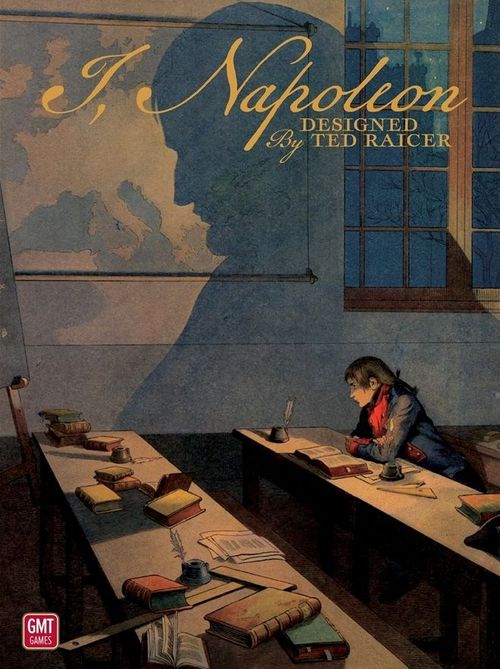
I, Napoleon
I, Napoleon Rulebook
Table of Contents
Table of Contents
- 1.0 Introduction
- 2.0 Components
- 3.0 Full Campaign Scenario
- 4.0 Being Napoleon
- 5.0 Sequence of Play
- 6.0 Year Setup Phase
- 7.0 Card Deck Phase
- 8.0 Card Action Phase
- 9.0 Campaign Resolution Phase
- 10.0 Diplomatic Phase
- 11.0 Domestic Politics Phase
- 12.0 Clean-Up Phase
- 13.0 Game End & Outcomes
- 14.0 Card Play Clarifications
- 15.0 Scenarios
- 16.0 Key Terms And Abbreviations
1.0 Introduction
1.1 The Game
I, Napoleon is a solitaire, card-driven, role-playing game that puts you in the boots of one of the most famous figures in history, Napoleon Bonaparte, as he rises from artillery officer in the army of Revolutionary France to General, First Consul, First Consul for Life, and finally, Emperor, as Napoleon I. And then, having become the conqueror of Europe, he suffered a fall as dramatic as his rise, ending his life in exile on the island of St. Helena, far from the victorious battlefields of his career.
In I, Napoleon you will have to manage all the facets of Bonaparte's life: warrior, politician, diplomat, husband, and lover. You may fall to an enemy bullet or be arrested and executed by the Revolutionary government, becoming a mere footnote in history. Or you may die on the throne, master of Europe, with a son and heir, exceeding even the accomplishments of history. Every time you play you will face new challenges and decisions, as you explore the multitude of roads the life of Napoleon may take.
1.2 Equipment
- 1 Game Box
- 1 Game Board (22" × 34")
- 40 Counters
- 1 Ten-sided die
- 222 Playing Cards
- 11 Divider Cards
- This rulebook
- 1 Playbook
- 1 Player Aid Card (8 ½" × 11")
- 1 Campaign Battle Mat (8 ½" × 11")
Formatting Note: Key terms (see 16.0) are capitalized throughout this booklet and the first time they are mentioned, they are bolded. Card titles are printed in italics, card types are underlined, and card Location Boxes on the game board are ALL CAPS.
2.0 Components
2.1 Map
The game map shows Europe during the time of Napoleon, keeping in mind Napoleon and his enemies drew and redrew the map during this time period. Actual play makes use of the various Boxes on and bordering the Europe map, each of which is named.
There is a General Records Track running from 0 to 50 where you will keep track of Administrative or Admin (A), Diplomacy (D), Glory (G) and Politics (P) points. Below the General Records Track is the Year Track covering 1793 to 1816 in yearly increments, and 1817-1821 as a single, final, game Year. (Napoleon died, probably of stomach cancer, in 1821). The background color of the Year Track boxes shows when the Commander, First Consul and Emperor Scenarios begin. This "Add" icon, when it appears on the track, reminds you that cards are Added during the Card Deck Phase.
Note: The change of Eras in the Campaign Game is not automatic based on dates, but only takes place according to the Play of Brumaire (47) and Imperial Plebiscite (110) cards and rules 14.8.1 and 14.8.2.
Along the left-hand side of the map is the Card Draw Track to indicate how many cards have been drawn and the Die Roll (DR) needed to end the Card Action Phase (8.0). In the center-right of the map are the Diplomacy Tracks for whether Austria, Prussia, Russia, and Spain are Allied, Neutral or Hostile toward France (Britain is always Hostile, unless Peace of Amiens (104) is in BRITAIN). Finally, there are a handful of tables and aids to keep some of the most important information right in front of you during gameplay.
2.2 Cards
I, Napoleon has 222 playing cards. The cards are divided up into three decks:
- The Commander Deck (CMD) contains cards numbered 1 to 63
- The First Consul Deck (FCD) contains cards numbered 64 to 110
- The Emperor Deck (EMD) contains cards numbered 111 to 222
Each Deck represents one of the three main eras of the game. (CMD, FCD and EMD are also used to describe the eras during which that deck is added.) The majority of the card backs are the same so that they may be shuffled together throughout the game. However, cards that enter the game by being Placed on the board, instead of into the Draw Deck, are easily differentiated because they have Placement instructions printed on their card backs.
Each card contains a historical person, place, or event. Cards are the heart of I, Napoleon, and each card has a brief explanation of its game effects, costs to Play it, the Location Box on the map it is Placed in (if any) and when it enters (is Added) or leaves (is Removed) from the game.
IMPORTANT: Placing vs Playing
Placing a card in a Box when drawn is not necessarily the same as Playing the card for its card effects. Many cards are Placed without immediately being Played and are then Played later in the game; other cards are Played immediately upon being Placed.
Card anatomy. Title: In the top center of the card is the card Title. Card Type: This banner contains the Card Type, which describes the "who" or "where" of the cards and often matches a Location Box on the map where the card is Placed. Alternatively, the card type may be noted as an Immediate Effect, which means it is Played without being Placed. The "When Revealed" Instructions on Immediate Effect cards are both Instructions and Effects. When instructed to lose Resources, apply 8.1.3.2.
Note: If a card's Title or Card Type references a country (e.g., Russia or Prussia), the card is considered to be associated with that country.
Main Section: The Main Section contains the content of the card and its effects. Each card has one or more italicized Instruction Text phrases that instruct you how to handle each card as it is drawn.
The most common instruction is "When revealed", which instructs the player on what immediate decision or action needs to happen when the card is drawn. Generally, a "When revealed" instruction provides a "must" or "may" instruction. "Must" instructions are Mandatory. "May" instructions provide an option to Place and/or Play the card now or Discard the card to potentially be Played the next time it is drawn.
Other common instructions are tied to the type of effect the card has on the game. The type of effect typically tells you when the effect happens.
- Campaign effects have an impact during the Campaign Resolution Phase (9.0).
- Combat effects have an impact during an individual Combat Round during the Campaign Resolution Phase.
- Income effects alter the income provided in the Resource Income Segment (6.2).
- Ongoing effects are active until the card is Removed.
- Triggered effects either occur in reaction to the Play of another card or may be triggered (Played) by the player, usually during the Existing Card Play Segment (8.2).
Effect Banner and Icons: These serve as visual reminders when there are ongoing and/or income effects present on a card.
Added By: The bottom left contains the Era, Year, or Condition under which the card is Added to the game.
Card Number: In the bottom middle is the card number (1 to 222).
Removed By: The bottom right is the Year or condition (if any) in which the card is Removed from the game. The "Remove When Played" icon indicates the card is Removed When Played (which may not be the same as when it is drawn and Placed).
Note: Commanders with a "Remove When Played" icon are only Removed when you use the DRM that triggers Removal, per the card text.
Examples:
- Desaix (1) is only Removed if you use his +3 DRM in the 2nd Combat Round.
- Macdonald (64) is only Removed if you use his +2 DRM.
2.2.1 Divider Cards
There are 11 Divider Cards included to help organize the playing cards according to the ten different "Added By" events that may occur throughout a Full Campaign of I, Napoleon. Each Divider Card includes the name of the Era during which the cards are added, the Added By condition, the cards included, and the specific cards that are immediately Placed.
As can be seen in the Full Campaign Scenario Setup illustration, it's recommended that a stack of cards is set aside for each Added By event with the immediately Placed cards (face-down) and the Divider card on top.
2.3 Counters
Counters in the game are used to track:
- Key game resources such as Admin, Diplomacy, Glory and Politics.
- Game status information such as the Year, diplomatic relations and the Die Roll Modifier (DRM).
- Narrative events, such as legitimate and bastard sons.
Additionally, there are markers with effect icons on them that can be placed on or near a card that has a special ongoing effect (e.g., an Income effect) as a reminder of that effect.
2.4 Player Aid and Campaign Battle Mat
The Player Aid has an extended Sequence of Play and important game reminders on one side. On the other side is the EMD Potential Campaigns table (10.3.2) to aid in choosing the correct Campaign card during the Diplomatic phase or whenever the status of a nation changes on the Diplomatic Tracks.
The Campaign Battle Mat can be used to aid in Campaign resolution.
2.5 Rules
These Rules are organized in a case-by-case format, generally in the order you meet them in the Sequence of Play (5.0).
Full Campaign Scenario Setup (illustration):
- 1796 Divider Card Placed on top; Cards 35-45, 47, 49-50, 52-53 added by 1796 Deck on bottom
- Cards 46, 48, 51 Placed below Divider
- Glory, Politics, Diplomacy markers (0)
- Admin marker (3)
- Year marker (1793)
- Card Draw marker (1)
- Sequence of Play marker
- Napoleon's Luck marker (unused)
- Draw Deck (cards 1-17, 19-21, 24-34); these cards are shuffled together
- Cards set aside (added later)
- General Bonaparte (18) face down
- Diplomacy markers (all Hostile)
- DRM marker
- Bonaparte Leads (22) face up
- Manoeuvre sur les Derrières (23) face down
2.6 Game Scale
Each game Year represents one year between 1793 and 1816, with the final Year representing a little over four years between 1817 and Napoleon's death in 1821. Each Card Draw represents events taking place during that year, some of which in reality would be only a day or two, some would be simultaneous, and some could be spread over many months of historical activity.
3.0 Full Campaign Scenario
I, Napoleon can be played (and is perhaps most enjoyable) as a Full Campaign which encompasses the Years 1793 to 1821, assuming Napoleon survives that long. Setup instructions for the Full Campaign Scenario are found below.
Instructions for three shorter Scenarios can be found in Scenarios (15.0).
3.1 Full Campaign Scenario Setup
Place on General Records Track
| Item | Placement |
|---|---|
| Glory, Diplomacy & Politics markers | 0 Space |
| Admin marker | 3 Space |
Place on Diplomacy Tracks
| Item | Placement |
|---|---|
| Austrian, British, Prussian, Russian, and Spanish markers | Hostile Space |
Place on Year Track
| Item | Placement |
|---|---|
| Year marker | 1793 Space |
Place on Card Draw Track
| Item | Placement |
|---|---|
| Card Draw marker | 1 Space |
Place in Boxes
| Item | Placement |
|---|---|
| General Bonaparte (18), face-down | I, NAPOLEON |
| Face-up: Bonaparte Leads (22), face-down: Manoeuvre sur les Derrières (23) | STRATEGY & TACTICS |
Create and Place Decks
| Cards | Instruction |
|---|---|
| Cards 1 to 17, 19 to 21, 24 to 34 | Shuffle together, place face-down next to the Game Board where it says Draw Deck |
| Cards 35 to 53 | Under "1796" Divider card as illustrated above |
| Cards 54 to 63 | Under "Card 29 or FCD" Divider |
| FCD and EMD Cards | Separate according to the one "First Consul" and seven "Emperor" Divider cards and set aside |
Other Marker Placements
| Item | Placement |
|---|---|
| Napoleon's Luck marker | "Unused" side up, in its board location |
| Sequence of Play marker | To the right of the Sequence of Play on the board |
| DRM marker | On the 0 space of the DRM track |
3.2 Game Length
The Full Campaign Game continues until the 25th Year (1817-1821) unless the Game End (13.0) is triggered by another event.
3.3 Full Campaign Scenario Outcomes
The Full Campaign Game in I, Napoleon does not have a single set of objectives the player is trying to achieve. You are living one of the great lives in history, and your ultimate goal is to match or exceed the historical Bonaparte's achievements across the full spectrum of his activities. There is neither one path to victory, nor one single measure of success or failure. Instead, there are various marks of distinction you must aim for, and a judgment of how well or poorly you have done when you are finished.
Once the game has ended, find the best matching Outcome description below to determine your level of achievement. You can read a full description of your Outcome in the rules section listed.
| Condition | Outcome |
|---|---|
| Napoleon dies before reaching the rank of General | A Minor Footnote to History (13.2.1) |
| Napoleon dies as a General | A General, No More (13.2.2) |
| Game Ends when Napoleon is First Consul | The Man Who Saved the Revolution (13.2.3) |
| Overthrown during EMD | No Guts, No Glory (13.2.4) |
| Napoleon dies in Exile | Exile (13.2.5) |
| Game ends with Napoleon on the throne, but without a Legitimate Heir | Emperor of the French (13.2.6) |
| Peace of Europe (209) card ends the game | Emperor of Europe (13.2.7) |
| Game ends with Napoleon on the throne and with a Legitimate Heir | Founder of a Dynasty (13.2.8) |
| The Limits of Glory marker is on the General Records Track* | Extended the Limits of Glory (13.2.9) |
* If you have at any point Extended the Limits of Glory (4.2.1), you achieve this Outcome as well as whatever other Outcome occurred.
4.0 Being Napoleon
"In war, luck is half in everything." —Napoleon Bonaparte
4.1 Napoleon's Luck
Napoleon has a Luck marker. Once per Year, the player may use it for any one of the following options:
- To reroll any one Die Roll.
- To immediately Ignore any one Mandatory Card just drawn and redraw a new card instead.
- During the Campaign Resolution Phase, use Napoleon's Luck instead of paying the cost of any one Commander or Strategy & Tactics card.
Once used, flip the marker to its Luck Used side until the Clean Up Phase (12.0). Every Year the player will have only one use of Napoleon's Luck. In other words, use it (wisely) or lose it. Napoleon's Luck may not be used after Abdication.
Example: During the CMD (Commander Deck) Era, Napoleon draws Artillery Lyons (6). The player judges that both Victory and Defeat in this Campaign are results they do not want, so they Discard the card without Playing it, flip the Napoleon's Luck marker to its Luck Used side, and draw another card instead.
4.2 Glory
If Glory in both life and game terms is an abstract concept, it was important to Napoleon and so, in turn, it is important in the game.
Glory is tracked throughout the game and rises and falls in response to game effects and events. Track Glory by moving the Glory marker along the General Records Track. Flip the Glory marker to its +50 side if you exceed 50 Glory.
4.2.1 Extended The Limits of Glory
If, at any moment in the game, you achieve 100 or more Glory, place the Limits of Glory marker in the Limits of Glory space on the General Records Track (you do not actually track above 100 Glory points). The Limits of Glory marker can never be removed once placed, even if you subsequently lose Glory.
At the end of the game, if the Limits of Glory marker is on the General Records Track, you have Extended the Limits of Glory, in addition to whatever other outcome occurs (13.2.9).
4.3 Staying Alive and In Power
Napoleon's life was filled with dangers, as is the life of any political or military leader. Surviving and maintaining power are critical to your legacy as Napoleon.
The game immediately ends if any of the conditions listed in Game End & Outcomes (13.0) occurs. As soon as a game-ending event occurs, proceed to Outcomes (13.2).
5.0 Sequence of Play
The Sequence of Play determines the order of the player's actions each Year. Note that some parts of the Sequence of Play are skipped at different points in play, as noted. Each phase is assigned a number for ease of reference. They are explained in detail, in sequence order, on the pages that follow. You can use the SoP marker to track your progress throughout each Year.
Year Setup Phase [6.0] (Skipped in the first Year of any Scenario)
- Year & Card Draw Marker Segment
- Resource Income Segment
Card Deck Phase [7.0] (Skipped in the first Year of any Scenario)
- Remove Cards Segment
- Add Cards Segment
- Shuffle Draw Deck Segment
Card Action Phase [8.0]
- New Card Draw Segment
- Existing Card Play Segment
- Phase Advancement Segment
Campaign Resolution Phase [9.0] (Skip if appropriate, see 9.0.)
- Assign Commanders Segment
- Spanish Ulcer Expeditions Segment (EMD Only)
- Resolve the Campaign Segment
- Commander Casualties Segment
- Other Campaign Events Segment
- Additional Campaign Resolution Segment
- Campaign Clean-up Segment
- Abdication Check
Diplomatic Phase [10.0] (FCD and EMD only)
- Foreign Diplomacy Segment
- Treaties Segment
- Potential Campaigns Segment
Domestic Politics Phase [11.0] (FCD and EMD only)
Clean-Up Phase [12.0]
- Reset Cards and Markers Segment
- Game End Check
6.0 Year Setup Phase
(Skip this phase for the first Year of any Scenario.)
"Ability is nothing without opportunity." —Napoleon Bonaparte
6.1 Year & Card Draw Marker Segment
Advance the Year marker on the Year Track to begin the new Year. Each game Year equals one actual year, except for the last which represents 1817 to 1821.
Then, reset the Card Draw marker back to 1 on the Card Draw Track.
6.2 Resource Income Segment
In I, Napoleon there are four key Resources:
- Administrative points (A)
- Diplomacy points (D)
- Glory points (G)
- Political points (P)
Resource points are tracked on the General Records Track, moving the appropriate marker as you gain, lose or spend Resources. If ever required to lose more Resources than you currently have, during any game phase, set the marker to 0 and the remaining losses are ignored.
6.2.1 Income Effects
Income effects are ongoing effects which Trigger each Year during this segment for any Placed Card that says INCOME EFFECT, unless otherwise noted. Income effects, typically, increase your available Resource points for the upcoming year (though some income effects do decrease Resource points).
Note: General Bonaparte (18) includes an Income Effect on the back and front of its card. Use the Income Effect on the back of the card until it is flipped over (when Napoleon becomes a General).
Example: It is the Resource Income Segment of the Year 1798, during CMD. General Bonaparte (18) is face-down in the I, NAPOLEON Box. Berthier (54) is in the CHIEF OF STAFF Box and Joseph Fouché (48) is in the MINISTER OF POLICE Box. Therefore, you gain +1 A for the Income Effect on the back of General Bonaparte and +2 A for Berthier's Income Effect for a total of +3 A. You do not Trigger the Income Effect for Joseph Fouché (–2 G and +1 P), because the text on that card says it only occurs during FCD or EMD.
6.2.2 Resource Points Exchange
There may be times when you want to exchange one type of Resource point for another to gain a tactical edge.
During this segment (only):
- Political points may be exchanged for Admin points on a 1-for-1 basis
- Glory points may be exchanged for Admin points on a 3 G-for-1 A basis
Either Resource conversion may only yield up to a maximum combined total of 3 Admin points per Year.
Resource exchanges for Diplomatic points and Political points may only be done during other game phases (see 10.1 and 11.0).
7.0 Card Deck Phase
(Skip this phase for the first Year of any Scenario.)
"I was never truly my own master but was always ruled by circumstances." —Napoleon Bonaparte
During the Card Deck Phase, the Draw Deck is prepared for the new Year. Cards are Removed from the game, Added to the Draw Deck or Placed in the appropriate Location Box on the Game Board. Finally, Discarded cards are returned to the Draw Deck, which is then shuffled for the upcoming Card Action Phase.
7.1 Remove Cards Segment
The majority of cards that get Removed in I, Napoleon are Removed from the game after they've been Played. These cards have the "When Played" icon in the Removed By area in the lower right corner of the card.
During this segment, you must check if any cards in the Discard pile, Draw Deck or Location Boxes on the board should be Removed for the following reasons:
- The current game Year matches the Year printed in their Removed By area
- The Era starting this Year (e.g., FCD or EMD) is listed in their Removed By area
- Instructions on another card require you to Remove the card
Some cards indicate they are only Removed "if not in play." In this case, if the card has been Placed, you do not Remove it. You only remove it if it is still in the Draw Deck or Discard pile.
Example: It is the Remove Cards Segment of the Year 1794. The player searches the Discard pile and Draw Deck, removing all cards with 1794 in the Removed By area, such as Artillery Toulon (7).
After being Played, cards causing the Removal of another card can be placed next to the draw pile as a reminder until the indicated card is Removed. Once the indicated card has been Removed, be sure to Discard or Remove the reminder card as well.
However, it is imperative that you check the Removed By area each time you draw a card in the Card Action Phase (8.0), prior to Playing or Placing that card. If you draw a card that should already have been Removed, for any reason, immediately Remove it and draw a replacement card without advancing the Card Draw marker (8.3).
7.2 Add Cards Segment
There are multiple times throughout the game when new cards are Added to the Draw Deck. The Divider Cards (2.2.1) summarize the entry condition, identify the cards that are added, and specify which are immediately Placed. Each individual card also notes when it is Added to the game—lower left corner of the card—which can be used to order the cards during setup or when storing the game.
During this segment, Add cards to the Draw Deck due to their entry condition:
- Year Entry
- Era Change Entry
Unless otherwise stated on a card, such as Robespierre's Fall (29), this is the only segment when cards are Added to the game.
7.2.1 Year Entry
Some cards' Added By area will note that they are Added to play in a specific Year (1796, 1807, etc.). These cards are Added to the Draw Deck during this segment of that Year.
7.2.2 Era Change Entry
Era changes occur when Napoleon takes a significant step forward in his political career, either from General to First Consul or from First Consul to Emperor (14.8).
Each of these promotions introduces a new deck of cards into the game which is Added directly to the Draw Deck during the first Card Deck Phase after the new Era starts.
7.2.3 Triggered Entry
Play of Robespierre's Fall (29) and Imperial Plebiscite (110) trigger the immediate addition of a group of cards to the game as indicated in their Main Text. Abdication immediately triggers the Abdication Segment (13.1) which includes adding cards. In these cases, you do not wait for the Card Deck Phase.
7.2.4 Placed Cards on Entry
Cards that enter the game by being Placed on the board, instead of into the Draw Deck, are easily differentiated because they have Placement instructions printed on their card backs, which note where they are Placed. Unless otherwise noted, Place cards face-up.
Example: It is the Add Cards Segment of 1796. Cards 35 to 53 are Added at this time due to Year Entry. Most of the cards are Added directly to the Draw Deck. However, Joseph Fouché (48), among others, has Placement instructions on the card back. So Joseph Fouché (48) is Placed directly into the MINISTER OF POLICE Box.
7.3 Shuffle Draw Deck Segment
The final step of this phase is to prepare the Draw Deck for the current Year and is performed regardless of whether new cards were Added during this phase.
Add the Discard pile back to the Draw Deck, shuffle, and place the entire pile face-down next to the Draw Deck label in the lower left of the Game Board.
8.0 Card Action Phase
"I have made all my calculations; fate will do the rest." —Napoleon Bonaparte
The Card Action Phase is the core engine of game play, in which players will draw cards from the Draw Deck and perform various actions.
This phase is made up of a minimum of 5 and a maximum of 12 New Card Draws per Year, which is tracked by the Card Draw marker on the Card Draw Track. Each New Card Draw consists of three actions: drawing and considering a new card (8.1), potentially Playing existing cards (8.2), and checking for phase advancement (8.3).
The last of these actions determines the number of Card Draws that occur. Starting at the end of the 5th Card Draw, a die is rolled to determine whether to proceed to another Card Draw or end the Card Action Phase and proceed to the Campaign Resolution Phase.
8.1 New Card Draw Segment
During this segment, the top card of the Draw Deck is drawn (flipped face-up) and you must consider the text in the card's Main Section, which is often preceded by "When revealed" and will include some of the following:
- Prerequisites and/or costs for the card to be Played
- Whether the card is Mandatory or not
- Where to Place the card
- Options for you to choose between
- Instructions to roll a die to obtain a result
- An interaction with another card
Whether the card is Mandatory and whether prerequisites are met or costs can be paid must be considered before anything else.
8.1.1 Mandatory Cards
If a card's "When revealed" instruction has the word "must" in it, that card is Mandatory. Note that in some cases, whether a card is Mandatory or not depends on whether it meets prerequisites.
If a card is not Mandatory, it is resolved by a player's decision to either:
- Play the card (8.1.3), assuming prerequisites are met and/or costs can be paid
- Discard the card
8.1.2 Prerequisites and Costs to Play a Card
Prerequisites: If the prerequisites for any card are not met, the card is "Discarded with no effect," which ends the New Card Draw Segment for the current Card Draw. But occasionally the card will instruct you to Discard and immediately reveal a new card. When this happens, the Card Draw isn't over, so even though a new card has been drawn the Card Draw marker is not increased.
Example: Army of Italy (37): "When revealed: Must Place in CAMPAIGN if empty, otherwise Discard this card and immediately reveal a new card."
Costs: Costs, typically, will instruct you to pay one or more Resources in exchange for another Resource or to Trigger an effect. If you do not have enough to pay the cost (or do not want to pay the cost) of a newly-drawn card, you cannot Play that card and must Discard it, without re-drawing a new card.
Example: You draw France Reorganized (75) which says: "When revealed: May -3 A to Place in FRANCE, then +1 P." If you do not have or do not wish to spend 3 A, Discard this card without drawing another.
8.1.3 Play the Card
If you Play the Card, read the card's Main Section and execute the actions it describes.
The majority of cards have one or more of the following contents in their Main Section:
- Instructions
- Effects
- Results
IMPORTANT: After you understand the general flow of the Card Action Phase, see Card Play Clarifications (14.0) for specific instructions on resolving certain cards and card types.
8.1.3.1 Instructions
Instructions are preceded by text explaining when to execute them (most often "When revealed") and may:
- Tell you in which Location Box on the Game Board you Place the card
- Provide options for you to choose between
- Tell you to roll a die
- Describe an interaction with another card
- Describe an effect, such as adding or subtracting Resources.
When Revealed and When Played instructions are a one-time effect. Implement as many of them as you are able when the card is Played. Effects that cannot be implemented do not occur.
8.1.3.2 Effects
The type of effect typically tells you when the effect happens:
- Campaign effects have an impact on the entire Campaign Resolution Phase (9.0).
- Combat effects have an impact on an individual Combat Round during the Campaign Resolution Phase.
- Immediate effects require you to implement the effect described on the card immediately.
- Income effects alter the income provided in the Resource Income Segment (6.2). You'll notice that a special icon on the card highlights cards with Income effects.
- Ongoing effects are active until the card is Removed. You'll notice that a special icon on the card highlights cards with Ongoing effects.
- Triggered effects usually occur in reaction to the Play of another card, a change in game state as noted in the effect, or provide an action that can be Triggered at the will of the player.
If an effect forces you to lose a Resource and you do not have enough of that Resource, you lose what you can, but do not go below zero.
However, unless otherwise noted on the card, if a card presents you with a choice of effects, and you cannot fully satisfy one of the choices, you must make the other choice. If you cannot fully satisfy either choice, you may choose.
Examples:
- The player draws Bonaparte's Plans (10), which is Placed face-up in the STRATEGY & TACTICS Box. In the subsequent Combat Resolution Phase this card may be Played for the combat effect, at a cost of –1 A.
- The player draws Censorship (87). Since the card says "Must" in its instructions, it is Mandatory. The player must choose to either lose 5 G and gain 1 P or gain 5 G and lose 2 P. The player has 1 P and 10 G, so they must choose the first option, because they cannot fully satisfy the second choice.
- The player draws Émigrés Pardoned (90). Since the card says "May" and does not contain a Location, the player may decide what to do. With a difficult Campaign coming up, the player decides not to pay the –1 A cost, so they choose to Discard the card, rather than Play it.
8.1.3.3 Results
The Results section describes an outcome of resolving the Main Section which you execute. Results are often dependent on a Die Roll.
Results happen even if you can't fully execute the demands of the result. If a result forces you to lose a Resource and you do not have enough of the Resource left, you lose what you can, but do not go below zero.
8.1.3.4 Play and Removal/Addition of Cards
The Play (not Placement or Discarding) of certain cards may cause other cards to be Added or Removed as noted on the cards. Unless otherwise indicated, such as with Robespierre's Fall (29) or Imperial Plebiscite (110), this will be done in the next Card Deck Phase (7.0).
Cards that cause the Addition/Removal of another card can be placed next to the Draw Deck as a reminder until the indicated card is Added/Removed. Once the indicated card has been Added/Removed, be sure to Discard or Remove the reminder card as well.
8.2 Existing Card Play Segment
Regardless of whether the card drawn in the previous segment was Played, Placed, or Discarded, any other Eligible, face-up Placed Cards on the map may now be Played, by resolving the Main Section (8.1.3). If the Placed card has a cost to trigger the effect, you must be able to fully pay the cost to Play the card.
After Playing the card, be sure to Remove or Discard it, if required. If the card has an Ongoing Effect which can only Trigger once per Year, you may want to exhaust the card by rotating it as a reminder that its effect has been used.
This is generally the only time that previously Placed Cards may be Played, although there are some exceptions noted on cards, such as Brumaire (47), which may be Played at the start of the Campaign Resolution Phase.
Example: After drawing and placing Infantry Vendée (8) in the prior segment, the player chooses to Play Augustin Robespierre (20), which is in the POLITICS Box and allows the player to Ignore the just-drawn Campaign card. Infantry Vendée is Discarded immediately. Augustin Robespierre (20) remains in the POLITICS Box, as this is an Ongoing Effect which does not require Removal When Played. But because it may not be Played to Ignore another Campaign this Year, per the card's instructions, the player rotates the card to help them remember that it has been used.
8.3 Phase Advancement Segment
Each Year in I, Napoleon contains a variable number of New Card Draws, reflecting the uncertainty of life. During this segment you will determine whether to advance the Card Draw marker and conduct another New Card Draw or advance to the Campaign Resolution Phase.
If the space the Card Draw marker is moving into does not list a DR (spaces 2-5), increase the Card Draw marker one step and repeat 8.1 to 8.3 again.
If the space the Card Draw marker is moving into lists a DR (spaces 6-12), roll the die to determine whether the Card Action Phase continues or ends.
- If the roll falls outside the listed range (e.g., a roll of 3 when the range is DR 1-2), increase the Card Draw marker one step and repeat 8.1 to 8.3 again.
- If the roll is within the listed range (inclusive), end the Card Action Phase and proceed to the Campaign Resolution Phase.
If the Card Draw marker occupies the 12 space, the Card Action Phase automatically ends (no roll is involved) and play proceeds to the Campaign Resolution Phase.
Note: In the extremely rare event that there are no cards left in the Draw Deck during this segment in the CMD Era, immediately skip to the Campaign Resolution Phase and Play Brumaire (47). If you cannot afford the combined 20 G/P, the game immediately ends.
9.0 Campaign Resolution Phase
"Never interrupt your enemy when he is making a mistake." —Napoleon Bonaparte
The Campaign Resolution Phase represents the major military campaigns and battles of Napoleon's career. Smaller campaigns, and those commanded without Napoleon in places like Spain, are treated as Expeditions (though the Spanish Ulcer Expeditions are resolved during this phase as well).
The proper use of Commanders and Strategy & Tactics cards will be crucial in achieving victory. A bit of luck won't hurt either.
- If the CAMPAIGN Box is empty and Spanish Ulcer Expeditions (221) is not active, Discard all Campaign Modifier cards, flip all Commanders face-up, then proceed to the Diplomatic Phase (10.0).
- If the CAMPAIGN Box is empty, but Spanish Ulcer Expeditions (221) is active, resolve the Assign Commanders Segment (9.1) and Spanish Ulcer Expeditions (9.2), then Discard all Campaign Modifier cards, flip all Commanders face-up, then proceed to the Diplomatic Phase (10.0).
- Otherwise, follow the entire procedure below to resolve the current Campaign, including (possibly) Spanish Ulcer Expeditions.
Note: Final DRMs are capped at +/-4 during this Phase, which means they are capped for Spanish Ulcer Expeditions and Campaign Resolution.
9.1 Assign Commanders Segment
The player may spend Admin, Glory or Political points as noted on each Commander card to assign Commanders to the CAMPAIGN Box or to the SPAIN Box (for use with the Spanish Ulcer Expeditions (221)).
The cost is paid regardless of whether the Commander ends up being used during combat resolution. If the cost cannot be paid, the Commander cannot be assigned.
Many Commanders have special abilities noted on their card which may limit when they can be used or give them special abilities if used at specific times.
Note: Only some Commanders can act as Independent Commanders, as indicated on each card.
If Spanish Ulcer Expeditions (221) is in play, you assign Commanders specifically to Spanish Ulcer Expeditions by placing their card in SPAIN. These Commanders may not be used for a Campaign this Year. You may assign up to two Independent Commanders (ICs), like any normal Expedition (14.4). However, if any ICs are available, at least one must be assigned to Spanish Ulcer Expeditions.
In general, Commanders may only be used in one Combat Round per Campaign and no Commander may be used in a Campaign and an Expedition in the same Year.
Commanders that are face-down in the COMMANDERS Box cannot be assigned during this segment.
After this segment, no further Commander cards may be assigned. So, choose wisely!
9.2 Spanish Ulcer Expeditions Segment (EMD Only)
The Spanish Ulcer Expeditions (221) card is Placed in the SPAIN Box during EMD setup and starts inactive (face-down).
When Spain becomes Hostile, immediately flip Spanish Ulcer Expeditions (221) face-up to make it active. It remains active until the game ends or Napoleon abdicates (13.1).
Once active, resolve the Spanish Ulcer Expeditions Segment during each Campaign Resolution Phase, regardless of whether any Commander cards were assigned (9.1).
Resolve the Spanish Ulcer Expeditions (221) using any Eligible cards in the BRITAIN Box and any assigned IC to determine DRMs, which are totaled into a final DRM. The final DRM may not exceed +/– 4. ICs may only use DRMs that apply to the first Combat Round. Strategy & Tactics cards may not be used when resolving Spanish Ulcer Expeditions.
Roll the die, apply the final DRM and check the result on Spanish Ulcer Expeditions (221). Apply the result of Success or Failure. Failure requires any one IC assigned to Spanish Ulcer Expeditions to be randomly Discarded. Junot (2), if assigned, must be Removed per his card instructions and if there was another IC, it must also be Discarded.
Return used Commander cards to their appropriate Boxes, face-down until Campaign Clean-Up Segment (9.7).
9.3 Resolve the Campaign Segment
It is possible that a Campaign may take multiple Combat Rounds to resolve. A Combat Round represents a single battle, resolved by a single Die Roll which can be modified by a handful of effects.
To resolve a single Combat Round, follow the steps below.
9.3.1 Select Commanders
From among the face-up assigned Commanders in the CAMPAIGN Box, select those you want to use in this Combat Round for their DRM. Some Commanders may only be used in specific Combat Rounds.
9.3.2 Add Strategy & Tactics Cards
Strategy & Tactics cards may be added to the CAMPAIGN Box by paying the cost (if any). Unlike Commander cards, they do not need to be added ahead of time. Some Strategy & Tactics cards may only be used in specific Combat Rounds.
A Strategy & Tactics card that says it applies during all Combat Rounds, such as La Grande Armée (83), may be used more than once. Otherwise, an effect may only be applied in one Combat Round.
Note: Some Strategy & Tactics cards include ongoing effects that provide DRMs you may use without any cost.
9.3.3 Check Location Boxes
Nations that are currently Hostile toward France may have a card in their Location Box that adds combat effects and DRMs. The POLISH QUESTION and SWEDEN Location Boxes may also have modifiers, in some situations.
9.3.4 Check Cards in the CAMPAIGN MODIFIERS Box
Some cards in the CAMPAIGN MODIFIERS Box have effects that provide DRMs during specific Combat Rounds.
9.3.5 Determine Final DRM
Total up all DRMs (+ and –) from the Campaign card itself, selected Commander cards, Strategy & Tactics cards, cards in the CAMPAIGN MODIFIERS, and Location Boxes. Use the DRM marker and the track to monitor the final DRM. It is important to remember that the final DRM may not exceed +/– 4 (it may exceed that limit during the process of totaling up modifiers).
9.3.6 Flip Used Commanders Face-Down
Flip all Commanders selected for this Combat Round face-down as a reminder that they may not be used in any subsequent Combat Round.
9.3.7 Combat Roll and Resolution
Roll the die, apply the final DRM and check the roll against the Combat Resolution Table printed on the Game Board for a result.
| Modified DR | Result |
|---|---|
| 1 or less | Bloody Defeat |
| 2 | Defeat |
| 3-4 | Bloody Stalemate |
| 5-6 | Stalemate |
| 7-8 | Bloody Victory |
| 9 or more | Victory |
9.3.8 Check for Adjusted Result
Check to see if any Placed Cards adjust the result to determine the final Result. Some cards may cause a Victory or Defeat to be converted to a Stalemate, for example.
If both friendly and enemy cards can adjust the result, the enemy card's effect is applied first. This may mean that the friendly card no longer adjusts the result or that it now does adjust the result. Card effects which adjust results may only be applied once per Year. Once applied, they will not affect the result again that Year.
Note: Certain combinations of Campaign Effects can result in an unavoidable Victory, Defeat or Stalemate result. They can also make it impossible to have a Bloody Result or avoid a Bloody Result.
9.3.8.1 Bloody Result
If the final outcome is a Bloody result, place a Bloody Result marker near the Domestic Politics Table, as this will cause a –1 DRM during that Year's Domestic Politics Phase. Bloody Result markers are not placed during CMD.
9.3.8.2 Campaign Result
If your final outcome is a Victory or Defeat, apply the results noted on the Campaign card for that result. In the case of Victory, Treaty cards are Placed face-down in the CURRENT TREATIES Box. If the result calls for a Treaty to be Placed and it is not in the POTENTIAL TREATIES area off to the side of the board (because it was Placed previously and/or Removed), the nations affected by that Treaty may be Conquered instead (10.2.3). If your final outcome was a Stalemate, and the Campaign includes a result for a Stalemate, apply that result. If the Campaign does not include a result for Stalemate, you must fight another Combat Round (9.3.8.3). After applying the result, proceed to the Commander Casualties Segment.
Note: Some cards, such as Enemy Reserves (49) and La Patrie en Danger (149), may require you to achieve more than one Victory to win a Campaign. In this case, after your first Victory, perform additional Combat Rounds until you achieve the necessary number of Victory results or suffer Defeat. Treat these as 2nd (or 3rd, etc.) Combat Rounds when considering card effects. Face-down Commander cards, used in a previous Combat Round, are not usable in these additional Combat Rounds.
9.3.8.3 Stalemate
If the result is a Stalemate (and the Campaign does not include a result for a Stalemate), you lose 2 Glory (–2 G) and must perform additional Combat Rounds until you achieve Victory or suffer Defeat. Treat these as 2nd (or 3rd, etc.) Combat Rounds when considering card effects. Face-down Commander cards, used in a previous Combat Round, are not usable in these additional Combat Rounds.
Include an additional –1 DRM for each previous Stalemate result. Stalemate results are cumulative so negative DRMs stack and 2 Glory are lost for each Stalemate result. If you need to achieve more than 1 Victory to win a Campaign, Stalemate DRMs do not carry over after a Victory.
Note: Some Campaigns, such as Polish Campaign (151), end after a limited number of Combat Rounds, regardless of the result. In this case, the card will include a Campaign result for a Stalemate.
9.4 Commander Casualties Segment
After a Campaign ends, roll one die for each Commander card in the CAMPAIGN Box (regardless of whether they are face-up or face-down). On a DR of 1 or 2, the Commander is wounded and Discarded.
You do not roll for Commanders used in Expeditions or Spanish Ulcer Expeditions (221).
Note: Oudinot (66) does not roll but is automatically wounded, and Poniatowski (144) is Removed (killed) instead of being wounded.
9.5 Other Campaign Events Segment
Resolve the Main Section for any cards in the CAMPAIGN MODIFIERS Box with an effect that Triggers after Campaign Resolution.
Example: Looting (41) is in the CAMPAIGN MODIFIERS Box. During this segment, regardless of the outcome of the Campaign, the –1 A, –1 G and +2 P are applied.
9.6 Additional Campaign Resolution Segment
Sometimes a Campaign's resolution will call for another Campaign card to be Played and resolved immediately.
In that case, Place that Campaign card in the CAMPAIGN Box. This is considered a new Campaign, and all Commanders assigned to the original Campaign (only) may be used again at no cost. Flip them all face-up. Strategy & Tactics cards may also be used again in this Campaign; if they have a cost, it must be paid again.
Any cards from the CAMPAIGN MODIFIERS Box that were already Played in the Other Campaign Events Segment (9.5) are Discarded.
Proceed to Resolve the new Campaign (starting with 9.3.1).
Example: The player has just achieved Victory in Prussia & Russia Declare War (153). Part of the Campaign Result allows the player to Place Polish Campaign (151) in the CAMPAIGN Box and resolve immediately. The player flips all Commanders face-up so they may be used again, Discards Campaign Modifier cards used in Prussia & Russia Declare War (153), and then Resolves Polish Campaign (151), starting with 9.3.1.
Note: Brumaire (47) may NOT be Played between the Egyptian Campaign (43) and Syrian Campaign (46) since the card can only be played at the start of the Campaign Resolution Phase.
9.7 Campaign Clean-up Segment
Remove any card in the CAMPAIGN or CAMPAIGN MODIFIERS Box that had its Removed By condition occur (such as Removed When Played).
Note: For Campaign cards that are Removed When Played, resolving the Campaign counts as Playing it for this purpose.
Discard any cards in CAMPAIGN MODIFIERS that weren't Removed.
Return Commander and Strategy & Tactics cards to their appropriate Boxes, face-up. Flip all face-down Commanders face-up.
Return Potential Campaign cards to POTENTIAL CAMPAIGNS off to the side of the board, unless they must be Removed.
During this segment, if you have the necessary G, you may flip General Bonaparte (18) face-up.
9.8 Abdication Check
If the Campaign Resolution Phase result was a Defeat in La Patrie en Danger (149), Game End has been triggered. Go to Game End & Outcomes (13.0) and perform the Abdication Segment (13.1) before determining your outcome.
Campaign Resolution Example: It's the Combat Resolution Phase of 1807 and Prussia & Russia Declare War (153) is in the CAMPAIGN Box. In addition, the following cards are in Boxes on the Game Board, which will impact this combat:
- COMMANDERS: Junot (2), Marmont (4), Murat (5), Davout (56), Macdonald (64), Ney (65)
- CAMPAIGN MODIFIERS: Siege (74), March to the Sound of the Guns (107), Unreliable Allies (129), An Army Marches on Its Stomach (178)
- STRATEGY & TACTICS: Bonaparte's Plans (10), Manoeuvre sur les Derrières (23), La Grande Armée (83), Old Guard (173)
- PRUSSIA: Blücher (164)
- RUSSIA: Tsar Alexander (85), Bennigsen (168)
Napoleon has 3 A and 25 G available and has not used his Luck marker yet this Year.
The presence of the Unreliable Allies (129) card in the CAMPAIGN MODIFIERS Box means Napoleon is under pressure to win in the first Combat Round, since a Stalemate result will become a Defeat.
With that in mind, Napoleon decides to throw everything into the first round without leaving anything in reserve for Round 2.
During the Assign Commanders Segment, Napoleon decides to assign Junot and Marmont as Commanders for this Campaign, spending –1 A each (–2 A total) for their +1 DRMs.
Napoleon does not assign Murat or Macdonald (neither provides DRMs in Combat Round 1) or Davout, who would require spending Glory points. He also does not add Ney during this Segment, for reasons which will become clear later.
He now resolves the first Combat Round, assessing the Die Roll Modifiers (DRMs).
He gets a +1 DRM from the Campaign card in the 1st Combat Round. (Austria is Neutral so he does not get the extra +1 DRM.)
Both Commanders he assigned are added, bringing the total to +3 DRM so far.
From Strategy & Tactics cards, he gets a further +1 DRM each from Manoeuvre sur les Derrières and La Grande Armée without having to spend any resources. He has 1 A left, which he spends on Bonaparte's Plans for a +1 DRM. He also uses March to the Sound of the Guns to add Ney (which is why he did not spend -1 A to add him), for another +1 DRM. His total is now +7 DRM.
Checking Hostile Nations' Boxes, Blücher (in the Prussia Box) and Bennigsen (in the RUSSIA Box) each add a –1 DRM, for –2 Total. Tsar Alexander (also in the RUSSIA Box) already used his +1 DRM in the previous Year.
In the CAMPAIGN MODIFIERS Box, An Army Marches on Its Stomach applies an additional –1 DRM.
Totaling all that up, Napoleon has +7 DRM and his enemies have –3 DRM, so Napoleon has the maximum +4 DRM possible.
Junot, Marmont, and Ney are flipped face-down to indicate they have been used and Napoleon rolls the die, getting a 2, modified to 6, which results in a Stalemate, which is adjusted to a Defeat as a result of Unreliable Allies!
Napoleon decides to use his Luck to re-roll. He flips the Napoleon's Luck marker to its "Luck Used" side and rolls the die again, getting a 5, modified to a 9 for a Victory!
He applies the Campaign result for Victory, choosing to spend –5 G to Play Treaty of Tilsit (163), rather than Polish Campaign (151), as he feels he lacks the resources for more battles. This gives him +1 D, +20 G and +2 P. The Treaty card is Placed face-down in the Current Treaties Box, Prussia is set to Allied, and Russia is set to Neutral.
Checking for Commander Casualties, he rolls a 6 for Junot, a 4 for Marmont and a 2 for Ney, so Ney is wounded and put in the Discard pile.
Next, Campaign Modifier card effects which Trigger after a Campaign result are applied. A die is rolled for Siege (74), resulting in a 7 and an additional +5 G.
During Clean-up:
- An Army Marches on Its Stomach is Removed because its card text indicates it is Removed when Played.
- All remaining Campaign Modifier cards (Siege, March to the Sound of the Guns and Unreliable Allies) are Discarded. Unreliable Allies is not Removed because, due to Napoleon's re-roll, a Stalemate result didn't actually occur and therefore the Campaign effect wasn't used and isn't considered to have been Played.
- Prussia & Russia Declare War is returned to POTENTIAL CAMPAIGNS off to the side of the board.
- All used Commander and Strategy & Tactics cards are returned to the appropriate Box, face-up.
10.0 Diplomatic Phase
(FCD and EMD only)
"Men are ruled by only two things: fear and interest." —Napoleon Bonaparte
Foreign relationships are a key part of political success and in I, Napoleon you will need to use diplomatic tools to manipulate and respond to these fluctuating relationships.
10.1 Foreign Diplomacy Segment
Every Year, starting once the First Consul Deck enters play, you will have to make a Foreign Diplomacy roll for Austria, Prussia, Russia, and Spain if they are Neutral or Allied. A nation only moves towards being Hostile in this Phase, never towards being Allied.
At this time (only) you may exchange 3 Glory or 1 Political point for 1 Diplomatic point. You may only gain one Diplomatic point per Year this way.
Then, before rolling for a particular nation, you may spend Diplomatic points to add to the Foreign Diplomacy roll. You gain +1 DRM for each 1 D spent.
The player is not required to spend Diplomatic points just because they are available. Instead, you may want one of the foreign nations to move towards Hostile in pursuit of victory over that nation on the battlefield (10.3). Any Diplomatic points not spent are lost and they may not be saved from Year to Year.
The player may choose the order in which they make Foreign Diplomacy rolls for each nation.
If a nation is included in a face-down Treaty in the Current Treaties Box, no Foreign Diplomacy roll is made for it this Year. The back of Treaty cards have a note on them to remind you which nations are currently immune to the Foreign Diplomacy roll.
Choose a nation, roll the die, add the DRM and then implement the result on that nation's Diplomatic Track.
| Modified DR | Result |
|---|---|
| 1 to 5 | Remove Treaty, if present. Otherwise move the marker towards (or to) Hostile. |
| 6 or more | No effect. |
Note: Treaty cards and other card effects can affect this result, including maintaining a specific status regardless of the Die Roll. See Face-Up Treaties (10.2.1) before implementing the results of the Foreign Diplomacy roll.
10.2 Treaties Segment
In I, Napoleon Treaties play a big role in navigating diplomatic relationships and strategically allowing you to decide with whom and when you will Campaign.
During FCD and EMD, Treaty cards predominantly enter play due to a victorious result during a Campaign.
When a Treaty is Triggered, immediately execute its effects and then place it on the board in the CURRENT TREATIES Box face-down. During the Clean-up Phase (12.0) it is flipped face-up.
10.2.1 Face-Up Treaties
If a nation is included in a face-up Treaty in the CURRENT TREATIES Box, the roll is made but, during EMD, on a modified DR of 1 to 5, a Treaty card which includes that nation must be Removed instead of moving the nation towards Hostile.
Note: FCD Treaties are not Removed in this way, but instead are only Removed as noted on the Treaty card or by Breaking Treaties (10.2.2).
10.2.2 Breaking Treaties
During this segment, you may Remove any Treaty card that is in the CURRENT TREATIES Box (whether face-up or face-down), declare all nations named in the card's Triggered effect Hostile and move their marker to the Hostile space. This may be a good way to pursue victory on the battlefield, but be careful what you wish for.
Broken Treaties are Removed from the game.
Note: Breaking Treaties is the only way you may voluntarily worsen the Diplomatic status of a Nation.
10.2.3 Conquest
Austria, Prussia, and Britain may be Conquered, as described in the sections below.
Being Conquered for the first time results in each Conquered nation giving the player 10 G and 1 P during the Resource Income Segment (6.2) following their initial Conquest. Flip the Diplomatic marker to its Conquered side.
If a nation ceases to be Conquered, it goes back to being Hostile. Flip its Diplomatic marker back to its normal side. It may be Conquered again, however, you do not get 10 G and 1 P if you conquer that nation again.
A Conquered nation is not considered to be Allied, Neutral, or Hostile. A Conquered nation skips Foreign Diplomacy rolls.
Austria and Prussia
Austria and Prussia are conquered if they are defeated in a Campaign and no Potential Treaty card exists to bring the war to a conclusion. Flip its marker on the Diplomatic Track to its Conquered side.
A Conquered Austria or Prussia remains Conquered until Napoleon suffers a Defeat in a Campaign or the cards Prussia Rises (198), English Gold Austria (188) or English Gold (189) are Played to change their status.
Britain
Britain can be Conquered only by Playing Trafalgar (117) if Nelson (36) is not face-up in the BRITAIN Box and then succeeding on the die roll. If Britain is Conquered, flip its marker on the Diplomatic Track to its Conquered side and Remove any cards which include "Britain Conquered" in their Removed By box.
A Conquered Britain remains Conquered for the rest of the game.
Russia and Spain
Russia and Spain may never be Conquered. If there is no Treaty they simply remain Hostile.
However, if Russia suffers a Defeat while Prussia and Austria are Conquered, flip its Diplomatic marker to the Inactive side, unless Kingdom of Poland (142) is in play. A Campaign that results in Austria and/or Prussia being Conquered can also make Russia Inactive immediately if all conditions are met. Implement the Conquest rules for Austria and/or Prussia first. Then, if both are Conquered, set Russia to Inactive due to the Defeat in this turn's Campaign.
An Inactive Russia does not take part in any Campaigns until a Conquered Austria or Prussia becomes Hostile, at which point the Diplomatic marker is flipped back to its normal side and Russia is considered Hostile.
During the Domestic Politics Phase (11.0), an Inactive Russia is still considered Hostile for DRMs.
10.3 Potential Campaigns Segment
The purpose of this segment is to determine whether or not a Potential Campaign card is Placed in the CAMPAIGN Box to be resolved next Year, and if so, which one is selected. An important thing to remember is that during FCD, aside from the Austria (Italy) (67) campaign, which is Placed as part of adding the FCD cards, Placing a Potential Campaign card is optional. Whereas during EMD, Placing a Potential Campaign card is usually mandatory.
10.3.1 FCD Potential Campaigns
At the start of FCD, Austria begins Hostile and Austria (Italy) (67) must be the first campaign. Subsequently during FCD, if Spain or Prussia is Hostile, alone or in combination, you may pick either Republican War with Prussia (70) or Republican War with Spain (71) from POTENTIAL CAMPAIGNS and Place it in the CAMPAIGN Box. This will be the Campaign for the following Year. These campaigns are optional rather than mandatory but a Hostile Prussia and/or Spain is a dangerous way to begin as Emperor. Note also that a successful Republican War with Prussia (70) effectively deals with Spain.
If Spain is Allied, you may choose to launch Louisiana Campaign (69). During FCD, Russia's diplomatic status only affects the Domestic Politics roll (11.0).
If Events during any other Phase change the Diplomatic status of a nation such that the current Campaign is no longer valid, immediately return that Campaign to POTENTIAL CAMPAIGNS. Do not replace it.
10.3.2 EMD Potential Campaigns
(Skip if La Patrie en Danger (149) is in CAMPAIGN)
During EMD, it is mandatory to check whether an EMD Campaign card must (or may) be selected during this segment. Use the EMD Potential Campaign Table to select the playable Campaign card and Place it in the CAMPAIGN Box. This will be the Campaign for the following Year.
With the exception of Russia (155), you must Place an EMD Campaign card if its Diplomatic conditions are matched. This may result in the same Campaign card being selected multiple turns in a row.
Example: If Austria is Conquered, Prussia is Neutral, Russia is Hostile, and Spain is Any, you must select Austria & Russia Declare War (148). If Treaty of Pressburg (160) has been Removed, you will continue to select Austria & Russia Declare War until the Diplomatic markers for one or more nations move.
If events during any other Phase change the Diplomatic status of a nation, check for a Campaign card that reflects the new line-up against Napoleon and Place the new Campaign. If there is already a card in the CAMPAIGN Box, move it back to POTENTIAL CAMPAIGNS. (The card that is replaced is not considered Played, for purposes of Removing when Played.)
Note: There are two exceptions to this rule:
- Retreat From Russia (154) must be resolved once Placed. Do not replace it if a card, such as Armistice (122), changes the situation after it is Placed.
- La Patrie en Danger (149) must be resolved once Placed. Do not change Campaigns if the Diplomatic situation changes. Changes in Diplomatic status can affect how many Victories you need during Campaign Resolution for La Patrie en Danger, however.
With the exception of Napoleon in Spain (150), Polish Campaign (151), Retreat from Russia (154), and Russia (155), all EMD Campaign cards return to POTENTIAL CAMPAIGNS after they are resolved and may be selected again. Napoleon in Spain (150), Polish Campaign (151), Retreat from Russia (154), and Russia (155) all have the "Remove When Played" icon in the Removed By area of their card and are Removed after being resolved.
EMD Potential Campaigns Table. Use the table below to aid in selecting a playable Campaign during the Potential Campaigns Segment (10.3).
Diplomatic Status of Nations:
| Austria | Prussia | Russia | Spain | Potential Campaign to Select |
|---|---|---|---|---|
| Hostile | Allied, Neutral, Conquered | Allied, Neutral, Inactive | Any | Austria Declares War (145) |
| Hostile | Hostile | Allied, Neutral, Inactive | Any | Austria & Prussia Declare War (146) |
| Hostile | Hostile | Hostile | Any | Austria, Prussia & Russia Declare War (147) |
| Hostile | Allied, Neutral, Conquered | Hostile | Any | Austria & Russia Declare War (148) |
| Conquered | Allied, Neutral |
If the Diplomatic situation matches none of the rows above, no EMD Campaign gets Placed.
Selected After Resolution of Other Campaigns:
| Austria | Prussia | Russia | Spain | Potential Campaign to Select |
|---|---|---|---|---|
| Any | Any | Any | Any | La Patrie en Danger (149) - Must Place when Triggered by a Campaign Result. Resolve as Campaign for the next Year. Cannot be replaced by another Campaign. |
| Any | Any | Any | Any | Polish Campaign (151) - May Place and resolve immediately when Triggered by Victory in Prussia & Russia Declare War (153). |
| Any | Any | Any | Any | Retreat From Russia (154) - Must Place and resolve immediately when Triggered by Stalemate or Defeat in Russia (155). Cannot be replaced by another Campaign. |
11.0 Domestic Politics Phase
(FCD and EMD only; not after Abdication)
"It is a mistake to think I would behave like Louis XVI and offer no resistance. I am a man of the people and I would never let myself be insulted like a King." —Napoleon Bonaparte
This phase represents Napoleon's efforts to maintain support on the home front. Things were rarely going well for him, as measured by the drain on Glory points during this phase.
During this phase (only), you may exchange 2 Admin or 3 Glory points for 1 Political point. You may only gain one Political point per Year this way.
Before rolling, you may spend Politics (P) points to gain a +1 DRM for every 2 P spent.
Roll on the Domestic Politics Table, modifying the Die Roll according to the list below:
- –1 for each Bloody Result in a Combat Round this Year
- –1 if Continental System (133) is in play
- –1 for each Hostile, Conquered, or Inactive nation (Britain is always considered Hostile unless Peace of Amiens (104) is in play)
- +1 for each Allied nation
- +1 for every 2 Political points spent
After the die is rolled and DRMs applied, adjust the Glory marker on the General Records Track as required by the Domestic Politics Table.
| Modified DR | Result |
|---|---|
| 0 or less | –10 Glory |
| 1-3 | –5 Glory |
| 4-6 | –3 Glory |
| 7-9 | –2 Glory |
| 10 or more | No effect |
Finally, return all Bloody Result markers to stock. They do not accumulate year over year.
12.0 Clean-Up Phase
"Soldiers! I am pleased with you!" —Napoleon Bonaparte
12.1 Reset Cards and Markers Segment
Flip all face-down cards in the CURRENT TREATIES Box face-up.
Flip the Napoleon's Luck marker, if used, to its unused side.
Reset the Admin (A) and Diplomacy (D) markers back to zero. A or D Resources do not carry over from Year to Year. Politics (P) and Glory (G) do not reset.
Exception: In the first Year of the Full Campaign and Commander scenarios (1793), the Admin marker is not reset.
12.2 Game End Check
If one of the following is true, proceed to Game End & Outcomes (13.0) and see how well your Napoleon fared compared to your historical counterpart.
- It is 1802 and you have not yet Played Brumaire (47).
- It is 1806 and you have not yet Played Imperial Plebiscite (110).
- It is Year 25 (1817-21).
Otherwise, return to the Year Setup Phase (6.0).
13.0 Game End & Outcomes
"The only victories that leave no regrets are those over ignorance." —Napoleon Bonaparte
A game of I, Napoleon ends in one of the following ways, after which you check your Outcome (13.2).
- Card text gives a result explicitly noting that the game ends (e.g., Napoleon being killed or overthrown).
- You run out of cards in the Draw Deck in CMD and do not have the 20 G/P to pay for Brumaire (47) (see Note in 8.3).
- Brumaire (47) has not been Played before the end of CMD in 1802, or if Imperial Plebiscite (110) has not been Played before the end of FCD in 1806.
- Napoleon is overthrown as First Consul or Emperor, because Glory reaches 0 at any moment during those eras. For this purpose, Napoleon is not considered to be the Emperor during the Abdication Segment (13.1).
- You choose to play a card, such as Louis XVIII Writes (97), Natural Frontiers (156), or Peace of Europe (209), whose instructions say the game ends.
- During the Abdication Segment (13.1).
- At the conclusion of the final Year of the Campaign or Scenario.
13.1 Abdication Segment
"The Emperor, faithful to his oath, declares that he is ready to descend from the throne, to quit France, and even to relinquish life, for the good of his country." —Napoleon Bonaparte
If Napoleon has Abdicated as the result of a Defeat in La Patrie en Danger (149), immediately (performing no steps in-between) conduct the following steps before determining your Outcome.
You may not use Napoleon's Luck at any point in the Abdication Segment.
a. Place Emperor of Elba (215) in the I, NAPOLEON Box, and then choose one of the following options:
- End the game, +5 G, and immediately check your Outcome (13.2).
- Attempt to Escape from Elba by rolling a die. On a 1-2, game ends and immediately check your outcome. On 3-10, conduct the remainder of the Abdication Segment starting with step b.
b. Move the Year marker to the next Year and perform the Resource Income Segment (6.2).
c. Remove any cards which include "Abdication" in their Removed By box which are currently in play. Discard any cards in CAMPAIGN or CAMPAIGN MODIFIERS, if any are there.
d. Take Abdication cards 210 to 214 and 216 to 220 and shuffle them in with any remaining Commander cards in the COMMANDERS Box to create a small Abdication Deck. Place Austria & Russia Finale (222) in POTENTIAL CAMPAIGNS.
e. Draw cards from the Abdication Deck one at a time and Play or Place as you would normally during the New Card Draw Segment (8.1), but do not increase the Card Draw marker or perform the Existing Card Play Segment (8.2). Instead, continue drawing until either Waterloo (220) or Prisoner of St. Helena (219) is drawn.
f. If Waterloo (220) is drawn first, Place it in the CAMPAIGN Box and resolve it immediately, as you would any other Campaign:
- If Waterloo (220) results in a Defeat, –10 G and immediately proceed to step g below.
- If Waterloo (220) results in a Victory, +10 G, set Prussia to Neutral, and immediately conduct Austria & Russia Finale (222) after which the Game Ends as follows:
- Victory during Austria & Russia Finale: Trigger the effect on Natural Frontiers (156). [Outcome 13.2.6]
- Defeat during Austria & Russia Finale: proceed to step g below.
g. If Prisoner of St. Helena (219) is drawn first OR you were defeated at Waterloo or in the Austria & Russia Finale, add Glory for any of Betsy Balcombe (211), Hudson Lowe (214) or Memoirs (217) that have been Placed, after which the Game Ends. [Outcome 13.2.5]
13.2 Outcomes
Once the Game has ended, find the best matching Victory condition below and then read the description of the Outcome to see how well your Napoleon fared compared to your historical counterpart.
| Condition | Outcome |
|---|---|
| Napoleon dies before reaching the rank of General | A Minor Footnote to History (13.2.1) |
| Napoleon dies as a General | A General, No More (13.2.2) |
| Game Ends when Napoleon is First Consul | The Man Who Saved the Revolution (13.2.3) |
| Overthrown during EMD | No Guts, No Glory (13.2.4) |
| Napoleon dies in Exile | Exile (13.2.5) |
| Game ends with Napoleon on the throne by Play of Natural Frontiers (156) or reaching the end of 1821, but without a Legitimate Heir | Emperor of the French (13.2.6) |
| Peace of Europe (209) card ends the game | Emperor of Europe (13.2.7) |
| Game ends with Napoleon on the throne and with a Legitimate Heir | Founder of a Dynasty (13.2.8) |
| The Limits of Glory marker is on the General Records Track* | Extended the Limits of Glory (13.2.9) |
* If you have at any point Extended the Limits of Glory (4.2.1), you achieve this Outcome as well as whatever other Outcome occurred.
13.2.1 A Minor Footnote to History
If Napoleon dies before reaching the rank of General, he is a figure known only to the most fanatic military historians. In actual history, who knows how many potential Bonapartes fell to a shot or disease before they could reveal their genius?
13.2.2 A General, No More
If Napoleon dies as a General, check his Glory points and compare:
- Less than 10: One of many generals with a victory or two but no lasting effect on history.
- 10 to 19: A moderately successful general, admired by military history buffs.
- 20 or more: A successful general whose attempt to move into political control cost him his head. A might-have-been and a cautionary tale.
13.2.3 The Man Who Saved the Revolution
If Napoleon is killed or dies as First Consul, he goes down in history as the Man Who Saved the Revolution and a hero of democratic forces ever after.
If he is overthrown as First Consul he goes down in history as a man who grasped the cup of power, only to have it slip through his fingers.
If Napoleon decides to retire and hand back the rule of France to Louis XVIII with Louis XVIII Writes (97), he goes down as a traitor to the Revolution but earns the admiration of reactionaries and monarchists for the next 100 years.
13.2.4 No Guts, No Glory
If Napoleon is overthrown as Emperor, he goes down in history as a leader who either lost his campaigns, failed to keep the support of the French people, or conducted a pacifistic rule at odds with the stuff of which a great Napoleon is built. In words attributed to Bonaparte: "Glory is only for a day, but obscurity is forever."
13.2.5 Exile
If exiled, Napoleon goes down in history as a man whose Empire crashed down around him.
If he Extended the Limits of Glory he is the Bonaparte of history. Perhaps a great Bad Man, but in any case a legend.
If he loses the throne without having Extended the Limits of Glory he is just another failed authoritarian.
13.2.6 Emperor of the French
If Napoleon becomes and remains Emperor, but is unable to either produce a legitimate heir or achieve the Peace of Europe (209), he loses the respect of democrats like Beethoven but endures forever as an object of fascination to those attracted to Great Men.
Dying on the throne, his acceptance of France's Natural Frontiers (156) marks him as a realist. If Natural Frontiers is not Played, Napoleon dies as First Among Equals, with the understanding that France's extended borders will make France a future target of the other powers for years to come.
13.2.7 Emperor of Europe
If Napoleon dies on the throne having achieved the Peace of Europe (209), he goes down as the greatest ruler since Augustus, and permanently alters the course of European and world history.
13.2.8 Founder of a Dynasty
If Napoleon dies on the throne with a legitimate heir, whether as Emperor of the French or Emperor of Europe, he founds a dynasty that rules France for decades to come.
If the dynasty follows Natural Frontiers (156), it must still survive the coming of another great Bad Man, the Prussian Bismarck.
13.2.9 Extended the Limits of Glory
No matter what level of success is attained above, you are not truly following in the footsteps of Napoleon unless you have Extended the Limits of Glory. If the Limits of Glory marker is on the General Records Track, you have Extended the Limits of Glory in addition to whatever other outcome you achieved.
14.0 Card Play Clarifications
"I can no longer obey; I have tasted command, and I cannot give it up." —Napoleon Bonaparte
This portion of the rulebook is dedicated to giving detailed information regarding how the unique card types (e.g., Campaign, Campaign Modifier) or specific cards in I, Napoleon are handled.
The sections are arranged alphabetically.
14.1 Adviser to the Turks
When Adviser to the Turks (9) is drawn, you may choose to Play it or Discard it, as with any non-Mandatory card.
If you choose to Play it, Place it in the I, NAPOLEON Box, Discard any cards currently in the CAMPAIGN or CAMPAIGN MODIFIERS Box and then continue with the Card Action Phase.
If this card is in the I, NAPOLEON Box during the Card Action Phase (8.0), you handle newly drawn cards as follows:
- If it is a card that must be Placed, and is not a Campaign or Wife card, Place it normally but do not Play it, even if it is Mandatory.
- If it is a Campaign or Wife card, Discard it.
- If it is Robespierre's Fall (29), Play it normally.
- If it is any other card, Discard it.
Always move the Card Draw marker and check whether the Card Action Phase ends after each draw, even if the card was Discarded.
Additionally, if Adviser to the Turks (9) is in the I, NAPOLEON Box, you may not Play any cards during the Existing Card Play Segment.
If this card is in the I, NAPOLEON Box during the Year Setup Phase (6.0) of 1794, pay –1 A and Remove the card. This is the cost of Napoleon returning to France.
If not Drawn or Played, it is Removed during the Year Setup Phase (6.0) of 1794 along with other cards that have 1794 in their Removed By area.
14.2 Campaigns
There can never be more than one Campaign card in the CAMPAIGN Box.
If a Campaign card is drawn and there is already a Campaign card in the CAMPAIGN Box, Discard the newly drawn Campaign card and draw a new card without advancing the Card Draw marker.
Note: Sometimes additional Campaigns follow immediately after resolution of the current Campaign, as in Retreat From Russia (154) after Russia (155), but since the first Campaign card is resolved before the second, this does not violate this rule.
14.2.1 Egyptian Campaign
The Egyptian Campaign (43) occurs overseas. As a result, no more than three Commanders may be assigned.
Campaign Modifier cards that say they apply to Egypt/Syria only apply during the Campaign Resolution Phase if Egyptian Campaign (43) or Syrian Campaign (46) is in the CAMPAIGN Box.
Campaign Modifier cards that do not specifically say they apply to Egypt/Syria may not be used in the Campaign Resolution Phase if Egyptian Campaign (43) or Syrian Campaign (46) is in the CAMPAIGN Box.
14.2.2 Campaigns as Commander
Unlike during FCD and EMD, Campaigns are randomly drawn during the Card Action Phase during CMD. As a Commander, Napoleon could not always choose his battles.
If the CAMPAIGN Box is empty, cards drawn during CMD must be Placed in the CAMPAIGN Box unless you Ignore it through the use of another card, such as Augustin Robespierre (20).
14.2.3 The First Campaign as First Consul
The first Campaign Played when Napoleon becomes First Consul must be Austria (Italy) (67).
If Napoleon suffers Defeat in this Campaign, the game ends immediately.
If he wins, Austria will be Neutral under The Treaty of Lunéville (80) until Napoleon becomes Emperor. The earliest it could become Hostile again is during the Diplomatic Phase (10.0) the Year Imperial Plebiscite (110) is Played.
14.2.4 Campaigns as First Consul and Emperor
After the first Campaign of the First Consul Era, Campaigns are selected during the Potential Campaigns Segment (10.3) based on the diplomatic status of other nations.
14.2.5 Polish Campaign
When resolving the Polish Campaign (151), you face the same enemies you faced during the Prussia & Russia Declare War (153) Campaign that triggered it. That means, normally, you would face Prussia and Russia and their cards. If, however, Prussia was Conquered when the initial Campaign was resolved, Prussian cards are not used in Polish Campaign, the same way they were not used in Prussia & Russia Declare War.
14.2.6 Waterloo
The only cards from Location Boxes that affect Waterloo (220) are the ones named in the card text: Wellington (118) and Blücher (164) which can be affected by Rise of Prussia (198), if in play.
14.2.7 Austria & Russia Finale
Cards in AUSTRIA and RUSSIA apply to Austria & Russia Finale (222).
14.3 Campaign Modifier Cards
Campaign Modifier cards are Placed in the CAMPAIGN MODIFIERS Box when they are drawn, regardless of whether there is currently a Campaign in the CAMPAIGN Box.
Campaign Modifier cards may always be Placed, even if they cannot be used with the Campaign in the CAMPAIGN Box. They are simply Discarded without being Played after Campaign Resolution.
Example: Infantry Vendée (8) occupies the CAMPAIGN Box when Bubonic Plague (42) is drawn. Bubonic Plague (42), which only applies to Egypt/Syria, is Placed in the CAMPAIGN MODIFIERS Box, though it will be Discarded without effect when Infantry Vendée (8) is resolved.
14.3.1 Armistice
If the Campaign effect on Armistice (122) is triggered by a Stalemate, you may only choose between the 2 effects if you have 1 A available to pay the cost of the first effect. If you do not have 1 A, a random Neutral country becomes Hostile. If there are no Neutral countries, the first effect is mandatory and you must pay as much of the 1 A, 10 G and 1 P as you have available. In either case, if this causes G to go to 0, you are overthrown and the game ends (13.0).
If a new Campaign card is Placed due to Armistice, continue Campaign Resolution with that Campaign. Combat Rounds and Stalemate DRMs are not reset.
14.4 Expeditions
When an Expedition card is drawn, it is resolved immediately.
When resolving Expeditions, the player may assign Independent Commanders (9.1), paying the associated cost for each IC.
Up to 2 ICs may be assigned, unless otherwise noted on the Expedition card itself. When an Expedition says "with no Supporting Commanders" (or anything similar), it means you may not use any Commanders at all.
No other cards (such as Strategy & Tactics cards) may be used unless otherwise noted on the Expedition card.
Total up all modifiers into a single DRM and resolve the main text on the Expedition card to achieve a result in that Expedition and then apply the effects of that result. ICs may only use DRMs that can apply to the first Combat Round.
After Expedition resolution, return Independent Commander cards to the appropriate box face-down; they may not be used again for the remainder of the Year.
Note: Even though they share the term Expedition, the Spanish Ulcer Expeditions (221) are resolved during the Campaign Resolution Phase instead.
14.5 Kingdoms and Making Kings
14.5.1 Kingdom of Holland, Kingdom of Westphalia, and Spain
Once Making Kings (137) is in the I, NAPOLEON Box, you may Play it during the Existing Card Play Segment for its Triggered effect: –1 A and move one Eligible card (which lists Making Kings as a prerequisite) to a Location Box listed on the card.
You may Play Making Kings (137) more than once per Existing Card Play Segment, as long as you have sufficient A and cards that are Eligible.
14.5.2 Crown Prince Of Sweden
Crown Prince of Sweden (121) is a Mandatory card that, when Played, is Placed in that Location Box along with Bernadotte (55). If necessary, search Discards and the Draw Deck to find Bernadotte (55) and move it to the CROWN PRINCE OF SWEDEN Box. If you search the Draw Deck, reshuffle before continuing.
Making Kings (137) does not have to be in play for Crown Prince of Sweden (121) to be Played.
14.5.3 Kingdom of Naples
During the Existing Card Play Segment, if Murat (5) is in the COMMANDERS Box and Making Kings (137) is in the I, NAPOLEON Box, he may be moved to the KINGDOM OF NAPLES Box by paying the –1 A cost listed on the Making Kings card.
If Murat (5) is in the KINGDOM OF NAPLES Box, Joseph Bonaparte (114) may not move there and vice versa.
14.6 Napoleon's Love Life and Lineage
There are cards that represent Napoleon's historical wives, potential wives, and a selection of his mistresses and their ability to produce an heir. In game terms, Wife cards provide opportunities for Napoleon to gain a Legitimate son to whom he can pass the throne.
14.6.1 Wives and Legitimate Sons
Other than Joséphine de Beauharnais (60), Wife cards are not Mandatory. If Napoleon is currently unmarried (no card in the WIFE Box) when a Wife card other than Joséphine de Beauharnais is drawn, the card may be Placed in the WIFE Box or Discarded.
If Napoleon is currently married when a Wife card is drawn, the card must be Discarded. If Discarded for this reason, the Card Draw marker is still increased.
When a card is Placed in the WIFE Box, roll to see if the marriage produces a son. This is rolled only once, and there are limits to when Joséphine de Beauharnais (60) may perform this roll, listed in the main card text.
If an heir is produced, place a Legitimate Son marker in the Son space. A Wife who produces a son may die, but never be Divorced. When Napoleon becomes (or is) Emperor, flip the Legitimate Son counter to the side that says King of Rome.
Note: If you remarry when you have a Legitimate Son, you may roll for subsequent Wives to see if you produce another son for narrative purposes. But you only get Glory and place a marker for producing your first son and heir.
If the Wife fails to produce a son and Napoleon has produced a Bastard Son, his Wife can be divorced, using Divorce (135) if it is in the I, NAPOLEON Box. Remove a divorced Wife card from the WIFE Box and from the game.
Désirée Clary (24) Removal Clarification: If Bernadotte (55) is Played before Désirée Clary (24) is Placed in the WIFE Box, she is Removed from the game. This mechanically represents the historical reality that Clary ended up with Bernadotte instead of Napoleon.
14.6.2 NAPOLEON'S BED and Bastards
Some cards, when Placed in NAPOLEON'S BED, allow a roll to produce a Bastard Son. As with producing a Legitimate Son, this roll is done only once. If successful, put a Bastard marker in the Son space, which will allow Play of Divorce (135).
When a new card is Placed in NAPOLEON'S BED, any card that is currently there is Removed from play.
14.7 Treaty Clarifications
14.7.1 Natural Frontiers
Natural Frontiers (156) is a Potential Treaty card that allows you the option of ending the game on your terms. Narratively, you've recognized it's time to quit while you are ahead and are willing to accept your natural borders.
Natural Frontiers (156) may be Played after a Combat roll if all of the following are true:
- The result of the Combat Round was a Defeat
- The current Campaign is not La Patrie en Danger (149)
- Prince Metternich (113) is in play
Natural Frontiers (156) is Played directly after the combat roll, before executing the Defeat outcome: +10 G, end the game and check your outcome (13.0).
In other words, if you are defeated during a Campaign you may immediately call for a truce, Play Natural Frontiers (156), and continue on to the Game End.
After Abdication, Natural Frontiers is the automatic result ending the game if Napoleon wins both at Waterloo (220) and the subsequent battles of Austria & Russia Finale (222).
14.7.2 Kingdom of Poland and Treaty of Smolensk
Treaty of Smolensk (162) takes precedence over Kingdom of Poland (142). This represents Napoleon dictating peace to a defeated Russia. This only lasts as long as the Treaty of Smolensk is in play, so once removed Russia would immediately revert to Hostile.
14.8 Politics
Moving up the chain, from General to First Consul to Emperor, is necessary if you want to replicate or exceed the success of your historical counterpart.
14.8.1 Becoming First Consul
As a General, Napoleon may Play Brumaire (47), enabling him to conduct a Coup and, if successful, become First Consul.
This involves a Die Roll, with a greater chance of success against the Directory than Robespierre.
Certain Placed cards influence the success of this attempt. The player should try and get as many of Talleyrand (59), Joseph Fouché (48), Abbé Sieyès (57), and Napoleon's brother Lucien Bonaparte (35) in play as possible before attempting a coup.
As a reminder, if the coup is successful and Napoleon becomes First Consul, this doesn't take effect until the FCD cards are added during the Add Cards Segment of the following Year. For instance, that means Napoleon still receives the Admin income for being a General because he isn't yet First Consul during the Resource Income Segment.
14.8.2 Becoming Emperor
As First Consul, Napoleon's goal is to become Emperor, which occurs during the Add Cards Segment when Emperor Napoleon I (136) is Placed.
This requires he first become First Consul for Life (77) and then, during a subsequent Year, pass an Imperial Plebiscite (110).
Both of these cards are Placed in the I, NAPOLEON Box at the start of FCD and may be Played during the Existing Card Play Segment (8.2) if you feel the moment is right.
As noted above, Imperial Plebiscite (110) may not be Played until First Consul for Life (77) is Played and cannot be Played in the same Year as First Consul for Life (77).
14.9 Treason
If Treason (201) is in the FRANCE Box, it must be Played at the start of the Campaign Resolution Phase if La Patrie en Danger (149) is in the CAMPAIGN Box. This is the only time it may be Played and at this time it must be Played. It requires you to check which Commanders remain loyal to Napoleon.
Marmont (4) is automatically Removed if he is in the COMMANDERS Box. Davout (56), Eugène De Beauharnais (204), and Grouchy (213) are never treasonous.
All other Commanders currently in the COMMANDERS (and only those in the COMMANDERS) Box must roll to see if they remain loyal. The number or range of numbers (inclusive) they need to roll to remain loyal are listed on each Commander card. Each Commander who fails the roll is Removed.
You may attempt to buy the loyalty of an individual Commander before you roll for them, spending Politics (P) points to add +1 to the Die Roll for each P spent. The ensuing Die Roll cannot be increased above a result of 10.
15.0 Scenarios
"All great events hang by a hair." —Napoleon Bonaparte
15.1 Commander Scenario
The Commander Scenario begins at the outset of Napoleon's rise to fame and Glory and allows you to play his potential rise from Commander to First Consul.
15.1.1 Setup
Use the same setup as found in the Full Campaign Scenario (3.0), except that you do not need to set aside the FCD and EMD Cards, which are not used in this scenario.
15.1.2 Game Length and Outcome
The Commander Scenario ends when Napoleon becomes First Consul or at the end of Year 1802, unless a card effect (such as being executed) ends the game.
Napoleon wins if he becomes First Consul and loses if he does not.
15.2 First Consul Scenario | Medium-Length Campaign
The First Consul Scenario may also be used as a starting point for a medium-length campaign game.
15.2.1 Setup
Place on General Records Track
| Item | Placement |
|---|---|
| Diplomacy marker | 0 Space |
| Politics marker | 2 Space |
| Admin marker | 5 Space |
| Glory marker | 25 Space |
Place on Diplomacy Tracks
| Item | Placement |
|---|---|
| Austrian marker | Hostile Space |
| Prussian and Russian markers | Neutral Space |
| Spanish marker | Allied Space |
Place on Year Track
| Item | Placement |
|---|---|
| Year marker | 1800 Space |
Place on Card Draw Track
| Item | Placement |
|---|---|
| Card Draw marker | 1 Space |
Place in Boxes
| Card(s) | Box |
|---|---|
| Card 76 | I, NAPOLEON |
| Card 77 and 110 | I, NAPOLEON (face-down) |
| Card 60 | WIFE |
| Card 54 | CHIEF OF STAFF |
| Card 48 | MINISTER OF POLICE |
| Card 59 | TALLEYRAND |
| Cards 1-5, 39, 40, 55, and 56 | COMMANDERS |
| Card 23 | STRATEGY & TACTICS |
| Card 36 | BRITAIN |
| Card 27 and 62 | CURRENT TREATIES |
| Card 67 | CAMPAIGN |
| Card 63 | RUSSIA |
Create and Place Decks
| Cards | Instruction |
|---|---|
| Cards 10, 12, 13, 28, 41, 52, 64-66, 68, 72-75, 78, 83-109 | Shuffle together, place face-down next to the Game Board where it says Draw Deck |
| Cards 6-9, 11, 14-22, 24-26, 29-35, 37, 38, 42-47, 49-51, 53, 57, 58, and 61 | Removed from Play |
| EMD Cards (111-222) | Return to game box |
Other Marker Placements
| Item | Placement |
|---|---|
| Napoleon's Luck marker | "Unused" side up in its board location |
| Sequence of Play Marker | To the right of the Sequence of Play on the board |
| DRM Marker | On the 0 space of the DRM track |
15.2.2 Game Length and Outcomes
The First Consul Scenario ends when the Emperor Deck would enter the game or the end of Year 1806, unless a card event (such as being executed) or being overthrown ends the game sooner.
In the First Consul Scenario, Napoleon must pass the Imperial Plebiscite (110) and have at least 35 Glory to win and loses if he does not.
In the Medium-Length Campaign Game, play continues into the EMD era and ends after Year 1817-1821 unless death, deposition, failure, exile, or victory ends it sooner. See 13.0 for Game End & Outcomes.
15.3 Emperor Scenario
15.3.1 Setup
Place on General Records Track
| Item | Placement |
|---|---|
| Diplomacy marker | 0 Space |
| Politics marker | 1 Space |
| Admin marker | 5 Space |
| Glory marker | 27 Space |
Place on Diplomacy Tracks
| Item | Placement |
|---|---|
| Austrian and Russian marker | Hostile Space |
| Prussian marker | Neutral Space |
| Spanish marker | Allied Space |
Place on Year Track
| Item | Placement |
|---|---|
| Year marker | 1805 Space |
Place on Card Draw Track
| Item | Placement |
|---|---|
| Card Draw marker | 1 Space |
Place in Boxes
| Card(s) | Box |
|---|---|
| Cards 136, 138, and 139 | I, NAPOLEON |
| Cards 114, 115 | BONAPARTE FAMILY |
| Card 60 | WIFE |
| Card 54 | CHIEF OF STAFF |
| Card 48 | MINISTER OF POLICE |
| Card 59 | TALLEYRAND |
| Cards 2-5, 39, 40, 55, 56, 64, and 65 | COMMANDERS |
| Cards 23 and 83 | STRATEGY & TACTICS |
| Card 36 | BRITAIN |
| Card 75 | FRANCE |
| Card 85 | RUSSIA |
| Cards 141 to 144 |
Create and Place Decks
| Cards | Instruction |
|---|---|
| Cards 10, 12, 13, 28, 41, 49, 52, 66, 73, 74, 86, 87, 92, 100, 103, 106-109, 111-113, 116-135, 137, 140, and 164-203 | Shuffle together, place face-down next to the Game Board where it says Draw Deck |
| Cards 1, 6-9, 11, 14-22, 24-27, 29-35, 37, 38, 42-47, 50, 51, 53, 57, 58, 61, 63, 67-72, 76-78, 80-82, 84, 88-91, 93-99, 101, 104, 105, and 110 | Removed from Play |
| Remaining EMD Cards | Separate according to the "Emperor" Divider cards and set aside |
Other Marker Placements
| Item | Placement |
|---|---|
| Napoleon's Luck marker | "Unused" side up in its board location |
| SoP Marker | To the right of the Sequence of Play on the board |
| DRM Marker | On the 0 space of the DRM track |
15.3.2 Game Length and Outcomes
In the Emperor Scenario, game play continues until the end of Year 1817-1821 unless death, deposition, failure, exile, or victory ends it sooner. See 13.0 for Game End & Outcomes.
16.0 Key Terms And Abbreviations
Administrative or Admin (A): Points which represent Napoleon's ability to administer his army and nation. Used to pay the cost of Playing many cards, most notably Commander cards during Campaign Resolution.
Add: To have a new card enter the game, going either to the Draw Deck or directly into the Box on the Game Board named on the card.
Allied: A Nation that is currently Allied to Napoleonic France. This will provide a positive modifier to the Domestic Politics Die Roll, and may provide other benefits.
Bloody: An outcome possibility during a Combat Round. For each Bloody result during a Year, a –1 DRM is applied to the Domestic Politics Die Roll.
Campaign: A major military action that will generally decide the current war between Napoleon and any Hostile Powers. Campaigns usually result in either Victory or Defeat.
Combat Round: A single battle in a Campaign, resolved by a single Die Roll.
Commander Deck (CMD): Cards 1 to 63, which represent events and personalities during Napoleon's time as a Commander.
Diplomacy or Diplomatic (D): Points which represent Napoleon and France's diplomatic strength. Used to add positive DRMs to a Die Roll on the Diplomacy Table.
Discard: To put a card in the Discard pile either because it could not be Played or Placed, the player chose not to Play it, or because it has been Played, has no Location Box to return to, and is not Removed When Played.
Die Roll (DR): A roll of the game's 10-sided die, in which 0 is treated as 10.
Die Roll Modifier (DRM): Additions to or subtractions from a Die Roll.
Eligible: A card is considered Eligible for Play only if its main card text's prerequisites can be met.
Emperor Deck (EMD): Cards 111 to 222, which represent events and personalities during Napoleon's time as Emperor of France.
Era: A collective term used to refer to the point of Napoleon's life being played through and which is paralleled by the deck of cards in play (CMD, FCD, or EMD).
Expedition: A lesser military action, or the ongoing war in Spain. Except for Spanish Ulcer Expeditions (221), these are resolved during the Card Action Phase. After Napoleon becomes First Consul, he never takes part personally in an Expedition, but assigns Independent Commanders to that task. Expeditions result in either Success or Failure.
First Consul Deck (FCD): Cards 64 to 110, which represent events and personalities during Napoleon's time as First Consul.
Glory (G): Points which represent Napoleon's standing in the eyes of France, the World, himself, and History. A major goal of the game is to gain as much Glory as possible. Glory is also sometimes spent to Play certain cards.
Hostile: A nation at war with France. This provides a negative modifier to the Domestic Politics Die Roll, determines what Campaigns are Placed during FCD and EMD, and allows the Play of certain other cards. Britain is always Hostile, unless Peace of Amiens (104) is in BRITAIN.
Ignore: Fully dismiss and disregard the Effect of a card when drawn and put it in the Discard pile.
Independent Commanders (ICs): French Commanders who can be assigned to take part in Expeditions, including the Spanish Ulcer Expeditions (221).
Location Box: A space on the Game Board where cards are Placed as indicated on the card. The major purpose of Boxes is to help keep clear which cards are available for various actions. There are also two notional Location Boxes off the board, one for Potential Treaties and one for Potential Campaigns. Their existence is indicated by text on the right edge of the board.
Loyalty Rating: Commanders have Loyalty Ratings which determine whether or not the Commander will remain loyal to Napoleon if Treason (201) is Played (14.9).
Mandatory: Any card whose main text says "Must" is considered a Mandatory card and must be Played if its prerequisites are met.
Neutral: A Nation that is neither Hostile nor Allied.
Politics or Political (P): Points which represent Napoleon's domestic political power. Used to modify the Die Roll on the Domestic Politics Table and sometimes to Play certain cards.
Place: The act of putting a card into its designated Location Box on the Game Board. Placing a card is not the same as Playing it.
Placed Card: A card that is in a Location Box on the Game Board. Placed Cards may provide game effects, such as income, and some may be Played after being Placed (8.2).
Play: To undertake the actions and mark the effects of a card. The Play of many cards requires the expenditure of Resource points as noted on the card.
Potential Campaign or Potential Treaty: Campaigns or Treaties that are available for Play, generally through Placement in the CAMPAIGN or CURRENT TREATIES Boxes. Cards in the Potential Treaties Location Box are not considered in play and are not Removed by the play of cards such as Austrian Reform (112), English Gold Austria (188), English Gold (189) or Prussia Rises (198).
Remove: To Remove a card from the game. Cards that are Removed are not used for the remainder of the game and may be put back in the game box. There is no distinction between Remove and Remove from Play.
Resources: Collectively, Administrative (A), Diplomatic (D), Glory (G) and Politics (P) points are referred to as Resources.
Treaty: When a Campaign ends in Victory it will list the Treaty that then goes into effect and remains in effect until it is Removed. Treaties may be Removed by Card effects, results on a Diplomacy roll or when the Treaty is broken by Napoleon. No Treaty, apart from Papal Concordat (102), is ever used more than once, but some Campaigns can repeat. If Victory in a Campaign is achieved and the Treaty does not exist (it has been previously Removed), see Conquest (10.2.3).
Trigger: Activate an effect or outcome.
When Played: Often signified by the "Remove When Played" icon, and generally referring to a card that has been Played and is then Removed.
Year: Game round that encompasses a year of Napoleon's life (except for the final game Year which encompasses 1817-1821).