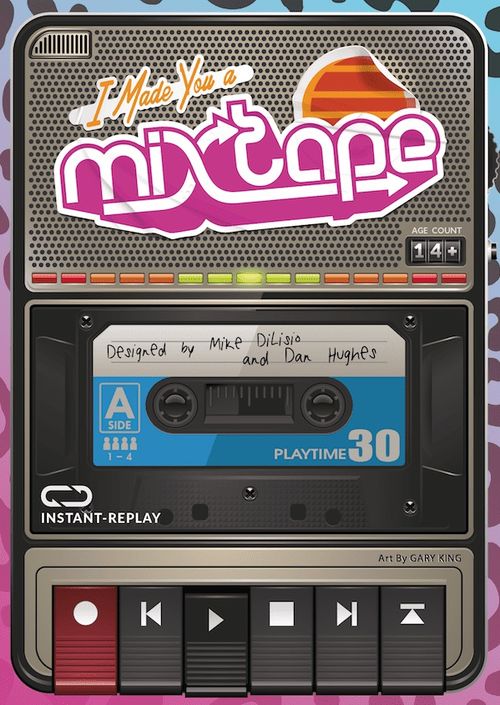
I Made You a Mixtape
I Made You a Mixtape Rulebook
Table of Contents
Table of Contents
Gameplay Overview
All players simultaneously complete each step listed below, before they all proceed together to the next step.
- Split: Draw three Track cards and split them into two piles.
- Pass: Pass both piles to the player on your left.
- Keep: From the Track cards you have been given, choose a pile to keep.
- Return: Give your unwanted pile back to the player who passed it to you.
- Add: Add Track cards to your Mixtape.
- Repeat: Continue until the Track deck is empty.
Finally, score - see End Game Scoring.
On the Cards
A. Balance number: This can appear on either the left or right of a Track card, and its position shows on which side of your mixtape the card can be placed. The higher the number, the longer the track is, and the further your Balance cube will move.
B. Flow: These tape ribbons show you how fluidly each track flows into the next. Flow can connect in three possible places (left, center, right), on both the top and bottom of the card.
C. Genre: There are six genres that score points: Pop, Alternative, Punk, R&B, HipHop/Rap, and Rock. Each genre is a different colour and design.
There is a seventh type of track, the Wild track, but these do not score points in a set. They do however make the Mixtape flow better. These cards have tape ribbon at all connection points.
D. Player-count Markings: Each Track card is marked with a set of lines at the edges to indicate which player counts it can be used for:
- 2 Players: Use only the Track cards with 2 lines.
- 3 Players: Use the Track cards with 2 and 3 lines. Return any unused cards to the box.
- 4 Players: Use all Track cards, including those with 2, 3, and 4 lines.
Setup
If you are playing with fewer than four players, separate all of the Track cards by their player-count (see Player-count Markings). Shuffle the selected Track cards and place them face down to form the Track deck.
Each player:
- E. Takes three Equalizer cards with matching coloured backs and arranges them in a row (Trk A/red on the left, Trk B/blue on the right). Leave space below for two columns, called your Mixtape.
- F. Places a Balance cube on the "30" square in the center of their Equalizer cards.
- G. Draws one Track card. If it's Wild, set it aside, redraw, then reshuffle the Wild(s) back into the deck.
- H. Places their Track card in their Mixtape. 'A' Track cards (with Balance numbers on the left) go in Trk A. 'B' Track cards (with Balance numbers on the right) go in Trk B. Move the Balance cube the number of spaces indicated by the card's Balance number.
Finally, return a number of face-down cards from the Track deck to the box unseen, based on the number of players:
- 2 players = -4 Track cards
- 3 players = -0 Track cards
- 4 players = -2 Track cards
Ready, Set, PLAY!
Gameplay
A game of 'I Made You a Mixtape' is played over a number of rounds, until the Track deck runs out. Each round follows the same steps. All players simultaneously complete each step, before all proceed together to the next step.
1.Split -> 2.Pass -> 3.Keep -> 4.Return -> 5.Add -> 6.Repeat
Once the deck runs out, complete that round, and then proceed to End Game Scoring.
Round Structure
1. Split: Draw three Track cards and split them into two piles (a pile of two cards and a pile of one card).
2. Pass: Pass both of these piles, face down, to the player to your left (clockwise around the table). You should all pass your piles at the same time to avoid confusion.
3. Keep: Pick up the two piles of Track cards you have received from the player on your right, examine them, and choose which of the piles you wish to keep. You must keep all the cards in the pile you have chosen, even if you do not want one of them.
4. Return: Return the pile you did not choose to the player on your right (pass counter-clockwise). You must all do this at the same time, both to avoid confusion, and so that you all have the same information when choosing.
5. Add Track Cards to Your Mixtape: Place your Track cards and adjust your Balance accordingly (see About Balance). You will gain between two and four cards each round.
You must observe the following placement rules:
- Each card must be placed into one of two columns in your player area. 'A' cards (with red balance numbers on the left) must be placed in the left column. 'B' cards (with blue balance numbers on the right) must be placed in the right column (see About Balance).
- You must place the cards at the bottom of the appropriate column. If you have two or more cards for the same column, you may choose in which order to place them.
- Place each new Track card so that it overlaps the card above it. The top edge of a new Track card should line up with the top line of the player count marker of the card above it.
- The sides of each Track card must be aligned with the other cards in its column. You may not stagger or rotate the cards in order to achieve flow.
- Once a card has been placed into a column, you are NOT permitted to move it.
6. Repeat: Once all players have completed the final step, return back to step 1, unless the Track deck is empty, in which case proceed to End Game Scoring.
Example
1. Split: Mike has these 3 Track cards. He chooses to put the 2 'A' cards in one pile and the 'B' card in the other. He passes both piles clockwise to Cora face down.
2. Pass: Mike has been passed these two piles.
3. Keep: He chooses the pile of 2 cards as they go best in his Mixtape.
4. Return: Mike waits until all players have made their decisions and then passes the 1 card back counter-clockwise. Cora returns the 1 card to Mike at the same time.
About Flow
Flow represents how well each track goes with the tracks before and after it. This is shown on the cards by the cassette tape ribbon. Try to align Flow as much as possible. A perfect alignment will be worth 3 points, and a partial alignment will be worth 1 point, at the end of the game (see End Game Scoring).
A Wild Track card will always align with the Track cards before and after it.
5. Add: To get the best Flow, Mike places the Punk A card then the HipHop/Rap A card. He also places his one Punk B card.
Mike's red A cards have Balance numbers of 3 and 1. He moves his Balance cube 4 spaces to the left. His blue B card has a Balance number of 2, so he moves the Balance cube 2 spaces to the right.
6. Play repeats until the Track deck runs out, then they score the game (using the rules on the End Game Scoring page).
About Balance
It is important for you to keep the lengths of both sides of your mixtape as equal as possible. Whenever you add a Track card to your Mixtape, you must immediately move your Balance cube a number of spaces equal to its Balance number. For numbers on the left, move the cube to the left. For numbers on the right, move the cube to the right.
If the Balance cube would move off the edge of the Equalizer, then you are not allowed to place that card into your Mixtape and you must discard it to the box.
Solo Rules
Single Player Variant by Mike DiLisio
In the solo version of 'I Made You a Mixtape' you're competing against Otto Mah, the neighborhood's most annoying kid, to create the best Mixtape.
Setup
- A. Set up the solo game as for a two-player game, setting up player areas for both you and Otto. (Refer to steps E-H in Setup).
- B. Rather than returning them to the box, set aside the 3 and 4 player Track cards and place them near Otto's play area in a face-down shuffled deck.
- C. Place the Solo 'Active player' card, 'Me' side up, between the two players' areas.
Gameplay
The structure of a solo game is different. In each round either you or Otto will be determined as the 'Active player'. The Active player alternates each round between you and Otto. You will be the Active player in the first round. At the end of each round, flip the Solo 'Active player' card to the other side.
When you are the Active player:
Draw three cards from the main (A) Track deck. Turn two cards face up, and keep one face down.
You must choose to take either two cards OR one card. If taking two, one of them must be the face-down card. If taking one, it may be any card (including the face-down card).
Place all remaining cards into Otto's Mixtape, adjusting their Balance as normal. If placing two cards on the same side, ensure that they are in the best Flow possible.
When Otto is the Active player:
Draw three cards from the main (A) Track deck and place them all face up.
Otto will choose one or two cards based on their preference as described in Solo Rules - Otto's Preference.
After Otto has chosen cards and their turn has ended, you must take all remaining cards and put them into your Mixtape.
Solo Rules - Otto's Preference
Otto will consider which cards they take based on the following three factors: Balance, then Genre, then Flow. These considerations are assessed in descending order of priority, beginning with Balance, until a choice is made. Once a factor has been "moved past", it no longer has an impact on Otto's choices.
As a rule of thumb: if you are ever unsure what decision Otto makes - choose the one that most disadvantages you.
1. Consider Balance
Otto will take the one or two cards that bring them closest to perfect Balance. If one card moves them closest, they will take that one card. If two cards move them closest, they will take those two cards. If both one card AND two cards would move them closest, Otto will choose the two cards.
If, however, there are two tied options with the same number of cards that will both move them closest to perfect Balance, or if there are no options that will move them closer to perfect Balance, then proceed to the Genre as the next priority.
2. Consider Genre
Otto will take the card(s) that create or add to their largest Genre set. If one card would create or add to their largest set, they will take that one card. If two cards would create or add to their largest set, they will take those two cards.
If it is still a tie, proceed to the Flow as the next priority.
3. Consider Flow
Otto will take the cards that best fit the Flow of their Mixtape. If only one card would be in Flow with Otto's Mixtape, they will take just that one card. If two cards would be in Flow, then they will always choose those two cards in preference to just one card.
If three cards, or none of the cards, would be in Flow, choose two cards at random.
Special Rule for Otto
When Otto is the Active player, they will ALWAYS get two cards per round to add to their Mixtape. Any time when Otto would keep only one card from the drawn three due to following their preference, draw an additional card from the top of the (ß) 3 and 4 player Track deck, and then add both to Otto's Mixtape.
Otto's turn is now over and you become the Active player.
Solo End Game Scoring
The game ends when the main two-player deck runs out. Calculate both your and Otto's points as in the multiplayer game (using the rules in End Game Scoring).
If you have more points than Otto, you win. Take that Otto!
If you have equal or fewer points, you lose, and Otto becomes even more annoying.
End Game Scoring
Once the Track deck is empty and each player has completed the final round, End Game Scoring occurs.
Score each player area as follows, in this order:
- Balance: Score the points shown on the square that the Balance cube is on.
- Flow: For each card where its Flow aligns with just one of the adjacent cards (either before or after it) score 1 point. For each card where its Flow aligns with both the cards before and after it, score 3 points. If the card's flow doesn't align with either adjacent card it scores 0 points.
- Genre Sets: Each genre scores points depending on the number of Track cards in your Mixtape in that genre set (the total from both the Trk A column, and the Trk B column, combined). See the table below:
| Sets of: | 1 | 2 | 3 | 4 | 5 | 6 | 7 | 8 | 9 | 10 | 11 | 12 |
|---|---|---|---|---|---|---|---|---|---|---|---|---|
| Points | 0 | 3 | 6 | 10 | 15 | 21 | 28 | 36 | 45 | 55 | 66 | 78 |
Wild Track cards do not score anything for genre sets, even if a Mixtape has more than one of them.
The player with the highest total score is the winner, and will be crowned the mixtape master! In the case of a draw, the winner is the tied player with the highest Balance score. If it is still a draw, then the tied players share the victory.
Design: Dan Hughes & Mike DiLisio Art & Graphic Design: Gary King Proofreading: Ruth Riddle Rules Editor: David Digby Special thanks to: Frank West, Jason Matthews, Taylor Reiner, and all our amazing playtesters.