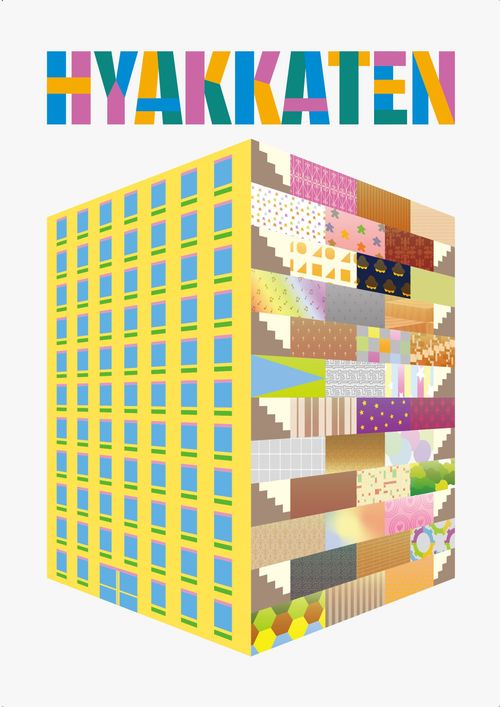
HYAKKATEN
HYAKKATEN Rulebook
Table of Contents
Table of Contents
Summary
This page gives an overview of the flow of the game. See the main rules for the details of each step.
Store Recruitment Phase
- Starting with the start player and going clockwise, each player takes a turn.
- The active player picks one store tile from the waiting stores and places it on the game board. The active player gets the store's basic income and basic VP.
- After placing the store, the active player may place an escalator by paying ¥1.
- The top row of the waiting stores shows the store's recruit cost. The bottom row shows the recruit cost plus ¥2, which is paid to the bank.
Ad Cost Decision Phase
- The right to move the customer pawns is decided by a bidding race in the order blue → red → yellow → green. Each player simultaneously shows money from their hand.
- The player who bids the most gets the right to move the customer pawns of that color.
Customer Movement Phase
- In the order blue → red → yellow → green, the player who won the right to move a color's customer pawn moves it.
- The advertiser rolls one die and moves the customer pawn by the number of pips shown (a roll of 1 is rerolled).
- Each store the customer pawn passes that has the same customer color as the pawn is a "store that was shopped at". Its owner receives the purchase fee in money, and the advertiser receives money and VP.
Cleanup Phase
- Each player receives basic income from the bank according to their basic income track.
- Advertising cost markers move down one space, the waiting stores are updated, the start player marker passes to the left, and the top round card is removed.
Scoring
- The game lasts 7 rounds. Score VP for money in hand, for having the most stores of each customer color, and for owning at least one store of every customer color.
- The player with the most VP wins.
Scoring at game end (summary box as printed):
- Each player gains 1 VP for every ¥5 in hand.
- For each customer color, the player with the most stores of that color (alone) gains 3 VP.
- A player who owns at least one store of each of the four customer colors gains 2 VP.
Each VP is scored by advancing your player marker on the VP track.
Components
- Game board: 1
- Scoring board: 1
- Money: ¥1, ¥5 and ¥10, 30 of each
- Round cards: ROUND 1–7, 7 cards in total
- Die: 1
- Player markers: black, grey, brown and purple, 14 of each
- Customer pawns: blue, red, yellow and green, 1 of each
- Start player marker: 1
- Store tiles: 37
- Entrance tile: 1
- Initial store tiles: 4
- Front-half store tiles (marked II): 16
- Back-half store tiles (marked III): 16
- Escalator tiles: 28
Store Tile Details
Information shown on each store tile. Each item is briefly explained here; the full rules are given in the sections on the game flow.
- Basic income: The amount that advances the owner's basic income track when this store is recruited.
- Basic VP: The amount that advances the owner's VP track when this store is recruited.
- Recruit cost: The amount of money needed to recruit this store.
- Store name: The name of the store inside the game. The store name has no effect on play.
- Store image: The look of the store. It has no effect on play.
- Customer: The customer color this store is for. There are four colors in total, and each color corresponds to the color of the customer pawn: blue for students, red for working adults, yellow for families and green for the wealthy.
- Purchase fee: The amount paid to the store's owner when a customer pawn of the matching color passes through the store. Payment details are explained in the Customer Movement Phase (page 9 of the printed rulebook).
Store Tile Breakdown
The parameters of all 36 store tiles, not counting the entrance tile. Basic income runs blue > red > yellow > green, and purchase fees tend to run blue < red < yellow < green.
Columns: Recruit cost | Basic income / Basic VP | Purchase fee. A cell showing a number followed by "VP" gives the basic VP; a cell with only a VP figure, as printed, gives no basic income figure. "Initial" means the tile is one of the four starting store tiles and is recruited for free during setup.
Blue (students)
| Store (Japanese name) | Recruit cost | Basic income / Basic VP | Purchase fee |
|---|---|---|---|
| クワトローレアイス (Quattro Rare Ice) | Initial | 2 | 0 |
| バベール (Babel) | 1 | 0 | 1 |
| ストロベリーショート (Strawberry Shortcake) | 2 | 1 | 1 |
| カジュアルタウン (Casual Town) | 3 | 1 | 2 |
| ムーンミュージック (Moon Music) | 4 | 1 | 2 |
| スイーツバイキング (Sweets Viking) | 6 | 2 | 2 |
| プルミエール (Premiere) |
Red (working adults)
| Store (Japanese name) | Recruit cost | Basic income / Basic VP | Purchase fee |
|---|---|---|---|
| バーガークイーン (Burger Queen) | Initial | 2 | 0 |
| ファーストバーガー (Fast Burger) | 1 | 0 | 1 |
| ミゼールコーヒー (Misere Coffee) | 2 | 1 | 1 |
| レモンブックス (Lemon Books) | 3 | 1 | 2 |
| サヴィルロウ (Savile Row) | 4 | 1 | 3 |
| コエダ珈琲 (Koeda Coffee) | 6 | 1 | 3 |
| アーカム書店 (Arkham Bookstore) |
Yellow (families)
| Store (Japanese name) | Recruit cost | Basic income / Basic VP | Purchase fee |
|---|---|---|---|
| フレッシュジュース (Flesh Juice) | Initial | 2 | 0 |
| フルーツミックス (Fruits Mix) | 1 | 0 | 1 |
| ヴィレッジガーデン (Village Garden) | 2 | 0 | 2 |
| トイパーク (Toy Park) | 3 | 0 | 3 |
| ククマノン (Cucco Manon) | 4 | 1 | 3 |
| カタン青果 (Katan Greengrocer) | 6 | 1 | 4 |
| ドミノ模型 (Domino Model) |
Green (wealthy)
| Store (Japanese name) | Recruit cost | Basic income / Basic VP | Purchase fee |
|---|---|---|---|
| ワイナリー (Winery) | Initial | 2 | 0 |
| バッカス (Bacchus) | 1 | 0 | 1 |
| 寿司 銀 (Sushi Gin) | 2 | 0 | 2 |
| タイムトラック (Time Track) | 3 | 0 | 3 |
| ギャンビット (Gambit) | 4 | 0 | 4 |
| 松竹梅 (Shochikubai) | 6 | 0 | 5 |
| スモールセコンド (Small Second) |
Note: The store-name transliterations in parentheses are the English logos or readings of the Japanese names, added by the translator for reference.
Setup
Preparation before the first game. Lay out everything needed on the table. Refer to the diagram and the steps below when preparing each component.
-
Place the game board in the center of the table so that all players can reach it.
-
Place the scoring board near the game board.
-
Make a draw pile of round cards in ascending order from the top, and place it in the round card space of the scoring board. (The top card is the ROUND 1 card.)
-
Place the escalator tiles and the die together where all players can reach them.
-
Each player chooses a color (black, brown, grey or purple) and takes all of that color's player markers.
-
Each player places one of their player markers on the 0 space of the VP track, one on the ¥2 space of the basic income track, and one on the bottom space of the blue, red, yellow and green advertising cost areas. Keep the remaining player markers in hand. (Each player keeps 8 player markers in hand.)
-
Give each player five ¥1 bills. This is each player's money in hand.
-
Place the remaining money as ¥1, ¥5 and ¥10 piles where all players can reach them. This is called the bank.
-
[3-player game only] Remove a total of 8 store tiles from the store tiles, consisting of the tiles with recruit cost 1 and the tiles with recruit cost 6, and return them to the box.
-
Separate the 16 front-half store tiles and the 16 back-half store tiles, shuffle each group thoroughly, and place them face down as store draw piles where all players can reach them. Then turn over store tiles from the front-half draw pile, arranging them in 2 rows with as many tiles per row as there are players:
- 3 players: 3 × 2 = 6 tiles
Game Overview and Objective
Players are sharp-minded owners trying to profit by recruiting stores into a newly opened department store in Tokyo. Market research shows that customers in this area will not spend a single yen at a store that does not suit them, but they do not mind spending on a store they like.
Other owners have had the same idea, and they are moving in to seize the department store's supremacy. This cannot be tolerated. To show that you are a better owner than the others, recruit stores that suit the customers, invite customers into your stores by paying advertising costs, and build escalators to make customers move more easily.
Who will become the number one owner with authority over this department store?
Game end and victory
The game is played for a total of 7 rounds, and the goal is to earn VP. Recruiting stores and putting them into the department store alone does not earn VP. VP are earned as follows:
- During play, each customer pawn you moved earns 1 VP for every ¥5 of purchases made during the round. (Purchase amounts are explained below.)
- Each store recruited earns the basic VP printed on the store tile.
- At game end, 1 VP for every ¥5 in hand.
- At game end, for each customer color, compare the stores each player owns. The player who owns the most stores of that color alone earns 3 VP. If more than one player owns the most stores of that color, no one earns this VP.
- At game end, owning at least one store of all four customer colors earns 2 VP.
When the game ends, calculate every player's VP. The player who earns the most VP wins. If two or more players tie for the most VP, the tied player with the most money in hand wins. If that is also tied, all of the tied players share the victory.
Make good use of your skills as an owner to have many customers shop for you, earn more money than anyone else, and aim to become the number one owner!!
Game Flow
This game is played for a total of 7 rounds, with each round made up of the following phases.
- Store Recruitment Phase: Each player recruits a store tile they want from the waiting stores and places it in the department store. After placing a store tile, an escalator may be placed.
- Ad Cost Decision Phase: The players decide who moves the customer pawns of each color in the next Customer Movement Phase. Each player uses the money in hand to bid in a race, and the player who bids the most gets the right to move the customer pawns of that color. In Round 1, this phase is skipped.
- Customer Movement Phase: The advertisers roll the die and move the customer pawns, so that customers shop at the stores. The advertisers and the players who moved the customer pawns receive money and VP as a result.
- Cleanup Phase: Preparation for the next round is carried out. Each player receives basic income according to their basic income track, the waiting stores are updated, the advertising costs change, and the start player marker moves.
Store Recruitment Phase
In the Store Recruitment Phase, each player in turn, starting with the start player and going clockwise, performs the following procedure.
-
The active player chooses 1 store tile from the waiting stores and pays its recruit cost to the bank to acquire it. The bank cost is shown as follows:
- Top row of waiting stores: pay the store tile's recruit cost.
- Bottom row of waiting stores: pay the store tile's recruit cost + ¥2.
The diagram shows the recruit cost paid for each waiting store, for example:
- Dice Denki (recruit cost ¥10, printed as "pay ¥9" in the example): see the note below.
- Fast Burger, Bacchus (top row, recruit cost ¥1): pay ¥1.
- Sweets Viking (bottom row, recruit cost ¥6): pay ¥8.
- Sushi Gin (bottom row, recruit cost ¥2): pay ¥4.
- Red Airship (bottom row, recruit cost ¥10): pay ¥12.
If you cannot pay the recruit cost of any store, choose any store tile from the waiting stores and remove it from the game. If there is at least one store you can acquire, you must acquire one of them.
-
Place the acquired store tile on the game board. Store tiles must be placed adjacent to a store tile already on the board. Be sure to place your player marker on the store tile you placed.
-
Gain the basic income and basic VP printed on the store tile. Advance the basic income track by the basic income amount, and advance the VP track by the basic VP amount.
-
After replacing the store tile, the active player may pay ¥1 to the bank to place an escalator tile once during this turn. (This is also possible when a store tile has been removed from the waiting stores.) An escalator tile is placed across two store tiles already on the board, as shown in the diagram. If an escalator tile is already placed there, it may be placed on top of the existing one. Lining up the edge of the escalator tile with the customer-color edge on the right side of a store tile makes for a neat placement.
Note on the example price: the printed rulebook's example shows Dice Denki as "pay ¥9", but Dice Denki's recruit cost is ¥10 on the tile and in the store tile breakdown table, and the rule above is to pay the recruit cost. The printed example figure ¥9 is kept as printed here, and this discrepancy is in the source.
Ad Cost Decision Phase
In the Ad Cost Decision Phase, the players decide who moves the customer pawns of each color, in the order blue, red, yellow, green. The right to move a customer pawn is decided by a bidding race, in which each player shows money from their hand at the same time. In Round 1 the players who move the customer pawns have already been decided, so this phase is skipped and play proceeds to the Customer Movement Phase.
Reading the advertising cost area (when deciding the player who moves the blue customer pawn)
- The top space of the advertising cost area is called the advertiser space. The player whose marker is on this space wins the right to move the customer pawn of that color.
- The other spaces show the minimum amount a player must show to bid for that right. Each player's minimum bid is the amount in the space their marker is on. In the example diagram, the brown marker's minimum bid is ¥5, the black marker's is ¥3, and the grey and purple markers' is ¥1 each.
- The amount shown by each space changes as the rounds progress. The amounts are printed on the round cards.
Procedure
- Each player decides, from the money in hand, how much to bid for the right to move the blue customer pawn. If a player does not want the right, they bid ¥0. (Keep the amount you bid aside, under the table, for example.) If a player wants the right, they must bid at least the minimum amount shown by their marker's position in the blue advertising cost area. If a player cannot bid that minimum, they bid ¥0.
- All players reveal their bids at the same time. (Put the money you set aside on the table so that it is visible.)
- Compare the bids. The player who bid the highest amount wins the right to move the blue customer pawn and becomes the blue advertiser. If two or more players bid the same highest amount (including ¥0), the advertiser is decided by the following priority:
- The player whose marker is higher in the current blue advertising cost area.
- If the markers are on the same space, the player nearest to the start player in clockwise order.
- The new advertiser pays the amount they bid to the bank and moves their marker in the blue advertising cost area to the blue advertiser space. The other players take back the money they revealed.
Decide the red, yellow and green advertisers in the same way, replacing "blue" in the text above with the color being decided. When the green advertiser has been decided, proceed to the Customer Movement Phase.
Customer Movement Phase
In the Customer Movement Phase, the blue, red, yellow and green customer pawns are moved to make customers shop, in that order. The advertiser of each color is the player whose marker is on the advertiser space of that color's advertising cost area.
Flow of customer pawn movement
-
The advertiser of each color rolls the die. If the die shows 1, roll again.
-
The advertiser moves the customer pawn. Within the rules below, the advertiser is free to choose the route.
Movement rules:
- The customer pawn moves to the adjacent stores on its left or right, as many stores as the number of pips on the die. (For a die result of 1, the pawn moves one store. For a die result of 2, two stores, and so on.)
- To move to a higher or lower floor, the pawn must pass the stairs at the end of a floor, or the store must be connected by an escalator. Stairs are not counted as stores.
- During one move, the customer pawn cannot pass through or stop at a store it has already passed through in that move, including the store it started from.
- If there is still a store the pawn can move to, it must move as far as possible.
- If there is no store the pawn can move to, it stops at the store it is in.
The printed rulebook illustrates these rules with examples for a die result of 2 and a die result of 5.
-
After the customer pawn has finished moving, process the income according to the store tiles it passed through, as explained under Purchase Processing.
Purchase Processing
After moving the customer pawns, process purchases. When customer pawns are moved, the owner of each store the pawns passed through and the player who moved the pawns each receive income. Process it as follows.
A store that the customer pawn passed through this round (including the store it started from and the store it stopped at) whose customer color matches the customer pawn's color is called a store where a purchase was made. Stores whose customer color does not match the pawn are not affected by this processing.
- Store owner income: The owner of each store where a purchase was made receives that store's purchase fee from the bank.
- Example: a yellow pawn passes Dice Denki (purchase fee ¥6, owner brown), Red Airship (red store, so not processed because the pawn is yellow) and Cucco Manon (purchase fee ¥3, owner grey). Brown receives ¥6 and grey receives ¥3.
- Advertiser income 1: The advertiser receives ¥1 from the bank for each store where a purchase was made. (It does not matter who owns the store.)
- Example: two stores were shopped at, so the yellow advertiser receives ¥2.
- Advertiser income 2: For every ¥5 of total purchase fees calculated in step 1, the advertiser immediately gains 1 VP. Advance the advertiser's marker on the VP track by the VP gained.
- Example: the total purchase fees were ¥9 (¥6 + ¥3), so the advertiser gains 1 VP. If the total were ¥10, the advertiser would gain 2 VP.
When the blue, red, yellow and green customer pawns have all been processed, proceed to the Cleanup Phase.
Cleanup Phase
The Cleanup Phase prepares for the next phase. Carry out all of the following.
Receiving basic income
Check each player's basic income track. Each player receives from the bank the amount of money shown on their basic income track.
Updating the advertising cost areas
In each color's advertising cost area, every player marker not on the bottom space moves down one space. Markers already on the bottom space stay where they are.
Updating the waiting stores
- Move all store tiles in the waiting stores to the top row.
- Turn over as many store tiles from the store draw pile as there are players, and place them in the bottom row of the waiting stores. Draw from the front-half draw pile first. When the front-half draw pile is empty, draw from the back-half draw pile. (The waiting-stores update of Round 3 empties the front-half draw pile, so from Round 4 the back-half draw pile is used.)
Moving the start player marker
The player holding the start player marker passes it to the player on their left.
Updating the round card
Take the top card from the round card space on the scoring board and return it to the box. This ends the current round, and the next round begins. Continue the game from the Store Recruitment Phase of the new round.
When the round 7 cleanup is finished, the game ends. Carry out the processing after the game.
After the Game
When the game ends, calculate VP. Each VP earned on a calculation is advanced on the VP track on your player marker.
- Each player earns 1 VP for every ¥5 in hand. Any remainder does not affect VP.
- For each customer color, compare the stores owned by each player. The player who owns the most stores of that color alone earns 3 VP. If more than one player owns the most stores of that color, no one earns this VP.
- Each player who owns at least one store of all four customer colors earns 2 VP.
Example of scoring
Each number below shows how many stores of that color the player owns.
- Player A: blue 4, red 2, yellow 1, green 1. Scores +2 VP: owns at least one store of each color (+2 VP). As printed: the blue stores are not a sole top.
- Player B: blue 1, red 1, yellow 3, green 3. Scores +5 VP: owns at least one store of each color (+2 VP), and is the sole top in green (+3 VP).
- Player C: blue 0, red 2, yellow 4, green 2. Scores +3 VP: is the sole top in yellow (+3 VP).
- Player D: blue 4, red 3, yellow 0, green 1. Scores +3 VP: is the sole top in red (+3 VP). As printed: the blue stores are not a sole top.
Calculate all VP. The player who earns the most VP wins. If two or more players tie for the most VP, the tied player with the most money in hand wins. If the money is also tied, all of the tied players share the victory.
Tips for Running a Department Store
This game offers many ways to earn VP. For owners who do not know how to win, here are some tips for running a department store. They are only an introduction to strategy.
Do not keep to stores of a single color.
Owning only one color of store and paying its advertising costs to receive many purchases may seem like a way to gain a large amount of money at first. In fact, it is not a lasting strategy. As the rounds progress, the amount you must pay for advertising grows, and eventually you may be blocked and receive no purchase fees at all. Recruit stores of various colors and be ready to respond flexibly.
Earn profits together with other players.
In the Customer Movement Phase, players other than the store owner can also earn income by moving customer pawns. In particular, every ¥5 of purchases made by a customer pawn you move earns VP. Even if a store a customer passes through belongs to another player and you hand that player money, you can still take a route that earns you more VP.
Place stores where customer pawns often pass.
Recruiting a store is not enough to earn profit: customer pawns must pass through it. The range a customer pawn can move is decided by the die, but it covers only 2 to 6 stores. If you place a store far away from where customer pawns often travel, customer pawns may not reach it, and you may receive no purchase fees. To avoid this, place stores of the same color close together where possible. Many stores recruited from Round 4 onward have high purchase fees, so using them well may also be worthwhile. In that case, it is good to place these stores in places that are easy to reach from the stores you placed earlier.
Place escalators with foresight.
Escalators are useful for moving customer pawns to higher or lower floors. You do not have to place one in the current round, but if there is a place you want to expand stores into later, place an escalator there now so that movement becomes easier. However, there is no need to place escalators where they benefit only other players. By thinking about how you place stores and how you want to move customer pawns, you can get closer to becoming the better owner.