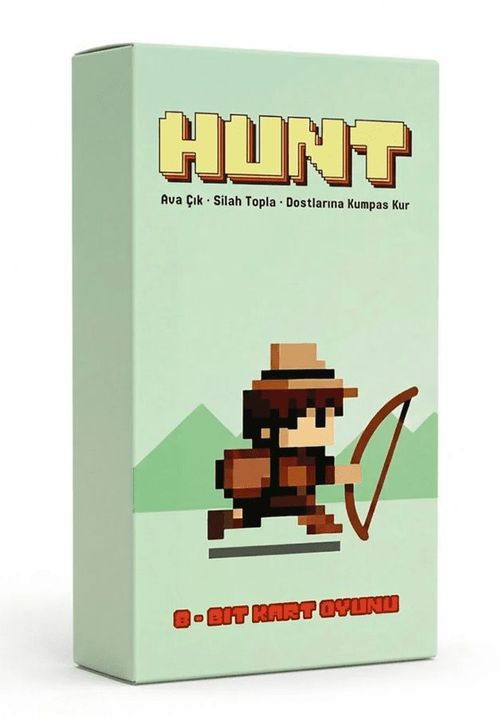
HUNT
HUNT Rulebook
Table of Contents
Table of Contents
Setup
- HUNT consists of 50 cards: 25 Hunt cards and 25 Loot cards, plus one game die.
- Place the Hunt and Loot cards in two separate decks, side by side, in the middle of the table.
- Deal one Loot card to each player.
- Each player rolls the die. The player who rolls the highest value starts.
- You are now ready to play.
Playing the Game
On your turn you must either go on a hunt or draw a Loot card.
Drawing a Loot Card
- If you decide to draw a Loot card, take the top card of the Loot deck into your hand.
- Your turn ends immediately. You may not make any other move.
- Caution: If you have 2 or more Loot cards in your hand, you must go on a hunt on your turn. (If you are playing with an expansion, this limit is 3.)
Going on a Hunt
When you decide to go on a hunt:
- Turn over the top card of the Hunt deck and place it on the table, face up, where everyone can see it.
- Roll the die.
- If the result matches the Hunt Chance shown by the symbol in the upper right corner of the card, the hunt succeeds.
- Successful hunt: Place the card you have won face up in front of you.
- Failed hunt: The Hunt card is sent to the discard pile.
Hunt Chance
- Hunt Chance shows the die values you must roll to make a hunt succeed. It is shown by the die symbol in the upper right corner of each Hunt card.
- For example, if the Hunt Chance is "4-5-6", the die you must roll to catch that creature is a 4, 5 or 6.
Changing Hunt Chance
- Some Weapon and Trap cards can increase or decrease a player's Hunt Chance. For example, the "Balıkçı Oltası" [Fisherman's Rod] gives the player +1 Hunt Chance in the water biome.
- In this case, you only have to add or remove a die value from the current Hunt Chance.
- For example: You play the "Balıkçı Oltası" [Fisherman's Rod] card to go on a hunt, and you encounter a water biome creature.
- To hunt water biome creatures, the die values you must roll are 3, 4, 5 or 6. The "Balıkçı Oltası" [Fisherman's Rod] also gives you +1 Hunt Chance.
- In this case you add one die value, so the die values you must roll for a successful hunt become 2, 3, 4, 5 or 6.
- In the same way, when a -1 Hunt Chance effect is played, you remove one die value: if the values you must roll are 3-4-5-6, they drop to 4-5-6.
Loot Cards
There are two types of Loot card in the game: Weapons and Traps.
Weapons
- Weapon cards give you various effects on your own turn.
- A Weapon card may only be played immediately before going on a hunt (before a Hunt card is turned over). If you play a Weapon card, you must go on a hunt.
- A player may use only one Weapon card on their own turn.
- If the conditions are met, you may play a Weapon card and a Trap card at the same time on your own turn.
Traps
- Trap cards are played at any time, unless the card says when it is to be played. They are used to make your opponents' work harder or to protect yourself, depending on the situation.
- Trap cards may be played one after another.
- Follow exactly what the card says.
- Playing a Trap card on your own turn does not end your turn. Your turn does not pass until you go on a hunt or draw a Loot card.
End of the Game and Winning
- The goal of the game is to win as many Hunt cards as possible and reach the target score.
- Your score is the total of the points printed on the Hunt cards you own.
- The target score depends on the number of players:
- 3 players: 20 points
- 4 players: 15 points
- 5 players: 12 points
- 6 players: 10 points
- Caution: If a player wins a Hunt card during another player's turn by playing a Trap card and reaches the target score, they cannot declare victory before their own turn comes around. When their turn comes, if they still have the target score, they have won the game, without having to go on a hunt.
- Also important: If a player succeeds on a hunt on their own turn and reaches the target score, the other players may still prevent this by playing Trap cards. If no one can prevent it, victory is declared.
- For example: You go on a hunt, succeed, and reach the target score. Another player may then play the "Rüyaymış" [It Was Only a Dream] card to force you to go on a hunt again.
Conflicting Effects
- Every card in HUNT and in its expansion packs is unique, and each has its own effect on the game. When several cards are played at the same time, their effects can sometimes conflict with one another.
- In such cases, keep the following rules in mind:
- The effect of a Hunt card that has been turned over always takes place.
- When several players play Trap cards one after another in the same round, the effects printed on the cards take place in the order in which they were played.
- For example: Player A succeeds on a hunt. Then Players B and C each play a card one after another.
- B plays the "Haksız Rekabet" [Unfair Competition] card to try to send this hunt to the discard pile.
- C plays the "Meydan Okuma" [Challenge] card to try to take this hunt.
- Because "Haksız Rekabet" [Unfair Competition] was played first, its effect applies first. If it succeeds, the Hunt card is sent to the discard pile, so the card C played has no meaning any more, and it returns to C's hand.
- It is not possible to explain every combination of cards one by one.
- When you are unsure what to do, or when you cannot be sure what should happen, consider the rules and the effects printed on the cards played, and reach a common decision among the players.