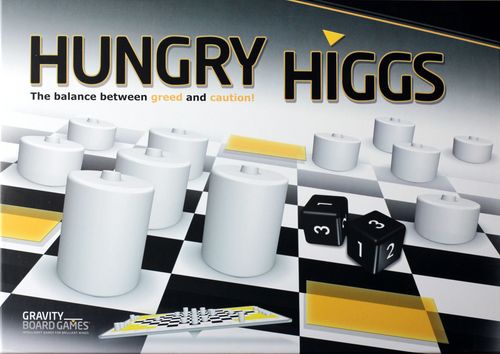
Hungry Higgs
Hungry Higgs Rulebook
Table of Contents
Table of Contents
Dice and Pieces
- The game contains two dice.
- The game contains 28 pieces in total.
- 2 pieces, 1 for each player or team.
- 1 counterweight with a value of 7.
- 25 prey pieces with varying values.
- 6 pieces with a value of 1
- 10 pieces with a value of 2
- 4 pieces with a value of 3
- 5 pieces with a value of 4
- Note: the sheet's Norwegian labels are Spillerbrikker (player pieces), Byttebrikker (prey pieces) and Modvægtslod (counterweight).
Roll of the Dice
What is the highest value you can obtain by a roll of one dice? With both dice?
Lining up the Game
Begin by placing the pieces as illustrated on the board diagram of the rules sheet. Read the game rules on the following page.
Now It Is Time to Play
The players each throw a dice. The one with the highest throw begins.
The Dice
You shall take turns at throwing both dice and moving your piece according to the value of both dice. If you throw a 1 and a 3, you must move your piece 1 and 3 squares. You decide which value you want to use first. The purpose of the game is to collect the greatest amount of weight on your board half or to capture the opponent. Begin by playing in pairs a couple of times to have a discussion partner.
Pieces
How to Move the Piece
You may move your piece on the white and black squares as you wish, but not on the yellow squares.
Throw two dice. The dice show the number of squares you can move the piece. You decide which dice value you wish to begin with. You may move the piece in the same direction for each of the dice values, or you may move the piece forward according to one dice value and in another direction according to the second dice value. When moving the piece, you can move in any direction: diagonally or straight ahead, back or to the side. However, you can only move in one direction per die.
When you have moved your piece the number of squares indicated by the first dice value, you will end up on a new square. Starting from this square, move your piece as indicated by the second dice value. Feel free to change direction. It is up to you which dice value you use first.
As you can see from the illustrations, the number of possible squares you may end up on depends on how close to the edge of the board you are.
Examples
How to move the piece if you got a 3 on one of the dice: the sheet shows the piece's possible destination squares for a single 3 in the centre of the board and near the edge, with the reachable squares marked by arrows.
Prey Pieces
How to Take a Prey Piece
If you choose to place the piece on a square that already has a prey piece on it, you must take the piece. Now, you place this piece on a vacant yellow square on your half of the board. Always place your prey piece on the yellow square that is closest to line 0, which is also named the centre line.
Each yellow square can contain only one prey piece, and the prey piece cannot be brought into play again. You can only take the prey piece from the square on which you land after moving according to each of the two dice values.
Counterweight
When you have moved your piece and collected the prey pieces, the game board might tilt to one side. Now you move the counterweight to restore stability.
How to Win Hungry Higgs
The winner of the game is the player or players who have collected that much weight on their half so that balance can no longer be restored, even if the counterweight is placed in the opposite extreme of the board.
You win when you can put your piece on top of the opponent's piece and thus capture him or her. This may take place after using either one or both dice values. If you do not win in one of these ways, you also win if you have the greater amount of weight on your half of the game board when all the prey pieces have been collected.
Tournament
Hungry Higgs continues until one player has won 3 sets. This means that you can win Hungry Higgs by a set score of 3-2, 3-1, or 3-0. The loser of a set begins the following set by throwing both dice and moving the piece.
Editor's note: the sheet ends this paragraph with an untranslated Norwegian fragment, "flytte sin spillebrik", which means "move your piece". It is a leftover from the Norwegian edition text and is not a separate rule.