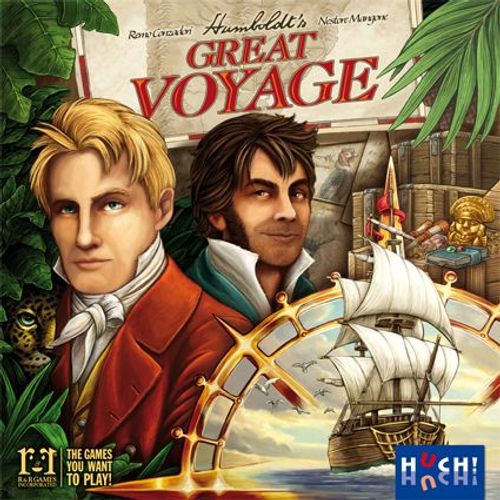
Humboldt's Great Voyage
Humboldt's Great Voyage Rulebook
Table of Contents
Table of Contents
Contents
- 60 acquaintances (10 per color)
- 72 cargo tiles (12 per color)
- 40 Ship cards (10 per ship type)
- 96 knowledge disks (16 per color)
- 1 game board
- 4 fame point markers
- 1 travel journal
- 4 expedition boards
- 1 player aid per language (without illustration)
- 1 cloth bag
Principle and Object of the Game
Draw knowledge disks – travel your route and collect cargo tiles – win with the most fame points as possible.
During the game, you draw two knowledge disks each round, thus determining the starting point of your journey. From there, you move forward Mancala style, taking all the knowledge disks lying on your starting circle into your hand and then moving ahead by leaving one disk at each location you visit. On your way, you collect items, and then you distribute them onto your ships in order to send off the findings of your journey as quickly as possible. You can also benefit from other players' turns by collecting knowledge (disks) that you may use to gather helpful acquaintances.
Once there are no knowledge disks left in the bag, the game ends. The player who has collected the most fame points by then is the winner.
Set-up
Preparing the gameboard
- Put the gameboard in the middle of the table.
- Distribute the knowledge disks onto the board locations based on the number of players.
- 4-player game: Throw all knowledge disks into the cloth bag. Draw 4 disks for each location on the board and place them in the respective circle.
- 3-player game: Throw all knowledge disks into the cloth bag. Draw 3 disks each for La Coruña, Angostura, Quito, and Mexico City and place them in the respective circle. Draw 4 disks for each of the remaining locations on the board and place them in the respective circle.
- 2-player game: Remove 6 knowledge disks – one of each color – from the game. Throw all remaining disks into the cloth bag. Draw 5 disks each for Angostura and Quito and place them in the respective circle. Draw 4 disks for each of the remaining locations on the board and place them in the respective circle.
- Sort the cargo tiles by color, mixing each color separately with the backs facing up, and put each of them as a face-down draw pile on the color-matching closed crate on the board. Then take 2 tiles from each pile and put them face up on the respective display spaces.
- Place the acquaintances as a face-up supply on the board.
- Sort the Ship cards according to their ship type (color on the reverse side). Shuffle the cards of each type separately. Put the 4 Ship card piles face up as draw piles next to the gameboard.
Preparing the players
Each player chooses a player color and puts the corresponding fame point marker on the "0" on the game board.
Give each player one card from each pile. Now everybody has one card of each ship type; he lays them out face up in front of him.
Each Ship card has two sections. In the upper section, you collect cargo tiles for shipping. In the bottom section, you collect knowledge disks to get acquaintances when the ship sails and the Ship card is fulfilled.
Each player takes the expedition board in his color. Here you collect acquaintances and may temporarily store cargo tiles. At the beginning of the game, each player decides whether they want to collect acquaintances face up or face down and places the board accordingly.
- face up: port scene
- face down: room scene
The player who last went on a journey becomes the starting player. He gets the travel journal and the bag with the knowledge disks. Then the players prepare themselves for their voyage:
- Each player may exchange 1 of his 4 cards for the face-up one on the corresponding pile – beginning with the starting player. It is recommended to exchange a card if you have 3 or more Ship cards displaying crates of a certain color.
- Each player receives one acquaintance from the supply – in the color that is most dominant on his Ship cards. If the cards have the same amount of crates in two or more colors, the player chooses one of these colors.
- Beginning with the starting player, each player may draw 2 cargo tiles from any of the face-down draw piles. The tiles may be from the same or different piles. Put them face up onto your expedition board.
The game proceeds in clockwise order. After finishing your turn, you pass the travel journal and the bag to your left neighbor.
Course of the Game
The active player is the one whose turn it is, and every turn always involves the active player as well as the other players.
Each turn consists of the following steps:
- You draw 2 knowledge disks one at a time
- You mark your route
- The other players take knowledge disks
- You collect and load cargo tiles
Course of a turn for the active player
-
At the beginning of your turn, draw one knowledge disk out of the bag.
-
Decide whether you want to start your journey from a location in the color of this disk. If you draw a green disk, for example, you could start from one of the 3 green locations (Cumaná, Angustura, or Caracas).
-
If you want to start from this color, put the disk on the left page of the travel journal. Then draw a second disk from the bag and put it on the right page.
OR
-
If you do not want to start from this color, put the disk on the right page of the travel journal. Then draw a second disk from the bag and put it on the left page. Now you must start from this color.
Attention: The travel journal can NEVER have two disks of the same color at the same time. So, if the second disk you draw has the same color as the first, put it aside for the time being and keep drawing new disks until you draw a disk of a different color; after that, throw the disk(s) you have put aside back into the bag.
Exception: Towards the end of the game, it can occur that only disks of the same color are left in the bag. In this case, you have to start from this color.
-
-
Choose one of the locations in the color of the disk on the left page of the travel journal and take all the disks currently at this location on the gameboard into your hand.
Attention: Keep the disks in the travel journal in place until the end of your turn!
-
Follow an arrow from the location that you took the disks from. At the next location, place a disk from your hand on the compass trying to match the color of this location. Then follow the next arrow to the next location and place another disk on the compass there. Keep doing this until you have no disks left in your hand. With this, you have marked your travel route.
Attention: It can happen that you visit the same location twice. In this case, place a second disk on the compass.
You may move only in the direction of the arrows. (However, moving back and forth between Quito and Angostura in the same turn is forbidden.)
-
Give the other players a moment to view your route. Then they may pick knowledge disks from your route (see "Course of the turn for other players").
-
Follow your route and check at each location whether the knowledge disk you have placed on the compass there matches the color of that location.
-
If the disk and the location are not of the same color, you gain nothing. Move the disk from the compass space in the frame onto the location space.
OR
-
If the disk and the location are of the same color, you may take a cargo tile of this color. You can pick one of the two face-up cargo tiles or draw the top tile from the face-down pile. (Empty spaces are immediately refilled with tiles from the pile.) Then move the disk onto the location space.
-
Course of a turn for the other players
-
The other players observe what route the active player has chosen. Once the active player has distributed his knowledge disks, each of the other players – beginning with the player to his left – may take one disk (take 2 disks in the 2-player game) from one of the visited locations, provided there are at least 4 disks at this location. The disk on the compass is not included in this count NOR can it be taken. When there are fewer than 4 disks on any location spaces along the active player's route, some or even all of the other players will not get disks.
Attention! If you have no spaces left on your Ship cards to place a disk, you may not take one from the board.
You may also opt to refrain from taking a disk.
-
The other players immediately put the disk they have taken on a suitable space in the bottom section of their Ship cards. Disks can be placed on a matching color or a white (wild) space. If you don't have any appropriate space left on your Ship cards, you can't take any disk from the gameboard.
Example: Beth has taken a blue knowledge disk from the board. There are still a few spaces empty on her Ship cards. She has the choice of putting the disk on the empty white (wild) space on the first card or on the blue space on the fourth card.
The Ship cards
If you fulfill a Ship card, you earn fame points (upper right) for the cargo tiles you have collected. Additionally, if you also filled the bottom section you can collect an acquaintance as well.
The Ship cards are partitioned as follows:
In the upper section, you must fulfill the following:
- Here you see what cargo tiles you have to collect on your turn in order to put the ship out to sea:
- On white crates, you may place any cargo tile.
- On colored crates, you have to place a cargo tile in the matching color.
- On crates with a symbol, you have to place exactly this cargo tile (matching in color and symbol).
- The victory points you receive when the ship sets sail are indicated in the upper right.
When you fulfill a card on your turn (i.e., all 2 or 3 cargo spaces are occupied), the ship sails and you immediately record its points on the scoring track. If you also fulfilled the bottom section you will receive an acquaintance tile (see bottom section). Take the cargo tiles off the card and place them in discard piles in the respective colors next to the gameboard. Place the Ship card on the discard pile of the same card type. Finally, draw a new Ship card from the respective pile, so that you again have one card of each ship type in front of you. If you still have 1-2 unused cargo tiles on your expedition board, do not place them onto the new cards yet. You may do that only at the end of your next turn.
In the bottom section, you may fulfill the following:
- In the bottom section of the card you place knowledge disks collected during other players' turns. These enable you to get acquaintances when the Ship card sails.
When you fulfill a card (i.e., have completely occupied the cargo spaces with the required tiles), the bottom section gives a bonus of an acquaintance if you have filled the lower section with the required knowledge disks.
Brown card (S) Condition: Here you can place any disk. The color is up to you. Shipping bonus: Take an acquaintance in the color of this knowledge disk from the supply and place the person onto your expedition board.
Blue card (W) Condition: Here you have to place a disk in the given color. Shipping bonus: Take an acquaintance in the color of this knowledge disk from the supply and place the person onto your expedition board.
Green card (E) Condition: Here you have to place two disks of one color of your choice. Shipping bonus: Take an acquaintance in the color of these knowledge disks from the supply and place the person onto your expedition board.
Yellow card (N) Condition: Here you have to place two disks in the given colors. Shipping bonus: Choose an acquaintance in one of the two colors of these knowledge disks from the supply and place the person onto your expedition board.
If you fulfill card E or card N and currently have only one knowledge disk in the bottom section of the card, you don't get an acquaintance. These cards require two disks for the bonus.
If you fulfill one or more Ship cards during your turn, put the disk(s) from these cards onto the travel journal (in addition to the two other disks that have been there since the beginning of your turn).
Example: Richard fulfills two cards during his turn: one S card and one N card.
For the shipped cargo on the S card, he earns 4 points that he immediately advances on the scoring track; and for the red knowledge disk, he gets a red acquaintance.
For the shipped cargo on the N card, he earns 12 points that he immediately advances on the scoring track. In the bottom section of the card, there is just one blue knowledge disk. Without the second (brown) knowledge disk, the task is considered incomplete and Richard gets no acquaintance for it.
Richard puts both knowledge disks (the red one and the blue one) on the travel journal, and the cargo tiles and the fulfilled cards on the respective discard piles. Richard draws one new S card and one new N card, places the collected knowledge disks from the travel journal onto his starting location on the gameboard, and ends his turn by passing the travel journal and the bag to his left neighbor.
Note: If a card pile or a pile of cargo tiles is depleted during the game, take the respective discard pile, shuffle it and use it as the new draw pile.
The acquaintances
Like Humboldt, you try to have contact with as many different personalities of your time as possible. You can use the acquaintances you collect during the game in two ways:
a) At the end of the game – Gain fame points for sets: The more different acquaintances you have collected in the game, the more fame points you get for them. For each set of up to 4 acquaintances in different colors, you get the following points in the end:
| Number of different acquaintances | 1 | 2 | 3 | 4 |
|---|---|---|---|---|
| Number of points | 1 | 3 | 6 | 10 |
b) During the game – Change the color of knowledge disks on your route: Alternatively, you can also give up an acquaintance during your turn to change the color of any knowledge disk on your route to the color of that acquaintance. (Essentially your acquaintance helps out by using their expertise.) For example, if you visit a yellow location on your travel route where you would have to place a disk in a different color, you can give up a yellow acquaintance and use her as a joker. Thus, even though your knowledge disk doesn't have the right color, you may still take a yellow cargo tile by giving up the acquaintance of the matching color.
End of the Game
The game ends as soon as one player has drawn the last two knowledge disks out of the bag and finished his turn. During this turn, the other players may still take disks from the board as described above.
Then the final scoring takes place.
First, each player gets the respective acquaintance for each completely occupied bottom section of his Ship cards and gives up the appropriate knowledge disks in return. The remaining knowledge disks and the cargo tiles stay on the Ship cards.
The acquaintances are not limited. If there are too few of any color left at the end, replace them for the final scoring by knowledge disks in the corresponding color. If a player still has cargo tiles on their expedition board that match spaces on their (newly drawn) cards, they may place those tiles and possibly fulfill cards and score them. However, they do not redraw cards. The remaining knowledge disks and the cargo tiles stay on the Ship cards.
Now, add up the points that you get for the acquaintances lying in front of you at the end of the game (see "The acquaintances") and advance the appropriate number of spaces on the scoring track. Finally, receive points for cargo tiles that remain on your cards or expedition board: 2 points per tile with a matching symbol, 1 point for each other tile (those on a non-symbol crate or on the expedition board).
The player who is now furthest ahead wins the game. In case of a tie, the tied player who has the most cargo tiles and knowledge disks left wins. If there is still a tie, the tied players share the victory.
Scoring example
Richard is in the following situation at the end of the game:
From the bottom section of the cards, he can still change the knowledge disks into 3 acquaintances: Richard receives a red, a green, and a blue acquaintance. The yellow knowledge disk goes to waste as there is no second disk on that card.
In the end, Richard has 1 set of 4 different acquaintances (10 points) and 1 set of 3 acquaintances (6 points). Altogether, 16 fame points for the acquaintances.
After having moved the two cargo tiles from his expedition board to the cards, he fulfills one more card and gets 12 points for it. In addition, he earns 2 points for the green cargo tile with the matching symbol, plus 1 point each for the two remaining two blue crates. So, 16 fame points in total for the remaining cargo tiles.
You can find a brief outline of Humboldt's stages of life in the appendix, on page III.
Humboldt's Stages of Life
"He is the actual discoverer of the New World. His wisdom gave America more than all the conquistadores." (Simón Bolívar)
Childhood / Education / Vocation
Alexander von Humboldt is born in Berlin in 1769. Humboldt grows up with various home tutors and, in part, is required to handle the same curriculum as his brother Wilhelm who is two years older. From early on, he pursues his enthusiasm for the observation of nature. He studies at the universities in Frankfurt/Oder and Göttingen. After that, he starts working as a mine inspector, improving mining methods and safety conditions and, in 1793, founding a free school for miners that he finances out of his own pocket. Around this time he undertakes his first journeys. When his last parent passes away in 1796, he inherits a fortune that enables him to lead an independent life.
Travel preparations
Humboldt quits his service for the government and prepares for a major research expedition. He cultivates contacts with leading scientists of that time and first travels to Paris, the center of science at that time. Because of political and war-related complications, he has to put most of his travel preparations on hold for quite some time. Finally, he manages to get a researcher passport from the Spanish king that authorizes him to have full freedom of action and the goodwill of all governors and officials throughout the entire Spanish colonial territory.
Great voyage to the Americas
Accompanied by the physician and botanist Aimé Bonpland, Humboldt departs from the harbor of La Coruña in June 1799 to travel to America. They carry many scientific instruments making use of the current state of technology: sextants, telescopes, hygrometers, barometers, and even a cyanometer for determining the blueness of the sky. After a stopover on Tenerife, they arrive at Cumaná on the 16th of July, 1799. On their trip through the jungle in South America, Humboldt and Bonpland verify the connection between the Orinoco and the Rio Negro, and travel the Andes almost up to the summit of Mount Chimborazo (according to what was believed at that time, the highest mountain in the world). They then sail to Mexico and Cuba and, at the end of their journey, meet then-president Thomas Jefferson in the USA.
During their adventures over several years, the two explorers collect and ship scientific samples of all kinds, examine the sea current along the Pacific coast (later known as the Humboldt Current) and a great number of other natural phenomena. They fill numerous notebooks and diaries, and make many acquaintances and friends, until they finally return to Europe in August 1804.
After the voyage
Humboldt's return is met with enthusiasm in Europe, especially since the newspapers have repeatedly reported about his alleged death. He settles in Paris, continues his research, and publishes his experiences and findings in books that sell very well. In addition, he gives speeches and lectures that are also open to the general public.
Over the years, Humboldt also supports other scientists, artists, and young entrepreneurs. His work and his writings inspire some of the best-known writers of his century, such as Jules Verne and Charles Darwin.
However, as early as during his journey to America, Humboldt begins denouncing the exploitation of nature and points out the overall connections within the ecosystem. Wherever he finds an opportunity, he voices his profound aversion to slavery and expresses his criticism of colonialism – for instance, in conversation with Simón Bolívar, the eventual fighter for independence in South America.
Journey to Russia
Soon after his journey to America, Humboldt wants to explore the Himalayas, which was British territory at that time. But as much as he tries, he won't get approval for this project during his lifetime. As an alternative, in 1829, Humboldt accepts the invitation of the Russian tsar, Nicholas I, to undertake a geological study trip. Humboldt, now 60 years old, travels more than 15,000 kilometers through the Ural Mountains and Siberia – under strict surveillance that he can get away from only for a short time. On this journey, he finds sensational diamonds and induces scientific developments in that country.
Kosmos
From 1834 on, Humboldt is writing his life's work, "Kosmos", an idea that has been on his mind since his youth. At the time of his death, he is working on volume five of this comprehensive description of nature and cultural history. Humboldt dies in 1859. Many people may be surprised to learn that there are probably more plants, animals, minerals, and places named after him than anyone else.