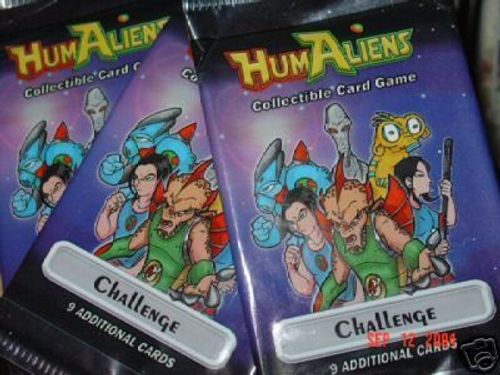
HumAliens
HumAliens Rulebook
Table of Contents
Table of Contents
- What's in a Faction Box?
- Winning the Game
- Preparing for Battle
- Game Play
- Basics
- Actions
- Understanding the Cards
- Humaliens
- Enhancements
- Building a Deck
- Attacking
- Knockout
- Discard
- Game Details
- Alert, Stunned and Recovery Rolls
- Recovery Rolls
- Resistance
- Golden Rule of CCGs
- Timing
- Hand Size
- Deck Etiquette
- FAQ
What's in a Faction Box?
Your Faction Box contains this rule sheet, 50 cards, a 10-sided die and 10 Energy Clips. The cards are designed around the faction you selected, though there are several random cards as well so each Faction Box is a little different.
Winning the Game
There are two ways to win in Humaliens: Battlefront Victory and Superbeing Victory.
Battlefront Victory
When a player has zero Humaliens (characters) on his or her frontline, that player is defeated and is out of the game. When all of your opponents have been defeated, you win!
Superbeing Victory
Humaliens become Superbeings upon reaching 500 Energy Points (EP) or when they reach three Knockout credits (your Humalien gets a Knockout credit when it knocks-out an opponent frontliner). When one of your Humaliens becomes a Superbeing, remove it from your frontline and put it in your Superbeing Zone (all attachments go to the discard pile). When you gain your third Superbeing, you win.
When one of your Humaliens becomes a Superbeing, you may immediately place a Humalien card from your hand onto your frontline. If the Humalien becoming a Superbeing was the only character on your frontline, this replacement prevents your frontline from being empty — but only if you have a Humalien in your hand to put on your frontline.
If two or more players get a third Superbeing at the same time, play continues normally until one player has more Superbeings than any other player. When this happens, the player with the most Superbeings wins.
Preparing for Battle
Select Starting Frontline
Choose up to five Humaliens and place them face-down on your frontline (see play area diagram). The combined printed EP (see Energy Points, page 9) of your starting frontliners cannot be more than 400EP. Make sure that the Humalien you've selected as your starting leader is in the front and center of your frontline.
Choose Your Faction
You may choose only one faction and you may not change that faction during the game. This does not restrict which Humaliens can be on your frontline, but does provide certain advantages when playing with Humaliens of your selected faction.
Factional Advantages
All factions share one advantage and most have a special advantage of its own.
All Factions: After a Humalien of your chosen faction enters play on your frontline, that Humalien gains 20EP. Remember that when your starting frontline is turned face-up they are considered to be "entering play."
While at least half of the Humaliens on your frontline are members of your faction, your frontline gains the appropriate Factional Advantage:
- Alien: When drawing cards as an Order, you draw 3 cards (this does not work with card effects).
- Beast: Once during each of your turns, you may re-roll a single die. The result of the re-roll replaces the first, even if it is worse.
- Clone: A Clone faction frontline may contain duplicates of Clone faction Humaliens: up to three at one time (maximum copies per deck). Clones may use this advantage even if they have less than three Clones on their frontline.
- Human: For purposes of linking Enhancement cards, each Human on your frontline is considered to have +50EP. Example: If a Humalien on your frontline has current EP of 100, it can link Enhancements with a total EP value of 150.
- Robot: Ignore opponent Actions, Attacks and Orders that would cause Robots on your frontline to become Stunned. They may still become stunned as a result of your Actions, Attacks and Orders.
- X-PET: None.
Turn Team Face-Up
After players announce factions, starting teams are turned face-up. When your starting team is turned face up, the Humaliens are "entering play", so any rule or effect depended upon a Humalien entering play may take effect.
Set Starting EP
After a Humalien enters play, place clips on the EP scale along the right edge of the card to note the Humalien's starting, or printed EP. Unless otherwise stated on the card or in the rules, a character's starting EP is equal to the Humalien's printed EP, which appears in the upper right corner of the card.
Shuffle Cards
Shuffle all of your remaining cards and set the deck face-down on the table in front of you. Each player may cut the deck of the opponent to his or her right.
Game Play
Draw Cards: All players draw 5 cards from their deck.
Roll Initiative: Each player rolls a die for initiative and the player with the highest result wins. (Dice are numbered 0-9 or 00-90, with 0 and 00 being read as zero). If players tie for highest result, they each roll another die and compare results until one has the higher result — and wins initiative.
Player Turns
The player who won initiative takes the first turn then players take turns, going clockwise around the table. During your turn, you may perform two Orders from the following list. There is no limit to the number of reacts or actions that do not require orders.
Unless otherwise stated, each of the possibilities below requires one Order to accomplish (most Orders can be performed in no particular sequence).
Orders List
- Attack with your leader: You may only Attack once per turn and the Attack must be your first Order of the turn. Your leader may perform an Attack even if it will not inflict damage on his opponent.
- Add a Humalien to your frontline: This requires TWO Orders. If, at any time, you have more than 5 Humaliens on your frontline or Humaliens with a combined printed EP greater than 400, choose and Knockout one of your frontliners. The next player's leader receives credit for such Knockouts.
- Link an Enhancement: Following the rules listed under "Enhancements," link an Ethic, P.E.T. or Technology.
- Perform an Order from a card on your frontline.
- Use an Action card from your hand: Some Action cards require you to use one or more of your Orders (the card will tell you the number of Orders). Discard the Action card after use.
- Draw cards from your deck: Draw two cards.
- Move a Humalien on your frontline: Target and Stun one of your frontline Humaliens. That Humalien switches places with your leader.
- Pass: When you don't have anything you want to do, or if you can't do anything, you may "pass", one Order at a time.
Basics
The Play Area
Frontline: This is where you place your Humalien team members. While in play, all of your Humaliens are on your frontline.
Your frontline may consist of up to five Humaliens whose combined Energy Points (EP) does not exceed 400EP, using their printed EP value only. There is no maximum for your frontline's "current" EP. If, at any time, you have more than 5 Humaliens or a combined printed EP greater than 400 on your frontline, choose and Knockout one of your frontliners. The next player's leader receives credit for such Knockouts.
You are limited to one copy of any given Humalien on your frontline. The Clone faction is an exception: you may have duplicate Clones on your frontline.
Superbeing Zone (SZ): When Humaliens have realized their full potential, either by attaining 500EP or by receiving three Knockout credits, they advance to the rank of Superbeing. Once that happens, they are removed from your frontline and placed in the Superbeing Zone. Superbeings are no longer Humaliens and are not on your frontline.
Deck (D): The deck includes all of your unused cards. If you run out of cards, the game continues but you will be at a disadvantage since your options are limited to those presented on your cards in play and what cards remain in your hand.
Discard Pile (DP): After a card has been used, discarded, or when you are otherwise instructed, place cards in your discard pile.
Energy Points (EP)
The upper right corner of every Humalien displays that character's printed Energy Points, or EP. The game uses EP to show how much life-force a Humalien has at any given moment, which can change numerous times (positively or negatively) during play.
An EP scale appears along the right edge of each Humalien card. When a Humalien enters play, use one or more Energy Clips (provided in the Faction decks) on the scale to note that character's starting EP. Starting EP matches printed EP unless otherwise instructed by rules or card text. As a Humalien's EP changes, move its Energy Clips to note each change. A Humalien's current EP is the character's EP at that moment.
When a Humalien's EP drops to zero or below, it is Knocked-out. If a Humalien reaches 500EP or more, it becomes a Superbeing.
Actions
Action cards play directly out of your hand. They do not have to be linked or put on your frontline before you can use them to produce a game effect. Action cards represent the quick thinking and tactical reflexes of your leader and the other Humaliens on your frontline.
Some Action cards are played as reactions, interrupting game play and resolving before you return to standard play. Action cards do not require an Order to play unless the card indicates otherwise.
Action cards contain the following information:
- Name: The name of the Action card.
- Card Text: The rules text for the Action card, usually explaining when and how to use the card, and what the card does.
Team cards are a type of Action, and are among the most powerful cards in the game. Because these special Action cards are so powerful, they are limited in your deck. A deck may include up to three (3) total Team cards.
Understanding the Cards
Humaliens has three card types [sic]: Actions, Enhancements and Humaliens. Cards display symbols for the set and rarity, and include a card number.
Humaliens
These cards represent characters belonging to one of the factions within Humaliens: Alien, Beast, Clone, Human, Robot and X-P.E.T.
Each Humalien card contains the following information:
- Name: The name of the character.
- Faction: Affiliation is displayed both by a symbol that appears in the upper left corner and by the card's coloring. (The rulesheet shows an icon beside each faction name: Alien, Beast, Clone, Human, Robot, X-PET.)
- Energy Points (EP): A Humalien's printed EP appears in the upper right corner of the card.
- EP Scale: This scale appears along the right edge of the card, below the character's starting EP. When the Humalien enters play, use Energy Clips to note its starting EP on the EP scale. Each time the Humalien's EP changes, be sure to note the new EP.
- Card Text: This is where the rules text for the character's Orders, Attacks, Resistances and other effects will appear.
Enhancements
Enhancements include Ethic, P.E.T. and Technology cards. Though different in flavor, these cards function similarly during play.
Enhancements enter play by being linked to a Humalien on your frontline. Until linked, Enhancements have no effect on play. A Humalien may link Enhancement cards with a combined EP value up to his or her current EP. Linking cards does not affect a Humalien's current EP.
If a Humalien's EP drops below the combined EP value of his linked cards, the Enhancements are not discarded but the character cannot link more until the character's EP is raised above the combined EP value of the links.
Example: A Humalien with current EP of 180 links several Enhancement cards with a total of 180EP value. The next turn he suffers 100DP from an opponent's attack. The Humalien, now at 80EP, does not lose his linked Enhancements but cannot link another Enhancement until his current EP is at least equal to 180 plus the EP value of the card to be linked.
Enhancement cards present the following information:
- Name: The name of the Enhancement card.
- Type: Identifies the card as an Ethic, P.E.T. or Technology.
- EP value: Shows the EP value of the item.
- Card Text: The rules text for the Enhancement card, usually explaining when and how to use the card, and what the card does.
Building a Deck
A deck must include at least 50 cards, but there is no upper limit to the number of cards in your deck. Your deck may include up to three copies of any card and your deck may include up to 50% of any card type (Action, Enhancement or Humalien). Your deck may include a maximum of three (3) Team cards. Team cards are counted as Action cards for deck construction.
Attacking
Unless otherwise noted, only your leader may attack and all attacks are directed against your opponent's leader.
If a card has multiple Attack or React options, you may choose only one Attack or React effect from the card for that Attack or in reaction to one event.
There are several types of attacks in Humaliens. Many revolve around causing Damage Points (DP) to opponent leaders or frontliners, while others cause Humaliens to be stunned, discarded or even knocked-out. When a Humalien takes DP, its EP is reduced by the amount of DP inflicted. Example: Laser has 140EP to start, but when he takes 80DP from an opponent's attack his EP is reduced to 60.
Direct Attacks
Direct attacks include "(direct)" in the text and usually list a specific amount of damage points (DP) inflicted. Example: Laser has two attacks, one says "Inflict 50DP (direct)" and the other reads "Inflict 100DP (direct)." In order to use a direct attack, the Humalien must have current EP greater than or equal to the DP of the attack. In the above example, once Laser is reduced below 100DP he will no longer be able to use his 100 DP attack. Once he is reduced below 50EP he can't use either of his attacks.
Note that this EP requirement is only for direct attacks.
Dice Attack
Dice attacks require a roll of one or more dice, either to determine the amount of damage caused or to determine if the attack causes damage at all. This type of attack will say something like "Roll one die," or "Roll two dice." The instructions to roll one or more dice will be followed with directions regarding what to do with the results.
Example: One of Light's attacks says "Attack: Roll one die. If the result is 40+, roll another die. If the result is 40+, continue rolling dice until the die result is less than 40. Inflict DP equal to the total of all rolls resulting in 40+."
This instructs you to roll one die, and compare the result to 40. If the result is 40 or more, roll an additional die and compare it to 40. If that result is also 40 or more, roll another die and compare the result to 40. This process continues, with you rolling and comparing die results to 40, rolling an additional die each time it is 40 or greater. Once you roll a number less than 40 (00, 10, 20 or 30), you stop rolling and total all of the previous results (not including the last roll, which was less than 40). That total is then turned into DP and inflicted on your opponent's leader (because the attack doesn't say otherwise, it always targets your opponent's leader).
Stun Attack
Some cards have a chance of Stunning one or more Humaliens on your opponent's frontline. Because these aren't DP attacks, Resistances which reduce DP attacks have no effect.
Knockout
When a Humalien's current EP is reduced to 0 (zero) or below, it is Knocked-out. There are other ways for a Humalien to be Knocked-out, through special attacks on certain Humaliens, but attacks that cause Damage Points (DP) are the most common.
When a Humalien takes DP, reduce its EP by the same amount. A Humalien that has been Knocked-out is placed in the discard pile along with all linked cards.
When an attack from a Humalien on your frontline causes an opponent Humalien to be Knocked-out, the attacking Humalien gains a Knockout credit. As soon as a Humalien has gained three Knockout credits, that Humalien becomes a Superbeing!
Discard
This is a way to remove a card from play, but being discarded is not the same as being Knocked-out. When discarded, a card is simply removed from play and placed in its player's discard pile. If the discard is a Humalien, any cards linked to that Humalien are also placed in the discard pile.
No Knockout credit is awarded for discarding an opponent Humalien.
Game Details
Reading the Dice
HumAliens uses a d10 (a 10 sided die) for resolving many random events or actions during play. The die may be numbered 0 to 9 or 00 to 90. If numbered 0-9, read the die as 00-90 (add a zero after the number that appears on the die). In Humaliens, a result of 00 is zero.
When a card requires that you roll a die, it sometimes lists a target number for the roll. For example, a card might say "Roll one die. If the result is 40+…" The "40+" indicates that any result of 40 or more fulfills the condition to generate the associated effect.
Types of Actions
During play, you will perform the different types of actions listed below. When an effect refers to a specific type of action, such as an Order, it does not apply to any of the other types.
Example: Ambush allows you to perform an Order from any of your cards in play before your opponent's attack is resolved. It does not allow you to make an Attack.
Action: An action is played from your hand and does not require one of your Orders unless the card says it does. A few cards, Team cards in particular, may require more than once Order to perform.
Order: A player may perform up to two Orders during a turn from any card in play, from the Orders list (page 7) or from his or her hand. Orders appear on Action, Enhancement and Humalien cards.
Attack: Normally, a player may make only one Attack during a turn. Attacks expend one Order and are performed as the first Order of the turn. When an effect refers to an Order, it does not refer to an Attack.
React: Reacts occur when a specified condition has been met. Reacts are not mandatory — you do not have to use a React. Reacts are resolved immediately, before resolving the triggering condition, unless occurring during an Attack. If the React occurs "when this Humalien attacks", it is resolved along with the Attack.
Alert, Stunned and Recovery Rolls
Stunned (S) indicates that the Humalien is exhausted, ill, asleep, disoriented, or just plain stunned. When a Humalien is Stunned, turn the card sideways. While Stunned, the Humalien cannot Attack, perform Orders, use reactions, link cards, use linked cards, or even use Resistance. A player may not target his own Stunned Humalien with any card or effect unless it returns the character to Alert status.
Alert (A) is the normal status for Humaliens. A Humalien must be Alert to perform Orders, link other cards, Attack or even defend himself.
Recovery Rolls
At the start of your turn you may make a Recovery roll for one Stunned Humalien on your frontline. This Recovery roll does not require an order. By using an Order, you may make a Recovery roll for every Stunned Humalien on your frontline. If the free Recovery roll was a failure, expending the Order allows you another Recovery roll for that character.
To make a Recovery roll, roll one die. If the result is 50+ (remember this means 50 or greater), the Humalien becomes Alert (straighten the card). If your leader recovers before your first Order (using the free Recovery roll), he may Attack normally.
Resistance
Some Humaliens have Resistance against certain factions. Resistance only works when the character is targeted by a Humalien whose faction matches his Resistances. Enhancement cards linked to an attacker are not affected by Resistance. Resistance appears on a card in one of two ways:
Reduce DP Attack
Each time this Humalien suffers a DP attack from a Humalien of the appropriate factions, reduce the DP amount by the listed Resistance. Example: -30DP Beast, Human. In this example, DP attacks from Beast or Human characters targeting this Humalien are reduced by 30DP.
Activate to Negate Effects of an Attack
This form of Resistance requires a die roll to activate. Roll a die for the Humalien with Resistance when targeted by a character of an appropriate faction. If the die roll is greater than or equal to the target number, the Resistance is activated and the effects of the Attack are negated.
Example: 50+ Alien, Clone. In this example, the Humalien has Resistance against Aliens and Clones on an activation roll of 50 or more.
Golden Rule of CCGs
When a card directly contradicts a rule in this book, the card takes precedence over the rule. It is important to note, however, that if the card does not directly contradict a rule, you must adhere to the rule. Overriding a rule is never implied in card text.
Example: The card Reinforcements has the following "Order: Add a Humalien from your hand to your frontline." The card does not say to ignore frontline limits of five Humaliens and combined printed EP of 400, so you must ensure that your frontline meets the standard frontline limits after resolving the card.
In contrast, P.E.T. Strike has the following text: "Before you attack, target your leader. If your leader may link P.E.T.s, search your deck for a P.E.T. Link selected P.E.T. to your leader, ignoring EP value limit." This card text directly overrides two rules. It allows you to look through your deck for a P.E.T. and allows you to ignore the EP value when linking the P.E.T. to your leader.
Timing
Most cards in Humaliens explain when they are played, with words like "before", "after" and "when." Other effects are performed as an Order or during an Attack. When dealing with multiple effects triggering from the same event, resolve the effects in reverse order (the last effect is resolved first, the next to last effect is resolved second, etc.).
Hand Size
Your maximum hand size is 8 cards. After drawing cards, check to make sure you don't have more than 8 cards. If you do have more than 8 cards in your hand, discard cards until your hand has been reduced to 8.
Deck Etiquette
When cards are discarded or drawn from your deck, those cards are always taken off the top of the deck.
Any time that you search your Deck for a card, shuffle the deck when you are through. The only time that this is not true is when a card instructs you to look at a specific number of cards from the top of your deck and then put one or more of them back on the top of your deck.
When required to draw or discard cards from your deck, if there are not enough cards in your deck to fulfill the instructions, draw or discard what you can and ignore any difference.
When required to discard from your hand, if you do not have enough cards in hand to fulfill the discard instructions, discard what you can and ignore any difference.
FAQ
When the word "Animal" appears on a card it refers to the "Beast" faction.
When the word "Defense" appears on a card it should be replaced with the word "Resistance".