Hull Breach!
Hull Breach! Rulebook
Table of Contents
Table of Contents
- Introduction and Preparing for Play
- Section 1.0 - Understanding Your Cards
- Section 2.0 - Card Types
- Section 3.0 - Traits
- Section 4.0 - Starting a Game
- Section 5.0 - Turn Anatomy
- Section 6.0 - Engagements
- Section 7.0 - Multiple Commanders
- Section 8.0 - Golden Rules
- Section 9.0 - Definitions
Introduction and Preparing for Play
The Setup Phase is when Commanders put their Stations on the battlefield, initialize their economies, and make their initial unit deployments. Once this is done, the game begins!
The Logistics Phase is when Commanders gather the Resources and Currency that they earn with every turn, and tend to other logistical concerns like repairs to their units.
The Manufacturing Phase is when Commanders spend their hard-earned assets on producing new ships, Marines, Modules, or Breakthrus.
Finally, the Engagement Phase is when the armadas of two Commanders meet in deadly combat!
The game proceeds through these phases for as long as it takes for a victor to emerge. The specific actions and rules governing each phase will be explained later in this manual.
Preparing for Play
Here's what you'll need to play a game of Hull Breach!:
- A deck of Hull Breach cards (we'll explain what goes in your deck in a moment)
- Several ten-sided dice
- Tokens to keep track of your economy and damage done to units
- At least one other player with the same items
- Time: a short two-player game can last ten minutes. A long 4-player game can last 2 hours.
- A rulebook, available in print or online, to reference game mechanics and rules
Your Constructed Deck
Decks of Hull Breach cards are sold ready-to-play and consist of 55 cards. Each deck is functional and can be used right out of the box. However, if you wish to mix and match from your collection of Hull Breach cards to create your own unique deck, that's fine too!
In order to be legally playable, a Hull Breach deck must consist of no more or less than 55 cards. Five of those cards are mandatory for all decks: one Station card, at least two Module-Station cards, a Resource Stockpile card, and a Currency Stockpile card.
The 50 other cards in your deck are determined at your discretion. You may choose from a wide array of Event, Tactic, Ship, Marine, Module, and Breakthru cards to fill out your deck. When picking cards to include, you must also abide by the following rules:
- You may include a maximum of 5 copies of any Ship, Marine, or Module card.
- You may include only one copy of any Event, Tactic, Breakthru, or Marine-Character card.
What Should You Include?
As general guidelines for constructing a deck, we recommend that you include at least 4 Module-Station cards, 15-20 ships, and at least a few Marines. The remaining card slots can be any combination of Breakthrus, Events, Tactics, or additional Ships and Marines.
Section 1.0 - Understanding Your Cards
Example card does not actually exist.
Marines are the military assault and defense forces aboard ships. You may attach Module - Marines cards to them which drastically improves their effectiveness. Unique Marine - Character cards represent subordinate Commanders, and a small security detachment, that significantly augment your combat power through their exceptional talent, vast experience, or technical and tactical expertise.
Event cards represent the influence of tragedy, fate, and boon on a Commander. Tactic cards represent your fleet leadership prowess as a Commander, including tactical gambits. To use Event or Tactics cards, you simply pay their deployment cost and resolve the effects described on the card.
A Breakthru is a technological advantage achieved by your scientists and capitalized on by your leaders. This technology - whatever it is - is so new and complex that the other factions have not yet been able to countermand or reproduce it, giving your faction a vast advantage.
Section 2.0 - Card Types
Ships are the most common unit of Hull Breach! and although not specifically marked on the card as a Ship you'll see that in the sub-type block of the card, listed therein, is the class of ship. Later on in this chapter this is described more in depth.
Fighter Wings are a special ship class; they can be docked aboard larger ships equipped with Fighter Bays. Ships that can hold Fighter Wings have a white Fighter icon with the number they can load, Fighter Wings have a red Fighter icon which shows how much capacity they use when loaded. Fighter Wings may be deployed directly into open space from your hand or ship, and may not have module cards attached.
Frigates and Destroyers are the only ships with Escort and Hunter respectively. While not the most powerful ships, they are very cost effective and are required to execute certain tactics as a Commander.
Cruisers are the most common class of ship in Hull Breach! and vary widely in function and effectiveness at certain combat tasks and tactics. Due to their excellent ratio of cost vs. effectiveness they usually become the basic building block of any Commander's fleet.
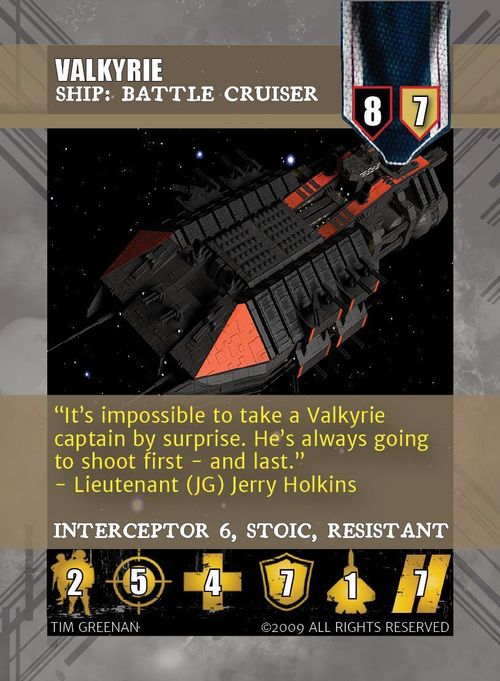
The Battle Cruiser's role generally revolves around a specific function for a fleet, such as command and control or electronic warfare, although some Battle Cruisers are built simply to bring more firepower to bear on the enemy than a Cruiser. Battle Cruisers are the smallest size-class ship able to attach the special version Module - Ship cards with the trait FACE UP - FACE DOWN.
Transports are a special class of their own. They are the only ships that actually produce Resource and Currency per turn during your Logistics Phase and you may decide instead to help a possible ally by providing Resources and Currency to their stockpile. Transports can never attach any Module - Ship cards.
Battleships range from troop transports designed to assault major objectives to ships specifically designed to overpower opposing ships in engagements. Capital Ships are large enough to house an entire city of support personnel and able unleash a hail of devastating volley fire. They are very powerful, very expensive, and very rare.
The class-size of a ship determines its mass and size relative to other ships in the game. Certain effects in the game may only effect ships of a certain size (larger than a Cruiser for instance.) Other times certain Modules or Marine units require the additional space of larger ships, as they are simply larger in physical size and cannot be fit or attached to a smaller ship.
Class-Size Table
| Ship Class Type | Length | Unloaded Mass | Avg Crew Size |
|---|---|---|---|
| Star Fighter Wing | 8 m (x15) | 20 m/tons (300 m/tons) | 2 (30 total) |
| Frigate | 75 m - 150 m | 180 - 375 m/tons | 75 |
| Destroyer | 110 m - 225 m | 275 - 563 m/tons | 150 |
| Cruiser | 400 m - 500 m | 1K - 1.25K m/tons | 500 |
| Transport | 625 m - 725 m | 1.68K - 1.94K m/tons | 150 |
| Battle Cruiser | 600 m - 750 m | 1.95K - 2.32K m/tons | 900 |
Modules modify the attributes or abilities of the specific card that its attached to and improve the unit's overall performance. There are three subtypes of Modules: Module-Station, Module-Ship, and Module-Marine, each able to be attached to the corresponding unit type. Here are some general rules regarding attaching Modules:
- Any ship or Marine card may only have one Module card attached to it.
- You may choose to attach a new Module card onto a unit that currently has one only if the current module attached is destroyed, placed onto your scrapheap, and replaced by the new one.
- You may not attach Module-Ship cards to Fighter Wings and Transports.
Attaching cards happens frequently in Hull Breach! and during the course of a game you will be instructed to do so numerous times. Attaching a card means that a specific card is linked or associated with another card. So for instance, a Module-Ship card is attached to a ship. This Module, once deployed and attached, cannot be moved to another ship for any reason. If the ship is destroyed, so is this module card.
Marines cards and Module-Marines cards go sideways under the ship on the Marine capacity side. Once paid for, the Module-Marines card slides under the Marines card so that any of its additional stats are visible beneath the stats that they are now modifying. The Mod card slides up showing its name and hiding any stats it may have. The Marine and attached Mod are strictly passengers until the boarding phase and cannot be engaged during the ship's volley fire phase.
In this example you can see the Module-Marines "Proven in Action" card being attached to the Marines card RDF "Military Police Company." If the MPs are destroyed, so too is that Module. You can easily adjust the card so that only the card text and attributes are showing. This makes it very easy to calculate your totals and additional benefits on your cards.
Stations are at the very heart of your Command. Protect it at all costs, for losing your Station means losing your game of Hull Breach! In order to win you must eliminate all other opposing Commanders' Stations by either destroying them outright or by hijacking them with your Marines. Stations vary widely in purpose and design; some are focused on an economic, industrial, or military victory, while others are more generalized in design, providing a Commander various options for success.
Stations, like ships and Marines, may have Modules attached which increase their overall performance. At most you may attach 4 Module-Station cards to your station, unless card text indicates otherwise, none of which may be duplicates of one another. During the Setup Phase of Hull Breach! you will deploy two Module-Station cards at no cost along with your Station.
Above are a few examples of the many different Module-Station cards. While some are powerful military modules which improve the attack or defense values of a Station, others focus mainly on economic strength by producing additional Resource or Currency every turn. As the Station Commander, you must decide which modules are the best for your Command style. All Module-Station cards must be destroyed before targeting a station to destroy it; each module must be targeted individually and they do not share or pool wounds with its attached station. However, each module does share the attack and defense values of its attached station - when a Station fires at enemy ships, it does so as one unit.
2.1. The Card Types
There are 7 major card types in Hull Breach!: Stations, Ships, Modules, Marines, Events, Tactics and Breakthrus. There are restrictions on the numbers of each card you may include in your custom deck. Here's a recap:
- 2.1.1. You may use up to five of any of each specific Marine, Ship or Module card to build your constructed deck.
- 2.1.2. You may only have one copy of a specific Event, Tactic or Breakthru, although you may have several different Events, Tactics or Breakthrus in your deck (for example, you may not include two copies of the Event card "An Unexpected Turn of Events" in your deck, but you may have many other Event cards).
- 2.1.3. You may only have one Station card - you may not include a second station card in your deck, since when your station is destroyed or hijacked you lose the game immediately.
2.2. Stations
This is your home base in the game. If your station is destroyed by opposing ships, hijacked or scuttled by opposing Marines, you lose the game immediately. The maximum number of Module-Station cards that may be attached to any station is 4, unless card text specifies otherwise, and you may never attach more than one copy of any specific Module-Station card. You begin the game with two modules attached at no cost and you may attach new Module-Station cards later. No Station card may be targeted by volley fire until all its attached Module-Station cards have been destroyed. Gained Resources or Currency and attack or defense values are cumulative for a station with all its attached modules. So, for example, any attached Module-Station card has a defense value equal to the space station's defense value plus any additional defense granted by all other modules. Stations may never board a ship or another Station but they may be boarded by other ships with Marines. Stations may never participate in an engagement at an opposing Commander's Station, except in the rare occasion that a card's printed text indicates otherwise.
2.3. Modules
Modules modify the attributes of the card they are attached to. There are three subtypes of Modules: Module-Station, Module-Ship, and Module-Marine. To deploy a Module, simply subtract the number of Resources and Currency listed on the card from your stockpile and attach that card to the target Station, Ship, or Marine respectively. Modules can only be deployed during your Manufacturing Phase and can be replaced by new Modules if desired - the Module being replaced is placed onto your Scrapheap. If the Station, Ship, or Marine the module is attached to is destroyed then the attached modules are also destroyed. You may never have more than one Module card attached to any ship or Marine, and you may also never attach more than one copy of any specific Module card to a Ship, Station, or Marine for any reason.
2.4. Marines
Marines are both an attack and defense force and are specifically trained to board opposing ships or repel boarding attempts by opposing Marines. Any ship larger than a Fighter Wing may generally garrison one Marine aboard, however, larger ships have the capacity to attach several Marines (see below). Note that some Marines are further class-size restricted to the classes of ships they may be assigned to or attempt to board; this restriction is indicated by the card's printed text. Marines, unless specified on the card, do not enhance the traits or stats of the ship or Station to which they are attached.
2.4.1. Marine Capacity Restrictions
Marines may be attached to any ship larger than a Fighter Wing, but larger ships have more capacity for Marines. The specific capacity of a ship is marked on the card itself with a white icon and number. Marine cards also have a red icon and number indicating how much space they consume when attached.
2.4.2. Marines - Character
These cards are characters who, although treated like Marines, are generally used to affect other units already deployed. Characters ignore space requirements when being attached (meaning they can fit on any ship or station that can carry Marines, regardless of how many are already aboard), may not attach Module-Marines cards to them, and must always be deployed at cost from your hand of cards. They cannot be Regimented or Conscripted.
2.5. Ships
Ships are broken down into various size classes, and some modules can only be equipped to a ship of a certain size. Here are the ship subtypes, from smallest to largest:
2.5.1. Fighter Wing
The smallest of the ship units, this card actually represents a wing of fighters consisting of approximately 48 to 60 spacecraft. You may not attach Module or Marine cards to Fighter Wings.
- 2.5.1.1. Fighter Wings may attach themselves to a ship or Station with the printed capacity for them. These ships or stations have fighter bays in which the fighter wings reside until they are needed. A Fighter Wing attached to a host ship or station cannot be targeted by an opposing Commander's volley fire and is immune to Event or Tactic card effects. If not attached to a ship then they deploy into open space and function like any other ship. Note that ships and stations can be REGIMENTED with Fighter Wings, just like Marines.
- 2.5.1.2. Fighter Wings carried in a fighter bay may be deployed into space at any time, but may only return to a fighter bay in combat on their turn to volley fire, and must sacrifice their turn to fire to do so. Fighter Wings can also be reassigned into or out of the fighter bays of a ship or station with the capacity to hold them during your Manufacturing Phase or at the end of an engagement before the end of your turn.
2.5.2. Frigate
Larger than a Fighter Wing, these ships are small, fast, and agile. Most possess the trait ESCORT (See Section 4.4.3 Traits) and are best used in that role.
2.5.3. Destroyer
These ships are better-armed than Frigates and possess the trait HUNTER (See Section 4.4.6 Traits), which allows them to detect and fire at STEALTH enemies.
2.5.4. Cruiser
Cruisers are the most common ship class across the galaxy and are very versatile. They are the building blocks of most fleets because there's a Cruiser for every job.
2.5.5. Battle Cruiser
Battle Cruisers often serve a specific function within the fleet, such as Command and Control or electronic warfare, although some are simply larger and better-armed versions of Cruisers. Battle Cruisers can attach Module-Ship cards with the trait FACE UP - FACE DOWN (See Section 4.4.4 Traits).
2.5.6. Transport
These ships are designed to produce Resource and Currency for their owner, and are poorly-equipped for heavy combat. They may not attach Module-Ship cards. For purposes of Marine boarding actions, they are considered to be the same size as Battle Cruisers.
2.5.7. Battleship
Battleships are the largest and toughest combatants most Commanders will see regularly. Some are troop transports for Marines, carriers for Fighter Wings, or simply gunboats designed to destroy smaller ships via brute force.
2.5.8. Capital Ships
These enormous vessels are monuments to a Commander's technological know-how and determination to dominate fleet engagements. Capital ships are all UNIQUE (See Section 4.4.12 Traits), meaning you may only have one of a specific type in play at a time, although you may have several copies in your deck.
Note: Size Matters! Modules with the FACE UP - FACE DOWN trait may only be attached to Battle Cruisers, Battleships, and Capital Ships. Also, some Modules and Marines can only be attached to certain sizes of ships, as described on the card.
2.6. Events
Events are special cards that may be deployed at any time during the game, even during another Commander's turn. To use them, simply read the card text and resolve the effects described. Unless the Event card says otherwise, an Event card is always placed on the Scrapheap after it has been resolved. If an Event card is deployed directly on to the battlefield, then this Event card stays in play indefinitely. If an Event card is deployed and then attached to another card, then this Event card remains attached to this other card until that card is destroyed.
2.7. Tactics
Tactics are special cards that may only be deployed during an engagement. They can sometimes be deployed into other Commanders' engagements, even if you are not specifically involved - the card will always tell you specifically when this is a possibility. Like Event cards, you may only have one copy of any specific Tactic in your deck.
2.8. Breakthrus
A Breakthru is a technological advantage achieved by your scientists and capitalized on by your leaders. Breakthru cards may only be deployed during your Manufacturing Phase, but are deployed at no cost. Once deployed, the card stays deployed on the battlefield indefinitely. You may only have 1 copy of any specific Breakthru in your deck.
Section 3.0 - Traits
3.1. It's All About the Traits
Traits are used to denote special abilities that your units possess. Traits are listed in gold and capitalized text. For example: STOIC, HUNTER, and REPAIR +3. Some of these special abilities are stackable, meaning there is a specific value of X granted by the trait which can be added together with similar bonuses from other cards to produce a final value associated with that specific trait. The stackable traits are Interceptor, Jammer, Overload, Repair, and Target Painter. For example: if you have a Zephyr Fighter Wing deployed with Interceptor +2 and a Sparrow Fighter Wing with no Interceptor at all, then you deploy an Eagle-class Battle Cruiser that adds Interceptor +1 to all ships in your fleet, your Zephyr Fighter Wing now has Interceptor +3, your Sparrow Fighter Wing now has Interceptor +1, and your Eagle has Interceptor +1 as well. You gain no additional effects by having two of the same "non-stackable" traits on the same ship, Marine, or Station. For example, a Crow destroyer possesses the trait FEARLESS. If you attach the Module-Ship card "Battle Seasoned Crew," which grants FEARLESS to the ship, you get no additional benefit from having FEARLESS twice.
3.2. The Differences Between Active and Passive Traits
There are two types of traits: Active and Passive. Active traits (or "stackable" traits) are activated during a unit's turn to volley fire, and are used instead of firing normally. The unit cannot both use an Active trait and fire its volley dice in the same turn. The active traits are: Interceptor, Jammer, Overload, Repair, Target Painter. When a unit uses an active trait in combat, a Commander rotates the card 180 degrees to face the opposing Commander. Reset the card's facing at the start of its next turn to volley. Units can only use one active trait at a time, even if it has more than one available. On the unit's next turn to volley, the card is reset to its normal facing on the battlefield and the Commander can again choose to volley or use a trait.
Passive traits are traits that are always available regardless of what your unit is doing: they are Alpha Strike, Annihilate, Escort, Face Up - Face Down, Fearless, Hunter, Regimented, Resistant, Stealth, Stoic, and Unique. These traits, as explained later, do not interrupt your unit's normal volley fire, but in many instances enhance it.
3.3. The Active Traits
3.3.1. Interceptor +X
Any unit that has the trait Interceptor is assumed to be extra-vigilant and always ready for a fight. During the Interceptor Phase at the start of an engagement, a Station with this trait may fire one volley of X dice at any attacking ship it may legally target. This occurs before the attackers have an opportunity to fire and is a defensive deterrent against attacks. Ships with the trait Interceptor do likewise, but only when they are defending their own station. Marines with this trait may fire a volley of X dice at any enemy Marines attempting to board their ship, regardless of which Commander's Station the ships are. Any ships or Marines destroyed by Interceptor volley fire are considered immediately destroyed. Note that the Interceptor trait stacks and can be modified by other units or attached cards.
3.3.2. Jammer +X
Any unit with this trait has Electronic Countermeasures that interfere with another unit's targeting and weapons systems. During your volley fire, a unit with the trait Jammer +X may, instead of volley firing, jam one local opposing ship. The unit being jammed loses X from its current attack value. Jammer may never be used against an opposing Station or Module-Station card, as they are too large to effectively jam. Any unit with Jammer cannot be targeted by a defender's Interceptor fire - this is an innate feature and does not need to be activated to take effect.
3.3.3. Overload +X
Any unit with Overload may choose, once per engagement, to use this trait instead of its usual attack value. When using Overload, you may select one target and roll X number of volley dice associated with the trait (this volley cannot be split between multiple targets). A unit that has used its Overload trait may not fire on its next turn to volley - this is called the Overload Drawback. However, this unit may still declare boarding actions, use other traits, or attempt to retreat from combat as normal.
3.3.4. Repair +X
On its turn to volley fire, a damaged unit possessing Repair +X may choose to remove X wounds from itself instead. During your Logistics Phase, any damaged ship, Station, Module-Station card or Marine with the Repair trait may remove all wounds that it has suffered. All other wounded ships, Stations, and Marines may remove only one wound during their Commander's Logistics Phase if damaged.
3.3.5. Target Painter +X
A unit with this trait can temporarily remove X from the current defense value of a single target by using this trait. This allows for your other units to hit this designated enemy more easily. The unit using Target Painter may not fire as normal during its volley fire phase if it is using this trait. Target Painter may never be used against an opposing Station or Module-Station card and may not be split between multiple targets.
For example: your Seagull-class Cruiser with the trait Target Painter +3 targets an opposing Roc-class Battleship with a defense value of 7. The Roc loses 3 from its defense value, and now all your other ships only need to roll a 4 or better to wound it. On its next turn, the Seagull can choose to Target Paint the Roc again, another ship, or volley fire as normal.
3.4. The Passive Traits
3.4.1. Alpha Strike
Any unit with this trait gains +3 to the results of its first volley die roll in an engagement. This trait works in conjunction with Target Painter or any other roll-result bonuses in effect. After its first attack, the unit volley fires as normal.
3.4.2. Annihilate
A unit with this trait inflicts extra damage anytime it rolls a natural 10 (an unmodified result of 10 on a ten-sided volley die) against its target. A 10 always inflicts a wound, but a unit with Annihilate will inflict two extra wounds on this result, for a total of three. Rolling two or more natural 10s in the same volley against one target results in the immediate destruction of the target. A ship with the trait Resistant is immune to the effects of Annihilate.
3.4.3. Escort
A ship with the trait Escort exists primarily to guard other ships during the Boarding Phase of an engagement. During the Escort Phase of an engagement, any ship with the trait Escort may cancel one opposing ship's boarding action. Each ship with the trait Escort may only perform this action once per Escort Phase during an engagement - although there can be several Escort Phases during an engagement. Escorts are not innately immune to hostile boarding actions, although an Escort can choose to cancel a board that has been declared against it, which counts as the one opposing boarding action they may cancel during the Escort phase.
3.4.4. Face Up - Face Down
Some Module-Ship cards possess this trait. These modules function like other Module-Ship cards: they are deployed during your Manufacturing Phase, they grant the ship to which they are attached some bonus or special capability, and a ship may only have one attached module. However, they are restricted to ships larger than Cruisers, are deployed at no cost, and are always deployed face-down on your attached ship. Modules with this trait are kept face-down until their 'trigger' occurs - the trigger is always specified in the card's printed text. Once the trigger occurs, you may choose to flip the card face-up, at which point you immediately perform whatever action the card describes. While face-down the card has no effect on the game. At the end of an engagement you may choose to turn this module Face Down again so that you may repeat the process in your next engagement.
3.4.5. Fearless
Any unit with Fearless may choose, once per engagement, at any time during that engagement, to invert its printed attack and defense values. This exchange lasts until the end of the engagement and cannot be reversed for any reason. Note that this 'Fearless Swap' only applies to the card's printed attack and defense values; any other bonuses to this unit provided by other cards are added after this swap.
3.4.6. Hunter
A ship with the trait Hunter is designed to be the eyes and ears of a fleet against opposing Stealth ships. Hunters ignore the trait Stealth and may volley fire against Stealth ships, use other traits against them, or board them without penalty. Ships without Hunter will find it very difficult to hit a Stealth ship, and cannot board them at all.
3.4.7. Regimented
A unit with this trait deploys with Marines or Fighter Wings attached to it for free. When a unit with Regimented is deployed, you may search your Shipyard for and deploy an appropriate unit at no cost and immediately attach it to that Regimented unit. The card's printed text will specify either Regimented - Wing, or Regimented - Marine, indicating what type should be retrieved from your deck, and sometimes how many of that type. In the case of Regimented x2, simply perform this action twice and retrieve two of the appropriate card from your deck. Marines and Fighter Wings deployed in this fashion must be assigned to the Regimented ship or Station first, but may be reassigned afterward as normal. If you do not have enough of the required unit left in your deck to satisfy a Regimented requirement, simply ignore the trait. You may not use cards from your hand to satisfy this trait.
3.4.8. Resistant
A unit with this trait ignores any compulsory wounds - a compulsory wound is any wound that is inflicted on a unit without rolling volley dice (such as by a Tactic card). Resistant units also ignore the extra damage effects of Annihilate, although they will still be wounded once as normal by a roll result of 10.
3.4.9. Stealth
A unit with the trait Stealth is equipped with technology that renders it nearly impossible to detect by conventional sensors. A ship with this trait gains 5 to its printed defense value. However, a volley roll result of 10 will always hit the target. Furthermore, units firing at this ship may add any other result bonuses if applicable (such as Target Painter) to help cut into this penalty - but the Stealth ship's defense is calculated at its printed defense plus the Stealth bonus, in addition to whatever other defensive bonuses (from Modules, for example) are relevant.
For example: a Stealth ship with a printed defense of 8 has a 'real' defense value of 13. If opposing ships Target Paint that ship for 4 points, a volley result of 9 will be sufficient to inflict a wound. Stealth ships cannot be boarded by an opposing ship unless that opposing ship possesses the trait Hunter - Hunters completely ignore all the effects and penalties of Stealth and can volley fire against it or declare boarding actions as normal.
3.4.10. Stoic
A unit with the trait Stoic, when destroyed by volley fire, may immediately respond with one last attack volley of its own against any legal target - not necessarily the unit that destroyed it - before it is discarded onto the scrapheap. This Stoic unit cannot take any other actions besides this last volley, such as using the trait Repair. A Stoic unit takes this last volley in whatever state it was in when destroyed - all bonuses or traits remain in effect, but none can be activated if they weren't already.
For example: a ship that has already activated its Fearless trait remains Fearless for its last volley, but cannot activate it if it hasn't already.
3.4.11. Unique
Commanders may only deploy one copy of a card with the trait Unique at a time, but Commanders may have multiple copies of cards with this trait in their constructed deck. Multiple copies of a card with this trait may be in play simultaneously provided they were each originally deployed by different Commanders. If your Marines hijack an opposing Commander's Unique ship, you may keep it even if you have already deployed that same ship yourself. Note that some Module-Ship cards have the trait Unique, and only the module is treated as Unique - not the ship to which this module is attached.
Section 4.0 - Starting a Game
4.1. The Setup Phase
During the Setup Phase of the game you will deploy your Station and initial military forces before the game begins. This process, and that of taking turns in the game, is explained in greater detail later on in Section 5.0 - Turn Anatomy.
4.2. Arraying Your Forces
To start a game of Hull Breach!, first deploy your Station Card onto the Battlefield in front of you. Then pick any two Module-Station cards from your Shipyard and deploy them at no cost. Selecting your first two Module-Station cards is very important for determining the initial disposition of your deck. Some Stations and Module-Station cards have effects on the game that are resolved when they are deployed - read the instructions printed on the cards and resolve the effects.
4.3. Resource and Currency Stockpiles
Next find your Resource and Currency Stockpile cards and place them somewhere visible to both you and your opposing Commander. Add 10 Resource and 10 Currency to your Stockpiles by placing a token on the 10 positions on both cards.
4.4. Drawing Cards
Draw 5 cards from your Shipyard.
4.4.1. Mulligan Rules
If during your Setup Phase you are unhappy with the hand of cards you drew, you may discard them onto your Scrapheap and draw five new cards from your Shipyard. This costs 1 Resource and 1 Currency from your Stockpile every time you Mulligan your hand. You may do this as many times as you wish, but only during your Setup Phase.
4.5. Collect Your Resources and Currency
Look for the black and gold circles on your Station and Module-Station cards. These full circles denote the amount of Resource and Currency you'll collect at the beginning of your turn after you draw your cards.
Add together the total for both Resource (indicated by black) and Currency (indicated by gold), then add them to your respective Stockpiles. Now you can start deploying cards from your hand.
4.6. Deploying Your Forces
While you cannot play any Event cards or Tactic cards during your Setup Phase (unless otherwise stated specifically on the card) and you cannot attack another Commander, you may deploy as many ships, modules, and Marines as you can afford. Deploying these cards is as simple as deducting the number of Resource and Currency denoted in the large half circles on the top of the card, announcing the deployment, and placing the card face-up on the Battlefield. When you are finished with this process you have completed both your Logistics Phase and your Manufacturing Phase.
4.7. Finishing Your Setup Phase
Lastly, you have the option to discard any cards in your hand you do not want or need. They may be placed on your discard pile, called the Scrapheap.
4.8. Determining Initiative
All Commanders will roll a volley die (a ten-sided die). The Commander who rolled highest takes his or her turn first and all other Commanders proceed in clockwise order thereafter. Re-roll any ties if necessary.
Section 5.0 - Turn Anatomy
Setup Phase Recap
- Deploy one Station card, at no cost, and resolve its effects, if any.
- Deploy two Module-Station cards, at no cost, and then resolve their effects, if any.
- Deploy your Resource and Currency Stockpile cards, and use two tokens to add 10 Resource and 10 Currency to them.
- Logistics - Draw five cards from the top of your Shipyard.
- Logistics - Gain your per-turn income as indicated by the cards you have deployed.
- Manufacturing - Deploy cards from your hand, paying the appropriate cost, and resolve their effects, if any.
- Discard any unwanted cards left in your hand to your Scrapheap, if you wish.
- All Commanders roll a ten-sided volley die to determine initiative. The highest result wins the roll.
5.1. Special Rules During Setup Phase
Commanders cannot engage one another or deploy most Event cards in the Setup Phase. Event cards which are legally deployable during the Setup phase have the printed text "May be deployed during your Setup Phase" on them. Since Tactic cards can only be deployed during an engagement, they cannot ever be deployed during the Setup Phase.
5.2. Anatomy of Your Turn
Your turn is divided into three phases: the Logistics phase, the Manufacturing phase, and the Engagement phase. Certain actions may only be taken during certain phases of your turn, so it is very important to do them in order. The first part of your turn consists of the same steps taken during the Setup Phase, but now Commanders are able to declare engagements against one another, which was not possible during the Setup Phase.
5.3. Logistics Phase
During the Logistics phase, you'll restock the cards in your hand, update the amount of Resource and Currency at your disposal and deal with the logistics of managing your forces.
5.3.1. Reinforcements
Draw up to your maximum hand size, generally five cards, from your Shipyard. Simply replace the cards you deployed or discarded last turn with new ones drawn from the top of your Shipyard. If you have no cards left in your shipyard, you must continue to make do with what you have.
5.3.2. Taxes and Collections
Every Station card has a gain Resource and/or Currency icon on its face, which indicates how much of each you gain per turn during your Logistics Phase. Many Module-Station cards also add Resource or Currency, as well as some Event cards on the battlefield and Transport ship cards, so be sure to total these numbers up accordingly. Add these totals to your respective Stockpiles.
5.3.4. Space Dock Operations
Repair up to one wound on every ship, station, Marines unit, and Module-Station cards you own with damage tokens on it. If a ship, Station, or Marine has the trait Repair +X, repair all wounds on that card.
5.3.5. Logistical Events
Resolve any card effects that specifically state, "during your Logistics Phase."
5.4. Manufacturing Phase
This is the part of your turn when you are able to deploy new ships, Marines, or module cards.
5.4.1. Research and Development
You may deploy onto the Battlefield any Breakthru cards that you may have in your hand at no cost.
5.4.2. Deploy Reinforcements
You may deploy any ship, module, or Marine card from your hand you may legally deploy at cost. Remember to take into account any discounts or penalties you may gain from your Station, Module-Station cards, or Event cards deployed on the Battlefield.
5.4.3. Conscription
You may choose to Conscript one Ship or Marine unit during this phase. You may search your Shipyard and choose one Ship or Marine you wish to deploy, pay double its face value (any discounts you may ordinarily get on this unit's deployment cost are ignored) and then deploy it onto the Battlefield. Marine-Character cards cannot be Conscripted.
5.4.4. Manufacturing Events
Resolve any card effects that specifically state "during your Manufacturing Phase."
5.4.5. Assign and Reassign Your Assets
You may reassign any Marines or Fighter Wings already in play to a new legal host ship or Station and attach them accordingly.
5.5. Engagement Phase
This is the phase of your turn where you may send your fleet out to attack another Commander at his or her Station. Combat is explained in the following chapter, but the basic steps are:
5.5.1. Declare an Attack on an Opposing Commander
You may declare an attack on an opposing Commander, or decide not to attack this turn and skip to Section 5.5.4.
5.5.2. Select Your Attacking Fleet
You may select any number of ships from your current fleet and proceed to your engagement with an opposing Commander. You may only attack one Commander at a time, and you may only attack once per turn.
5.5.3. Engagement Begins
Enter and resolve the engagement with this opposing Commander.
5.5.4. Discarding Options
You may choose to discard on your Scrapheap any cards left in your hand that you no longer want or need.
5.5.5. End Your Turn Officially
Declare the end of your turn.
5.6. Continuing On With the Game
Once you have declared the end of your turn, play passes clockwise to the next Commander, who takes his or her turn. As a new Commander, be cautious moving from step to step during your turn, as only certain actions can be done legally during certain phases of a turn. If you make a mistake, and forget to do something there is no going back -- being a Commander is stressful so expect to make some mistakes.
Section 6.0 - Engagements
6.1. Winning a Game of Hull Breach!
The object of the game and the win condition for any Commander in Hull Breach! is to hijack or destroy all opposing Stations. In order to do that, you need a strong and effective fleet of ships and Marines. During the Engagement Phase of your turn, you may choose to declare an engagement against an opposing Commander. Since all combat takes place at a Station, with only a few exceptions, you'll need to decide which of your ships are going to be heading out on the attack - it can be wise to leave a few ships at your Station to defend it in case your attack fails. Once you've decided on your attacking fleet composition, declare your attack aloud to the other Commander and slide the attacking cards towards your opponent. Remember that no Commander may engage during the Setup Phase of a game of Hull Breach!
6.2. How Combat Works
Each unit has an attack and defense value marked on its card. The attack value represents the number of volley dice (ten-sided dice) the unit rolls in its attack during its turn to volley, and the defense value represents the result an opposing Commander must roll equal to, or greater than, to wound the unit. When one unit rolls a volley die against an opposing unit, the opposing unit suffers one wound if the die result is equal to or greater than its defense value. In order to keep track of which of your units have fired and which have not, it may be helpful to separate the ones that have fired slightly from those that have not, or angle the cards slightly - whatever helps you remember. When a unit sustains a number of wounds equal to or greater than the number of wounds printed on the card, it is destroyed. Any shots that are 'overkill' are considered to fly off into space and do not affect any other unit. You must decide where all your unit's volley dice are targeted before you roll them - you may choose to roll all these dice against one target or 'split fire' them among several targets, but you must abide by your decision no matter what the result of those rolls were.
For example, your Griffin-class Battleship has an attack value of 5. This means this ship has five volley dice to target and volley fire with on an opposing unit. You target with all the Griffin's volley fire on the opposing Dragon-class Battleship which has a defense value of 7. You choose to use all of your volley fire on this ship, so you declare your attack aloud, "this Griffin targets that Dragon with five volley dice," and you roll. The results of this volley fire are 3, 6, 7, 9, 10. The 3 and 6 inflict no wounds on the Dragon since her defense value is 7. However, your other volley results score three wounds. The Dragon suffers three wounds due to this volley fire, and is marked with damage tokens, but can sustain five wounds before she is destroyed. She is seriously wounded but not yet destroyed.
Or, you might decide to split a ship's available volley dice between multiple targets. Your Phoenix-class Capital Ship boasts tremendous firepower, with eight volley dice in her normal volley. Since your opponent has a Cockatrice-class Cruiser and two Zephyr Fighter Wings you decide to split fire between the three targets, so you declare your attack aloud, "this Phoenix targets that Cockatrice with six volley dice and both Zephyrs with one volley die each," and you roll. The volley results are rolled individually so there is no confusion. The first volley of six dice against the Cockatrice results in a 4, 5, 5, 6, 8, 8. Since the defense of the Cockatrice is 6 and she only has three wounds available, she is destroyed. Your second volley of one die versus the Zephyr results in a 3, and since the Zephyr's defense is a 5 there is no effect. Your third volley of one die against the other Zephyr is an 8. Since the Zephyr's defense is a 5, you score one wound, destroying the Fighter Wing.
When it is your turn to volley fire, you may resolve your ships' fire in any order you choose. If, for example, you want to save your Battleship's volley dice for last and instead fire your Cruiser's volley dice first, you may do so. Since there are no restrictions on the order in which your ships fire, you can first use ships that have the traits Target Painter or Jammer and then distribute your volley dice to make maximum use of those effects.
6.3. A Brief Overview of Engagement Continuity
When engaged, each fleet volleys at the other in turn. First, Event or Tactic cards with the printed text "deploy at the start of an engagement" printed on them may be deployed, and then defending units with the trait Interceptor may fire one free volley against the attacking fleet. Then the attacker's ships then fire at the defender and declare boarding actions. After the attacker has fired and declared his or her boarding actions, the defender's ships return fire. Defending ships that are not already the target of a boarding action may then declare their own boarding actions. Next, each ship with the trait Escort may cancel one boarding action declared by the opposing Commander. When Escort effects are resolved, resolve the boarding actions in turn. After all boarding actions are declared, resume volley fire between the attacker and the defender. The engagement continues in this fashion until one side is destroyed or the attacker retreats.
If you destroy or successfully board and then hijack an opposing Commander's Station, you eliminate that Commander from the game. If there were only two Commanders playing, the game ends. If there were three or more Commanders playing the game, the eliminated Commander picks up his or her cards (including those, if any, hijacked by other Commanders) and the victorious Commander receives his or her Spoils of War (See Section 7.1.3 - Multiple Commanders) and the game continues until there is only one Commander left standing.
6.4. Deciding to Engage an Opposing Commander
Keep in mind that engagements are always destructive both for you and the opposing Commander. In a three or more player game of Hull Breach! it is important to weigh the chances of defeating a Commander in combat against the losses you may suffer in doing so. When your turn is finished, other Commanders may decide to attack you, and your station will only be defended by whatever units survived the engagement you just concluded (See Section 7.0 Multiple Commanders). Another consideration is whether or not the Commander you are deciding to attack has cards left in his hand. An opposing Commander with cards left in hand could have powerful Event and Tactic cards (See Section 3.0 - Card Types) that could tip the scales against you during an engagement. Sometimes being a wise Commander means knowing when not to attack your enemy.
6.5. General Rules for Engagements
6.5.1. Declaring and Resolving an Engagement
An engagement begins after a Commander declares his or her intention to attack and ends when one of the sides has been destroyed or the attacker retreats.
6.5.2. Fleet and Space Travel Logistics on the Attack
If you as the attacker leave any ships behind at your own Station they may not join an engagement after it begins.
6.5.3. How to Target, Damage, and Destroy a Station
When volley firing against a Station you must destroy all attached Module-Station cards first. The defense value of a Module-Station card is the combined defense of the Station itself plus any bonuses from attached Module-Station cards and other applicable cards such as: Events, Tactics, or Breakthrus. The module's number of wounds is always the number printed on the module card itself. Unlike defense value, wounds are not pooled among the Station and its modules. A Station may never be the target of volley fire, or a boarding action, during the first round of an engagement unless there are no other legal ships to target. After the first round of the engagement, regardless of the number of defending ships - that Station is now a legal target and may be volley fired on as described above.
6.5.4. Deploying Cards Into an Engagement
The only cards that you may deploy from your hand during an engagement are Event or Tactic cards, unless a card's printed text indicates otherwise.
6.6. Engagements and Combat - A Step by Step Guide
Now that you've declared an engagement, decided which of your forces are attacking, and physically moved those cards over to your opponent, here's a step-by-step guide to resolving the engagement:
STEP 1: Any Commander may deploy Event or Tactic cards with the printed text "deploy at the start of an engagement," then resolve their effects.
STEP 2: Defending ships or Station with the trait Interceptor may volley fire at the attacking fleet.
STEP 3: The attacking fleet may use any applicable traits and/or volley fire on any opposing ships, or Module-Station cards or Station it may legally target. The attacking fleet, or individual ships within this fleet may attempt to retreat. If a ship decides to retreat it may not volley fire, use any traits, or declare a board during this round of volley fire. If they are not destroyed by the end of STEP 9, they are returned to their Commander's Station safely.
STEP 4: The attacking fleet declares boarding actions against opposing ships or Station. Note that this is a declaration of the intent to board, and although the attacker has the initiative when boarding, the boarding action has not happened yet. Move your boarding ships to in front of their boarding targets. This action is so the defending Commander knows which ships are about to be boarded.
STEP 5: The defending fleet may use any applicable traits and/or volley fire on the opposing ships.
STEP 6: The defending fleet declares any boarding actions with opposing ships. However, any defending ship that already has been declared the target of a boarding action is 'locked down' and can only resolve the boarding action declared against it - it cannot declare one of its own. Boarding actions are always between only two ships; they cannot be interrupted by anything other than an Escort. If at this point neither Commander has declared any boards, skip to STEP 9. The attacker, already having the benefit of volley firing first, does not get to respond to boarding actions declared by the defending fleet with volley fire from his or her ships.
STEP 7: Ships with the trait Escort may cancel one opposing boarding action each. Defending Escorts choose first, then any attacking Escorts may choose.
STEP 8: All boarding actions resolve. Both Commanders reveal their involved Marines and deploy them slightly forward of the ships involved to make identification of the involved units easier. If a ship involved in a boarding action has no Marines attached to it, the Marines attempting to board it are automatically successful. All boarding happens at the same time; simply start with one and resolve all of them in any order. Marine combat resolves the same as ship-to-ship volley fire:
- STEP 8A: Any defending Marine with Interceptor may fire at attacking Marines.
- STEP 8B: All attacking Marines target and volley fire at defending Marines.
- STEP 8C: All defending Marines target and volley fire at attacking Marines.
- STEP 8D: All Marines continue to volley fire, in turn, until one or the other boarding party is destroyed. Marines may attempt to retreat from a boarding action, but the defending Marines have the option of pursuing the retreating Marines back to their own ship and continuing the boarding action with the roles of attacker and defender reversed. However, no ship may ever retreat from a boarding action unless the opposing Commander decides not to pursue the retreating Marines back to their ship. This is explained in greater detail in Section 6.10 - More on Boarding.
- STEP 8E: Resolve all boarding actions. The victorious Marine boarding party may choose to either Hijack the opposing ship or Scuttle it (ships that are Hijacked stay in your control until destroyed or Hijacked by an opposing Commander - you may not later scuttle a ship you have hijacked). In either case, ships engaged in boarding actions must wait for their new Commander's next volley to perform any other action after a boarding action has been resolved. If you have successfully boarded a Station, that Commander is immediately eliminated from the game.
STEP 9: The engagement continues from STEP 3 until either a) the attacking fleet has been destroyed thereby ending the engagement, b) the attacking fleet successfully hijacks or destroys the opposing station, or c) the attacking fleet retreats with all its ships as explained in STEP 3. This engagement continues until there is a clear winner by meeting one of the three conditions listed above in STEP 9.
Abbreviated Engagement
- Deploy any Event or Tactics cards that say, "deploy at the start of an engagement."
- Resolve any Interceptor volley fire, if any.
- Attacker volley fires.
- Attacker declares boarding actions.
- Defender volley fires.
- Defender declares boarding actions.
- Resolve all Escort effects, if any.
- Resolve all boarding actions.
6.7. Destruction and the Concept of "Immediately"
When a unit is destroyed by volley fire, it is important to make the distinction that it is not immediately destroyed - this can be important in several situations. One example is a unit possessing the trait Stoic. The unit is destroyed by the volley dice but the last action it performs before being discarded on your Scrapheap is to fire its Stoic volley fire. Another example is that Fighter Wings garrisoned aboard a ship that is destroyed, or even hijacked, can deploy out into open space. However, if a card is immediately destroyed, it is discarded onto your Scrapheap and cannot perform any actions whatsoever - and all Marines and Fighter Wings aboard are lost.
6.8. Notes on Event and Tactic Deployment and Timing
A Commander's timing in warfare is of the utmost importance, and this is particularly true when a Commander intends to deploy an Event or Tactics card. Most of the time this is as simple as deploying the card, reading the card's printed text and resolving its effects. Remember that a card's effects are resolved upon deployment, and if the card's effects are immediate then nothing else can happen until those effects are resolved. The action is complete once volley dice have been rolled or another card has been deployed.
However, it is likely that at some point two Commanders will find themselves each trying to deploy a card against the other and be unsure as to which card effect resolves first. For example, on his turn, Commander A intends to attack Commander B. He declares the engagement and slides his cards across the table, then deploys "Shipboard Spies," which compels Commander B to discard the cards in her hand. Commander B simultaneously deploys "Diplomacy First," which immediately cancels the engagement. Since the cards essentially invalidate one another, only one of them may have an effect on the game.
The first measure of which card will take precedence is the printed text. In this case, both specify that they should be deployed at the start of an engagement, which is normally enough to determine priority of the effects, but here it is not.
The next step is determining who deployed their card first, which in the simplest terms is who managed to get it down on the table fastest, since card effects resolve immediately upon their deployment. If there was no clear 'faster' Commander, then the matter must be resolved by a roll-off (See Section 8.7 - Golden Rules).
6.9. More on Boarding
Here are some points to keep in mind regarding boarding actions:
6.9.1. Your ship may volley fire at and attempt to board different targets, but you may only board one ship at a time. For example, a Griffin-class Battleship cannot attempt to board two different ships because she carries two Marines. All her Marines attack the same opposing ship simultaneously in the same boarding action, unless restricted from going aboard that ship by printed text on the Marine card. Remember that the target ship's Marine capacity is not a factor until after the boarding action is complete and these Marines are reassigned.
6.9.2. Only one ship is allowed to attempt to board one opposing ship or station at a time. You may not declare two or more of your own ships to board against the same target.
6.9.3. A Marine unit attempting to board a ship or station without Marines aboard automatically succeeds in that boarding action. Note: that if your attacking Marines are destroyed by the defending Marines, and the ship that transported them is left undefended as a result, any surviving opposing Marines involved in that boarding action (meaning, the ones that just killed yours) may immediately Hijack or Scuttle your ship unopposed if they so choose by means of Pursuit.
6.9.4. Unless indicated by printed text on a card you have deployed, Marines attached to a Station may not attempt to board opposing ships - the Station is a stationary object and cannot physically get them there. In this situation, defending Marines aboard a Station may only get involved in the action if the attacker attempts to board the Station.
6.9.5. If a boarding action occurs between ships with different Marine capacity limits, all Marines still participate in the boarding action, except if class-size restricted. For example, if the Griffin-class Battleship declares a boarding action on the Merlin-class Frigate with one Marine aboard, both Marines aboard the Griffin participate in the attack. Some Marines are class-size restricted to what ships they can board, or even be assigned to.
6.9.6. You must have a Marine attached to a ship in order to declare a boarding action with it.
6.9.7. Marines who have Hijacked a ship must stay garrisoned aboard it or be relieved by other Marines if reassigned either at the end of an engagement or during the end of your Manufacturing Phase. Otherwise the surviving crew revolts and the ship is immediately returned to its previous owner. You may not Scuttle a ship after you have Hijacked it.
Section 7.0 - Multiple Commanders
7.1. What's Different, What's Not
Very little actually changes in a game involving three or more Commanders. The Setup Phase is still taken simultaneously, play always passes clockwise, and engagements still occur between only two Commanders. Remember that some Event and Tactic cards can be played during an engagement that your forces are not involved in.
7.1.1. Treaties, Truces, and Alliances
Commanders may make unofficial alliances or truces if they wish but there is no such in-game mechanism to enforce any such agreement. Moreover, any pooling or sharing of Resources or Currency, cards in hand, and especially any ships, stations, or Marines is strictly prohibited. Some cards will allow you to pay or trade with, or even take from, another Commander however these cards say very specifically when and how these transactions take place.
7.1.2. Multi-Commander Engagements
Engagements still occur only between two Commanders; there is no provision for a three-way fleet fight in the usual course of a game of Hull Breach!
7.1.3. The Spoils of War
If you destroy or hijack another Commander's Station in a game with more than two Commanders, you are entitled to some spoils of war.
- 7.1.3.1. Your Stockpile is Mine: You may add that Commander's current total stockpile to your own.
- 7.1.3.2. To the Victor Goes the Spoils: You may search your Shipyard for one card that you may legally deploy and deploy it immediately at no cost.
- 7.1.3.3. Get Out of My Galaxy: You may not keep any of that Commander's cards. Ships you have hijacked from that Commander are destroyed, and the Marines that you have aboard them are immediately reassigned to any of your local ships with available capacity to accommodate them. If you have no more room in your fleet, those Marines must be discarded in your scrapheap.
7.2. Quitting a Game of Hull Breach!
A Commander may, if he or she so chooses, voluntarily withdraw from the game at any time. This act of surrender is referred to as 'scooping' or 'folding.' The same Spoils of War rule is in effect if a Commander that you declare an attack against scoops rather than fights back.
Section 8.0 - Golden Rules
8.1. We Break Our Own Rules
Any card text with printed text that is in opposition to the basic rules of the game takes precedence.
8.2. Never Ever Perfect
Any natural roll result of a 1 is always a miss/failure, and any natural roll result of a 10 is always a hit/success during an engagement with volley fire regardless of any other penalties or bonuses.
8.3. Always Shuffle
Anytime you search your shipyard for any reason, you must reshuffle your deck.
8.4. Never Something From Nothing
Regardless of any reduced cost bonuses, you may never gain Resource or Currency from any card being deployed unless the card says specifically to do so. For example, if you have a card that reduces cost by 2 Resource and you are deploying a card that only costs 1 Resource, it would deploy for 0 Resource.
8.5. Always Tell Them What You're Doing
Always clearly state the effect of a card and what you're specifically doing with it when the card is deployed, and always specify your targets during volley fire. All cards deployed on the battlefield must be exposed and easily seen at all times, you may not 'stack' or 'hide' your cards for any reason.
8.6. What's Done Is Done
A Station Command is stressful - expect to make mistakes. However, if you made a decision in anything that MAY (any optional action) happen there is no going back, once either another card is deployed, destroyed, or volley dice are rolled. Any game rule effect that MUST happen (any card effect or game mechanic that is enforced by the rules) always will, even after the fact.
8.7. Solve Your Arguments Fairly
If the Commanders encounter a game rule or mechanics dispute that cannot be clearly and easily resolved, Commanders may decide among themselves what the most reasonable course of action is. All Commanders in the game will roll a volley die. The Commander who rolled the highest result decides the outcome of the situation - obviously, re-roll ties if necessary.
8.8. Prototype Cards
These are special cards generally given as a reward to tournament winners to play-test new card concepts for Hull Breach! Any Commander using these cards must tell all other Commanders they have prototype card(s) in their deck, and all other Commanders must agree to their use or they are considered illegal.
Section 9.0 - Definitions
9.1. Attached
A card that is linked or committed to another card. If a card with attached card(s) is destroyed, then all other attached card(s) associated with it are all also destroyed. Generally, a Commander partly tucks an attached card underneath the card he or she is attaching it to.
9.2. Battlefield
A general term for the area in which all deployed cards are used in play.
9.3. Boarding Action
A special engagement where Marines fight for control of a ship or station.
9.4. Capacity
Indicates a ship or station's ability to attach Fighter Wings and Marines. Capacity varies between classes of ships and per station. Specific Marine and Fighter Wing capacity is marked on cards that may attach them, and those numbers represent the maximum number of Marines or Fighter Wings that may be attached. If, for whatever reason, you suddenly lose capacity in your ship or station, check to ensure your Wings and/or Marines still have the capacity necessary to hold them. If not, your Wings must deploy into open space and any Marines that no longer fit aboard are discarded on to your scrapheap as casualties of this lost Module or event.
9.5. Commander
Any player in the game of Hull Breach!
9.6. Compulsory Damage
Compulsory damage is any damage that is not inflicted or suffered on a ship, station, or Marine by rolling volley dice, but rather by cards. Some card effects deal wounds and damage regardless of the ship, station, or Marine's defense value. The trait Resistant ignores this damage altogether.
9.7. Conscription
This refers to the ability to search your deck of cards, or shipyard, and deploy a Ship or Marine of your choice, provided you pay twice its normal Resource and Currency cost. You may do this once per turn during your Manufacturing Phase. Note that you cannot Conscript any Unique ships or Marines.
9.8. Counter
A marker that is used as a reminder for certain effects within the game, most commonly your Resources and Currency, or Wounds inflicted on a unit.
9.9. Currency
The amount of money in your treasury, or your tangible influence of you as a Commander. This is vital for deploying ships, modules, and Marines - and the powerful, game-altering Event and Tactic cards. Currency is one of two parts of your Stockpile.
9.10. Dead Space
A part of space where no stations are located. This is only used in special engagements.
9.11. Deploy
To play a card from your deck or your hand into the game. A card must be deployed to use its effects.
9.12. Destroyed
A unit that has suffered fatal damage or a card that, for whatever reason, must be placed on to your scrapheap with no further effect on the game.
9.13. Engagement
Fleet or Marine combat within the game of Hull Breach!
9.14. Faction
Your faction is the sub-type of the Station you have deployed. For example: RDF, Colonial, or Corporate. Some cards may only be used in certain decks by Commanders using a particular Station and faction.
9.15. Fleet
A collective term for all your local ships. If you have ships attacking an opposing station, and ships currently defending your station, then you have two separate Fleets.
9.16. Hijacked
Generally as the direct result of winning a boarding action - a ship has been taken out of the owner's control and placed under the control of another commander or vice-versa. If you hijack an opposing ship, you must leave a Marine aboard; otherwise as soon as it is left undefended it immediately reverts to its former owner.
9.17. Immediately
Anything that must happen directly after something else happens, and before anything else can have an effect on the game. For example, an Event card with the printed text "immediately" has its effects on the game resolved as soon as the Commander announces his or her intent to use it, before absolutely anything else can happen.
9.18. Local
This term is used to describe a Ship, Marine or Station's physical proximity to others. Local indicates that one ship is near another, as opposed to being on the other side of the galaxy. For example, two ships both attacking the opposing Commander's Station are local to one another. A third ship remaining at your Station and not participating in the attack is not local to those two ships.
9.19. Natural 1 or Natural 10
The result of any volley die, or dice rolled in an engagement that is unmodified by any other cards or their effects. See Section 8.1 Golden Rules.
9.20. Module
A module card is attached to a Ship, Marine, or Station, and grants a specific bonus or ability to the card it modifies.
9.21. Opposing
Any card that is controlled by another Commander, or a general term for your enemy in the game.
9.22. Printed Traits, or Printed Text
The actual physical print on a given card. In game terms, as explained later, certain attached cards can add a trait or ability or even remove it depending on the circumstance.
9.23. Pursuit
When attacking Marines attempt to retreat from a boarding action, the defending Marines may choose to launch a counterattack. If this occurs, then the roles of attacker and defender are reversed and combat continues. If you choose not to pursue then the Marines and their ship successfully withdraw from the boarding.
9.24. Resources
Represents a Commander's accumulated raw materials, such as metal, fuel, electronic components, etc at his or her disposal. Resources make up one part of your Stockpile.
9.25. Result
The rolled number of any volley die, or volley dice rolled.
9.26. Shipyard
Your constructed deck of cards. This is where you draw the cards in your hand from.
9.27. Stockpile
Your command's accumulated resources and currency. At the beginning of the game every Commander starts with 10 Resources and 10 Currency in their own stockpiles. Your station, whichever you choose, gives +X Resource and +X Currency per turn, where X is the number specifically marked on the card itself in the circular black or gold icon respectively. Your Resources and Currency are limited to 20 of each respectively and they both can never fall below 0 for any reason.
9.28. Retreat, or Retreating
A term used when an attacking fleet leaves or is attempting to leave an engagement prior to the destruction of one of the involved fleets or station. Marine units may attempt to retreat as well back to their boarding local ship. All retreating units do this in lieu of their normal volley fire, and before this retreat is effected all defending units may choose to volley fire at them as they retreat away.
9.29. Sacrifice
To destroy a card under your command; you may not sacrifice a card that is not under your control or that has already been destroyed. You may only sacrifice cards when instructed to do so by a card's printed text; this action is not generally available to you.
9.30. Scrapheap
A pile of discarded cards, whether they have been discarded deliberately or destroyed.
9.31. Scuttle
The act of destroying a ship your Marines have hijacked from an opposing Commander. You may only scuttle a ship immediately after you've won that boarding action. If scuttled, that ship is immediately destroyed. It does not revert to its former Commander nor may it use the trait Stoic, if applicable. The Marines who scuttled the ship return to the ship they boarded from.
9.32. Station
Your home base, which you must defend at all costs. If your station is hijacked, scuttled, or destroyed you lose the game immediately.
9.33. Subtypes
A division of a type of card, such as Module, Marine, Ship, or Station that further defines its use or effect on the game. For example: Module - Station. If a card targets a type of card, it also targets any of its subtypes as well. If a card targets a specific type and sub-type it can only be used in the fashion stated on the card against that specific type and sub-type of card.
9.34. Types
There are seven types of cards in the game: Station, Module, Ship, Marine, Breakthru, Event, and Tactic. Some types of cards have subtypes, which state more specifically how they are used or deployed in the game.
9.35. Unit
A generic term for Ships, Stations and Marines, mainly used in this manual.
9.36. Volley, or Volley Fire
A generic term used to describe the action of an attack, or the firing upon of an opposing ship, station, or Marine. Volley dice are ten-sided dice used when volley firing, but are occasionally used to determine the effects of certain Event cards.
9.37. Volley Die, or Volley Dice
A ten-sided die, or dice used to determine a result in the game. There are a few situations in Hull Breach! which call for the rolling of volley dice to determine non-combat results or effects.
9.38. Wound, or Wounds
Represent how much damage a ship, station, or Marine can withstand before it is considered destroyed, or how much damage it has already suffered marked with wound tokens. Every time a volley successfully damages a target unit, that unit suffers a wound. Multiple wounds may be inflicted per volley, depending on how many volley dice are rolled successfully in the volley. A ship, station, or Marine is destroyed when the number of wounds it has suffered equals or exceeds the number printed on the card.
Transcriber's note: the printed manual's section numbering is reproduced as printed. Among other things, the Logistics Phase subsections skip from 5.3.2 to 5.3.4 (no 5.3.3 appears), the trait cross-references (e.g. 4.4.3, 4.4.12) do not match the headings in this text, the Section 6.10 "More on Boarding" reference has no matching heading (6.9 is the boarding section here), and the Section 3.0 reference in 6.4 points to card types, which the manual gives in Section 2.0. These references are left as printed. Obvious typos in the source were corrected (e.g. "hdeck", "modulhes", "Regiment-ed", "casualities", "TEHXT"); no rule wording was changed.