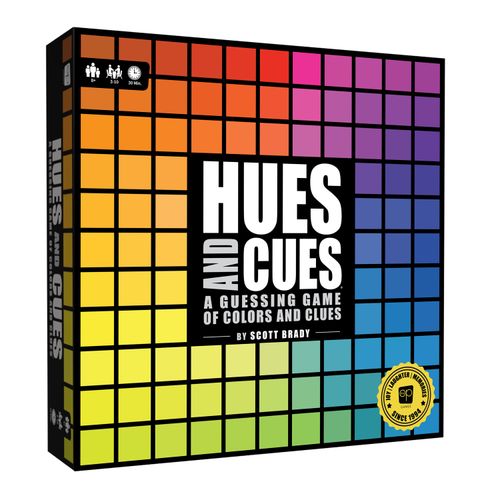
Hues and Cues
Hues and Cues Rulebook
Table of Contents
Table of Contents
Components
- 1 Game Board
- 100 Color Cards
- 30 Player Pieces (3 each in 10 colors)
- 1 Scoring Frame
Set-Up
- Place the board in the center of the play area.
- Give each player three pieces of the same color.
- One should be placed to the left of the score track, with the player keeping the other two.
- Shuffle the color cards to form a face-down draw pile.
- Set the scoring frame off to one side.
If this is your first time playing, assemble the scoring frame as shown, sliding pieces A and B onto C and D with fronts (side with 1's) facing outward and backs (sides with 2's) facing inward. Once intact it may be stored assembled in the game box.
Starting the Game
The player who is wearing the most colorful outfit will be the cue giver for the first round.
1. Draw a Card
The cue giver draws the top card off the deck and looks at it, making sure not to let any other players see it.
The cue giver chooses one of the colors on the card to try to describe with cues. (Coordinates are included for each color - this will be important for scoring.)
2. One-Word Cue
The cue giver gives a one-word cue to describe their chosen color.
The word given may be anything EXCEPT the following:
- May not be a common color name (orange, blue, green, yellow etc.) but may be an abstract color name (chartreuse, golden, lavender, etc.).
- May not refer to the color's position on the board or the letters and numbers.
- May not refer to any object in the room.
3. First Guess
In clockwise order, all other players now take turns guessing. On their turn, each player indicates their guess by placing one of their pieces on the square they think matches the cue giver's description.
Important! Each color can only be guessed once. A color is guessed if the space contains a piece.
4. Two-Word Cue
Once all guessing players have placed their first piece, the cue giver now gives a two-word cue, following the same guidelines noted as before.
They may choose to pass on their second cue or give another one-word cue. (See additional rules.)
5. Second Guesses
This time in counterclockwise order, players make a second guess by placing their remaining piece on any unoccupied space on the board.
Scoring
After all guessing players have made their second guess, the cue giver reveals the color by placing the scoring frame onto the board so that the color on the card is in the center. Use the letter and number coordinates on the card to ensure it is aligned properly. Points are awarded as follows:
- The cue giver receives one point for each piece that is within the scoring frame.
- Guessers receive points based on how close they are to the correct color.
- If a player guessed the color exactly, they receive three points.
- Each other piece within the scoring frame, but not on the exact color, receives 2 points.
- Each piece on a space adjacent to the outside of the scoring frame (including diagonally) is worth one point.
Track the points by moving each player's piece the appropriate number of spaces on the scoring track.
The cue giver can earn a maximum of nine points. Any individual guesser can earn a maximum of five points - three for a correct answer and two for their other piece being within the frame.
Starting a New Round
All guessing pieces are returned to their owners. The next player in clockwise order becomes the cue giver and draws a new card from the deck.
Game End
For games with 4-6 players, the play continues until each player has been the cue giver twice. If playing with 7 or more players, each person will be the cue giver once.
After all players have taken their turn at being a cue giver (once or twice), the person with the highest total score is the winner. If tied, the player who was the most recent cue giver wins.
Additional Rules
If a color is chosen on the edge of the board, scoring happens in the same manner with fewer possible areas to score.
After the first round of placing pieces, if the giver is happy with their score (because it was accurate enough to get a lot of near-correct answers), they may strategically elect to pass on their second cue, preventing other players from placing their second piece. In this case, scoring happens immediately.
Variant Rules
If you are playing with younger gamers we recommend letting players select any color from the board to provide cues. Prior to giving the first cue, the active player should write down the letter and number for the location of their chosen color, but keep it secret from the other players. This approach helps players who may have a difficult time creating cues for certain colors.