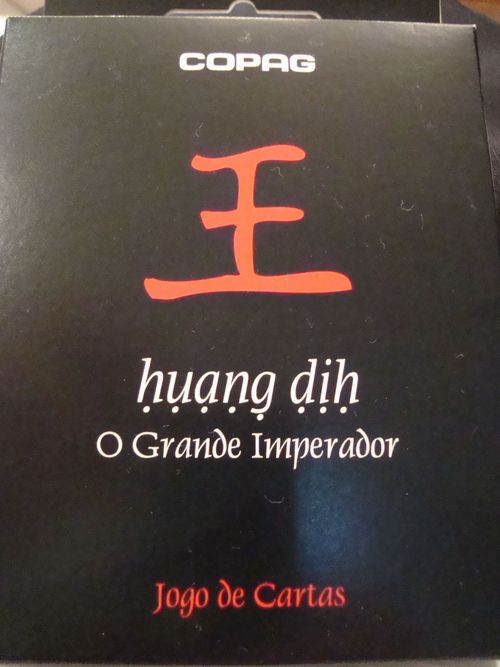
Huang Dih: O Grande Imperador
Huang Dih: O Grande Imperador Rulebook
Table of Contents
Table of Contents
Goal
Be the first to finish all the cards from your stock pile by building walls in the center of the table.
Stock Stack: Each player receives 10 face down cards that must be placed to their right. At the beginning of the game, the first card must be face up and exposed to all. When the last card in the stock pile is used, the player wins the game.
Discard pile: At the end of each player's turn, a card must be discarded in one of two discard spaces. The cards remain in the discard pile on top of each other. During each player's turn he can use one of each opponent's cards at the top of these 2 discard stacks to build the walls.
Purchase Stack: Used to purchase cards instead of each player. Every player must buy cards at the beginning of his turn until he completes five cards in his hand. During the game, 3 walls will be built. The walls begin with card 1 and follow in sequential order and grow to 10. When one wall reaches 10, it is removed from the game and another can begin to be built. During the construction of a wall the order can be reversed with the use of the reversed card. An inverted wall is removed from the game when it reaches 1. Walls taken from the game are shuffled and returned to the purchase stack.
Preparation
The dealer distributes 10 face down cards to each player (stack of stock), the remainder is placed in the center of the table forming the pile of purchases. Walls and discard stacks are only placeholders and have no cards at the beginning of the game.
The Game
The player to the left of the dealer starts the game by turning the card from the top of his stock pile leaving it exposed to everyone and buying five cards from the pile of purchases, forming his hand. Then check that there is 1 in your hand or at the top of your stock pile, so you can start a wall. If you have more than one card, it is possible that more than one wall (maximum of 3 Walls) can be started.
It is important to remember that it is always better to use the cards from your stock pile once the end of it determines the win. Wild cards are worth as any card (except the card reverses) and can be used as 1 to start a wall. The play continues by placing letter 2 on letter 1, 3 on 2 and so on, on any of the walls. When the player has no more cards to use, he discards a card in one of his discard stacks, facing up, and ends his move by passing the turn to the player to his left who proceeds in the same manner.
Disposal stack cards, if any, can be used to assist in the construction of the walls giving support for the stock pile cards to be used. If the player uses all 5 cards in the hand, he buys 5 more cards and continues to play. If he finishes playing with his fifth card discarded in his discard pile, he does not buy 5 cards in this move.
At the beginning of each player's turn, he must buy a few cards from the shopping pile that completes 5 cards in his hand. He then proceeds by completing the walls (always in sequential order) by playing cards from his stock, from the discard pile, or from his hand.
Special Cards
Invert: This card reverses the order of the wall from crescent to decreasing or vice versa. The reversed card can never be played by itself, it must always be played with the card that follows it. For example, if a wall is growing and the number 8 is at the top, the reversed card can only be played with card 7.
A crescent wall with 1 at the top can't be reversed. It is important to leave the cards inverted next to each wall so that the number of inversions can be tracked.
Joker: Joker can replace any card, except for the card reversed. It is very common for a joker to be the card that accompanies the card reverses, and this is allowed.
Layout
The layout diagram on the final page labels the play areas: Purchase Stack, Walls, Hand, Discard, and Stock.