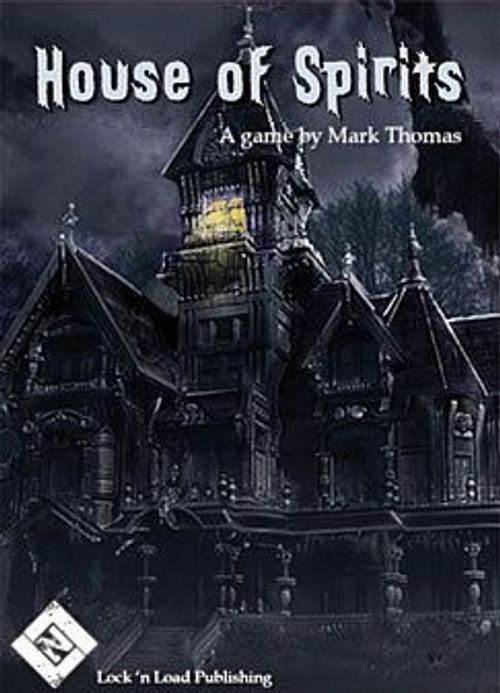
House of Spirits
House of Spirits Rulebook
Table of Contents
Table of Contents
Overview
- Number of Players: 2 – 4
- Playing Time: 30 – 60 minutes
- Recommended Age: 12+
Components Included
- These Rules
- 72 Cards:
- 6 Player Character Cards
- 15 Room Cards
- 7 Plot Cards
- 7 Secret Victory Condition Cards
- 10 Monster Cards
- 22 Item Cards
- 4 Event Cards
- 1 First player turn card
Required but not included
- 1 six-sided die
- scratch paper / pencil
Recommended
- An additional die per player, and a die that can be designated as the "monster" die.
- Tokens to track player score and player / monster health.
The Goal of the Game
House of Spirits has both cooperative and competitive aspects to it. In order to win the game, you not only need to survive until the end, but you also have to have the most points. If the dangers of the house ever conquer all players in the same round, the game is over.
Game Setup
Before playing the game, follow these steps:
- Separate and shuffle all room cards into a stack, leaving them face down, with the Vestibule on top. The vestibule is the starting room of the game. This stack will be referred to as the "room deck".
- Separate and shuffle the plot cards into a stack, leaving them face down. This is the "plot deck".
- Separate and shuffle the monster cards into a stack, leaving them face down. This is the "monster deck".
- Separate and shuffle the character cards into a stack. Have each player select one blindly. This will be the character the player controls in the game. Left over character cards can be set aside. They will not be needed for the rest of the game.
- Separate and shuffle the secret victory condition cards into a stack. Have each player select one blindly. Players keep this card to themselves; if they achieve it by the end of the game, they receive bonus points. These points can often mean the difference between winning and losing.
- Shuffle the main cards together into one stack and place it face down. This will be referred to as the "main deck".
Sequence of Play
Each round of the game is comprised of turns. Each player gets one turn per round. When each player has completed his turn, a new round begins. Note: Many actions require the player to roll a single six-sided die. Throughout these rules, you'll see this referred to as rolling 1D6.
Each round there are several actions that can occur. Below is a summary, followed by details about each step.
- Determine player order
- Explore new room if current room has no monsters in it
- Determine if new room has monsters in it
- Draw and lay down as many cards from the main deck as there are players
- Each player in turn decides on a course of action
Determine Player Order
At the beginning of the game, each player rolls 1D6. If there is a tie in the roll, continue rolling until someone wins. The player who rolls the highest number picks up the "First Player" card. He will take his turn first, and play continues to his right. Each round after the last person has taken his turn the first player of the round gives the "First Player" card to the player to his right. This helps keep track of who gets to go first.
Exploring
When the game starts, turn over the first room card and set it away from the other room cards. This will form the discard pile of room cards. The first room is always the vestibule of the house; every game starts here. It is the only room in the house that has no chance of monster attacks, so it gives the characters a chance to pick up some weapons before exploring the rest of the house. As the characters progress through the house, explored room cards will be placed into a discard pile. If the entire house is explored and the game has not yet been won, re-shuffle the discard pile and continue exploring the house again.
After a new room card is played, check the number of skulls (if any) that appear on the face of the card. This represents the possibility that monsters will appear. Each player rolls 1D6. If a roll matches the number of skulls or less, turn over a monster card and lay it in the play area. For example, if there are 3 skulls on the room card, a monster card will be drawn if you roll a 1, 2, or 3. Remember to do this for each player. Each round there will be one card in play for each player. If there are fewer monsters than there are players, draw a number of cards from the main deck up to the number of players and lay them face up.
Example: In this example there are three players, and they have just entered the Library. The Library has two skulls on it, meaning that a monster will be drawn if a player rolls a 1 or a 2. Player 1 rolls a 4, so no monster card is drawn. Player 2 rolls a 2, so a monster card is drawn and placed in the play area. Player 3 rolls a 6, so again there is no monster card drawn. Since there are three players but only one card currently in play, two cards are drawn from the main deck and laid next to the monster card. Based on these cards and other conditions, players will decide on a course of action. Each round, cards are drawn from the main deck to bring the count back up to the number of players. Monsters, however, are only checked for when first entering a room. Continuing our three player example, if two item cards and a monster card are drawn, and both items are picked up, the following round two more cards will be drawn.
Until all monsters in the room are killed, a new room card is NOT turned over. Otherwise, a new room card is turned over each round that begins with no monsters in play, even if there are other cards in play that have yet to be picked up. These cards immediately go to the discard pile. Consult the 'pick up a card' section for more information.
Player Actions
Each turn, a player must take one (and ONLY one) of the following actions:
- Investigate
- Play a plot card
- Pick up a card
- Heal his character or another player's character
- Attack a monster
Investigation
The players win the game by gathering and playing all of the plot cards. Each plot card contains a fragment of a diary containing the secret to ridding the house of evil. Each round, only one player is allowed to investigate. To successfully investigate, the player must exceed the investigation score of the top card in the plot deck. Of course, the card hasn't been turned over yet, so the player does not know what that score is, exactly.
The player uses his investigation score (the number next to the magnifying glass icon on the character card) as a base. He may then play as many investigation item cards as he pleases in an attempt to boost his investigation score. Investigation items have a number next to the magnifying glass icon. Next he rolls 1D6 and adds that to his investigation score. Finally, he turns over the top plot card and checks the investigation score on it. If he has exceeded it, he gets to pick up the card. If he failed, the card goes to the bottom of the plot deck. In either case, as with all items, any investigation items used are immediately discarded.
Example: Kraig Quartzheim is investigating. His base investigation score is 3. He has two investigation items in his hand, the broken mirror (+1 investigation) and the flashlight (+2 investigation). He wants to insure success, so he plays both cards. This boosts his investigation score to 6. Finally he rolls 1D6, getting a 2. His final investigation score is 8. Turning over the plot card, he sees that he only needed a 5. He has succeeded, so he picks up the plot card. He also discards the item cards he played.
Playing Plot Cards
When fully assembled and arranged in numeric order, the plot cards reveal the mystery of the house and how it can be stopped. Once they have assembled the entire plot, they will have won the game. Points are then tallied and the ultimate victor is declared.
In order to further the plot and receive points, the player must actually play a plot card. This constitutes the player's entire turn. Plot cards can be played in any order; each one has a number on it to help you keep them in order once they are laid down. Under most circumstances plot cards can NOT be played in the same round they are gathered. Note that players can get plot cards through means other than investigation.
Example: Rudolph investigates on his turn, and gets a plot card. On his NEXT turn, he can choose to play the plot card, provided that all criteria are met to do so (see below).
Some plot cards do not contain any special instructions. These can simply be played during the player's turn, provided that at least one round has passed since the player gained the card.
Another kind of plot card contains a list of rooms. In order to play one of these cards, two conditions must occur:
- The players must actually be in one of the rooms on the card, and
- The player must roll 1D6, and after optionally adding or subtracting the room modifier (the large number in the lower-right corner of the room card), get the number of that room on the card.
Example: Olivia is attempting to play a plot card containing a list of rooms. The characters are currently in the Garage, which is listed as number 3 on her plot card. Looking at the Garage room card, she sees that the garage grants a bonus plus or minus 2 to her plot roll. This means that she can add or subtract 0, 1, or 2 to whatever number she rolls on 1D6, and as long as the result is 3, she can play the plot card. Continuing our example, she rolls a 4. The room bonus allows her to subtract up to 2 points, but she only needs to subtract 1 in order to reach a 3 result. She gets to play the plot card and receive her points.
Additionally, when the players move to the next room, the plot room card is placed on top of its associated plot card. This helps to indicate what room relates to what plot card.
Another type of plot card involves a list of items. Similar to playing the room plot cards, the player is attempting to roll 1D6 to match a specific item. In order to play the item plot card, the player must possess the item in question. Like room cards, some item cards impart bonuses that can be used to help produce a specific result.
Example: Kraig has a plot card containing a list of items. He also has the Ancient Tome card. To play the plot card and make the ancient tome the "plot item", Kraig must roll 1D6 and produce a 4 result. When the players are in the Library, the ancient tome provides a bonus plus or minus 2 to this roll. In any other room, it provides a bonus plus or minus 1. Kraig rolls a 6. The characters are currently in the attic, so Kraig can only alter his roll by 1 point. That leaves him with a 5, so he can NOT play the plot card.
When a player plays an item plot card, that item's card is then placed on top of the plot card, effectively removing it from play. If the player has more than one plot item card in his hand, he must declare which one he is attempting to play prior to rolling.
When a player successfully plays a plot card, he receives 3 points. The player who plays the final plot card also receives a bonus 3 points, making the final card worth 6 points total. Note that the final plot card does not always mean plot card #7; they can be played in any order. See the 'end of the game' section for more details.
Pick up a card
As mentioned before, when a new room card is turned over, players first determine if any monsters are in the room by rolling 1D6 for each player, adding a monster for each number rolled that is less than or equal to the number of skulls on the room card. Cards are then drawn from the main deck to bring the total number of cards in play equal to the number of players. Cards can represent powerful items, dangerous monsters, or strange events. Each turn, the player can choose to pick up an item or event card as his single action for the round. The players will stay in this room until all monsters have been removed. Until that happens, cards will be drawn each round to bring the count up to the number of players. The next round after all monsters are removed, a new room card is turned over. Any cards that were not picked up go to the discard pile. If at any time the player gets more than 6 cards in his hand (this does not count the player character card or the secret victory card) he must discard down to 6.
Heal himself or another player
During the game characters can get wounded. The character card indicates how many wounds the character can sustain before dying. This number is next to the heart icon. Track these wounds with a piece of scratch paper. Some cards represent items that can heal the player. A player can use his turn to play one or more of these cards (but not in the same round he collected the card), instantly restoring the indicated amount of health to either himself or another player. Healing cards can't be played on characters that have full health. Healing another player grants the healer 1 point. The player only receives 1 point, no matter how many healing cards he may have used. No points are granted for healing your own character.
Once a character dies, he is returned to full health on the next round, but he loses 2 points and all his cards with the exception of his secret victory card and his character card. Any plot cards that were in his possession go to the bottom of the plot deck. Other cards go to the discard pile of the main deck.
Attack a Monster
Some cards represent monsters lurking in the house. Before the characters can continue exploring, all monsters in the current room must be killed. Players can choose to use their turn to attack a single monster. Each monster MUST be attacked by at least one player each round; if there are three players and three monsters, each player must attack one monster and may not take other actions. The character's base attack score is the number next to the sword icon. Players can also use any offensive item cards to increase their chances of success. In fact, they can use as many as they like all at once, unless otherwise specified. Offensive items have a number next to the sword icon. All items can only be used one time unless otherwise specified. They then must be discarded. If an item has both offensive and defensive abilities, the player can benefit from both of them (discard the item after the monster retaliates). Some items are more useful against certain monsters. The player then rolls 1D6 and adds the result to his current attack score (base attack + items being used). Roll 1D6 and add the result to the monster's base defense score, which is the number next to the shield icon. If the player's final attack score EXCEEDS the monster's defense score, he has made a successful attack. A successful attack causes one wound to a monster. If the player's final attack score is so great that the monster has no chance of defending against it (higher than 6 + the monster's defense score) then the player has scored a critical hit and the monster is automatically killed. On a piece of scratch paper, track the number of health points that the monster has remaining. Once the monster loses all of its health, it dies and its card goes to the bottom of the monster deck. The player that deals the final blow to a monster receives 3 points.
If the monster survives the player's attack, he immediately retaliates. The attack procedure for a monster is identical to that of a player except that monsters can't use items. Players can play as many defense items as they wish, but they must decide to play them before the monster's attack roll. As with other items, defense items are discarded after use.
Combat Example: Olivia decides to attack a vampire. Her base attack score is a 2. She uses her wooden stake, which would normally increase her score by 1, but since she is fighting a vampire, it increases it by 3. Rolling 1D6, she gets a 3. Olivia can re-roll attacks, but chooses to keep her 3. This makes her final attack score 8. The vampire's defense score is a 2. Rolling 1D6 for the vampire, the result is a 4, giving the vampire a final defense score of 6. Since Olivia's attack score exceeded the vampire's defense score, she succeeded in her attack. The monster loses one health point, but since the vampire is still "alive" it immediately strikes back. The vampire's attack score is a 3, and after adding 1D6 the vampire's final attack score is 7. Olivia's defense score is 3, and she doesn't have any defensive items to help boost her score. Rolling 1D6 results in a 4. This makes her final defense score a 7. Since the vampire did not exceed her score, the attack is a miss.
Character Special Abilities
Each character has one or more abilities that make him or her unique, aside from different statistics such as defense and attack power. Usually these abilities can only be used once per game, but some of them can be used repeatedly (once per turn). You may decide when to use your character's ability, but abilities can only be used on your turn.
End of the Game
There are three ways the game can end:
- If all characters are killed in the same round, the game immediately ends in failure.
- If at any time a player gets 18 points, the game ends with that player as the winner.
- Otherwise, the game ends the moment all plot cards have been played. At that moment, tally the scores (including any secret victory conditions that may have been met) to determine the winner. Secret victory conditions are worth 4 points.
Scoring Summary
| Action | Points |
|---|---|
| Killing a monster | 3 points |
| Playing a plot card | 3 points |
| Playing the final plot card | bonus 3 points |
| Healing another player | 1 point |
| Your character dying | -2 points |
| Achieving your Secret Victory Condition | 4 points |