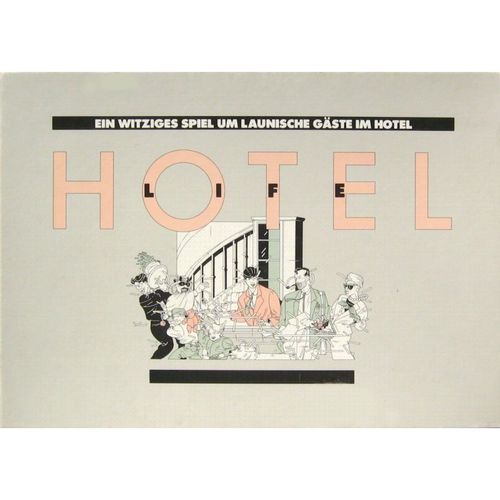
Hotel Life
Hotel Life Rulebook
Table of Contents
Table of Contents
Contents
- 1 game board with reputation table
- 4 pawns
- 2 dice
- 16 marker cards
- Play money
132 equipment tiles:
- 24 phones
- 24 minibars
- 24 TVs
- 24 baths
- 24 extra beds
- 4 elevators
- 4 saunas
- 4 tennis courts
16 staff tiles:
-
4 housekeepers (Gouvernante)
-
4 room service waiters (Etagenkellner)
-
4 receptionists (Receptionisten)
-
4 house doctors (Hausärtze)
-
46 guest cards (45 in 9 categories + 1 special card)
-
80 action cards
The Board
The board depicts 4 hotels, each with 6 rooms. The rules often refer to adjacent rooms. Follow this rule to determine which rooms are adjacent to which others:
- Room 1 borders on room 2 and room 4
- Room 2 borders on room 1, room 3, and room 5
- Room 3 borders on room 2 and room 6
- Room 4 borders on room 1 and room 5
- Room 5 borders on room 2, room 4, and room 6
- Room 6 borders on room 3 and room 5
The reputation track runs through the middle of the board. It shows the reputations of the hotels and gives information about the current state of the game.
Guest Cards
There are nine different categories of guests: musician, artist, family, scientist, media, athlete, military, business and patient, plus a card which is homeless. On the guest's card are the name of the guest, the category to which he or she belongs, and a list of his or her needs.
Before a hotel can house a guest, it must fully meet his or her needs!
The following picture shows the layout of a guest card:
The Rolling Bones (5) — Hard-Rocker
MUSICIAN 2 rooms + 1 extra bed, 1 minibar, elevator, 1 TV
A Begin huge party → trash both rooms. However, for every adult female hotel guest → reputation +2 L Encourages them → activates B Threaten annoying guest with their guitars → bothered
If flees: Fr. 1800.-
W checks out if Rain or Thunderstorm, always
Satisfaction points: 0
The parts of a guest card are:
- Name — the guest's name
- Description / occupation
- Category — the guest's category
- Needs — what the hotel must provide before the guest can be housed
- A — activity
- L — reaction to noise (→L)
- B — reaction to nuisance (→B)
- F — points if they flee (→F)
- Pays per week
- W — checks out if…
- Z — satisfaction points
Numbers before an arrow mean that a die is rolled, e.g., "4-6 →" is shown: only if 4, 5 or 6 are rolled does the effect following the arrow occur.
Similarly, if there is a condition before an arrow, the effect following the arrow only occurs if the condition is met. Not all text before an arrow is a condition – in the example above, there are no conditions. However, in a case such as "B By family → F," the guest only flees if the B was triggered by a family guest.
A: Becomes active — This section is read and implemented when the appropriate category is activated by an action card or an →A result.
B: Feels bothered — A →B result causes this section to be read and implemented.
L: Suffers from noise — An →L result causes this section to be read and implemented.
V: The room is trashed — The room is now useless for this week and all of next week. Exception: see Housekeeper. The equipment in the room does not have to be removed (unless otherwise indicated). A trashed room is marked with a "verwüstet" (laid waste) marker card. The guest in question may be placed in another room if a receptionist is present; otherwise he or she flees → F.
F: The guest flees — The guest promptly leaves the hotel.
W: The guest checks out — Checking out is often dependent on weather. Example: "W Sun 4-6" means that the guest departs in sunny weather when a 4, 5, or 6 is rolled. Checking out cannot be prevented.
Z: Guest satisfaction — You get these reputation points if a guest remains at your hotel after making the check-out die roll.
Action Cards
There are three different types of action cards: activation cards, weather cards, and special cards.
Activation Cards
Activation cards activate a category of guests, e.g., "Activate patients." For each guest in this category the A section on the card must be read and implemented.
Example: patient Raoul Hechel "smells smoke and activates the sprinkler system in the entire hotel →B." He bothers all other guests of the hotel (→B) this way. Now their B sections must be checked to see how they react to it.
Activation cards activate all guests of the named category at all hotels. They can therefore cause large chains of actions and reactions. The play order is observed when resolving the activation card effects.
Weather Cards (Sun, Rain, or Thunderstorm)
When a weather card is played, it is placed on the weather-card space on the board. This determines the current weather in the village.
The card that was on the space is placed at the bottom of the action deck.
Special Cards
Special cards indicate special events or special offers.
Making Purchases
You can buy equipment or hire staff at any time. However, you may never go into debt.
Phones, minibars, and baths must remain in the rooms where they are installed, while TVs and extra beds are mobile, which is to say they can be moved from one room to another according to demand.
A tennis court is built by two neighboring hotels. They must agree on how to divide the cost.
An elevator, sauna, tennis court, or safe counts for the entire hotel.
You receive a safe automatically when you hire a receptionist.
Purchasing and hiring can increase the reputation of your hotel, either directly or by increasing your general standards: see the bonus points table for the star level requirements. When you reach a given star level, you receive the full points for that level, so if you reach the 5-star level you will have scored at least 18 points for hotel improvements: 14 for reaching levels 2-5 and 4 for the required elevator (you would have more if you installed a sauna).
Tip: Specialize either as a spa hotel or as a sports hotel. The combinations elevator + doctor or tennis court + sauna are good ones. Also pay attention to the special offers on the action cards.
Staff
Staff service the entire hotel. Their costs are paid only once.
The room service waiter mostly serves to improve the chance of taking in new guests (because of the needs on the guest cards).
The housekeeper prevents rooms from being trashed. For a player who has hired a housekeeper, a →V has no effect.
A player who hires a receptionist also gets a safe. The receptionist allows for an optimal room allocation. Only a player who has a receptionist on staff is allowed to relocate guests at his or her hotel, provided that their needs are still met afterwards.
The waiter, housekeeper, and receptionist together provide one additional card in phase 3 (distributing of action cards).
The house doctor concerns himself with the welfare of your guests and raises the respect of your hotel. For the hotelier who would like to take in patients he seems to be indispensable. In phase 7 (points for satisfied guests) a hotelier who employs a doctor receives an additional reputation point (every week).
Order Of Play
When not otherwise indicated, the hotel with the best reputation plays first. Other hotels follow according to their order on the reputation table.
When dealing with actions, reactions, moves, or similar actions the room order also counts, beginning with room number 1 and going up from there. If two or more players are on the same space on the reputation table, they roll the dice to determine their play order.
The clarifications below are not in the rules, but are based on e-mails from Urs Hostettler.
If, when dealing with a given effect, another effect is triggered, you put the first effect "on hold" while you deal with the new effect, which might in turn have to be interrupted for yet another effect. It is possible for these later effects to affect rooms or hotels which were already checked for earlier effects – this is fine.
If a guest flees because of a later effect, the earlier effects are not applied to it. However, if an already-triggered guest flees, you continue to apply its effects when you get back to that step of the evaluation.
If an effect (A, L, or B) on a card is triggered twice, the results occur twice. In many cases this will have no additional effect, but there are cards (e.g., the ones which require dice rolls) for which it is important.
Example: An action card activates all Family guests. Hotel 1 has the highest reputation and has its first Family guest card in room 2. Activating them causes guests in adjacent rooms to be disturbed by noise. So, you stop activating guests and look at the adjacent rooms to see which guests have L effects. The guest in room 1 has one, which causes him to bother everyone in the hotel. Now you start checking the guests in rooms 2-6 for B effects. The card in room 2 has one which causes it to flee. The card in room 3 also flees due to a B effect.
Assuming that none of the guests in rooms 2-6 have B effects which trigger any other guests, once you are done with room 6's B effect you go back to the L effects for rooms 3 and 5, which are the others adjacent to room 2; even though the guest in room 2 has fled, the L triggering happened before that, so it is completed. However, room 3 is considered to be empty – the guest that was there does not have his L effect triggered, since he fled before you got to it. So only room 5 needs to be checked. Once that is done, you go back to the original action card effect, namely activating Family guests.
Object of the Game
The winner of the game is the one who first reaches 40 reputation points. There are a number of ways to get points:
- Guests who stay for more than one round may give you points.
- Guests who flee your hotel in the night may cause you to gain or lose points, and taking in guests fleeing other hotels may give you points.
- Having a doctor will give you a point every round.
- You get a point every round in which you have a full hotel.
- Purchasing various pieces of equipment gives you points, as detailed on the board and player aid.
- Reaching the star levels gives you points, the details of which are also on the board and player aid.
- Various guests and action cards can give you points under certain conditions.
Setup
Each player selects a hotel.
Each player receives a pawn (cone) and places it on space 1 of the reputation track.
A player is chosen to administer the bank. Each player receives Fr. 20,000 starting capital (2x5000, 6x1000, 6x500, 7x100, 6x50) and places it near the board.
Now the banker takes the action card box. In one of its compartments are the weather cards (rain, sun, and thunderstorm). The banker shuffles the weather cards and draws one. He or she now places this card face-up on the space labeled for weather cards. This indicates the weather at the start of the game. Now the remaining weather cards are mixed with the other kinds of action cards (activation cards and special cards) to form a deck. Then the banker deals 3 action cards to every player.
Now the banker places the remaining action cards face-down on one of the spaces labeled for action cards. The other action-card space remains empty for the time being.
The banker takes all the guests (guest = card) from the guest card box and shuffles them well. Afterwards he or she draws 12 guest cards for the first round and places them face-up near the board in the order they were drawn in. He or she places the remaining guest cards face-down on the space labeled for guest cards.
Now the banker gets the staff cards from the box and places them face-up separately on the space labeled for staff cards.
The banker places the large equipment cards (tennis court and sauna) face-up separately on the space near the personnel cards.
For the small equipment cards there are 10 spaces on the board. Distribute the 6 kinds of equipment (phones, minibars, TV, baths, extra beds, and elevators) face-up in such a way that the piles do not become too high. However, they can be placed one type of equipment per space, so that 4 spaces remain empty.
You can leave the marker cards in the box for the time being. They are only required later, as indicated by the rules.
Now you can begin the game.
Game Phases
The 7 game phases in Hotel Life correspond to the days of a week. This has no bearing on the game.
Phase 1: The Guests Arrive
In the first round of the game 12 guests arrive: the advertising campaign was a real success. This is done in step 6 of setup, so do not draw any new guest cards on the first round.
In future rounds the banker rolls 2 dice to determine the number of new guests. They are placed next to the board in the order they were drawn in.
Now each player looks at the requirements of the guests, since their needs offer the first clues as to which staff must be hired and which equipment the hotels must purchase to be able to take in suitable guests.
Each player can now hire personnel and furnish his or her hotel accordingly (for prices see the price list on the board, small equipment costs are also on the equipment cards). Equipment and personnel can be bought or hired at any time during the game. Note: you cannot go into debt.
The player places the acquired personnel cards on his or her marked personnel spaces, the equipment cards which service the whole hotel (sauna, tennis court, elevator) on the marked spaces, and small equipment in the rooms. In addition, the equipment rules must be followed. When all hotels (players) have finished preparing, they score their newly-acquired reputation points according to the table on the board. It is advisable for each player to verify the score with the banker in turn.
Phase 2: Housing
Every guest goes first to the hotel with the best reputation (according to the reputation table) for accommodation, then the second-best, etc. Hotels can only house guests whose needs (see the guest cards) are fully met. Place the card of an accommodated guest on the room that meets his or her needs. If not stated otherwise, it is not compulsory to house a guest.
This phase is performed as follows: the banker picks up the first guest card and reads aloud the category, the name of the guest, the description of the guest (occupation), his or her needs, the amount in francs which this guest pays for his or her stay, and the possible reputation points (prefixed with Z). Then this card is offered to the hotelier who currently has the highest score on the reputation track. If this hotelier wants to (and can) take in the guest, he or she may quarter the guest at his or her hotel. However, if the hotelier declines, the card is offered to the hotelier who has the second-highest reputation, etc. If none of the players want this guest, the card goes back under the guest card deck.
It is possible to veil one's intentions by waiting patiently to make purchases until the guest is read out, for items one decided upon when the guests were laid out. Because the banker is a very busy person, we recommend carrying out such purchases regularly, without self-service.
When accommodating group guests: every room has two beds as standard equipment and can have at most one extra bed added.
Mark the rooms which are occupied by the group but not covered by their card with "occupied" marker cards.
Guests who were not housed, either because no hotel met their needs or because no one wanted them, are placed at the bottom of the guest card deck (they leave the village).
Phase 3: Distribute Action Cards
Each player receives an action card from the deck. A player who has a housekeeper, room service waiter, and receptionist receives an additional card.
Phase 4: Play Action Cards
If the text of an action card doesn't say otherwise, it is applied in reverse play order: the hotel with the lowest reputation first.
Each player may play as many action cards as he or she wishes, starting with the player with the lowest reputation and continuing in increasing reputation order. A player can keep at most 6 cards. Unless otherwise specified, it is not allowed to discard a card with no effect, so it is possible to be forced to play cards.
When an action card is played, it is placed on the second action-card space while it is being resolved. Once used, action cards are placed back under the action deck.
Fleeing
Due to actions and reactions it is possible that a guest will leave a hotel hastily. The amount next to F on the guest's card is applied to the affected hotel's reputation immediately.
Example: Ferdinand Brodler (artist, with F-1) flees. The hotelier who has lost him must move his pawn back a space on the reputation table.
The departed guest's card is placed on the "flight" space. After all effects of the action card are resolved, hotels which have not yet accommodated these guests in this round can take them now (in play order). If you take a guest this way who has a negative F number, you get the same number of positive reputation points. In any case you receive a tip of 100 Frs from the overjoyed guest who thanks you thus for his admission in the middle of night (this is paid out from the bank).
We continue the above example. Another hotelier can fully meet Ferdinand Brodler's needs, and takes him as a fled guest. The player may move his or her pawn forward a space on the reputation table (he or she "inherits" the reputation loss (F -1) from the deserted competition). In addition, he or she receives a tip of 100 Frs.
Another example: the slightly problematic guest Boris Monster flees. The player who loses this guest immediately moves up 2 points on the reputation table (F +2). The guest's card is laid on the flight space. Another player takes the fled family monster. He or she collects 100 Frs from the bank. This move does not affect the reputation table (positive points with F do not become negative).
Staff Giving Notice
Under certain circumstances your staff can also leave you.
An employee that leaves is put up for auction after all effects of the action card that caused the situation are resolved, and goes to the highest bidder. The proceeds of the auction go to the former employer. An employee who leaves a hotel cannot return to the same hotel that week.
If none of the other hoteliers want to hire the employee, the tile goes back to the bank.
Phase 5: Collect Money
For every guest still present at your hotel you receive their weekly payment in cash from the bank.
Phase 6: Checking Out
Now every guest in the village is checked to see if they will remain another week or depart. Obey the instructions next to W on each guest card (see Guest Cards – W).
Guests that check out have no effect on a hotel's reputation. They are put back under the guest card deck.
Phase 7: Collect Points for Satisfied Guests
Check whether there are still guests at your hotel that have points in the Z section. If so, add these points to your reputation.
If all your rooms are occupied, you receive an extra point. In addition, having a doctor provides an extra point.
Now a new week begins: begin again with phase 1.
Special Rule For Three Players
A tennis court can be built by a player together with the bank. The player must pay half the total price.
Special Rule For Children (Simplistic Play Variant)
Activated guests flee immediately. Because of this, no other actions or reactions occur. All other rules still apply.