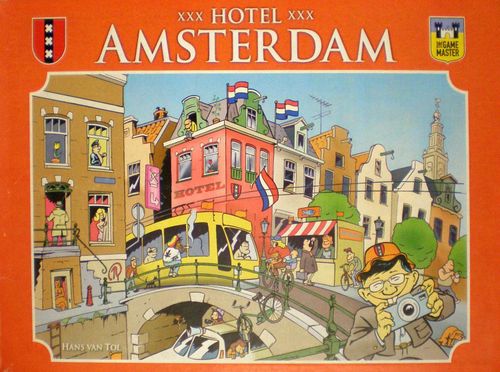
Hotel Amsterdam
Hotel Amsterdam Rulebook
Table of Contents
Table of Contents
Objective of the game
- Be the first player to collect 12 tourists around your hotels.
- (with 2 players: collect 15 tourists)
Game materials
- 8 Hotels (2x red, 2x blue, 2x green and 2x yellow)
- 4 Proofs of ownership (with the shape of a hotel)
- 1 Dam tile
- 24 Canal tiles
- 24 Building tiles
- 30 Tourists (orange pawns)
- 1 Mayor (white pawn)
- 1 Nightwatchman (black pawn)
- 1 Mayor die (white, with 1, 2 and 3)
- 1 Nightwatchman die (black, with 1, 2 and 3)
- 1 Canal tour boat
Game overview
The players build hotels on the intersections of four tiles. It is important to collect as many tourists as possible on the four tiles around the hotel. Each player builds his two hotels on intersections in rounds 1 and 2. During the game, a tourist leaves the canal tour boat, which travels around the city. The players may use the Mayor and the Nightwatchman to change the function of the building tiles. Each building has a daytime and a nighttime function. The Mayor wants a clean, tidy city and can change a night location (black symbol) into a day location. The Nightwatchman does the exact opposite. The dice are thrown to decide where the tourists leave the canal tour boat and how many steps the Mayor and the Nightwatchman may take through the city.
The game finishes when one of the players has 12 points (15 points if there are 2 players) or when no more tourists enter the city. In the latter case, the winner is the player who has the most points (tourists) collected around his two hotels at that moment.
Preparation
Preparation in 7 steps (check page 7):
- Each player chooses a colour and takes 2 hotels and a proof of ownership in that colour; the proof of ownership is only there to show who plays with which colour.
- Place the Dam tile in the middle of the table.
- Sort the canal tiles and building tiles. Shuffle the building tiles and place them around the Dam, with day (white) and night (black) sides showing alternately, as shown in the example.
- Use the 24 canal tiles to create a ring around the building tiles.
- Place the canal tour boat on the jetty tile.
- Place the Mayor on one side of the Dam and the Nightwatchman diagonally across on the other side of the Dam.
- Place the 30 tourists next to the board. Take 4 tourists from the group and place them on the building tiles as indicated in the 'starting position' picture on page 7.
Game sequence
The player who has most recently been on a canal tour boat starts the game.
The players take turns (clockwise) to proceed through the following 6 game phases:
1. Throw the dice
2. Tour with the canal tour boat
Add up the value of the 2 dice and move the boat (A) by that many tiles around the canal. The boat moves clockwise.
3. Drop off a tourist
Take a tourist from the group and place him/her on the building tile next to the boat (B).
If the boat arrives in one of the four bends, the tourist is left behind on the quay (C). There may be more tourists waiting and they can be picked up when the boat passes the same bend in a next round. In such cases, more than one tourist is placed on a building tile (D).
4. Place a hotel
Place a hotel on an intersection of four tiles of your choice. The locations of the Mayor or the Nightwatchman are not important. Each tourist who is on one of the four tiles around this intersection is worth 1 point to the player in question. The tourists on a tile adjacent to 2 hotels of the same player only count once.
The hotels must be placed during the first two turns!
5. Walking around the city
Move the Mayor by as many steps as shown on the white die. Move the Nightwatchman by as many steps as shown on the black die. It is possible to cross the Dam diagonally.
The Mayor and the Nightwatchman cannot be on the same location in the city. They can stand on or pass intersections with a hotel.
6. Turning tiles and moving tourists
The Mayor and the Nightwatchman can both turn over one of the surrounding building tiles on the intersection on which they have arrived. The Mayor can only turn over a tile with a black symbol and the Nightwatchman can only turn over a tile with a white symbol.
As soon as the building tile is turned over, the tourists are chased away. They look for a new location in the city with the same function, but with the fewest tourists. If this involves multiple locations, the player can choose.
Example
Three tourists are in a coffee shop (E). The Mayor turns this tile over, so that it becomes a mansion. These tourists then want to go together to another coffee shop, and the player must move these tourists to a different location in the city with a coffee shop (also recognisable by the same symbol).
If there is one coffee shop with two tourists (F) and two coffee shops with one tourist (G,H), the player has to choose from the two coffee shops with a single tourist. The three tourists then go there.
TIP: First move the tourists to the different location and only then turn over the tile, so that you still know which location the tourists have to be moved to.
Special situation
There is no location with the same symbol available for the tourists that have been chased away. In such cases, these rootless tourists go to the Dam (I). See also under the heading 'The Dam'.
After a player has finished game phase 6, it is the turn of the player to the left of him/her, and he/she starts at game phase 1 (throwing the dice). Game phase 4 is only played during the first two rounds.
The Dam
The Dam is a special location, a place of refuge for stranded tourists. If tourists are chased away from a location, because the Mayor or the Nightwatchman changes the function of the building, and there is no alternative left, these tourists go to the Dam.
From the Dam, the tourists can be led to a random location in the city. But only one tourist at a time. The players do this by placing the Mayor or the Nightwatchman next to the Dam. There is one important restriction, however: the Mayor can only move a tourist to a random day location (white symbol) and the Nightwatchman can only move a tourist to a random night location (black symbol).
It is also important that the Dam tile can never be turned over. It is permitted to build a hotel in an intersection adjacent to the Dam.
End of the game and winner
Hotel Amsterdam ends as soon as one of the players has collected 12 tourists around his/her hotels (15 tourists in the case of 2 players). The game can also end if no new tourists come to the city. The player who dropped off the last tourist in the city is permitted to finish his/her turn. The player who has collected the most tourists around his/her hotels after this is the winner. It is still possible that there may be tourists left behind on the quay, who can then no longer be picked up.
Tactical tips from The Game Master
Monopoly
It can be useful to reduce the competition by turning over tiles of the same type. This means that there are fewer tiles available to which the tourists can go. This increases the chance that other players have to go to a tile which is adjacent to your hotel.
Tactical variant
Hotel Amsterdam is a family game, but you can also add a tactical touch to it. For this, do not use any dice and apply the following rules:
- In a game round, you can move the canal tour boat forward 1, 2, 3 or 4 places.
- In a game round, you can divide a maximum of 4 steps between the Mayor and the Nightwatchman. However, both pieces cannot move more than 3 steps. It isn't allowed to move 4 steps with one piece, if you stay put with the other.
- If there are four tourists on a tile, this tile can no longer be turned over.