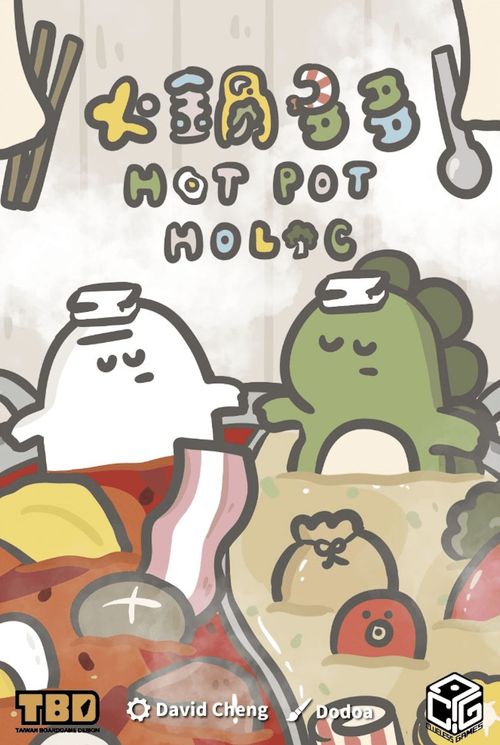
Hot Pot Holic
Hot Pot Holic Rulebook
Table of Contents
Table of Contents
Game Components
- Food Cards x56 (4 colors, 14 cards each)
- Heat Level Card x1
- Strength Ranking Card x1
- Number Scoring Cards x3
- Color Scoring Cards x3
- Heat Scoring Cards x3
- Favorite Scoring Card x1
- Player Plate Cards x4
- Player Markers x4 (blue, yellow, red, pink)
- Start Player Token x1
Game Setup
- Randomly select 1 Number Scoring Card, 1 Color Scoring Card, and 1 Heat Scoring Card. Place these three cards along with the Favorite Scoring Card face up on the table for all players to see.
- Place the Heat Level Card next to the Heat Scoring Card. Place the Player Markers next to the Heat Level Card.
- Place the Strength Ranking Card in the center of the table.
- Each player takes a Plate Card and places it in front of them.
- Depending on the number of players, some Food Cards will be removed from the game:
- 2/3 players: Remove cards numbered 4&5.
- 4 players: Use all cards.
- Shuffle the Food Cards and reveal a number of cards to create the Central Hot Pot area:
- 2/3 players: Reveal 4 cards.
- 4 players: Reveal 6 cards.
- Deal 9 Food Cards to each player as their hand. Then, deal 2 Food Cards face up on top of each player's Plate Card. Return any unused components and leftover Food Cards to the box.
| Players | Food Cards in Game | Cards on Plate | Cards in Hand | Cards in Central Hot Pot | Cards Returned to Box |
|---|---|---|---|---|---|
| 2 | 0-3 &K | 2 | 9 | 4 | 3 |
| 3 | 0-3 &K | 2 | 9 | 4 | 3 |
| 4 | 0-5 &K | 2 | 9 | 6 | 6 |
- The player who ate hot pot most recently is the starting player (or decide randomly). This player takes the Start Player Token and determines whether K or 0 is the strongest number to start the game. Flip the Strength Ranking Card accordingly (K>0 or K<0). (Refer to "Card Strength Resolution" for more details.)
Now, let the hot pot feast begin!
Advanced Setup Variant
Instead of randomly dealing 2 Food Cards on the Plate Cards and 9 cards to players' hands, deal 11 cards to each player's hand. Before the game starts, each player selects 2 cards from their hand to place face-down on their Plate Card. After all players have made their decisions, reveal their 2 Food Cards, and the game starts with 9 cards in hand.
Gameplay Overview
The game consists of 8 rounds. Each round has two phases: Playing Cards Phase and Pick or Eat Phase.
Playing Cards Phase
Starting from the player who has the Start Player Token and going clockwise, each player takes turns playing one card face up. Then, resolve the card strength to determine the turn order for the Pick or Eat Phase.
Card Playing Rules
- You cannot play a card with a number already played by a previous player in the same round. However, the card you play can be ANY COLOR.
- If you cannot play a nonredundant number, show your hand and play any one card face-down. Your card is considered the weakest for this round.
- If multiple players can't play a nonredundant number, the one who plays later has the weaker strength.
Example: The start player Dodoa plays a 5. David plays a 3. Then the third player Poki cannot play 5 or 3. Poki decides to play a 4.
Strength Ranking Card Flip
If K and 0 are played in the same round, the Strength Ranking Card is flipped immediately, reversing the card strength from that round onward.
Card Strength Resolution
- The Strength Ranking Card indicates the strength of the played cards.
- If K>0 is face-up: K > 5 > 4 > 3 > 2 > 1 > 0
- If K<0 is face-up: 0 > 1 > 2 > 3 > 4 > 5 > K
- The stronger your card is, the earlier you act in the next phase. Your turn order also determines how many cards you can Pick or Eat.
- 1st player: Move their Player Marker up by one space on the Heat Level Card. Take the Start Player Token. In next phase, they can Pick or Eat 1 card.
- 2nd/3rd/4th player: In next phase, they can Pick or Eat 2/3/4 cards.
- In 2/3 player games, there is no 4th player.
Pick or Eat Phase
Starting with the 1st player, each player takes turns to either Pick or Eat based on their turn order. However, you cannot perform both Pick and Eat actions in the same round.
Example: The 3rd player can Pick or Eat 3 cards. They cannot Pick 2 cards and Eat 1 card.
Beginning of this phase, if your Plate is empty, you have to choose to Pick. If your Plate is full, you have to choose to Eat.
Pick
- Take Food Cards from the Central Hot Pot and place them above your Plate Card. The amount of cards you can Pick is equal to your turn order.
- Important: You cannot Pick the cards played this round.
- You can hold up to 4 cards on your Plate. If there is enough space on your Plate and you choose to Pick, you must Pick as many cards as your turn order.
Example: The 3rd player already has 2 cards on their Plate and decides to Pick. Normally, they can Pick 3 cards, but since the Plate can hold at most 4 cards, they can only take 2 more cards from the Central Hot Pot, resulting in a full Plate of 4 cards.
Eat
- Select Food Cards from above the Plate and move them to the area underneath the Plate, which is considered the Belly. The amount of cards you can Eat is equal to your turn order.
- Important: Only the Food Cards in the "Belly" will be used for scoring. Cards still on your Plate or in the Central Hot Pot are worthless.
- If there are enough Food Cards on your Plate and you choose to Eat, you must Eat as many cards as your turn order.
Example: The 3rd player has 2 cards on their Plate and decides to Eat. Although they can Eat up to 3 cards, there are only 2 cards to be moved from above their Plate to the "Belly". Now their Plate is empty.
Perfect Eat
When you Eat, if your turn order equals the total number of Food Cards on your Plate, you made a "Perfect Eat". You can move your Player Marker up by 1 space on the Heat Level Card.
Example: The 3rd player has 3 cards on their Plate and chooses to Eat. They Eat all 3 cards, which equals the total number of cards on the Plate. So they make a "Perfect Eat".
After all players finish their turns to perform Pick or Eat, the round ends. Any unused Pick or Eat actions are lost and do not carry over to the next round. Move all cards played this round, along with the remaining Food Cards in the Central Hot Pot, to form the new Central Hot Pot for the next round (flip over any cards that were played face-down). Then, start the new round with the player holding the Start Player Token.
Game End and Scoring
The game ends after 8 rounds. Each player will have one Food Card remained in their hand that was not played. Before final scoring, each player may choose to Eat exactly one Food Card on their Plate.
Players will score victory points (VP) based on the four types of Scoring Cards. The player with the highest total VP wins! In case of a tie, the player who is higher on the Heat Level Card wins. If still tied, those players share the victory.
In 2/3 player games, K is treated as number 4. In 4-player games, K is treated as number 6.
Number Scoring
1. Straight
Consecutive numbers of 3 or more cards form a Straight. The longer the Straight, the more VP you score. You can have multiple Straights, but each card can only be used once toward this scoring.
| Consecutive Cards | 3 | 4 | 5 | 6 | 7 |
|---|---|---|---|---|---|
| VP | 3 | 6 | 10 | 15 | 21 |
2. Identical
The fewer different numbers you have, the more VP you score.
Example: If you have 4 cards of number 5, and 3 cards of number 2, you score 20 VP, because you have only 2 different numbers.
| Different Numbers | 1 | 2 | 3 | 4 | >5 |
|---|---|---|---|---|---|
| VP | 25 | 20 | 15 | 10 | 0 |
3. Pairs & Quartet
Two cards of the same number form a pair, and the VP of a pair equals the number.
Example: A pair of two 3s is worth 3 VP.
Four cards of number 0 is worth 15 VP. (Only 0 has Quartet Scoring.)
Note: In 2/3 player games, a pair of K worths 4 VP; in 4-player games, a pair of K worths 6 VP.
Color Scoring
4. Balance
One Food Card of each color forms a set, and a set is worth 10 VP. You can have multiple sets, but each card can only be used once toward this scoring.
5. In-between
Choose two colors from the Food Cards in your Belly. Multiply the number of cards of the two colors to get your score.
Example: With 5 red cards, 4 yellow cards and 1 blue card in your Belly, you choose red and yellow to score 5 × 4 = 20 VP.
6. Protein Feast
- Each Red/Meat Food Card: 2 VP
- Each Blue/Seafood Food Card: 1 VP
- Each Green/Vegetable Food Card: -1 VP
Heat Scoring
Reminder: Each round, the player who plays the strongest card and the player who makes a Perfect Eat can each move up one space on the Heat Level Card. The highest level is 7.
7. Champion
The player in the 1st place on the Heat Level Card scores 12 VP, the 2nd scores 6 VP, and the 3rd scores 3 VP.
If tied, the combined VP for the tied positions is averaged among the tied players (rounded down).
Example: If three players tie for the 2nd place, the VP for 2nd & 3rd places are added together (6 + 3) and divided by 3. So each tied player receives 3 VP.
8. Last & Least
The player in the last place loses 8 VP. If there is a tie for the last place, all tied players each loses 8 VP.
9. Progress
Score 2 VP for each space you climb on the Heat Level Card. If you reach the fourth space, receive an additional 4 VP. After the fourth space, continue scoring 2 VP per space climbed.
| Space | 1 | 2 | 3 | 4 | 5 | 6 | 7 |
|---|---|---|---|---|---|---|---|
| VP | 2 | 4 | 6 | 12 | 14 | 16 | 18 |
Favorite Scoring
10. Favorite
At the end of the game, each player will have one card remained in hand. You score 2 VP for each Food Card in the Belly that matches the color of your final hand card.
Example: In your Belly, you have 5 red cards, 4 yellow cards, and 1 blue card, and your final hand card is yellow. You score 4 cards × 2 VP, totaling 8 VP.
2-Player Rules
In a 2-player game, the setup and rules are generally the same as in a 3-player game, but you'll have a robot player to join your hot pot feast.
Game Setup
- Choose a Plate Card for the robot and place its Player Marker next to the Heat Level Card.
- Deal 9 cards as the robot's hand cards. Place them face down next to its Plate Card to form a draw pile.
- Deal 2 Food Cards face up on the robot's Plate.
Playing Cards Phase
- A round always starts with the robot. Reveal one card from the robot's draw pile. The player with the Start Player Token plays second, and the other player plays last.
- If the robot plays the strongest Food Card in the round, its Player Marker will move up one space on the Heat Level Card.
- Between the two human players, the player who played the stronger card in the round receives the Start Player Token.
Pick or Eat Phase
- The robot also joins the resolution of turn order by the card it played.
- When it's the robot's turn to act, the player with the Start Player Token gets to control the robot, following the same rules as for human players.
End of Round
At the end of each round, add all the cards played, including the one from the robot, to form the new Central Hot Pot, and proceed to the next round.
End of Game
The robot does not score points. However, it will occupy a ranking position on the Heat Level Card.
Food Types and Names
| Number | Meat | Vegetable | Seafood | Hot Pot Delicacies |
|---|---|---|---|---|
| K | Bacon | Jelly Fungus | Lobster | Fukubukuro |
| 5 | Meatballs | Enoki Mushroom | Oyster | Crab Meat Sticks |
| 4 | Duck Blood | Bok Choy | Fish Filet | Fish Roe Balls |
| 3 | Small Sausage | Broccoli | Crab | Fried Dough Sticks |
| 2 | Egg | Corn | Scallops | Pig Blood Cake |
Source Notes
The source PDF contains a few typos, which were corrected in this transcription: "You card" (read "Your card"), "to indicates" (read "indicates"), "Nomally" (read "Normally"), "phrase" (read "phase"), "Now their Plate in empty" (read "is empty"), "determins" (read "determines"), "robots turn" (read "robot's turn"), "each loses" in the Last & Least rule was kept as printed.