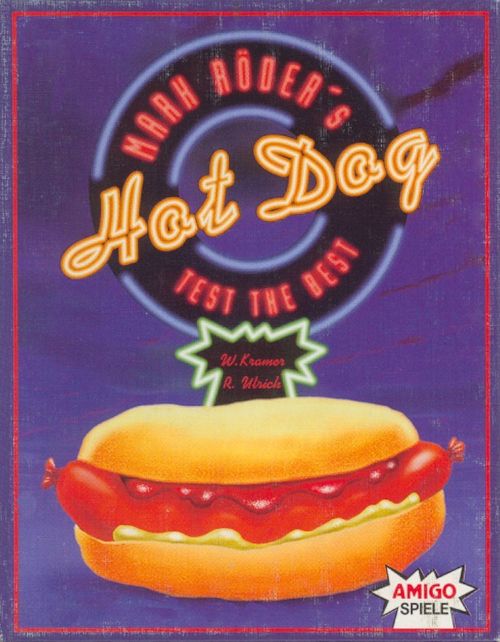
Hot Dog
Hot Dog Rulebook
Table of Contents
Table of Contents
Setup
Each player receives at the start:
- all 10 hot dog cards in one colour,
- the 5 and 7 table cards in the same colour for 2 to 3 players, or all three table cards in the same colour for 4 to 5 players,
- three cards with a value of one dollar.
The neutral table cards are placed in the middle of the table. For 2 to 3 players these are the 5 and 7 table cards; for 4 to 5 players the 9 table card is added.
The dollar cards are sorted by value and placed within easy reach in the middle of the table. The youngest player receives the mustard/ketchup card first. He places it in front of himself on the table, and play begins.
Course of a Sales Round
All players sell their hot dogs at the same time. Each player places face down in front of himself:
- one of his table cards,
- one or more of his hot dog cards,
- optionally none, one or several dollar cards,
and thereby determines at which table he wants to sell how many hot dogs. If a player places several hot dog cards, only the total number of hot dogs counts. That is, several hot dog cards are treated like a single card.
Example: Frank places his 7 table card and two hot dog cards with the values 2 and 3 face down in front of himself. This means that he wants to add his five hot dogs to the neutral 7 table card.
If a player additionally places one or more dollar cards, he wants to sell his hot dogs more cheaply. He thereby reduces his income, but has the chance to get his goods onto the table faster.
After all players have placed their cards face down, all cards are revealed and then added to the neutral table cards, as far as this is possible. First the 5 table is served, then the 7 table, and last the 9 table (with 4 to 5 players).
The number on a neutral table card indicates how many hot dogs can be sold (that is, added) at this table at most. At the 5 table at most five hot dogs can be added, at the 7 table seven, and at the 9 table nine hot dogs. The number of hot dog cards plays no role in this.
Hot dogs that a player cannot add to a table must be taken back into his hand. Perhaps it will work out in one of the next sales rounds.
Who May Sell Their Hot Dogs First?
If several players want to sell their hot dogs at the same table, the player with the lowest hot dog price is first to act.
Hot dog price = number of hot dogs minus dollars placed.
Caution: A player may never place more dollars than hot dogs. The hot dog price therefore may not fall below zero.
Example: Anna, Bernd and Chris all place their 5 table card and additionally:
- Anna: 4 and 1 hot dog cards minus 2 dollars = hot dog price of 3 $,
- Bernd: 1 and 1 hot dog cards minus 1 dollar = hot dog price of 1 $,
- Chris: 2 hot dog card with no dollar card = hot dog price of 2 $.
(Illustration: three price examples, showing the hot dog cards and dollar cards of Anna, Bernd and Chris with the resulting prices.)
Bernd is first to act. He places his two hot dog cards on the neutral 5 table card. Then Chris comes up. He likewise places his hot dog card on the 5 table. Now there are already four hot dogs there, and there is room for only one. Anna therefore comes away empty-handed. She cannot fit her five hot dogs and must take both her cards back into her hand.
Whoever was able to sell his hot dogs must hand over his placed dollars to the bank. Whoever was not able to sell his hot dogs takes his hot dogs and dollar cards back into his hand.
Caution: Dollars can only influence the order of sale. There is no guarantee that you will get rid of your hot dogs. This depends on whether there is still room at the table.
What Happens at the Same Hot Dog Price?
Here the mustard/ketchup card comes into play. It decides the order when several players with the same price want to sell hot dogs at the same table. Whoever has the mustard/ketchup card in front of him may begin, and then play continues clockwise.
Example: Anna has the mustard/ketchup card. All have placed the 5 table card and additionally:
- Anna: 2 hot dog card with no dollars = hot dog price of 2 $,
- Bernd: 3 hot dog card minus 2 dollars = hot dog price of 1 $,
- Chris: 1 and 2 hot dog cards minus 2 dollars = hot dog price of 1 $.
Anna has the mustard/ketchup card, but she may not begin anyway, because Bernd and Chris offer the lower hot dog price. Bernd comes before Chris clockwise and is first to act. He places his three hot dogs on the neutral 5 table card and the two dollars into the cash box. Chris cannot place his three hot dogs, because there is room for only two more at the 5 table. He must take his hot dogs and dollars back into his hand. Now Anna comes up. She can still place her two hot dogs on the 5 table.
A Full Table
Now there are dollars. If the number of hot dogs placed at a neutral table matches the value on the table card, then each player receives one dollar for each of his hot dogs at this table.
Example: Anna has a 3 and a 2 hot dog card. Chris has a 2 hot dog card lying at the 7 table. Anna receives 5 dollars and Chris 2 dollars.
Translator's note: the printed example pays Chris for his two hot dogs at the 7 table, although that table is not full in the example as given. The text is reproduced as printed.
All hot dogs at a full table leave the game. Afterwards, new hot dogs can be placed at that table again.
Cash Box
So that the cash box always has enough change available, the players may not hoard too many 1-dollar cards in their hands. A player may hold at most five 1-dollar cards in his hand. If he has more, he must exchange them. The same applies to the 5-dollar cards. Of these a player may have at most two.
End of a Sales Round
When all players have had their turn, regardless of whether they were able to sell their hot dogs or not, each player takes his placed table card back into his hand. The mustard/ketchup card is passed to the left-hand neighbour. A new sales round begins.
End of the Game
Whoever places his last hot dogs face down in front of himself must announce this by saying "last hot dog". If this announcement is forgotten, the hot dogs may not be sold.
The game ends when a player has been able to sell all of his hot dogs. All tables that became full in this last sales round are still paid out. For tables that did not become full, there are no dollars. Whoever has the most money is the winner.
Generally three games are played in a row. The results per player are noted on a sheet of paper. Whoever has earned the most dollars after that is the cleverest hot dog vendor.