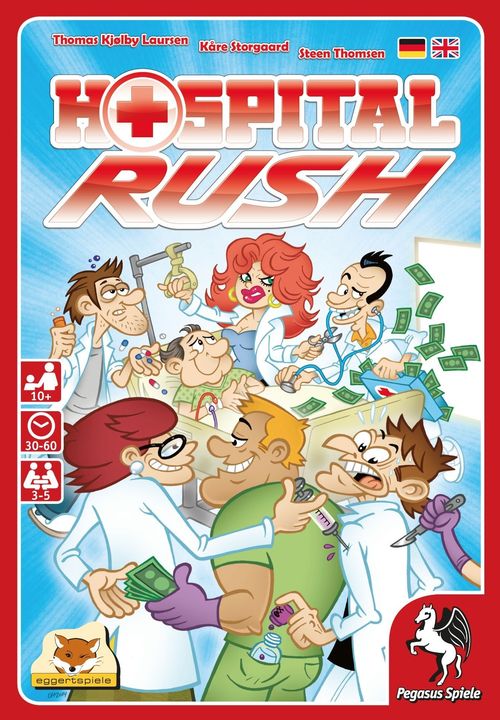
Hospital Rush
Hospital Rush Rulebook
Table of Contents
Table of Contents
- Components
- Setup
- Overview
- Playing the Game
- End of the Game
Components
- 1 double-sided main board (1 side for 3 and 4 players, 1 side for 5 players), showing beds (spaces for patient cards), the medicine chest, action spaces and the prestige thermometer
- 23 patient cards (each shows prestige points and the tiles necessary for curing the patient)
- 7 player boards (with notches for the study markers and action spaces)
- 20 study markers
- 10 action markers (2 each in 5 colors)
- 7 visiting cards
- 33 money tiles (bucks)
- 20 patch tiles
- 10 markers (2 each in 5 colors)
- 12 medicine tiles (4 each in 3 colors)
- 5 character markers
- 1 starting player marker
Setup
-
Put the main board in the middle of the table. If you are playing with 3 or 4 players, use the side marked "3/4". If you are playing with 5 players, use the side marked "5".
-
Place the patch tiles and the study markers next to the main board as a general supply.
-
Place the money tiles beside the main board, forming the bank.
-
Place the medicine tiles - sorted by color - onto the medicine chest on the game board. The number of tiles used depends on the number of players:
- in a 3-player game: use 2 tiles of each color
- in a 4-player game: use 3 tiles of each color
- in a 5-player game: use 4 tiles of each color
Return any spare medicine tiles to the box.
-
Each player receives a random player board that he places in front of him. Return any spare player boards to the box.
-
Place each player board's visiting card nearby. Each visiting card summarizes the actions of its player board and is meant as an overview for the other players. Return any spare visiting cards to the box.
-
Each player chooses a player color and receives the 2 action markers, 2 markers and the character marker of this color. Each player places his character marker onto his own player board. (It is meant as a reminder of his player color.) Then each player places one of his markers as his prestige marker onto space 0 of the prestige thermometer on the main board. The second marker of each player (which serves as his patient marker) is placed next to his player board along with his 2 action markers.
-
Each player receives 1 buck from the bank as his starting capital, which he places to the right of his player board. This area is the player's personal supply. Here he must place all medicine and money that he owns, clearly visible.
Overview
In Hospital Rush, players collect prestige points by curing patients, taking final exams and bribing hospital staff. Each round, players place their 2 action markers onto the action spaces on the main board or on their own player boards and perform actions, such as fetching medicine or money, treating a patient or learning an additional skill. They might also use unfair actions, such as stealing medicine and money from their opponents, though this runs the risk of being ratted out. The game ends when at least one player has gained 10 or more prestige points. The player with the most prestige points wins and gets the vacant doctor's position.
Playing the Game
The game is played over several rounds. Each round consists of 5 phases:
- Phase 1: Place the first action markers
- Phase 2: Place the second action markers
- Phase 3: Discharge patients
- Phase 4: Check whether the game end has been reached
- Phase 5: Prepare the next round
Phase 1: Place the First Action Markers
Beginning with the player owning the starting player marker and then in a clockwise direction, each player places 1 action marker onto an action space and performs that action immediately. He may choose any available action space on the main board or his own player board. The action spaces on the other player boards are off limits.
- Blue and red action spaces that depict the "once per round" icon may be only used once a round. The player that places his action marker there blocks it for the rest of the round.
- A player may always place his action marker onto action spaces depicting the "unlimited" icon, no matter how many or which action markers are already on it.
- The red action spaces on the main board and the player boards are unfair actions and are usually especially lucrative. But beware: If you use a red action space, you run the risk of being ratted out by an opponent (see action "rat out" below).
When it is your turn, you must place an action marker onto an action space. However, you are allowed to perform the respective action only partially or even forfeit it entirely.
Some Important Icons and Terms
- Patch / medicine: 1 patch tile or 1 medicine tile
- Patch tile: 1 patch tile
- Medicine tile of any color: 1 medicine tile of any color
- Medicine tile of a particular color: 1 medicine tile of this particular color (e.g. purple)
- Money tile: 1 money tile (buck)
- Amount to pay (e.g. 1)
- Amount to gain (e.g. 3)
- Number of prestige points (e.g. 3)
Prestige thermometer. The prestige thermometer is used to display the players' prestige points. If you gain prestige points, move your marker upward accordingly. If you lose prestige points, move it downward accordingly. You cannot fall below -2 or exceed 14 prestige points.
Medicine chest. If you take medicine from the medicine chest, you may only take tiles that are actually available in the medicine chest. If it is empty, you cannot take a tile at all.
Take tiles. If you are allowed to take bucks/medicine, you must place the acquired tiles in your personal supply next to your player board. If you take tiles from an opponent or if he gives you tiles, those tiles are "transferred" from his personal supply to yours.
The Action Spaces of the Main Board
Treat Patient
With the "treat patient" action, you place medicine and patches onto a patient to eventually cure that patient and gain prestige points.
If you choose a "treat patient" action space, you may treat exactly 1 patient. First, you claim your patient by placing your patient marker onto a patient of your choice that is not occupied by an opponent's patient marker. If your patient marker is already placed on a patient (due to an earlier action), you may now either continue to treat this patient or transfer your patient marker onto another patient that is not occupied by an opponent's patient marker. (Any tiles on the original patient stay where they are.) If all patients are occupied by opponents' patient markers, you cannot perform this action.
There are two "treat patient" action spaces:
- If you choose the first one, you may place up to 2 tiles free of charge onto your patient. Also, for each buck that you pay to the bank you may place 1 additional tile onto your patient.
- If you choose the second one, you may place 1 tile free of charge onto your patient. Also, for each buck that you pay to the bank you may place 1 additional tile onto your patient.
You can place medicine tiles as well as patch tiles (in any combination). Patch tiles are taken directly from the general supply and placed onto the patient (because patches are so common that they are available to everybody). If you want to place medicine tiles, however, you must take them from your personal supply (i.e. you must have obtained them beforehand, for example via the "Fetch medicine" action).
When is a patient cured? A patient is considered cured when all tiles depicted on the card are placed on the patient. It does not matter if this is achieved via a single action or over the course of several rounds. However, the player does not get the prestige points until his cured patient is discharged. This usually occurs in phase 3 (see below) and requires that all needed tiles as well as the player's patient marker are still present on the patient.
Fetch Medicine
With the "fetch medicine" action, you get medicine from the medicine chest.
- On the first "fetch medicine" action space, you may take up to 2 medicine tiles free of charge from the medicine chest.
- On the second "fetch medicine" action space, you may take 1 medicine tile free of charge from the medicine chest. In addition, you may pay 1 buck to the bank to take a second medicine tile from there.
Night Shift
With the "night shift" action, you mainly gain money.
If you choose "night shift", you must place your action marker onto the action space with the lowest number that is not yet occupied. This means that if you are the first to choose this action, you place your action marker onto the action space with the "1". If you are the second player to choose this action, you place your action marker onto the action space with the "2", etc. If all action spaces are occupied, you cannot choose this action.
After you have placed your action marker, immediately take from the bank the amount of bucks depicted next to the action space (2, 3 or 4).
If you place your marker onto the first action space, you only get 2 bucks but may also appoint the starting player of the next round. To do this, take the starting player marker and give it to a player of your choice (including yourself).
Note: The player order is quite important. If you are the starting player, you have more action spaces to choose from. If you go last, however, you can choose unfair actions (red action spaces) without running the risk of being ratted out. Depending on the situation, it can therefore make sense to either appoint yourself or the player to your left the starting player of the next round.
Study
With the "study" action, you learn additional skills that give you certain advantages.
If you choose this action space, pay 3 bucks to the bank and take a study marker from the supply. Then slide it check mark first into a free notch in your player board. By doing this, you mark the particular additional skill as learned and are allowed to use it from now on.
There are 4 additional skills:
- Intensive care. Every time you choose the "treat patient" action, you may place 1 additional patch tile free of charge onto your patient.
- Pharmacy. Every time a cured patient of yours is discharged, you may take 1 medicine tile free of charge from the medicine chest.
- Finance. Every time a cured patient of yours is discharged, you may take 2 bucks from the bank.
- Management. As soon as a patient of yours is fully cured, discharge that patient immediately (usually this only occurs in phase 3 - see below). Gain that patient's prestige points. Then remove any tiles from that patient by returning medicine tiles to the medicine chest and patch tiles to the general supply. Take your patient marker back and discard the patient to the discard pile. The patient's bed remains empty for now. (It will be filled again in phase 5.)
Very important: You may not learn (i.e. mark) "Management" until you have learned at least 2 other additional skills.
Final Exam
With the "final exam" action, you get prestige points for additional skills that you have learned.
In a 3 or 4-player game, there is only 1 "final exam" action space. If you choose it, pay 2 bucks to the bank and immediately gain 1 prestige point for each additional skill that is marked as learned on your player board. Then take another study marker from the supply and slide it check mark first into the "final exam" notch of your player board. This shows that you have already taken the "final exam" (because each player can do this only once per game). However, even if you have taken your "final exam", you still may learn new additional skills with the "study" action.
In a 5-player game, there is also a second "final exam" action space. If you choose it, you must pay 4 bucks to the bank to take your "final exam".
Rat Out
With the "rat out" action, you punish the unfair actions of your opponents and get money.
If you choose this action space, take 1 buck from the bank. Also take 1 buck from the bank for each action marker that is placed on a red action space (main board and player boards, including your own). Then each opponent with at least 1 action marker on a red action space is punished: For each of his action markers that is placed on a red space, the opponent must pay 1 buck to the bank or lose 1 prestige point.
Sabotage
With the "sabotage" action you can steal money and medicine from your opponents.
If you choose this action space, choose up to 2 opponents and take either 1 buck or 1 medicine from each chosen opponent. You may not take more than 1 tile from a single player.
Bribe
With the "bribe" action, you can buy prestige points.
In a 3 or 4-player game, there is only 1 "bribe" action space. If you choose it, either pay exactly 3 bucks to the bank and gain 1 prestige point or pay exactly 5 bucks to the bank and gain 2 prestige points.
In a 5-player game, "bribe" is divided into 2 action spaces.
- If you choose the first action space, pay exactly 3 bucks to the bank and gain 1 prestige point.
- If you choose the second action space, pay exactly 5 bucks to the bank and gain 2 prestige points.
Note: You cannot pay additional money to gain more prestige points.
The Action Spaces of the Player Boards
Each player board has 2 individual action spaces that can only be used by the owner of that player board. The actions differ from one another quite a bit and are explained on the player boards (and summarized on the visiting cards). If further questions should arise, you'll find a few additional explanations here:
- Marina Clementina: If, due to the "I'll just watch and learn" action, her marker is on an opponent's patient, she is allowed to treat that patient. However, as long as the opponent's marker is still on that patient when the patient is discharged fully cured, she still only receives 1 prestige point. Also, she cannot use any of her additional skills on that patient.
- Freddie Funster: If the patient in bed 4 is cured when Freddie discharges that patient with his "Chillax, man" action, the treating player receives that patient's prestige points as usual (just as described below in phase 3). If the patient is not cured yet, deal with the patient in the same way as if he is discharged preterm (as described in phase 5). Freddie may only choose a patient from the discard pile to place in bed 1. If he also places his patient marker onto that patient, he only marks that patient as his patient. He may not treat that patient with the "Chillax, man" action.
- Theo Goodberg: If Theo replaces an opponent's patient marker with his own marker when performing his "That's my patient now" action, his opponent gets his patient marker back. If the patient marker of Marina Clementina is also on that patient, her marker remains there (but only if her marker is there in addition to the other patient marker).
- Kurt von Schneider: If he treats a patient with his "Calling in a favor" action, all rules of the usual "treat patient" action apply - he just may not place tiles free of charge. (If he has the additional skill "Intensive care", he may use it, however.)
- Vanessa Toad: If she discards a patient with her "What a malingerer" action, that patient is discarded to the discard pile. Any tiles and markers on that patient are removed (medicine tiles go to the medicine chest, patch tiles to the general supply). Even if that patient is fully cured, Vanessa and the treating player each only get 1 prestige point.
- Players affected by the "I'm telling the boss" action always lose exactly 2 bucks or 1 prestige point, whether they occupy 1 or 2 red action spaces.
Phase 2: Place the Second Action Markers
When the turn passes to the player who began the round as the starting player, that player places his second action marker onto any available action space and performs its action as usual. Then, in a clockwise direction, each of the other players also places his second action marker and performs the chosen action as usual.
Phase 3: Discharge Patients
After all action markers have been placed, for each patient, check whether that patient is cured (i.e. all necessary tiles are placed on the patient card). Each player whose patient marker is placed on such a cured patient gains that patient's prestige points.
Then these players take back their patient markers and remove any tiles from their cured patients by returning medicine tiles to the medicine chest and patch tiles to the general supply. The discharged patients are then discarded to the discard pile. Patients that are not cured remain where they are for now (leaving all patient markers and tiles on them).
Some patients have 2 options for being considered cured. If all tiles depicted on the right side of such a card are already on the patient, the treating player may choose to discharge that patient now (gaining 1 prestige point). If he would prefer to continue treating the patient, he leaves the patient in place.
Phase 4: Check Whether the Game End Has Been Reached
If at least one prestige marker is located on space 10 or higher of the prestige thermometer, the end of the game is reached. Otherwise, continue with phase 5.
Phase 5: Prepare the Next Round
Before starting the next round, carry out the following steps:
- If there is a patient in bed 4 (the rightmost space), he is discharged preterm. Any tiles on that patient are removed (medicine tiles go to the medicine chest, patch tiles to the general supply). If there is a patient marker on the patient, that marker is returned to its owner. He does not get any prestige points. The patient is then discarded to the discard pile.
- If there are any other patients left, slide them (with any tiles and markers present) over to the right until that many beds on the right side are filled.
- Then fill the empty beds with patients from the patient stack (so that there is a patient in each bed again). If the patient stack should run out, shuffle the discards and place them as a new face-down patient stack next to the main board.
- Finally, each player takes back his action markers from the action spaces.
- Then the owner of the starting player marker begins the new round by placing his first action marker onto an action space as usual.
End of the Game
If at the end of phase 3 at least one player has 10 or more prestige points, the game ends. The player with the most prestige points wins and gets the vacant doctor's position. In the case of a tie, the tied player with the most tiles left wins (medicine and money tiles combined). If there is still a tie, the victory is shared.