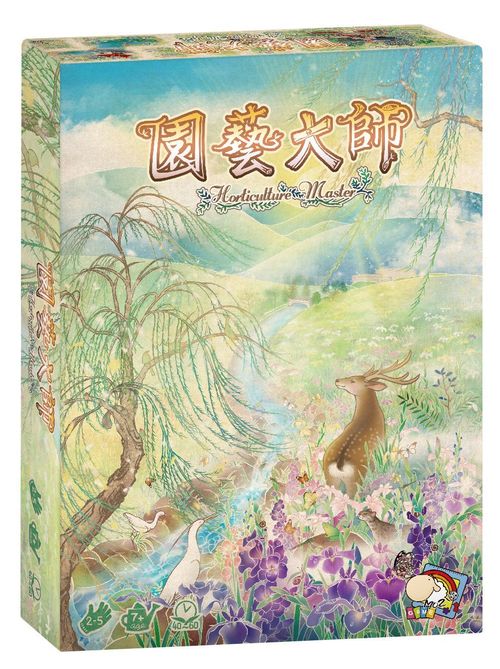
Horticulture Master
Horticulture Master Rulebook
Table of Contents
Table of Contents
Components
- Element Cards x 54
- Natural Element Cards: Sunshine, Earth, Water
- Life Element Cards: Bloom
- Reborn Element Cards: Frozen, Fire
- Magic Mushroom Cards
- Tool Cards x 8: Shears, Gloves, Shovel, Water Can
- Animal Markers x 7: Pangolin, Goose, Chicken, Leopard Cat, Owl, Wild Boar, Deer
- Horticulture Master Marker x 1
- Gardening Tiles x 44: Grass (with rabbits x4), Parterre, Fence, Pond, Pavillon (Gazebo), Chicken Coop, Cabin, Woodshed, Taichung Park, Taichung Station, The Luce Chapel, House of Leopard Cat, and a second Fence. The number of copies of each tile is shown on the tile.
- Element Board x 1: Source of Gardening Area, Prepared Area, Compost Area, Collector Area (spaces No. 1 to 9), and Instruction of Gardening Area.
- Player Garden Board & Gardening Costs Card x 5
Component note: the Gardening Costs card shows the planting cost of each tile shape and a summary of the effects of the tools as pictures. The printed rules below are the text the rulebook provides for these.
Preparation
A. Place the Element Board in the middle of the table.
B. Place Gardening Tiles according to the number of players on the respective areas of the Instruction of Gardening Area of the Element Board:
- Grass Tiles: 10 tiles (independent of the number of players).
- Cabin and Taichung Station Tiles:
- 2 and 3 Players: 2 tiles
- 4 Players: 3 tiles
- 5 Players: 4 tiles
- Other Gardening Tiles:
- 2 and 3 Players: 3 tiles
- 4 Players: 4 tiles
- 5 Players: 5 tiles
C. In turn, every player chooses an Animal Marker and places it on the top of Gardening Tiles. Each pile of tiles can only accommodate one single Animal Marker.
D. Each player takes 1 Magic Mushroom Card from the Element Cards.
E. Shuffle the remaining Element and Tool Cards and place the deck on the Source of Gardening Area.
F. Reveal 10 cards face up on the Collector Area (spaces No. 1 to 9) and Prepared Area.
G. Place the Horticulture Master Marker beside the Element Board.
H. Each player takes a Garden Board and a Gardening Costs Card in front of him.
I. The player who has recently visited a garden is the starting player.
Note 1 (from the setup diagram): Shuffle the Grass Tiles and keep the tile face up to form a pile. There are 4 Grass Tiles with rabbits, which are worth 1 point each at the end of the game.
Rules
The game is played clockwise.
Each player's turn has two phases:
- A. Work Phase
- B. Refill Elements Phase
A. Work Phase
Each player may choose one of the following actions:
- A-1. Collect Element or Tool Cards
- A-2. Plant and Transplant Gardening Tiles
Note 2: The Nature Element Card may be taken without costing. Bloom Card(s) must be taken by dumping a Sunshine Card.
Note 2 diagram: Adjacent (horizontal) and Adjacent (vertical) examples of identical Element Cards.
A-1. Collect Element or Tool Cards
To collect Element or Tool Cards, a player may choose one of the following actions on his turn.
Note: The hand maximum is 5. If a player has 5 cards in hand, he can't collect Nature Element Cards.
a. Collect Nature Element and Life Element Cards
Players may collect 1 or 2 identical and adjacent (horizontal or vertical) Element Cards.
To collect a Bloom Card, the player must dump 1 Sunshine Card to the Compost Area. A Sunshine Card may collect 1 or 2 adjacent Bloom Cards. A player can't play a Magic Mushroom Card as a Sunshine Card for collecting Blooms.
Take the Element Cards into hand. (Hand limit is 5.)
Note 3: Players may collect 1 or 2 identical and adjacent (horizontal or vertical) Element Cards.
b. Clean up Reborn Cards
Clean up Reborn Cards will block off refilling the elements.
Players may take 1 or 2 identical and adjacent (horizontal or vertical) Reborn Cards. After taking a Reborn Card, players shall place it beside the Restoration Area of the player's Garden Board. There is no limit for the Restoration Area.
3 identical Reborn Cards may be played as a wild element. However, it can't be played to borrow other players' tools.
Note 4: 3 identical Reborn Cards may be played as a wild element. After taking a Reborn Card, players shall place it beside the Restoration Area of the player's Garden Board. There is no limit for the Restoration Area.
c. Exchange Magic Mushroom Card
A Magic Mushroom Card can replace any Element Card for planting Gardening Tiles, developing and borrowing tools. However, it can't be used as "Sunshine" to collect "Bloom".
Players may dump 1 Element Card or 3 identical Reborn Cards to the Compost Area to collect a Magic Mushroom Card for it from the Collection Area. If there are 2 "Magic Mushroom" Cards, players may play 2 Element or 6 Reborn Cards to get them.
Players get 1 point for each Magic Mushroom Card in hand at the end of the game.
Note 5: The hand maximum is 5. If a player has 5 cards, he can't collect Nature Element Cards. But, he may dump a Sunshine Card to collect a Magic Mushroom Card from the Collection Area.
d. Developing Tool Cards
There are 4 different types of Tool Cards. When a player gets one of them, he places it beside the Tool Area of the player's Garden Board. Players may "cash" the benefits of a Tool Card on further turns. Tool Cards offer the following benefits:
- Shovel: Collect any 2 identical Element Cards diagonal to each other.
- Glove: Collect any 2 identical and adjacent Element Cards. If there is 1 more identical Element Card adjacent to the place of the first two cards, collect it.
- Shears: Collect any 2 identical Element Cards anywhere on the Collection Area.
- Water Can: Draw 1 card from the Source of Gardening Area. If it is a Natural or Life Element Card, keep it in hand. If it is a Magic Mushroom Card or a Tool Card, dump it to the Compost Area.
To get Tool Cards from the Collector Area, players must discard the corresponding Element Cards.
The tool limit is 1 for each player. If a player gets a new Tool Card, the old one should be taken out of the game. If a player owns a Gazebo, he may have one more Tool Card in his Tool Area.
The effects of Tool Cards may be added up:
- Shears and Gloves Cards: Collect 2 identical Element Cards anywhere. If there is 1 more identical Element Card adjacent to the place of the two first cards, then the player can collect it.
- Shovel and Glove Cards: Collect 2 identical Element Cards diagonal to each other. If there is 1 more identical Element Card adjacent to the place of the two first cards, then the player can collect it.
- Water Can Cards: May be executed before or after executing other Tool Cards.
Players do not need to discard their Tool Cards after executing them.
Players get 1 point for each Tool Card at the end of the game.
e. Remove Elements
Remove a row of cards of the Collector Area and refill with Element Cards (see the phase "Refill Elements" below).
Then, the player chooses one of the following actions:
- Collect 1 card from the Collector Area (follow the collection rules mentioned before), or
- Do this action and end the turn.
Note 6: Remove a row of cards of the Collection Area to the Compost Area and refill with Element Cards (see the phase "Refill Elements.")
A-2. Plant and Transplant Gardening Tiles
Players can only plant a Gardening Tile by discarding the Element Cards shown on the Instruction of Gardening Area. Place the Gardening Tile on the player's Garden Board and follow the rules below:
a. Plant the gardening tile
- The Gardening Tiles cannot be moved once placed on the player's board.
- The Gardening Tiles cannot go beyond the edge of the player's board.
- Players can rotate the Gardening Tiles on the player's board any way they wish. However, players cannot flip over the Gardening Tiles.
- Players may plant a couple of the same Gardening Tiles.
- Some Gardening Tiles with effects may be executed in the next turn after the player plants them. The effects of Gardening Tiles can be added up.
- If any Gardening Tile runs out, players can't plant it.
- Some Gardening Tiles can only be planted with the indicated tools. Players must own the indicated tools or borrow other players' tools by giving a Magic Mushroom Card to them.
- Note: players do not have to discard the tool after using or lending it.
- The player who is the first one to pick up a kind of Gardening Tile will get the Animal Marker on that pile of tiles and place it on his Gardening Tile. Players get 1 point for each Animal Marker at the end of the game.
Note 7: Players can only plant a Gardening Tile by discarding the Element Cards shown on the Instruction of Gardening Area. Place the Gardening Tile on the player's Garden Board. Players can rotate the Gardening Tiles on the player's board any way they wish. However, players cannot flip over the Gardening Tiles. The Gardening Tiles cannot be moved once placed on the player's board.
Note 8: Some Gardening Tiles can only be planted with the indicated tools. Players must own the indicated tools or borrow other players' tools by giving a Magic Mushroom Card to them.
b. Transplant the gardening tile
If a player needs more elements to plant Gardening Tiles, he can flip over any Gardening Tiles from his Garden Board and move it to the Warehouse Area to get the elements shown on it. Players must use these elements immediately for planting Gardening Tiles; they cannot use them in a later round.
- Players should not plant and transplant the same kind of Gardening Tile.
- Players should not transplant any Grass Tiles or Cabin / Taichung Station Tiles.
- When a player transplants a Gardening Tile with an effect, that effect is eliminated immediately.
For example: A player wants to build a Cabin by removing a Woodshed from his Garden Board, cards in hand and Reborn Element Cards from the Restoration Area. But the effect of the Woodshed is eliminated immediately because of being removed. As the result, he has to discard 3 rather than 2 Reborn Cards as an element to build the Cabin.
Note 9: Players can flip over any Gardening Tiles and move them to the Warehouse Area to get the elements shown on them. Players must use these elements immediately for planting Gardening Tiles.
B. Refill Elements
After a player collects Element Cards, the cards remaining in the Collector Area should first be shifted in the direction of the green arrow to fill the empty space below.
Then take cards from the Prepared Area to refill the empty spaces of the Collector Area (spaces No. 1 to 9), and reveal 1 card from the Source of Gardening Area to the Prepared Area. Keep refilling until there's no more empty space.
Snow cards in the Collector Area cannot be shifted in the direction of the green arrow to fill empty space. The space below the Snow cards will remain empty.
Note on terms: the rules call these reborn cards "Snow" cards; the component list prints the card as "Frozen".
If there is a Fire card in the Collector Area, it will fire any one card below (except a Fire card). In other words, dump the card below Fire to the Compost Area, then move Fire to fill the empty space below. If Fire is on the lowest level in the Collector Area, it will stay there until it is taken.
If the deck of the Source of Gardening is exhausted, players shuffle the cards dumped to the Compost Area to form a new deck.
Note 10: After a player collects Element Cards, the cards remaining in the Collector Area should first be shifted in the direction of the green arrow to fill the empty space below.
Note 11: Snow cards in the Collection Area cannot be shifted in the direction of the green arrow to fill in empty space. The space below the Snow cards will remain empty.
Note 12: If there is a Fire card in the Collector Area, it will fire any one card below (except a Fire card) before refilling the empty spaces.
Game End
When a player or players fulfill one of the following conditions, it will be the last round. Then the game ends.
- Any 3 kinds of Gardening Tiles are exhausted.
- A player's garden board is full. That player gets the Horticulture Master Marker.
Scoring
Players score their green finger points for:
- Horticulture Master Marker: 3 points
- Gardening Tiles: see tiles
- Removed Gardening Tiles: 1 point per tile
- Animal Markers: 1 point per marker
- Tool Cards: 1 point per card
- Magic Mushroom Cards: 1 point per card
The player who has the most points is the winner. In case of a tie, the player whose Garden Board has the fewest empty spaces is the winner. If there's still a tie, the player who has the most Element Cards wins the game.
The player who has the most points (cards, tiles, and green finger points) is the Horticulture Master.
Editorial note: the printed "Gardening tiles: see tiles" does not state a per-tile value in the text; the per-tile green-finger values are shown as icons on the tiles themselves and were not legible enough in the source to transcribe, so they are not reproduced here. The printed line "winsthe game" is read as "wins the game".
Editorial note: the source's A-1 heading is repeated in Chinese beneath the English heading on page 4; the duplicate Chinese line is omitted.