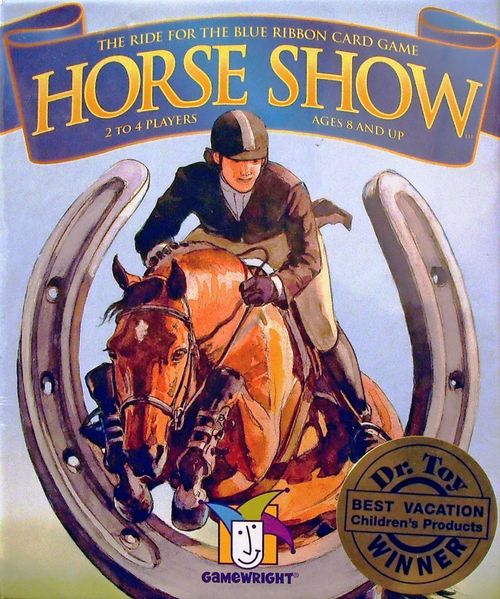
Horse Show
Horse Show Rulebook
Table of Contents
Table of Contents
Contents
Horse Show contains:
- 32 unique horse cards
- 12 assist cards
- 15 blue ribbon event cards
The first time you play, look over the three kinds of cards in the deck.
Horse Cards
- Point value for each event: "H6" means you earn 6 points in a hunter event.
- Black dot: this is the horse's main event.
- Tie-breaker score.
- Type of event.
Blue Ribbon Event Cards
- Type of event.
- Favor and penalty points.
- Extra points: add them to your point value for the event.
Assist Cards
- Extra points: add them to your point value for the event.
- Type of event.
Object
The player who wins the most blue ribbon event cards wins the game.
Set-up
Players select a dealer. The dealer separates the blue ribbon event cards from the rest of the deck, shuffles them, and places them face down in a pile in the center of the table.
The dealer takes the remaining cards — the horse and assist cards — shuffles them, and deals them face down, equally to each player. These cards will be your stable for the entire game. Depending on the number of players, there may be extra cards. Set these cards aside, out of play.
Game Play
There are four horse shows in each game. In each horse show, there are three different events.
Beginning with the dealer, take turns being the home club and hosting a horse show. The home club player lays out the blue ribbon event cards and announces the events. In some cases, he can earn additional points with a home club advantage or select the event in a dealer's choice.
- In a two player game, each player hosts two shows as the home club.
- In a three player game, each player hosts one show as the home club. In the fourth show, each of the three players also hosts one of the three events.
- In a four player game, each player hosts one show as the home club.
To begin each horse show, pick five cards from your stable to play in the next three events. Keep these cards in your hand and put the remaining cards from your stable face down, out of play until the next horse show. Of the five cards you pick, at least three must be horse cards, since you must play one horse in each event. The other two cards may be horse or assist cards.
When you've played all three events in the first horse show, take the remaining cards from your hand and return them to your stable. Now select five more cards from your stable to enter in the next three events. You may pick some of the same cards from the first horse show or different ones. The player to the left of the dealer becomes the new home club player. Play continues until four horse shows have been completed.
Beginning the Game
Playing an Event
To begin, the home club player takes the top three cards from the event pile and places them face down in a row in the center of the table. He turns over the first blue ribbon event card and announces the event. The card indicates whether it will be a jumper, hunter, dressage, or equitation event.
From the five cards in your hand, select one horse card to enter in the event and, if you like, one or more assist cards.
Here are some factors to consider in deciding which horse and assist cards to play:
-
Most blue ribbon event cards favor some horses and penalize others, so choose your horse card accordingly. If you're the home club player and the blue ribbon event card is a dealer's choice, you get to decide which event to play.
-
You may play any horse card you like. If you can, choose a horse whose main event is in the same category as the blue ribbon event card. If you can't, look at the point values on your other horse cards and choose one that has a high value in the event you're playing.
For example, if you're playing a dressage event, you might want to enter Star. Dressage is her main event and she's worth 5 points in that category. If you don't have a dressage horse, a horse like Chocolate Chip may be a good choice. She's worth 3 points in a dressage event, even though her main event is jumper.
- If you have an assist card in the same category as the blue ribbon event card, you may play it to earn extra points. The assist card must match the event, but it can be played with any horse card, regardless of the horse's main event.
For example, if you have a dressage assist card, play it with Chocolate Chip (whose main event is jumper) to earn even more points in a dressage event.
On the count of three, enter the event by placing your horse and assist cards face up on the table in front of you.
Note: In all our rules, we use either "he" or "she" to include everyone!
Scoring an Event
Tally the points from your horse and assist cards, then add or subtract applicable favor or penalty points from the blue ribbon event card. No matter which horse card you enter, use the point value that matches the event (if you're playing a jumper event, use the point value from the yellow box on your horse card). The player with the most points wins the event.
Breaking a Tie
If there's a tie between two or more players, use the tie-breaker score on your horse card to determine the winner of the event. (Don't count the points on the assist cards.) The player with the highest TB wins the event.
In a tie, Stranger would win the event because her TB score is higher than Summer Wind's.
The winner of the event takes the blue ribbon event card and places it on the table in front of him, with the winning horse and assist cards tucked underneath. Other players return the horse and assist cards played in that event to their stables (do not return them to the cards in your hand).
Continuing Play
For the second and third events of the show, pick horse and assist cards from your hand and compete as before. Remember, you may not use the cards in your stable until the next horse show. The first horse show ends when all three blue ribbon event cards have been played. The game continues until four horse shows have been played.
Ending the Game
The player with the most blue ribbon event cards wins.
If two or more players have the same number of blue ribbon event cards, the dealer reshuffles the cards and hosts one last event for those players whose score is tied. The player who wins that event wins the game.
Rider's Caution!
In a four player game, if you win several events in the first shows you may run out of horse cards (since you don't return winning horse cards to your stable). Without horse cards, you can't enter events, so you must sit out until the end of the game.
Glossary
Dressage. The horse and rider are judged on the exact execution of reasonably simple movements, like walking, trotting, and cantering on a flat course. The ultimate goal is harmony and understanding between horse and rider.
Equitation. The rider is judged on his riding ability and technique – how he holds his hands, positions his heels, sits in the saddle, and controls his horse.
Favor or Penalty Points. Most blue ribbon event cards favor some horses and penalize others. In horse shows, there are always some horses that are expected to do better in certain events or under certain conditions (just as when they're the home club in Horse Show).
Hunter. The horse is judged on how the jumps are executed. There should be a smooth action, arch of the back, with a snap of the front legs, legs not dangling, and clearing 3 to 3 1/2-foot jumps.
Home Club. The barn or association who sponsors the horse show is the home club. In our game, the player who lays out and announces the events is the home club player. In some events, the home club player has an advantage.
Jumper. Horses are judged on whether they clear the jump, regardless of their style in jumping. The jumps are high and the goal is to jump clean, with no faults, no knockdowns, or refusals.
Stable. A stable is your collection of horse and assist cards.