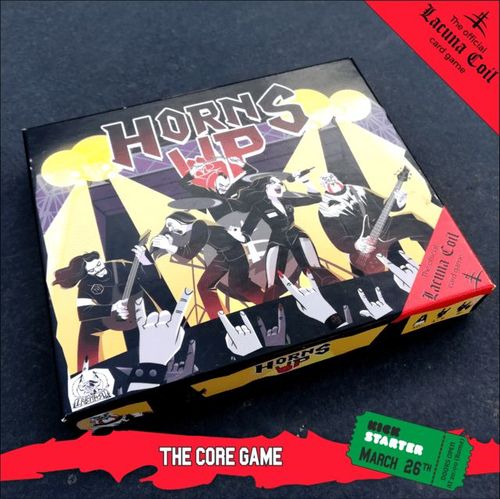
Horns Up!
Horns Up! Rulebook
Table of Contents
Table of Contents
Content
- 9 pawns
- 27 "Ballad" tokens
- 9 Legend cards
- 9 Entrance cards
- 1 VIP Pass
- 12 Stage cards
- 137 cards divided in:
- 46 Ticket cards
- 82 Path cards
- 9 Wall cards
Match Preparation
To begin a Horns Up game, shuffle the Entrance cards and the VIP Pass card. Distribute the cards, one at a time, to each Rocker. The Rocker who receives the VIP Pass card will start the game, then the turns proceed clockwise. Place the Entrance cards as shown in the picture. Each Entrance card must be eight positions away from the Stage. Shuffle the Stage deck and place it on the stage. Now shuffle the Audience deck made by the Path, Wall and Ticket cards. Taking turns, each Rocker draws four cards from the Audience deck, and chooses from which Entrance card they'd like to start, placing their Pawn on it.
The Turn
At every turn, each Rocker must draw a card, play two actions and move their Pawn. To play an action, each Rocker can either use one of the cards from their deck or discard a Ballad Token. It's not possible to play or discard any cards or move one's Pawn once the turn goes to the next Rocker. There is no limit to the number of cards each Rocker can keep in their hand.
Ballad Tokens: if a Rocker collects one or more Ballad Tokens, their priority from that moment will be to discard each token at the cost of one action. If at the start of the next turn, the Rocker still has Ballad Tokens, they can draw a card but must continue to discard Tokens at the cost of one action. The penalty is cumulative, but each Rocker can hold no more than three Tokens at once and cannot be targeted by cards that add to the level of Tokens if they have reached the maximum quantity and are actively discarding them.
Skip next turn: the Rocker will not play the next turn and will not draw a card.
Victory
To win, a Rocker must be the first to place a Path card in front of the stage, with the crowd facing the stage. If there is one (or more) Wall cards in front of the Stage, a Rocker may play a Crowd Surfing card to bypass the Wall and land directly on stage, winning the game.
Audience Cards
Ticket Cards
Ticket cards have immediate effect: once used, they should be put in the discarded pile. Playing a Ticket card always counts as an action. The symbols on each card are explained in the legend below:
- Draw one card
- Discard one card
- Remove a card from the game
- Gain one action
- Collect a Ballad Token
- Bypass a wall card
- Draw one stage card
- Target one Rocker
- Target all the Rockers
- Discard one ticket card
- Skip next turn
- Push another Rocker one position further
- "Or" (the player must choose between the symbols on the left or the right)
The cards are laid out with a type-of-card symbol, a name, a motto and the effects.
The cards with special effects are:
Pushed Away: this card allows the player to push one Rocker and the card they are standing on one step away, horizontally or vertically. It has a chain effect: if there are other Rockers in that same direction, they will also be pushed. If a Rocker ends up on an Entrance card, their card will be discarded. Whereas, if a Rocker is crushed on the border of the Stage, their Path card will not be discarded, but the Rocker will skip the next turn.
Crowd Surfing: this card allows a Rocker to pass over a Wall card in a straight line.
The Rocker playing this card must land on a Path card: if there isn't one available, they must play a Path card. To play Crowd Surfing, the first Path card must have the crowd open towards the Wall card; the position of the crowd doesn't matter on the arrival card. If there are two or more Wall cards close together in a row, with Crowd Surfing one can surf over them as long as the path is in a straight line. If playing a Path card is not possible because it would need to be positioned behind the Stage line, then the Crowd Surfing card cannot be played. If a Rocker can't play a Path card because it would have to be placed on the stage, they can play a Crowd Surfing card and win the game. Playing a Path card to land after a Crowd Surfing card is counted as an action.
Wall Cards
Wall cards are permanent: they block passage for Rockers and can be played anytime during the concert as long as they are placed next to a Path card or another Wall card. It's not possible to play other cards on a Wall card. To bypass Wall cards, Rockers must move around them, discard them if allowed, or play a Crowd Surfing card. There are three types of Wall cards:
- Troublemakers: can be removed if someone discards a Ticket card.
- Headbangers: can be removed if someone discards a Path card or a Ticket card.
- Mosh Pit: can be removed if the Encore card is placed on the Stage.
Path Cards
Path cards allow each Rocker's Pawn to advance through the crowd. In order to step from one card to another, the cards must be adjacent, and there must be an open path from the first to the second. Moving one's Pawn through an open path is a free action and it can be repeated several times during one's turn. The picture below shows an example of three paths. Position the cards horizontally, one after the other, to allow each Rocker's Pawn to progress towards the Stage. At the end of each Rocker's action, all the Path cards that don't have a Pawn on them must be flipped. After each Rocker's passage, the audience regroups. If another Rocker wants to take the same way, they have to play another Path card. Playing a Path card counts as an action. A Path card can be played over another Path card to change the direction of the Pawn's movement. This action can be played on one's own, to bypass a Wall card, or it can be played against another Rocker to send them in the wrong direction. The crowd image on the cards can be facing forward or backwards - it doesn't matter - but the card must be played horizontally. Multiple Rockers are allowed on the same Path card, and during one's turn, a Rocker can move to any Path card close to them that is already occupied by another Rocker, and this doesn't count as an action. You can play Path cards outside the border of the concert, but you can't play cards behind the stage line (behind the barriers).
Path Routes
- The Rocker may immediately reach point 1 or point 2.
- They can't reach point 3 because there is no connection between the paths.
- The card marked 4 is upside down: to walk on it, the Rocker must play a new Path card on its top.
Stage Cards
This card is drawn and can be changed when a Rocker plays a Horns Up card. The cards with special effects are:
Stage Cards special effects
- Fire Explosion: all Path cards must be rotated by 180°.
- Encore: all Mosh Pit cards played are discarded.
- Scream for me: all Rockers exchange cards by passing their own hand anti-clockwise to the next Rocker.
- Wall of Death: all the Path and Wall cards already in the concert area are affected. The effects of this card are divided into two phases. The first is the division phase, and the second is the approach phase.
- The division phase: this phase starts immediately. All the cards on the right side from the central line move one position to the right, the cards on the left move one position to the left. The movement is horizontal. The cards in the central column can move either left or right (the Rocker playing the Wall of Death card decides). Pawns follow the movement of the card on which they're placed. If a card reaches an Entrance card, it is discarded and the Rocker's Pawn is placed on the Entrance card. The game continues normally.
- The closing phase: when a Rocker plays a new Horns Up card, the closing phase begins. All the cards involved move one position toward the central column. The Rockers closer to the central column are crushed and skip the next turn. If some cards overlap in the central column, the Path card wins over Wall cards, which will be discarded. If the overlapping involves cards of the same type, the Rocker playing the Wall of Death card decides which ones to discard.
Entrance Cards
Entrance cards are the starting point of the game. They can never be discarded or moved. From this card, a Rocker's Pawn can move in any direction. If a Pawn falls upon an Entrance card by means of a Path card or Wall card overlapping, such card will be discarded, but the Pawn will be placed on the remaining Entrance card.