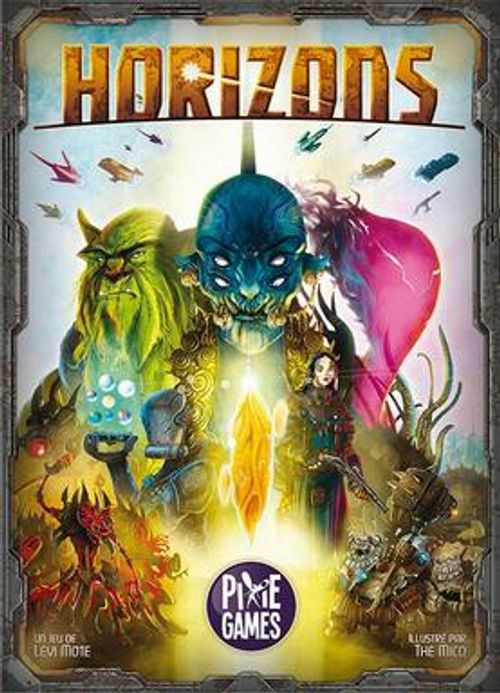
Horizons
Horizons Rulebook
Table of Contents
Table of Contents
How to Win
The player with the most victory points wins the game.
Players score points by gaining Knowledge, exploring new Worlds, completing Missions, and placing Structures to gain control of each System. See the scoring side of your Player Aid cards for more information.
Components
- 1 Box and Insert
- 5 Player Boards
- 30 Double-sided World Tiles
- 30 Habitat Markers (1 of each for every player)
- 5 Star Tiles
- 1 Cloth Bag
- 5 Exploration League Ally Cards
- 25 Double-sided Alien Ally Cards
- 5 Player Aid Cards
- 30 Mission Cards
- 40 Metal Tokens
- 40 Energy Tokens
- 40 Knowledge Tokens
- 25 Metal Collector Tokens (5 per player)
- 25 Energy Collector Tokens (5 per player)
- 25 Colony Tokens (5 per each player color)
Game Setup
- Each player takes a player board, a set of color-matched Structures (Colonies and Collectors), 6 Adaptation Indicator Markers, a Starting Ally card, a Player Aid card, a Knowledge token, 2 Energy tokens, and 2 Metal tokens.
- Place the remaining Knowledge, Energy, and Metal tokens in easy reach of all players.
- Shuffle the Mission cards, deal two to each player, and place the remaining cards face-down in a pile.
- Sort the Alien Ally cards into 5 stacks, one for each Action type symbol in the lower left corner, then shuffle each of the 5 stacks.
- Place a number of Star tiles equal to the number of players into the middle of the play area.
- Place the World tiles in the bag. Randomly choose who will go first and give them the bag.
- The First Player draws a random World tile from the bag and places it (either side up) next to any Star tile.
- The First Player then takes the Habitat marker that matches the World tile they just placed and attaches it to their player board.
- The bag is passed to the left and that player draws a random World tile from the bag and places it (either side up) next to any Star tile without a World. That player may then attach a Habitat marker to their player board matching any World tile in play. This becomes that player's first Activated World type (see Adapt Action).
- Repeat Step 9 until all players have placed a World tile and attached a Habitat marker. You are now ready for the first turn, starting with the First Player and proceeding to the left.
Iconography
- Either Resource
- Either Collector
- Energy Resource
- Energy Collector
- Metal Resource
- Metal Collector
- Knowledge
- Colony
- World
- System
- Opponent
- Habitat
- Ally
- Mission
- Adapt
- Harvest
- Build
- Explore
- Conspire
- Flip
- Discard
- Destroy
On Your Turn
Take 2 Actions: you may take any 2 of the Actions listed below. You may take the same Action twice.
Explore: Draw and play a World tile from the bag. Take 1 Knowledge.
Adapt: Activate a Habitat. Take the top Alien Ally from any stack.
Build: Build a Structure (Colony or Collector).
Harvest: Gain 1 Resource per Collector you have built.
Conspire: Draw 2 Mission cards -OR- 1 Ally and 1 Mission card.
Alien Allies and Actions: Actions may also trigger Alien Ally cards in your tableau. See "Alien Actions" for more information.
Discard Extra Cards: At the end of your turn, you may not have more than 5 Ally cards and 5 Mission cards. Discard Allies and Missions in excess of this limit. Allies discard to the bottom of their stacks, Missions into a discard pile next to their draw pile.
Explore
To Explore, draw a World tile from the bag and place it (either side up) adjacent to a Star tile of your choosing. You gain one Knowledge after placing the World tile. Note: There may never be more than 6 Worlds attached to a Star tile.
If all of the Star tiles are surrounded by 6 Worlds each, this Action may still be taken to gain a Knowledge token or trigger Ally effects, but no tile is placed.
World tiles may only be placed adjacent to a Star tile. Placing a tile next to other planets and not adjacent to a Star tile is not a valid move.
Adapt
When you Adapt you may activate a Habitat and/or take an Ally card.
To activate a Habitat, place a Habitat marker that is not already attached to your player board onto your player board. There are 6 different Habitat markers. When you attach the Habitat marker, it should match the color on your player board to complete the illustration of the World type. Once you have Adapted to a new World type, you may build Structures on that planet type in a future turn or Action.
You may still take this Action if all your Habitat markers are already attached to your player board.
To take an Ally card, take the top Ally card from any stack and place it in your tableau (on the table in front of you) with the "Use Then Flip" side facing up. If you do not wish to take any of the available Ally cards, then you may discard the top card of a stack, but then you must take the revealed card into your tableau.
Build
You may spend resources to Build a single Structure (Colony, Energy Collector, or Metal Collector) and then place it on an open and valid position on a World in any System.
You may only build on Worlds matching your active Habitats.
The build costs vary based on World type; these are listed on the player boards.
There is a maximum of 3 Structures per World, and most Worlds only allow one type of collector to be built (Colonies may be built on any World type).
Example: Laura wishes to build a Metal Collector. Since Oceanic Worlds do not allow the building of this Collector type, Laura must Explore a new World to create an open and valid position for her Collector - or - use an Ally power to displace an existing Collector - or - build a different Structure on the Oceanic World.
World Sharing: If you build a Structure on a World with another player's Structure on it, all players on that world (including you) gain 1 Resource of their choice.
Structure Rewards: Each Colony is worth 2 Control Points during the endgame when scoring for System Control. Each Energy and Metal collector provides 1 Resource of its type when you take the Harvest Action, and is worth 1 Control Point during the endgame when scoring for System Control.
Harvest
Use the Harvest Action to collect Metal and Energy Resources for each of the corresponding Collectors you have built on all Worlds.
Example: Kira has 3 Energy Collectors and 2 Metal Collectors in play. She takes the Harvest Action and takes 3 Energy Tokens and 2 Metal Tokens from the supply and adds them to her resources.
You are not required to take all of your available resources when harvesting.
Conspire
To Conspire, Draw 2 Mission cards -or- 1 Ally card and 1 Mission card. Each Mission card shows a game state and a number of Victory Points earned if that state is true at the end of the game.
When you take an Alien Ally card, place it in your tableau (on the table in front of you) with the "Use Then Flip" side facing up. Remember that at the end of your turn, you may not have more than 5 Alien Ally cards and 5 Mission cards. Discard Alien Allies and Missions in excess of this limit.
Example: As his second Action for the turn, Sebastian takes the Conspire Action and elects to draw 1 Ally card and 1 Mission card. Sebastian already has 5 Ally cards in his tableau; this new Ally card makes 6 total. He also already has 5 Mission cards in his hand; this new Mission card makes 6 total. With his second Action complete, his turn is ending and he must discard 1 Ally and 1 Mission to satisfy the 5 card limit on each of these. He chooses to discard a flipped Ally and a Mission he does not think he will be able to accomplish.
Alien Allies
Allies improve your Actions.
When you take an Action that matches the symbol shown on the Alien Ally card in the bottom left corner, you may trigger one Alien Ally card effect in addition to the Action selected. You may take your chosen Action or trigger your Alien Ally in either order. Then, either flip or discard the Alien Ally card based on the symbol shown in the lower right corner.
You may only trigger one Alien Ally card per Action.
Example: Chunaan has elected to take the Build Action. He has been gearing up for the Build Action in previous turns by acquiring Feshar Allies, which can be exploited to improve the Build Action. He must now choose only one of the Feshar Allies from his tableau to exploit.
If you do not wish to take any of the available Ally cards, then you may discard the top card of a stack, but then you must take the revealed card into your tableau.
Mission Cards
Mission cards should be kept secret from other players until the end of the game when they are revealed and scored. To score a Mission card, its text must be true at the end of the game.
If you ever need to draw Mission cards and the deck is empty, shuffle the discarded Mission cards to make a new deck.
Each Mission card is explained in detail in the Mission Appendix.
End Game
The game ends immediately when a player builds their last available Colony, even if this is the first Action of their turn.
Final Scoring
Mission Cards: All completed Mission cards are revealed and scored. Mission cards that were not completed do not count against you in any way.
Knowledge Tokens: Score 1 VP per Knowledge token.
System Control: Determine the player with the most control over each System.
Colonies are worth 2 Control Points each. Collectors are worth 1 Control Point each.
The player with the most Control Points in a given System scores 6 VP. The player with the second most Control Points in a given System scores 3 VP.
If two or more players are tied for the most Control Points over a System, each tied player scores 3 VP and the player or players with the second most score 0 VP.
If there is a single player with the most Control Points over a given System and two or more players are tied for second most Control Points in the given System, they each score 1 VP.
System Control Scoring table:
| Majority Control | Tied Majority* | Minority | Tied Minority | |
|---|---|---|---|---|
| Victory Points | 6 | 3 Each | 3 | 1 Each |
*No points scored for players in Minority Control when two players tie for Majority Control.
System Control Scoring Examples
System A: Alex (orange) has 2 Colonies and 2 Collectors earning him 6 Control points. Bahula (purple) has 2 Colonies earning her 4 Control points. Carlee (blue) has 1 Colony and 3 Collectors earning her 5 Control points. Alex earns 6 VP for Majority Control and Carlee earns 3 VP for Minority Control. Bahula has neither the most or second most Control in the System and earns 0 VP.
System B: Alex (orange) has 1 Collector, earning him 1 Control Point. Bahula (purple) has 4 Collectors earning her 4 Control points. Carlee (blue) has 2 Colonies, earning her 4 Control points. Since Bahula and Carlee tied for Majority Control, they each earn 3 VP. Because there was a tie for Majority, Alex earns 0 VP for having the second most.
System C: Alex (orange) has 3 Colonies and 1 Collector, earning him 7 Control Points. Bahula (purple) has 2 Colonies and 2 Collectors earning her 6 Control points. Carlee (blue) has 1 Colony and 4 Collectors, earning her 6 Control points. Alex earns 6 VP for Majority control. Since Bahula and Carlee tied for Minority Control, they each earn 1 VP.
Winning the Game
The player with the most VP wins the game. Ties are broken by the player with the most total Resources remaining. If there is still a tie, the player with the most VP derived from Mission cards is the winner. If there is still a tie, then all tied players share the victory.
FAQ and Clarifications
2 Player Scoring: In a 2 player game, award 6 VP to the player with the most Control Points over each System. No points are scored for the other player or in the case of a tie for Control Points. Also remove the 'Power's Shadow' Mission card from the game.
Term Clarifications — Build X: The term "Build" is used on some of the Alien Ally cards. In order to add a Structure to a World, it must be a legal placement. You must have activated the Habitat marker for the world you are building on and there must be space available.
Habitats: The term "Habitat" refers to the 6 worlds pictured at the top of your player board. Active Habitats are those with a Habitat marker connected to them.
Open Information: A player's Colonies, Collectors, and Resources are always public knowledge. Mission cards are intentionally hidden information until the end of the game.
Resources: The only 2 Resources in the game are Energy and Metal. Knowledge tokens are not Resources.
Structures: Colonies, Energy Collectors, and Metal Collectors are collectively called Structures.
Systems: Each Star tile and its attached World tiles form a System. Systems never connect to one another.
Token Limits: Resources and Knowledge tokens are intended to be finite.
Mission Appendix
Adaptable: I have adapted to build on all World types.
Ambassador: I have 3 or more unused ("use then flip" side) Allies in my tableau.
Arboreal: I have a Colony or a Collector (of either type) on 5 or more Arboreal Worlds.
Arboreal System: There are 3 or more Arboreal Worlds in a single System.
Coexistence: I share 5 or more Worlds. (To share a world, build a Structure on a World with another player's structure tokens on it.)
Contractor: I have all of my Colonies and Collectors (of both types) in play.
Desert: I have a Colony or a Collector (of either type) on 5 or more Desert Worlds.
Desert System: There are 3 or more Desert Worlds in a single system.
Ecology: I have 1 or more Energy Collectors in every system.
Efficiency: I have no Resources (Metal or Energy) remaining.
Environmentalism: I have no more than 2 Metal Collectors in play.
Expansionism: I have a Colony or a Collector (of either type) on 6 or more Worlds.
Extractor: I have 10 or more Resources (Metal or Energy).
Frozen: I have a Colony or a Collector (of either type) on 5 or more Frozen Worlds.
Frozen System: There are 3 or more Frozen Worlds in a single system.
Galactic Citizen: I have 5 Allies.
Gaseous: I have a Colony or a Collector (of either type) on 5 or more Gaseous Worlds.
Gaseous System: There are 3 or more Gaseous Worlds in a single system.
Industrialism: I have 1 or more Metal Collector in every System.
Intrepid: I have a Colony or a Collector (of either type) on 4 or more types of Worlds.
Isolationist: I have colonies in only one system.
Manifest Destiny: I have 1 or more Colony in every system.
Oceanic: I have a Colony or a Collector (of either type) on 5 or more Oceanic Worlds.
Oceanic System: There are 3 or more Oceanic Worlds in a single system.
Perfect Balance: I have a Colony, a Metal collector, and an Energy Collector all built on a single World. Note: Only Arboreal or Volcanic Worlds can hold all 3 structure types.
Power's Shadow: I have Minority Control or Tied Minority Control in all systems. Note: Having majority control of a system disqualifies you from completing this Mission.
Stellar Cartography: Two or more Systems have a full 6 Worlds.
Volcanic: I have a Colony or a Collector (of either type) on 5 or more Volcanic Worlds.
Volcanic System: There are 3 or more Volcanic Worlds in a single system.
Quick Play Guide
How to Win: Have the most victory points by the end of the game through System Control, Knowledge tokens, and completed Missions.
Turn Flow: Each player performs up to 2 Actions on their turn. You may take the same Action twice - or - 2 different Actions.
- Explore: draw & place a World tile. Gain 1 Knowledge.
- Adapt: Activate a Habitat and/or draw an Ally.
- Build: Construct 1 Colony or Collector.
- Harvest: gain 1 resource for each Collector you have built.
- Conspire: draw 2 Missions or 1 Mission and 1 Ally.
1 Ally card may be used with each Action to improve it.
Game End: The game ends immediately when any player builds their last Colony.
Scoring:
- 1 VP per Knowledge token
- Listed VPs for all completed Missions
- 6 VP for most System Control
- 3 VP for second most System Control
- 3 VP each if tied for most System Control
- 1 VP each if tied for second most System Control
Ties are broken by number of Resources. Persistent ties are broken by number of Missions completed.
© Daily Magic Games 2017, all rights reserved.