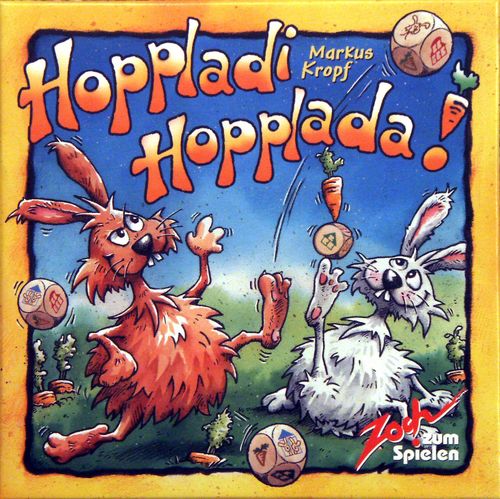
Hoppladi Hopplada!
Hoppladi Hopplada! Rulebook
Table of Contents
Table of Contents
Game Materials
7 dice showing the following symbols: hare, double hutch/double hare, triple hutch, 4-hutch, 5-hutch, carrot.
Keep these items handy: 1 memory aid, 2 marking tokens, 1 score pad.
Object of the Game
On each roll of the dice, players try to put up as many hares as possible in hutches. The first one to reach 333 or more points rings in the final phase of the game (see "End of the Game"). After that, the player who has earned the most points wins.
Whoever has the most points in the end wins!
Set-Up
The player with the longest ears is the starting player; he writes his name on the top left of the score pad. Next to his name, you write the names of the other players in seating order. The starting player grabs the 7 dice.
How the Game Plays
In the following introductory example, you can see how a game round plays. You find the general game rules in the boxes at the page margins.
Introductory Example
Rolling the 7 dice, Anne gets the following result:
Anne's first roll: Anne puts aside 4 dice: she piles up 2 single hares, one on top of the other. These two piled-up single hares score 10 points. She doubles her points with the double hutch (10 x 2 = 20 points). She may put aside only 1 hutch per roll (starting with the double hutch). She re-rolls the remaining 3 dice.
General rule: Roll all 7 dice. After each roll, you must put aside at least one hare. If you don't throw any hares, your turn ends immediately, and all points collected in this turn go to waste.
You may roll the dice again that you have not put aside.
Each single hare that has been put aside scores 1 point.
You pile up 2 single hares that you have thrown in one roll. They score 10 points. Double hares cannot be piled up.
The carrots are worthless.
The double hutch/double hare symbol can be put aside either as a hutch or as a double hare.
Anne's second roll with the remaining dice: At her second roll, the double hutch comes at just the right time for Anne because it also has another function – it can be used alternatively as a double hare (score: 2 points). Anne adds the two hares to her hares from the first round.
The single hare gives her 1 point, the double hare 2 points. She may not pile the single hare on top of the single hare from her first throw (in order to score 10 points for these hares) since she threw the two hares in different rolls.
Finally, Anne puts the triple hutch on top of the double hutch. This triples Anne's hare points: 14 hares x triple hutch = 42 points.
Since Anne could use all dice after this roll, she may now throw all put-aside hares again. She marks the hares collected so far (14) on the memory aid: 10 + 2 + 2 = 14 P.
General rule: If, after a dice roll, you have put aside all dice as hares or as hutches, you may throw all hares again. You mark the number of the hares you have thrown so far on the memory aid.
Anne rolls the dice again – with the following result:
Anne's third roll: Anne's third roll contains only one single hare that she has to put aside. She is so lucky to have also thrown the matching hutch. She puts aside the hare for another point and piles up the 4-hutch on top of the triple hutch.
Now she doesn't want to take another risk, notes down her 60 points (14 + 1 hares x 4) on the score pad and, in doing so, ends her turn.
General rule: Hutches are piled up one on top of another. After every dice roll, only one hutch may be put aside. The hutches may be piled up only in the order, from bottom to top: double hutch, triple hutch, 4-hutch, 5-hutch.
Next it's Steven's turn. He may either roll all 7 dice anew or continue playing with the remaining dice of the previous player. He decides to do the latter and throws the following result:
Steven's continued roll: Steven scores another double hare and also can pile up the 5-hutch on top of the 4-hutch. He doesn't risk another roll and notes down his 85 points (17 x 5) on the score pad.
General rule: You can end your turn after each roll if in this roll you have thrown at least 1 hare or only carrots. As a result, you score the points for the hares you have thrown multiplied by the top hutch of your pile.
You may take over the dice roll result of the previous player. To do so, you roll only the dice the previous player has not put aside. If you don't want to take over the previous player's result, you roll all 7 dice anew.
If your roll contains only exactly 1 double-hutch/double hare (that means no additional hare), you have to put it aside as a double hare (not as a double hutch).
Max is the next player. He would only be allowed to roll one dice. That seems too risky to him; so he decides to throw all 7 dice again:
Max's first roll: Max must put aside the double-hare he has thrown as a hare (2 points); he may not use it as a hutch. Max goes on rolling the remaining dice:
General rule: Each double hare that has been put aside scores 2 points.
Max's second roll: Bad luck! Max can't do anything with the hutches and the carrots. He would have had to put aside at least 1 hare. The 2 points he has collected so far go to waste, and the dice go to the next player.
General rule: After an unsuccessful throw, the next player rolls all 7 dice anew.
At the end of a player's turn, the points that player earned are added on the score pad to the points he has reached so far.
Any Carrots?
In general, the game carrots are worthless. However, it may occur that you have already put aside hares (and hutches) and now, on another roll, throw only carrots.
General rule: After throwing only carrots, put all carrot dice aside. You may continue your turn with the hare dice available. The carrot dice, however, are taboo until a player starts anew with all 7 dice.
Although there is no hare showing, in this exception your points don't go to waste and you may continue your turn – however, without the carrot dice! (So, in the example above, the player could again roll the two hare dice that he had already put aside.)
If the next player takes over your result, the carrot dice are taboo for him too. If you throw only carrots on a dice roll and only hutches have been laid out, you note down your result and your turn ends. The next player may not take over your result; he must roll all 7 dice anew.
General rule: If, after throwing only carrots, there are only hutches left, your turn ends. Note down your points. The next player starts anew with all 7 dice.
End of the Game
As soon as a player has reached 333 (or more) points, only those players who are sitting before the starting player in clockwise order still have a turn. The player who then has the most points wins.
General rule: When one player has reached at least 333 points, you still complete the current round.
Keep enough distance between put-aside hares and put-aside hutches!
Hare Points Scoring Chart
Multiply the number of hares thrown by the multiplier of the top hutch in your pile (x2 for double hutch, x3 for triple hutch, x4 for 4-hutch, x5 for 5-hutch):
| Hares | x2 | x3 | x4 | x5 |
|---|---|---|---|---|
| 2 | 4 | 6 | 8 | 10 |
| 3 | 6 | 9 | 12 | 15 |
| 4 | 8 | 12 | 16 | 20 |
| 5 | 10 | 15 | 20 | 25 |
| 6 | 12 | 18 | 24 | 30 |
| 7 |