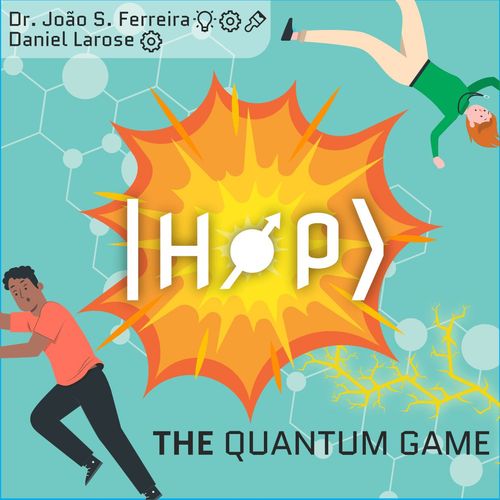
|Hop> Quantum Game
|Hop> Quantum Game Rulebook
Table of Contents
Table of Contents
Game elements
- 3 boards (front-back)
- 28 electron cubes (7 per color)
- 15 effects tokens (3 per type)
- 8 energy tokens
- 4 electrode cards (1 per color)
- 2 Hamiltonian cards (front-back)
- 7 effects cards (front-back)
- 36 site cards
The rulebook notes an online and video version of the rules is available by QR code.
Game goal
Players take turns moving their electrons through the site cards that make up the board, in an attempt to reach another electrode card. At each turn, players have 2 movements to choose from the movement board. To end the game, it's enough to place one electron in an opponent's electrode.
The player whose electrode is reached gets short-circuited and loses. The others are safe... for this round!
Game setup
Create a board by laying out the site cards in a square grid as below. With four players, you play individually but work together in teams of two to reach any electrode of the opposing team.
The setup diagrams show the site layout for each player count:
- 2 players: a 5 x 5 square of site cards.
- 3 players: a site layout of the shape shown in the 3 players diagram.
- 4 players: a 5 x 5 square of site cards, with the two teams marked as Team 1 and Team 2 (Équipe 1 / Équipe 2).
Replace the site cards with electrode cards based on the number of players as indicated above. Place the 7 electron tokens of the same color onto the respective card.
Now it's time to choose your academic degree and refer to the corresponding section!
Bachelor level
Place the movement board on the bachelor/master side, and the player's meeples next to it. Then, place the Hamiltonian board without any cards.
The Hamiltonian board shows H = followed by two empty slots, with a + between them.
The movement cards (Bachelor / Master) are:
- Hopping: Hop one electron from one site to the next.
- Doublon Hopping: Hop two electrons sharing the same site.
- Quantum Newton's Cradle: Inline, hop one electron against a sequence of electrons with the same spin. The last electron hops away.
- Spin Flip: In the same site, switch spins.
- Quantum Tunnel: Inline, bypass a sequence of electrons with the same spin.
General rules
-
All the electrons start from the electrode card of the corresponding color.
-
The site cards are divided in two components: spin up (orange part) and spin down (blue part).
-
There can never be more than a single electron (of any color) in the same site with same spin.
-
When moving an electron from an electrode, you can chose the its final spin.
-
Except for the spin flip, a movement cannot change the spin of an electron.
-
All the movements must respect the two directions of the grid (vertical and horizontal) and never change direction.
Gameplay
Spin the box, the direction of the arrow in |Hop> determines the first player.
Each player takes turn counter-clockwise.
- Blocking: Before your turn, the opponent to the left blocks a movement by placing your meeple on top of it.
- The movement cannot be used in this turn.
- The same movement cannot be blocked twice in a row.
- Movements: You can play a maximum of 2 movements per turn from the movement board.
Movements
Every movement must be initiated by one of your electrons but may affect other players' electrons. All movements can be used to enter/exit an electrode.
Hopping: Destroy an electron and recreate it on a site next to it with the same spin. In other words, move the electron to an adjacent site, vertically or horizontally.
Doublon hopping: Destroys a pair of electrons in the same site and recreates it in an adjacent site. This movement is not allowed if one of the two target spins is already occupied.
Quantum Newton's cradle: Hop an electron towards a sequence of electrons with the same spin. The last electron in the sequence is pushed, requiring an empty space for the first and last spin to hop.
Spin flip: In the same site, exchange the spin of a single electron if the target spin is empty.
Quantum tunnel: Destroy an electron in a line of electrons with the same spin. Recreate it at the end, in the first site available.
Master level
Place the magnetic field card and/or the attractive interaction card on the Hamiltonian board. Position the effects board, as shown below, around the game grid (to help remember the rules of energy conservation).
The diagram shown for this level has three panels headed Attractive interactions, Magnetic field (|B|), and Repulsive interactions.
In a 2-player game, each player starts with 2 energy tokens. In 3 and 4-player games, each player starts with 1 energy token. Place the remaining energy tokens next to the Hamiltonian, easily accessible to all players.
General rules (additional)
- When using a movement, energy must be exchanged as determined by the Hamiltonian.
- In an electrode, the energy is always zero (there is no Hamiltonian).
Hamiltonian and energy
The Hamiltonian determines the energy of the electrons on the grid and is composed of two terms.
Magnetic field:
- Spend 1 energy to create an electron in a spin up. Get 1 energy back when destroying it.
- Receive 1 energy when creating an electron in a spin down. Spend 1 energy to destroy it.
Some examples:
- No energy exchange required. The electron was destroyed but recreated with the same spin in a different site.
- In this spin flip, receive 2 energies for destroying an electron with spin up and then recreating it in the spin down.
Attractive interactions:
- Receive 1 extra energy when creating a pair of electrons sharing a site.
- Spend 1 extra energy for destroying a pair of electrons.
Repulsive interactions:
- Spend 1 extra energy to create a pair of electrons sharing a site.
- Receive 1 extra energy for destroying a pair of electrons.
More examples:
- No energy exchange required because the pair remained intact, i.e. received and spent the same energy.
Gameplay (Master level)
Each player takes turn counter-clockwise.
- Blocking.
- Movements.
- Energy conservation: With each movement, you must balance the energy on the board according to the Hamiltonian board.
- If you do not have enough energy (in hand or at the table), you cannot make the move.
- The color of the electrons does not matter for the Hamiltonian.
Doctorate level
Flip the effects board and position all the effect cards randomly (random side as well) on top. Position the effect tokens on the side. Flip the movement board to the doctorate side.
The movement cards (Doctorate) are:
- Hopping: Hop one electron from one site to the next.
- Doublon Hopping: Hop two electrons sharing the same site.
- Quantum Newton's Cradle: Inline, hop one electron against a sequence of electrons with the same spin. Last electron hops away.
- Spin Flip: In the same site, switch spins.
- Thesis Defense: During this round, unlock and play effect cards.
Attention: The quantum tunnel is no longer a movement and is replaced by the thesis defense.
Movements (additional)
Thesis Defense: It allows the player to play multiple effects by paying the corresponding energy on the board. Effects can be used at any time during the turn.
Gameplay (Doctorate level)
Each player takes turn counter-clockwise:
- Blocking.
- Movements.
- Energy conservation (except for thesis defence).
- Effects: After using the thesis defence, you can use one or more effects as long as you have enough energy to acquire them.
- The cost of an effect is determined by its position on the effects board.
- Effects do not require energy conservation.
- Acquired effects must be played immediately.
- Each effect can only be used once per turn.
- After the turn, the used effects are moved to the most costly positions on the effects board. The remaining effects are shifted to cheaper positions.
The effects board has three cost tiers:
- 3 energy: Diffusion (Swap two nearby electrons on the grid with the same spin.); Zero-point Energy (All other players must spend one energy.)
- 2 energy: Impurity / Vacancy (Create or destroy a lattice site. Destroyed electrons return to the source.); Ionization (Remove one electron out of the game.)
- 1 energy: Superconducting Vortex/Anti-vortex (Place in on a unit cell. Rotate electrons around the cell in the direction of the vortex.); Quantum Tunnel (Inline, bypass a sequence of electrons with the same spin.); Mobility Edge (Play any dynamic card (even if blocked).)
Effects
The orange effects allow you to place permanent tokens on the board. They cannot affect the electrodes, nor influence the same site. These tokens can be destroyed either by using the same effect twice or by removing a site they touch.
Tunnel effect: Identical to the movement in the previous levels but no longer subjected to the conservation of energy. (The 1-energy effect card is printed "Quantum Tunnel" on the effects board.)
Long-range hopping: Destroy and recreate an electron two sites away while preserving its spin. It is possible to pass through a site occupied by another electron.
Vacancy / Impurity: Remove or add a site to the grid. An electrode can never be isolated from the others. If there are electrons on the removed site, they return to their electrode.
Penning's trap: Place the trap token on a chosen site. Any electron may enter the site but no electron can leave while the trap is in place.
Dead short: Steal 1 energy from a chosen player.
Diffusion: Exchanges two electrons with the same spin in adjacent sites.
Superposition: Place an electron between the two spin states (superimposed). Whenever a movement or effect requires to know the position of the electron, the one who played the superposition chooses the spin where the electron really is. If the chosen spin renders the move impossible, the move is lost.
Heat source: Place the heat token on a chosen site. At the end of each turn, electrons with spin down change to spin up. With two electrons, the player can choose to switch them.
Resistance: Place the resistance token between two sites. From now on, whenever a player moves one (or more) electrons across, they get 1 energy from the table. Tunneling does not count.
Ionization: Eliminates from the game a single electron in a site.
Mobility edge: Allows the player to do an extra movement, even if blocked.
Superconducting Vortex: Place a vortex token between four sites in a chosen direction (clockwise or counterclockwise). At the end of each turn, all electrons on affected sites move one place in the direction of the vortex.
Microwave cavity: Place a cavity token between two sites. At the end of each turn, electrons on the initial site will hop along the direction of the arrow.
Zero-point energy: All the other players must spend 1 energy to the table.
Game variations
Players can experiment with different Hamiltonian combinations. Typically, repulsive interactions make the game more challenging to play.
Each effect card has both a front and back effect, so there are 128 possible effect combinations to discover.
You can play with other grid shapes. Why not try a triangular or even hexagonal grid. The triangular grid allows for quicker gameplay!
Discover more variations and extended rules in our website: hopquantumgame.com