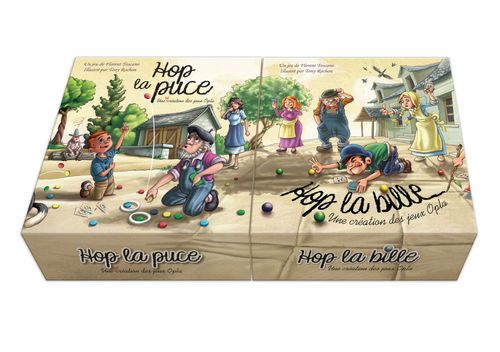
Hop la Puce
Hop la Puce Rulebook
Table of Contents
Table of Contents
- Components
- Goal
- Setup
- Gameplay
- Example of Play
- End of Game
- Variants
- Couic! (when you are in a hurry or short of time)
- Verlan! (when you want to do everything differently, or to do nothing the same way)
- Palchoa! (when you want constraints or no easy ride)
- Presque tradi! (when you want to go back to the roots, or backwards)
- Bronx! (when you need it to be really chaos or disorder)
- The Real Traditional Rules ("La vraie règle tradi!")
- Glossary ("Le langage des puces...")
Components
Contents of the box (from the "Contenu du jeu" page):
- 15 puces: 3 red, 3 green, 3 yellow, 3 blue, 2 white, 1 black.
- 4 launchers.
- 2 rings.
- 12 cards: 4 green cards (1 puce), 4 blue cards (2 puces), 4 red cards (3 puces). Each card shows a combination of puces, the same colours as the puces in the box.
- 1 goodies card for the game Hop la bille (a separate game from the same publisher).
- 1 rulebook.
Specifications (from the "What are puces?" page):
The material is very precise. In the traditional game the puces come in blue, green, red and yellow. For each colour there are two puces of 22 mm diameter and four puces of 16 mm diameter, all about 1.5 mm thick. Launchers measure between 25 and 51 mm in diameter and are no more than 5 mm thick. Their shapes may vary according to the shot to be made, as in golf.
The playing area is a rectangle of 6 feet by 3 feet. In Hop la puce you need not worry about putting your feet on the table: the only limits of the game are the edges of the table. The traditional pot is 38 mm high, with a diameter of 48 mm at the top and 38 mm at the base.
Translator's note: the printed specification gives six puces per colour (two of 22 mm and four of 16 mm), which is the traditional tiddlywinks set. The Hop la puce box contains three puces per colour, as listed above. The dimensions are transcribed as printed.
Goal
Each player must make the combinations of puces shown on their cards in one of the 2 rings common to everyone.
Setup
The only limits of the game are the edges of the table. Play on a hard table without a tablecloth, because a soft or sticky surface makes the puces bad-tempered, and then they jump in any direction or not at all!
Place the 2 rings wherever you like on the table, and scatter the 15 puces a little everywhere.
Shuffle all the cards and deal 3 to each player (one green, one blue and one red). Each player places their cards face up on the edge of the table.
Each player also takes a launcher. You may sit down, but you will soon find yourself standing up and walking around the table!
Caption of the printed example: "Example of the start of a 3-player game."
Gameplay
To win, a player must get, in one of the 2 rings, exactly the same combination of puces as the one shown on one of their 3 cards. That means neither more nor fewer puces, but exactly the same!
The player who last played a puce starts the game. The starting player presses their launcher on the edge of the puce of their choice, and flicks it. Be careful: the way you apply the launcher determines the distance and precision of your puce's jump. A little practice and training will help!
As soon as the combination of puces in a ring matches the card of a player, that player turns their card over and leaves the puces in that ring.
A few important rules:
- A puce lying inside a ring cannot be played.
- A player cannot play the puce that the previous player has just played.
- If a puce is sent off the table, the next player chooses where it is placed on the table, but that player cannot play it. The next player may even place it in one of the 2 rings (unless it is a white or black puce).
- A player who sends a white puce into a ring must remove any one puce from that ring to place it wherever they like on the table (but not in the other ring). They must also remove the white puce and place it likewise wherever they wish.
- A player who sends the black puce into a ring must remove all the puces from that ring to place them wherever they like on the table (but not in the other ring). They must also remove the black puce and place it likewise wherever they wish.
- If a puce you want to play is too close to a ring or to another puce, you may move it a few centimetres (but not too far either!).
Example of Play
Example of a game in progress with 3 players:
If on their turn player 1 sends the red puce into the ring on the right, they can make the combination on their card and turn it over.
Then, if player 2 sends the white puce into the ring on the left, they can remove one green puce from that ring and make the combination on their card.
End of Game
The first player to turn over their 3 cards wins the game!
Variants
Couic! (when you are in a hurry or short of time)
You play exactly as in the base rules, but instead of taking 3 cards, each player takes only one (a red one, with three puces). The first player to complete that combination wins.
Verlan! (when you want to do everything differently, or to do nothing the same way)
You play exactly as in the base rules, except that to win you must be the only player who has not had all three cards turned over!
So during the game, try to complete the other players' combinations to force them to turn their cards over, and also prevent them from completing your own combinations! Players whose 3 cards are turned over continue to play until only one player has cards face up in front of them.
This variant is particularly fun and sneaky, but it is only worth playing with three or four players.
Palchoa! (when you want constraints or no easy ride)
You play exactly as in the base rules, except that the cards are not dealt but placed in a pile. Each player takes the top card of the pile and places it face up on the edge of the table. Once they have completed that combination, they take the next card, and so on.
At the start of the game, fix the number of cards to be completed to win the game: for example, the first player to complete 3 cards is the winner.
More fun: the first player to accumulate 7 puces on the cards they have completed wins!
Presque tradi! (when you want to go back to the roots, or backwards)
Leave the cards in the box, along with the black and white puces. Stack the 2 rings one on top of the other in the centre of the table (this makes a new, higher ring), and scatter 12 coloured puces around this new ring at roughly equal distances.
Each player chooses a colour, and you each play one puce per turn. The first player to get the 3 puces of their colour into the ring wins! As soon as a player gets a puce of their colour into the ring, they may play again.
With 2 players, you may choose 2 colours each, but then you must get all 6 of your puces into the ring to win.
Bronx! (when you need it to be really chaos or disorder)
Everything happens as in the normal game, but everyone plays at the same time, with no turn order!
Play is interrupted only when a player shouts "hop la", because:
- they have completed a combination of one of their cards, so that everyone checks it;
- they knock a puce off the table: the player to their left at that moment places it wherever they like on the table or in a ring;
- a black or white puce enters a ring.
The Real Traditional Rules ("La vraie règle tradi!")
Printed as a sidebar on the traditional game of puces, whose equipment was used to make Hop la puce. Transcribed as printed.
To play Hop la puce, we used the equipment of the traditional game of puces, whose rules are very precise.
Puces are played by 2 teams of 2 players. If there are only 2 players, each takes 2 colours. At the start of the game, the puces of each colour are placed at each of the 4 corners of the playing area. On their turn, a player shoots one of their puces, and plays again only if they get it into the pot. A 25-minute timer determines the end of the game.
At the end, each puce in the pot scores 3 match points, and a puce still on the table that is not covered by another puce scores 1 match point. The player with the most match points wins 4 game points, the second 2 game points, the third 1 game point, and the last none. The 2 teammates add their scores together.
A player can "squop" an opposing puce with one of their own: they cover it and so prevent it from playing! This is where the game takes on its full strategic dimension, because it is not simply a matter of getting the puces of your own colour into the pot. A team must capture and keep the opposing puces while preserving its own.
The technique can be acquired in a few days, and it improves over years of practice until you become a puce virtuoso!
Glossary ("Le langage des puces...")
Puces do not talk like everyone else: they have a vocabulary all of their own, especially the English-speaking puce players.
- Carnovsky: at the very start, if I shoot my puce from my base straight into the pot, I have just made a Carnovsky!
- Blitz: if a player tries to get all six puces of their colour into the pot, it is a blitz! Obviously, a blitz can only be attempted at the start of a round, before having suffered one or more squops. It is bad luck to suffer a doubleton, that is, if a single opposing puce squops several of our puces.
- Squop: to cover an opposing puce with one of your own, which prevents it from playing (see the traditional rules above).
- Bomb: if a player shoots their puce onto a stack of squopped puces, that is obviously a bomb. It is even a crud if the stack is burst!
- Bristol: to send a stack of squopped puces onto another puce, one can attempt a bristol, holding one's launcher (which is in fact a squidger) vertically.
- Boondock: think also of the boondock, which lets you send a previously squopped puce very far. Even better, but it takes some nerve, is when doing so you squop a puce at the same time! That is definitely a John Lennon memorial shot!
- Scrunge: the unlucky move that also happens: to scrunge one's own puce, that is, to make it leave the pot.