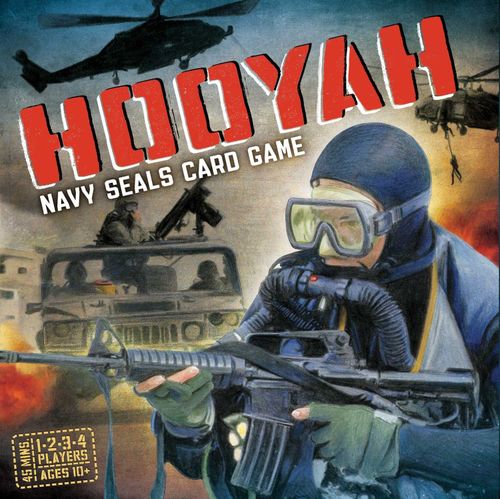
Hooyah: Navy Seals Card Game
Hooyah: Navy Seals Card Game Rulebook
Table of Contents
Table of Contents
- Object of the Game
- Components
- Setup
- Course of the Game
- Preparation Phase
- Events
- Hooyah: Ops Phase
- Mission Phase
- Scoring
- Difficulty of the Individual Missions
- Mission 1: Compound Raid
- Mission 2: GOPLAT Assault
- Mission 3: Panama Invasion
- Mission 4: High-Value Target Extraction
- Mission 5: POW Rescue
- Communication Between Players
- The Solo Game
Object of the Game
HOOYAH is a cooperative card game in which 1 to 4 players take the roles of Navy SEALs* and try to complete a Navy SEAL mission inspired by real events. The players win or lose together. They win if they complete the mission and all survive. If the life points of even one player drop to zero, the game ends without the mission having been completed.
* Special forces of the US Navy (Sea, Air, Land) for special operations by water, air and land.
Components
Ops/Event Deck (Ops is short for operations)
75 Ops/Event cards. In each of the 5 colors there are 14 cards, numbered from 1 to 5. These cards have a dual purpose. The number/color combination at the top of the card refers to the OPS. At the bottom of the card is the task connected with the event. These two aspects of a card do not work together.
1 Insertion card. This card is shuffled into the Ops deck when the mission requires it. Not all missions (games) require the Insertion card.
Skills and Equipment Deck
There are 10 cards of each of the five colors in the deck.
50 Skill cards. Of each color there are four different versions. These cards can be used for their color or for the "bonus" information found on each card. (Example: the Time Counter can be set forward by 2.)
20 Equipment cards.
5 Joker cards, Crosstraining. These Joker cards can take on any color.
5 Mission Cards and Holder
These 5 Mission cards represent 5 different games. For each HOOYAH game, one of these 5 cards is chosen. At the start of the game the holder is folded into 3 sides. The Mission card is put into the slots.
10 Navy SEAL Cards
At the start of the game each player receives one Navy SEAL card and embodies that identity for the whole game. These cards name the special abilities of each individual Navy SEAL.
Example: the Convoy Leader (Squad Leader) card. The Convoy Leader is the only player who can give another player a card. Each SEAL (as each marine is simply called) has one (or more) unique ability(ies), completely different from the other SEALs.
Excerpt from the Convoy Leader card: "During the Preparation Phase you may give another player one card once."
Note: The Navy SEAL special facts named at the bottom of the cards have no influence on the game.
Hooyah Turn Sequence Card
This card is a quick overview of the sequence of a Hooyah round. This card can also be put into the Mission card holder.
Time Counter
The Time Counter shows how much time the SEAL team still has to finish each Op (short for operation).
30 Health (Life Point) Tokens
During the game the players gain and lose life points. When a player loses all of their life points, they are "dead" and the game is over.
Setup
Table layout: each player (Player 1 to 4) has a Navy SEAL card with Health tokens next to it. In the center are the Mission card in its holder, the Ops area (5 rows of 2 cards), the Supply area (face-up Skill & Equipment cards) with the draw pile, the discard pile for Skill and Equipment cards, and room for additional and discarded Health tokens.
Mission card. The players choose one of the 5 large Mission cards and put it in the card holder. For the first game we recommend Mission No. 1 Compound Raid (Überfall auf ein Anwesen) or Mission No. 2 GOPLAT Assault (GOPLATFORM Übernahme). The players must follow the special instructions of the chosen card. Further details for this game can be found in the Missions section [pages 28-38].
Navy SEAL cards. A game leader is appointed who receives the Lieutenant Commander (LC) card. (The LC has more duties during the game than the other players.) The remaining Navy SEAL cards are shuffled and 1 of them is dealt at random to each player. (Optionally the players can agree that everyone picks their own card, making sure that one player gets the LC card.) Each player reads their Navy SEAL's abilities aloud to the others. The players must be able to rely on each other to complete the mission, and these abilities are important for that.
Health tokens. Each player receives 5 Health tokens and puts them next to their Navy SEAL card.
Ops area. The Ops/Event card deck is shuffled and 5 rows of 2 cards each are laid out face down next to the Mission card, as shown in the illustration. Each row is a single operation, equivalent to a game round. The remaining cards are placed on the table as a face-down draw pile. The first Op is turned face up.
Supply area. The Skill & Equipment cards are shuffled and 5 of them are laid out face up. The remaining cards are placed next to them as a face-down draw pile.
Time Counter. The values of the two face-up Op cards are added and the Time Counter is set to this value. In the example shown (illustration, page 6) it is 8 (3 + 5 = 8). The Time Counter is placed in front of the LC. He begins the game and the other players follow in clockwise order.
Course of the Game
THERE ARE 3 DIFFERENT PHASES IN THE GAME:
- Preparation Phase - the team collects Skill & Equipment cards.
- Ops Phase - the collected cards are played for each Op of the mission. In this phase the players must also deal with Events.
- Mission Phase - after 5 Preparation and Ops Phases, this is the last challenge to win the game.
Preparation Phase
The goal for all players is to jointly collect enough cards of the colors required by the Op. In this example (1st Op) the team needs 3 red and 5 purple cards.
Note: the Event at the bottom of the purple card 5 is ignored in this case, as it does not concern this part of the game.
A Player's Turn
- The player draws 2 cards from the supply area, one after the other. Each time they can take either the top face-down card of the draw pile or one of the 5 face-up cards. If they first take one of the face-up cards, it is immediately replaced by the top card of the draw pile before the player takes the second card. The card in the supply area is always replaced before the second card is taken.
- When the player has finished their turn, they pass the Time Counter to the next player, who sets it back by one number (unless "Hooyah" is called, see page 19).
- In this example the following 5 cards lie face up in the supply area. Since the team needs 5 purple cards, the purple card is the first choice. As a second card the player could take the top card of the draw pile (because the team needs neither blue, green nor yellow cards for the first Op). But then the player notices the Scuba Gear card. The instruction at the bottom right reads: "Draw 2 cards." If the player takes this card as the second card of their turn, they can play it immediately and take TWO cards from the draw pile and/or supply area.
- During their turn a player can play any number of "Prepare Equipment" cards.
The Time Counter
The Time Counter shows how much time remains until completion of the current operation. Navy SEALs are trained to complete their tasks in the shortest possible time.
In our example (illustration, page 6) the game begins with the Time Counter at 8. The LC begins the game. After taking two cards and playing as many "Prepare Equipment" cards as they wish (and can), they pass the Time Counter to Player 2, who sets the pointer back by one to 7. After Player 2 has finished their turn (drawing 2 cards), they pass the Time Counter to Player 3, who sets the pointer back by one to 6, and so on.
When the Time Counter is passed on while the pointer is at zero, the player passing the Time Counter loses one life point. This continues until the LC calls "Hooyah", triggering the Ops Phase (see page 19).
There is NO LIMIT to the number of cards in hand.
Note: the higher the number on the Time Counter, the better it is for the team. If an Op is completed before the pointer reaches zero, the members of the team receive additional life points (see Successful Op, page 22).
The Skill & Equipment Cards
As mentioned, there are three different card types in this game: Skill cards, Equipment cards and Crosstraining cards (Jokers).
Skill cards: always played for their color.
Equipment cards: can be played for their color OR for the instruction ("equipment benefit") on the card, BUT NOT both at the same time. At the top left of the card it states whether it is an OPS or PREPARE Equipment card. The PREPARE Equipment cards offer benefits that can be used during the Preparation Phase (e.g. "Set the Time Counter forward by 2."). OPS Equipment cards are helpful during the OPS Phase (e.g. "This card together with another red card = one card of any color.").
Joker cards: they can replace any color.
Draw pile: during the game the draw pile can run out. When that happens, the discarded Skill & Equipment cards are shuffled and placed face down as a new draw pile.
What the Colors Mean
- Blue: water skills such as diving and placing explosives for underwater detonations.
- Red: sniper skills.
- Yellow: air skills such as piloting an aircraft or parachuting.
- Green: SEAL strength and survival training.
- Purple: technological skills that the SEALs need in the field.
Card Combinations to Create Different Colors
- OPS Equipment cards. These 2 cards are examples of how OPS Equipment cards are combined with other cards to create the desired color.
- SEAL card special abilities. The SEAL cards Sniper, Explosives, Diver and Communications allow the player to count one card as two cards. (Detail of the Diver card: "Once per OPS Phase you can play a blue card as two blue cards.")
- Four cards of the same color. Each player can play FOUR cards of the same color as ONE card of any other color.
Roll Call
In the course of the Preparation Phase the players collect more and more cards that they need to complete the Op. To find out how far the SEAL team has progressed in its preparations to begin the Ops Phase, the team members must count their cards and also tell each other how many playable cards each SEAL has in hand. This is done by a Roll Call, in which each player states the number of cards of a color that they could contribute to the Op. The Roll Call is not necessarily an exact count, but gives a good overview of how strong and how ready the team is.
- The players should remember that they can combine cards to create different colored cards. They can count both Skill cards and unused Equipment cards of the corresponding color.
- The Roll Call is the duty of the LC, who may hold a Roll Call at the end of their turn. The LC makes the decision for the Roll Call, but the other players can ask them to do it, and discussions are also allowed, because this is teamwork after all. If the Roll Call shows that there are not yet enough cards to begin the Op, the players continue collecting cards.
- After calling the Roll Call, the Lt. Commander announces the highest number of a single color that they currently hold in their hand.
- Continuing clockwise, each player decides which color to announce, considering the following:
- which colored cards, and how many of each color, they have in hand;
- which colored cards are needed for the Op;
- which colored cards the other players have announced.
- The announcement a player makes during a Roll Call is not an obligation to actually play exactly those cards during the Ops Phase.
After all players have made their announcements, the LC can decide to hold another Roll Call immediately afterwards so that the players can announce other colors.
Attention: the LC must note how much time is still shown on the Time Counter to decide whether the players can still collect more cards.
The team should know that the players still have to face the Events before the Ops Phase begins. Some Events can mean the loss of Skill and Equipment cards. So when the decision is made to begin the next phase, the team should be sure not only to have enough cards to complete the Op, but also to have room to spare for the Events.
IMPORTANT: during each individual Roll Call, each player may name ONLY ONE COLOR, even though they may have other important cards in hand.
After a Roll Call the LC can hold another Roll Call, can call "Hooyah" to begin the Ops Phase, or can pass the Time Counter on so that the team can continue collecting cards.
Events
In the Preparation Phase the team has collected cards to be able to tackle the 1st Op. Another important aspect of the game is the EVENTS. EVENTS are challenges and unforeseen circumstances that the SEALs are confronted with on their missions.
At the start of the Ops Phase each player must deal with one Event card (or even several) and perform the task it requires.
The upper part of an Event card is ignored when carrying out Events. (In the example, the green color and the number "2".) In that case the player only has to try to be able to play a blue card.
Types of Events
1. Skill checks. Most Event cards require a skill check with a specific color. This can be passed in two ways:
- The player plays a card (or several) of the required color from their hand.
- The player draws up to 3 cards from the Skill & Equipment draw pile. As soon as they draw the required color (or a Joker card), they have passed the skill check and need not draw any more cards. (The player does not take these cards into their hand; the drawn cards are discarded.)
In skill checks the players should not forget their Navy SEAL special abilities (stated on the SEAL cards). Some SEALs pass certain skill checks automatically. In addition, all SEALs are snipers and can therefore draw 5 cards instead of only 3 in a red skill check.
Whoever fails the skill check loses a life point. Cards drawn for a skill check are discarded.
2. Mission Event. When an Event card states "Look at Mission Card and do Mission Event", the player must look at the Mission card set up on the table. Mission Events are always listed in the upper right corner of the card. In this example the event means "You lose 1 life point", meaning the player discards one of their Health tokens.
Other Types of Events
- If an Event instructs a player to draw and carry out two further Event cards, they must first deal with both Events before the next player is assigned an Event. Such additional Events do not count toward the total number of Events for the Ops Phase.
- If an Event instructs a player to discard a certain number of cards and they do not have that many cards, they discard all the cards they still hold. For example, if the team has completed 4 Ops and the player has only 3 cards in hand, they must discard these 3 cards.
- If an Event instructs a player to discard an Equipment card and they have none, they do not have to do anything.
- If an Event instructs a player to lose life points, or otherwise causes them to, and they are thereby reduced to 0 (or fewer) life points, all players have lost the game.
- If an Op card shows no Event, the player does not have to carry one out.
Hooyah: Ops Phase
Calling "Hooyah" means that the Preparation Phase is over and the Operations Phase has begun. This is done by the LC as soon as they think their team is ready to handle the current Op cards and the Event cards.
- The LC can call "Hooyah" after a player (including themself) has finished their turn, but before that player passes on the Time Counter.
- After "Hooyah" has been called, the time display no longer changes and the counter is no longer passed on.
- The LC determines the number of Events the team must handle (see the yellow box below) and draws that many cards from the Ops/Event card deck. They then play these cards one after another, face up in front of the players, beginning with the player who currently holds the Time Counter.
- Each player must complete the task of their Event card before the next Event card is played in front of the next player. (This happens in clockwise order.)
Remember: the upper area (number/color) of an Event card has no meaning for the Event (the text) in the lower area of the card.
How Many Event Cards Must the Team Handle for Each Op?
The number of Event cards a team must handle is the number of players plus the number of the current Op. For example, if three players play the 1st Op, they must draw 4 Event cards. If four players play the 4th Op, they must draw 8 Event cards.
Completing the Op
After all Events have been dealt with, the time has come to complete the Op. To complete an Op, the players must jointly play the number and colors of cards shown on the Op cards.
The LC and their team have now spent enough time carefully planning and preparing the completion of their 1st Op. Now we will see whether the planning was successful. Things have happened that were not planned (the Events); how these situations were handled will decide whether the whole mission is a success or failure.
Beginning with the player who holds the Time Counter (the last player to have taken a turn), each player plays as many cards as they wish to jointly meet the requirements of the Op. In our example (page 4) the 1st Op requires 3 red and 5 purple cards.
Example of Play
- Tom plays first. He begins by playing 2 purple cards, laying them face up in front of him and announcing "2 purple". He also has a Crosstraining card (Joker), but wants to see first whether anyone else plays purple, so that he may save his Joker for later.
- Bill is next. He lays out 1 red card but announces "2 red". Because he is the Sniper, he has the ability to play a red card as two red cards once per Op. (Card text: "Once per Ops Phase you can play a red card as two red cards.")
- Next, Sarah plays the cards shown. She announces "3 purple and 1 red". RED is created through the use of an Ops/Equipment card. (Card detail: "This card plus 2 other cards of any kind = 1 card of any color." It does not matter in this case that the Ops/Equipment card is yellow, nor that the other two cards are blue and green.)
See page 9 [sic, the Card Combinations section above] for special methods of combining cards to create different colors, as Bill and Sarah did in these examples.
IMPORTANT: a PREPARE Equipment card cannot be played during the Ops Phase for its special benefits. The cards keep their color and can only be played for their color. In the Ops Phase as many OPS Equipment cards can be played as the players want.
Ops are by no means always completed with the first three players playing (as in our example)! Play continues clockwise (possibly going around the table several times) until enough cards have been played to meet the requirements of the current Op.
Note: if a player can no longer play any cards for the current Op, they must PASS. A player who has passed cannot play any more cards for this Op.
Successful Op
If the required number/colors of cards have been played, the Op is completed. To get ready for the next step, the players do the following:
- All played Skill & Equipment cards are put on the discard pile.
- The 2 cards of the Op just completed are placed next to the Lt. Commander. (They are stacked face up on top of one another to keep track of how many Ops have already been completed.)
- The number on the Time Counter is looked at. The team receives that many Health tokens from the general supply. The LC distributes them to the players as they see fit.
For example, the Time Counter points to 2. The LC takes 2 Health tokens and can give both to just one player (including themself) or one each to two different players (including themself). Sensibly, players who have lost life points receive life points.
Failed Op
If the team has played all cards that were possible to complete the Op, but has not met the requirements, the operation was a failure. In this case the following happens:
- Each player puts one of their Health tokens on the Health discard pile. (Each team member loses 1 life point.)
- All played Skill & Equipment cards are put on the discard pile.
- Each player discards all Skill & Equipment cards from their hand onto the discard pile.
- The 2 cards of the failed Op are put on the Ops discard pile. Then 2 new Ops cards (from the Ops/Event card deck) are put in their place. The failed Op must be played again.
NO NEW HEALTH TOKENS ARE DISTRIBUTED (according to the Time Counter).
The Next New Op
If the team has achieved a SUCCESSFUL OP, it can continue with the next Op row. (If the team has just completed the 5th Op, it would now play the final Mission card, see page 36 [sic; the Mission Phase section below].)
To begin the next Op (in our example the 2nd Op), the team proceeds as follows:
- The Lt. Commander chooses one of the face-up cards of the supply area and discards it. (With each further Op there is one card fewer in the supply area.)
- The Time Counter is reset (to the sum of the two face-up Ops cards). In the example illustrated this is 5.
- The Lt. Commander turns up the 2 cards for the next Op.
All players keep the hand cards they did not play during the successful Op. (In the case of a failure, however, all players have no hand cards left.) A new Preparation Phase follows.
Who Plays First?
In the example of play (pages 20 and 21), Tom was the first player to play cards. He was therefore the last player to have taken a complete turn in the 1st Preparation Phase. Tom now passes the Time Counter (now set to 5) to his left neighbor (in this case Bill).
Bill now takes his turn in the Preparation Phase. He begins the new 2nd Preparation Phase by taking the Time Counter from Tom and taking 2 new Skill/Equipment cards from the supply area or draw pile.
Although Sarah was the last to play during the OPS Phase, she does NOT begin the new Preparation Phase.
For Ops 3 to 5 proceed in the same way: Preparation Phase, Events, Ops Phase.
Mission Phase
After the 5th Op has been successfully completed, the players are ready for the last step of the entire game: the Mission Phase. All missions are different, and there are variants of the basic game (described on the previous pages) for all missions. The details of each mission affect not only the Mission Phase of the game but also the play of the Preparation and Op Phases. The details of the missions are listed from page 28 of this rulebook, together with the special instructions on how each particular game is played.
Ending the Game
As soon as the 5th Op has been successfully completed, the following happens:
- Each player must immediately pass an Event.
- Beginning with the LC, the team must then play the number/colors of cards required by the Mission card in order to win the game.
The players should make sure to have the necessary colors in hand before completing the 5th Op, because between the 5th Op and the Mission card there is no time left to obtain new Skill and Equipment cards. Early in the game, when collecting and playing cards, think about the colors listed on the Mission card.
Scoring
Although HOOYAH is not in principle a game for winning points, the players may want to compare their results from game to game. This can be done as follows:
- 50 points for completing the mission.
- 10 points for each successfully completed Op.
- 10 points for each Health token of the player who has the most life points at the end of the game.
- 1 point for each Skill and Equipment card of the player who has the most hand cards at the end of the game.
Difficulty of the Individual Missions
The mission descriptions on the following pages serve to make each game easier or harder, depending on the difficulty level the group wants to play at. The descriptions of the background of each mission are unimportant for the game itself. This information is only of historical interest.
Mission 1: Compound Raid
Mission objective: capture or kill Osama bin Laden.
- Each player begins the game with one Health token fewer.
Mission completion: immediately after the 5th Op has been completed, each player must pass an Event and then the team must play 2 yellow, 3 red and 2 blue cards. This represents the helicopter problems with the air skill cards, the shooting at the compound with the sniper skill cards, and bin Laden's burial at sea with the water skill cards.
Mission Event: loss of one Health token.
- To make this mission easier, the Time Counter is set forward by one in each new Op Phase.
- To make this mission harder, the Mission Event is changed to the loss of two Health tokens.
Historical background (not relevant to play). Mission execution: this mission was carried out by two teams of the DEVGRU SEALs, also known as SEAL Team Six. Despite the crash landing of one of the two MH-60 Black Hawk helicopters as the troops landed, the raid on bin Laden's compound in Abbottabad, Pakistan went smoothly. The entire operation lasted 38 minutes from landing to departure without losses among the SEALs. Result: bin Laden was killed with two shots to the chest and head with a Heckler & Koch 416 military assault rifle. After the fatal head shot the SEAL shooter radioed the code for a successful mission: "For God and country, Geronimo, Geronimo, Geronimo, Geronimo, E.K.I.A." (enemy killed in action).
Mission 2: GOPLAT Assault
Mission objective:
-
Simultaneously take both sea-based GOPLATs (gas and oil platforms) off the Al Faw peninsula.
-
Secure the land-based refineries and pumping stations without warning, without delay and with minimal destruction.
-
Remove and neutralize enemy mines and explosives from waterways and sea platforms.
-
The Time Counter is set back by 1 at the start of the game and before every new Op.
Mission completion: immediately after the 5th Op has been completed, each player must pass an Event and then the team must play 2 yellow, 3 blue and 2 red cards. This represents the helicopter insertion of Navy SEALs from above, the synchronized attack from the water by the divers and the securing of the platform by the snipers.
Mission Event: discard one hand card.
- To make this mission easier, the LC distributes 6 cards from the Skill & Equipment deck to the players at his discretion before the game begins.
- To make this mission harder, the Mission Event is changed to discarding two hand cards.
Historical background (not relevant to play). As part of Operation "Iraqi Freedom", U.S. troops had to secure and take over the infrastructure of the Iraqi petrochemical industry before it could be destroyed by Saddam Hussein's "scorched earth" program. Mission execution: more than 1000 Allied soldiers were involved in this takeover, including the U.S. Air Force and Marines. With SEAL vans, SWCC special ops vehicles and rigid-hull inflatable boats the attack was made over the sea, with cover from SEAL snipers in Navy HH-60 Seahawk helicopters. Result: the double attack on the two GOPLATs was a complete success. Platform 1 was taken by Navy SEALs and Platform 2 by Polish troops. In total 32 crew members were captured, with no dead or wounded. Explosive ordnance disposal teams found explosives and diving equipment on the platforms. Any damage was successfully prevented. All facilities were handed back to the Iraqi people.
Mission 3: Panama Invasion
Mission objective: to forestall or prevent the escape of the Panamanian dictator Manuel Noriega and to weaken his defense forces.
- After each completed Op, each player loses one Health token. This loss of life points happens before the possible distribution of additional life points according to the Time Counter pointer.
Mission completion: immediately after the 5th Op has been completed, each player must pass an Event and then the team must play 5 blue and 5 yellow cards. This represents the destruction of the ships with water skills and the attack on the airport with air skills.
Mission Event: draw 2 cards from the Skill & Equipment deck.
- To make this mission easier, the Time Counter is set forward by one at the start of the game and also during every new Ops Phase.
- To make this mission harder, the Time Counter is set back by one at the start of the game and also during every new Ops Phase.
Historical background (not relevant to play). The code name of the U.S. invasion of Panama was "Operation Just Cause". One of its phases was the SEALs' plan to prevent Noriega's escape; this undertaking was called "Operation Nifty Package". Mission execution: the first Navy SEAL team had the task of destroying Noriega's private jet at Punta Paitilla airport. Under fire from the presidential defense forces, four SEALs of the first unit lost their lives and eight more were wounded. The SEALs nevertheless managed to destroy Noriega's aircraft with an AT4 rocket. As part of the second group, tasked with sabotaging Noriega's gunboat in Balboa harbor, 2 SEAL divers swam to the harbor floor and blew the ship up. Result: with Noriega's plane and gunboat destroyed, he could not flee Panama. He tried to find refuge in the Vatican embassy, but was driven out by psychological warfare. Finally Noriega surrendered.
Mission 4: High-Value Target Extraction
Mission completion: immediately after the 5th Op has been completed, each player must pass an Event and then the team must play 2 red, 2 green and 2 yellow cards.
Mission Event: an air skill check (yellow).
- To make this mission easier, the players do not discard their hand cards after the Insertion card has been drawn and the current Op completed.
- To make this mission harder, 2 cards of every color must be played as the mission completion.
Insertion card. After the 5 Ops have been laid out, the following number of cards is taken from the Ops/Event card deck. The Insertion card is shuffled into these cards, then these cards are put back face down on the Ops/Event card deck.
- SOLO GAME: 8 cards are taken, the Insertion card is shuffled into them.
- 2 players: 11 cards are taken, the Insertion card is shuffled into them.
- 3 players: 14 cards are taken, the Insertion card is shuffled into them.
- 4 players: 17 cards are taken, the Insertion card is shuffled into them.
- As soon as the Insertion card is drawn, it is set aside and the current Event phase is played to the end. Then all players lose 2 life points and begin playing cards to complete the current Op. When the Op is completed, all players discard their hand cards.
Historical background (not relevant to play). (Part of Operation Iraqi Freedom.) Mission objective: to find and capture for interrogation a high-ranking general of the Iraqi air force who is accused of having carried out missile attacks against U.S. targets. In addition, a missile guidance device must be secured. Mission execution: a SEAL team of 5 members stormed a house in which the general was supposed to live, but had the wrong address. The SEALs quickly regrouped and attacked the right house directly next door. The SEALs captured the general and his wife only minutes after entering, despite a brief firefight with a security officer, who then dropped his weapon and fled. Result: the SEALs handed the Iraqi general and his missile guidance device over to a CIA interrogation team, who thereby gained valuable information and saved many American lives. Mission accomplished, no losses.
Mission 5: POW Rescue
Mission completion: immediately after the 5th Op has been completed, each player must pass an Event and must then play 1 card of any color.
Mission Event: a sniper skill check (red).
- To make this mission easier, the LC distributes 12 cards before the game begins.
- To make this mission harder, the LC distributes 8 cards before the game begins.
Insertion card. After the 5 Ops have been laid out, the following number of cards is taken from the Ops/Event card deck. The Insertion card is shuffled into these cards, then these cards are put back face down on the Ops/Event card deck.
- Solo game: 19 cards are taken, the Insertion card is shuffled into them.
- 2 players: 24 cards are taken, the Insertion card is shuffled into them.
- 3 players: 29 cards are taken, the Insertion card is shuffled into them.
- 4 players: 34 cards are taken, the Insertion card is shuffled into them.
- As soon as the Insertion card is drawn, it is set aside. From this moment on, during the Event phase the team must deal with 2 more Events than usual. This includes the moment in which the Insertion card is drawn. (In other words, the Insertion card does not count as an Event the players must face.)
- The Lt. Commander distributes 10 cards from the Skill & Equipment deck at his discretion to the players before the game begins. (In the solo game the player takes 10 cards; they need not necessarily be the LC.)
- During every turn of the Preparation Phase each player draws only 1 card instead of 2.
Historical background (not relevant to play). (Part of Operation Iraqi Freedom.) Mission objective: to free Private Jessica Lynch, a U.S. Army supply clerk who was wounded during an enemy ambush and captured by Iraqi troops. Mission execution: once Lynch's whereabouts were known, U.S. Army Rangers, special forces and a group of Navy SEALs stormed the Saddam Hospital to free Lynch. Rangers secured the surroundings, special forces blocked the exits in the west and SEALs stormed the hospital from the east and brought Lynch out without firing a single shot. Result: alive but wounded, Private Lynch was taken to a waiting Blackhawk rescue helicopter. The bodies of 12 other U.S. soldiers were recovered from the hospital. Mission accomplished.
Communication Between Players
The players can freely agree how to adapt the rules regarding communication among themselves. Many groups prefer that each player names a color and its number. Others love the challenge of playing the game without any communication (which is very difficult). We recommend starting with the rules as described in this rulebook and then gradually adapting them to the players' wishes. You can also initially play with open cards, which makes it much easier to win the game.
The Solo Game
- HOOYAH works very well as a solitaire game. It is a very good way to learn the job of the Lieutenant Commander in the multi-player game.
- When setting up the solo game, only one card instead of two is laid out in each Op row.
- The player does not have to be the LC; they can play with any Navy SEAL card.
- There are no Roll Calls. After each Preparation Phase the player simply begins the Ops Phase.
- They must deal with the required number of Event cards and then play the cards to complete the Op.
- On success they gain as many life points as the Time Counter shows.
- Scoring is the same as in the multi-player game.
Good luck!