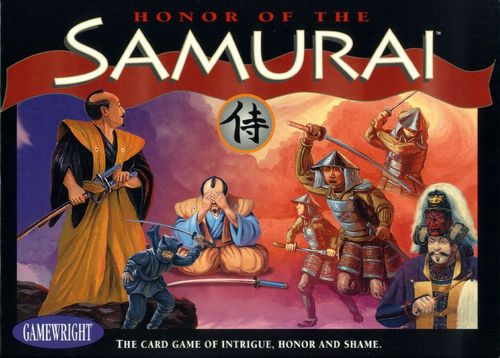
Honor of the Samurai
Honor of the Samurai Rulebook
Table of Contents
Table of Contents
- Object of the Game
- Game Components
- Setup
- Card Layout
- Sequence of a Turn
- Gaining and Losing Honor
- Tracking Honor Points with Honor Chips
- Allying with Another Player's Daimyo
- Assassinations
- Battle
- Battle Protocol
- Reshuffling the Discard Pile
- Winning the Game
- Card Description and Usage
- Historical Background
- Glossary
Object of the Game
The object of the game is to earn 400 honor points.
Game Components
Cards: The Honor of the Samurai deck contains 110 cards. Most cards have three basic attributes: honor, ki, and strength.
Honor: Daimyo, okugata (honorable wife), and possession cards have honor points. At the beginning of each turn, players add their current honor points to their cumulative honor score.
Ki: A measure of spiritual strength. In the game, this spiritual strength is expressed by allowing a player to draw or play extra cards. For each three points of ki, a player earns an extra card action.
Strength: For each three points of strength, a player may roll one battle die when engaged in combat.
Honor Chips: Honor chips are used to keep track of players' honor points. The chips come in denominations of 5, 10, 25, 50, and 100. Players should always trade up to higher denominations whenever possible (exchange five 5's for a 25, two 25's for a 50).
Custom Dice: Honor of the Samurai comes with six custom dice. Each face of these dice has an historically appropriate mon, or family crest, with a numerical value of 1 through 6.
Setup
- Remove the samurai, daimyo, and 'By Imperial Decree' (shogun) cards from the deck.
- Place the 'By Imperial Decree' card face up in the middle of the table. The card will go to the daimyo who takes the powerful title of shogun.
- The dealer then shuffles and fans the ten daimyo cards. Starting with the player on the dealer's left, each player draws a daimyo card which he places face up on the table in front of him.
- The dealer then deals each player a samurai card. Any extra samurai cards should be set aside and not used again in the game.
- Next, the dealer cuts the remaining daimyo cards, one by one, back into the deck and shuffles the deck. The player to the dealer's right then cuts the deck, after which the dealer deals seven cards to each player.
The remaining cards are placed in the center of the table as the draw pile. One player should be designated as the "banker" and put in charge of dispensing the honor chips.
Play proceeds clockwise starting with the player to the dealer's left.
Card Layout
Each player may play cards to the house of his daimyo as well as to that of his samurai. To represent these houses, each player lays out his cards in two horizontal lines, one above the other. The top line represents the daimyo's house, and the lower line the samurai's. Each house may include only one okugata (honorable wife) and no more than five army cards. There is, however, no limit to the number of possession cards and house guard cards that a player may place in his layout. Once a card is placed in the layout, it may not be removed except by the use of a ninja spy.
Sequence of a Turn
For each turn a player follows these steps in this order:
- Collect honor chips (see "Tracking Honor Points with Honor Chips" below)
- Determine the number of card actions (drawing or playing a card) permitted
- Draw and play cards, or discard them
- Make a declaration (optional)
- Declare the turn over
1) Score honor: At the start of his turn, each player tallies his honor points by adding the honor on each of his cards on the table in both houses. He declares his increase in honor points by stating "I gain xx honor points" and then receives the appropriate number of honor chips.
2) Determine the number of card actions: The act of drawing or playing a card is termed a "card action." Since each samurai (player) starts the game with six ki, and for each three ki he earns one card action, a player will always be entitled to at least two card actions. He may accrue additional card actions by earning more ki. To determine the number of card actions that he has earned, a player totals his ki and divides that number by three. Thus, a player with 12 ki is entitled to four card actions, 15 ki gives five card actions. Five card actions is the upper limit. Even if a player has more than 15 ki, he may still only draw or play a card five times. Neither discarding nor playing the save face card is considered a card action. Dishonor is counted as two card actions.
Example: A player with 14 ki would be entitled to four card actions (the first 12 ki give the player four card actions while the remainder of two ki cannot be used). If at any time during his turn, he gains an additional point of ki, then he would immediately gain a fifth card action because his ki would now equal 15. Although any further accumulation of ki would not entitle him to additional card actions, it would act as a kind of "insurance" against possible future losses of ki.
3) Drawing, playing, and discarding cards: A player may use his card actions either to draw new cards or to play cards. Any card played counts as a card action; this includes playing ninja and dishonor cards. Save face is the only card which does not count as a card action.
A player may not hold more than seven cards in his hand at any one time. This means that a player with seven cards in his hand must either play or discard a card before he can draw another card.
4) Make a declaration: Players may make one declaration per turn at any time after they score their honor. Declarations are not card actions. Declarations are:
- Declaring your daimyo to be shogun, if no other daimyo already possesses the title. Take the 'By Imperial Decree' card (shogun card) from the center of the table and place it by your daimyo. You will now earn extra honor points. (See 'By Imperial Decree' card description.)
- Attacking the player whose daimyo possesses the title of shogun, or who possesses a castle. An attack results in a battle.
- Allying your samurai with a daimyo who is controlled by another player. (This is explained below.)
- Dissolving an alliance. (This is explained below.)
- Dissolving an alliance causes a loss of 25 honor points.
5) Declare the turn over.
Gaining and Losing Honor
A player (samurai) gains honor by serving an honorable daimyo. The honor of both daimyo and samurai can be increased by a favorable marriage as well as by the acquisition of honorable possessions. At the beginning of each turn, a player receives honor points equal to the sum of the honor points shown on his cards on the table (not the cards in his hand). A samurai without a daimyo is considered a ronin (lone samurai), and cannot gain honor. Honor can be lost by dishonorable conduct such as using a gunpowder weapon, employing ninja, or receiving a dishonor card.
Tracking Honor Points with Honor Chips
The game comes supplied with honor chips. At the start of each turn, a player collects chips equal to his honor. Cards played during the turn will not produce honor until the beginning of the next turn. Players store their chips in a pile above the daimyo's house. If a player loses honor, he removes the corresponding value of chips from his pile. In a situation where a player without chips loses honor, he incurs negative honor. To keep track of this negative honor, the player will move his chips below the samurai's house. Chips in this position always indicate that the honor points are negative. When a player with negative honor gains honor, he removes the chips from below his house. Once these chips below the house are gone, any additional honor chips a player earns are then placed above the daimyo's house as explained above. Any honor that is not a multiple of 5 is rounded up (i.e., 17.5 honor points are scored as 20).
Example: Player 1 finishes his turn with 60 honor points. During the next round, player 2 dishonors player one with a dishonor card. Player 1 loses 75 points, and thus his score is reduced to -15 points (that is, 60 - 75 = -15). He keeps track of this loss by removing the 60 points of chips from above his daimyo's house, and putting 15 points of chips below his samurai's house. On player 1's next turn, he gains 30 points from his cards on the table. Thus, his score increases to 15 (that is, -15 + 30 = 15). He keeps track of this increase by removing the 15 points of chips from below his house and placing them above it. To continue the example, suppose that player 1 next plays a ninja card and suffers a 25 point loss of honor. His score becomes -10 (that is, 15 - 25 = -10). He removes 15 points of chips from above his daimyo's house, and places 10 below his samurai's house.
Allying with Another Player's Daimyo
Sometimes the daimyo you control may die in battle or be assassinated. Your samurai then becomes a ronin, and he cannot collect honor. There are only two ways to remedy this situation. First, you may play a new daimyo from your hand, an action which will entitle you to collect honor on your next turn. Second, you may serve another player's daimyo as his second samurai.
To serve a daimyo who is controlled by another player, declare an alliance during the declaration phase of your turn. On your next turn, you will serve your new daimyo as second samurai. The samurai who controls that daimyo remains the first samurai. You may not form an alliance with a daimyo who already has a second samurai. Only two samurai may serve a single daimyo at any one time. The daimyo may not refuse a second samurai.
As second samurai, you collect honor points each turn that are equal to the sum of:
- half the total honor points shown on cards controlled by the daimyo.
- half the honor points shown on the shogun card, if your daimyo is shogun.
- half the honor points of the cards in your second samurai's house.
Any honor points held by the first samurai have no effect on you.
Example: The daimyo you serve has 20 honor points. Because he is also shogun in a three player game, he gains an additional 50 honor points for a total of 70 points. Your samurai has a 5 honor point okugata card. Thus, on your turn you gain 40 points: one-half of the daimyo's honor (20 + 50 = 70, divided by 2 = 35 honor points) plus one half the 5 honor points from your okugata card. Since half of 5 is 2.5, it is rounded up to 5, and your total is then 40 honor points.
The daimyo you serve may use your strength immediately should he decide to engage in combat. As second samurai, you have no right to decide whether your daimyo can launch an attack. This choice rests solely with the first samurai.
As second samurai you may give army, okugata, possession cards and/or house guard cards to yourself or to the daimyo you are now serving. You may also play save face cards on the daimyo to save him from defeat in battle.
If you are second samurai when the first samurai is killed (or assassinated), then you immediately become the first samurai. You take control of the daimyo you are serving (yes, you take the entire daimyo's house from your opponent and move it to your side), and collect full honor points at the beginning of your next turn. Treacherous as this may seem, such events did occur.
If, as second samurai, you assassinate or attempt to assassinate the first samurai, you incur double the dishonor for such treachery.
When you are second samurai, you may dissolve your alliance with the daimyo you are serving by making a declaration during your turn. It takes one round of play for the alliance to be dissolved. Dissolving an alliance is dishonorable, so you must immediately lose 25 honor points if you do so.
As the daimyo who has a second samurai, you may use the strength of the second samurai immediately for attack and defense. You collect no additional honor for having a second samurai. A second samurai always poses a threat of assassination, and you must defend against this threat. House guards are always a help. There are three tactics you can employ to dissolve an alliance with a second samurai. You can assassinate him, dishonor him, or (even more radical) play a daimyo card from your hand to your second samurai, and send him on his way. The second samurai must accept the new daimyo and detach. When a second samurai is dishonored, the alliance is automatically dissolved, unless a save face card is played.
Assassinations
When the ninja assassin card is played, the person playing it must declare against which daimyo or samurai the card is targeted. Then, the samurai playing the card must roll a single die to determine whether the assassination attempt will succeed. For the assassination attempt to succeed, he must roll a 3, 4, 5, or 6. However, if the targeted house contains a house guard card, then he must roll either a 5 or 6. If the daimyo is assassinated, then the daimyo card as well as any other cards in the daimyo's house are discarded. The samurai serving that daimyo becomes ronin. An assassinated samurai must discard all the cards in his house (in both cases only the line of cards played on the table, not the cards in his hand); however, any daimyo he serves remains unaffected. Despite his death, the samurai card remains in play, just as if another family member has been promoted to fill the vacant position. If a daimyo who owns a castle is assassinated, that castle must be discarded.
Though most of the time a player will use these cards to attack his opponents, he may use them against his own daimyo or samurai if he thinks such a tactic will help him.
Battle
Battles are fought by rolling dice. The number of dice each side can roll is found by taking the strength of the daimyo's house, and adding to it the strength of the samurai's house. If there is a second samurai, the strength of the second samurai's house is also added. The total is then divided by three. This number (which is rounded down) tells how many dice to roll. Each side in turn rolls his alloted number of dice, and totals the sum. The side with the highest total wins.
Battle sequence:
- Attacker asserts intent to attack during his turn.
- Attacker counts strength and divides by 3 to determine the number of dice to roll.
- Attacker rolls dice and adds sum of the dice.
- Defender counts strength and divides by 3 to determine the number of dice to roll.
- Defender rolls dice and adds sum of the dice.
- The player with the higher sum is declared victor. In the case of a tie, roll the dice again.
Battle Protocol
- Only a daimyo may attack.
- Only the shogun or a daimyo with a castle may be attacked.
- If the loser is not shogun, he may use a save face card to avoid "death."
- Any other player may play a save face card for a losing daimyo (if the daimyo is not shogun).
- Without a save face card, the losing daimyo "dies," his entire house is discarded, and the first and second samurai become ronin.
- A daimyo who defeats the shogun must assume the title of shogun.
- The winner may either add the loser's castle to his layout, or else discard (burn) it.
- A player is limited to one castle per daimyo, though the daimyo may "upgrade" his castle by replacing it with the newly captured one.
Reshuffling the Discard Pile
When all cards from the draw pile have been used, the discard pile should be shuffled thoroughly to create a new draw pile.
Winning the Game
Play proceeds until one player has accumulated 400 honor points. That player is then declared the most honorable samurai, and is the winner.
For your first game, play with no more than three or four players, and don't focus too much on winning. You are just learning. As you gain experience, you may want to include more players. A five or six player game requires a certain decisiveness on the part of each player to keep the game moving, so large games are best attempted by experienced players. You may set a lower number of points as the goal: 250 or 300 points will give a shorter game.
Card Description and Usage
Daimyo: Function — Head of the daimyo's house. Honor varies, Ki varies, Strength varies.
There are ten different daimyos in the deck. Each one has different attributes. Each player starts the game with one daimyo who heads his upper house.
Samurai: Function — Head of the samurai's house. Honor 0, Ki 6, Strength 0.
Each player is dealt one samurai card. This card heads the player's lower house and remains in play throughout the entire game. It cannot be discarded even if the samurai is assassinated or commits seppuku, that is, ritual suicide.
'By Imperial Decree' (shogun): Function — Indicates your daimyo holds the title of shogun. Honor 30-150, Ki 0, Strength 0.
Awarded to the daimyo with the military strength, honor, loyalty, and administrative skills to unify the country, protect it from invaders, and keep the peace at home, the title of shogun was one of great honor which only the emperor could bestow. In Honor of the Samurai, the title of shogun confers extra honor points which vary with the number of players (see the card for the honor points).
For each turn your daimyo is shogun, you will receive extra honor points. Be careful, however. Not only may the shogun himself be attacked by other daimyo, but the additional honor points you earn by serving the shogun also mark your samurai as an attractive target for attack. So be on the lookout against assassination attempts, and expect dishonor to come your way. In addition, the daimyo who is shogun may not use a save face card to prevent his removal should he lose in battle.
Okugata: Function — Bring honor and ki to a house. Honor 5 or 10, Ki 3 or 4, Strength 0.
Okugata means honorable wife in Japanese. Since an advantageous marriage had the power to create an important strategic alliance between two clans, daimyo were forever scheming to forge the best matches for their sons and daughters. In the game, okugata bring both ki and honor to their samurai or daimyo because they symbolize powerful connections.
Ninjas: Function — Perform covert operations for their masters.
In Honor of the Samurai, the use of a ninja is dishonorable, and a player using a ninja loses 25 honor points.
There are three types of ninja cards: the ninja spy, the elite ninja spy, and the ninja assassin.
A ninja spy may steal or destroy one possession card from any one house, but he is not permitted to steal okugata (even a ninja would not stoop so low) or house guards. To destroy a card, steal it and discard it. A stolen card may also be placed in any house of the player who stole it, even that of his second samurai.
An elite ninja spy is better trained and more effective than an ordinary ninja. Trained in all of the deadliest martial arts, they are able to steal or destroy two possession cards from any one house. A player who steals two cards may: 1) place both items in the same house, 2) split up the two cards by placing one in the house of his daimyo and the other in the house of his samurai, 3) destroy both cards, or 4) play one and destroy the other. A ninja spy may steal or destroy any of the following cards: swordsmith, Noh theater, gunpowder weapons, no-dachi, daisho, and army cards.
A player with a ninja assassin card may attempt to remove either an opponent's daimyo or samurai by throwing a single battle die. For the assassination attempt to succeed, he must roll a 3, 4, 5, or 6. However, if the targeted house contains a house guard card, he must roll a 5 or 6. In any case, the house guard, in protecting his master, makes the ultimate sacrifice and is placed ceremoniously in the discard pile. If a daimyo is assassinated, his entire daimyo house must be discarded. All cards in the samurai's house except the samurai card are discarded when the victim is a samurai.
House Guards: Function — Protect his master's house.
In the game, house guards protect against assassins. For more details, see the instructions concerning the ninja assassin card.
Castles: Function — A defensive structure. Honor 5, 10, or 15; Ki 0, 1, or 2; Strength 3, 4, or 5.
Can only be held by a daimyo. Can only be used for defense. Cannot be counted in attack strength. Allows other players to attack you.
The castle fortress was a classic form of Japanese architecture. A castle added greatly to a daimyo's defensive strength. Likewise, in the game, a castle fortress is considered defensive and thus cannot be used to attack. A daimyo with a castle may, however, be attacked by another daimyo. If victorious, the attacking daimyo may either seize the other daimyo's castle (and upgrade his own castle should he have one and choose to do so), or he may decide to "burn" (discard) it. Since no daimyo may hold more than one castle at a time (and only a daimyo may hold a castle), a player can only upgrade his existing castle by simultaneously discarding the castle he already holds. If a daimyo with a castle fortress is assassinated, the castle must be discarded. Ninjas may not steal castles.
Dishonor: Function — Bring dishonor to an opponent. Honor 0, Ki 3, Strength 0.
Counts as two card actions. Causes targeted player to lose 75 honor points. Targeted player may choose to have his samurai commit seppuku and thus preserve honor.
A player who receives a dishonor card has three choices: 1) lose 75 honor points, 2) play a save face card and reduce that dishonor to 30 points, or 3) order his samurai or daimyo to commit seppuku and thereby incur no loss of honor. If a samurai or daimyo commits seppuku, all cards in his house must be discarded except the samurai card which remains in play on the table. It is as if the samurai were replaced instantly by a new samurai who has risen through the ranks. Second samurais who are dishonored are detached unless they can play a save face card.
Save Face: Function — Reduce dishonor; prevent death in combat.
Prevents 'death' after defeat in combat. Save face reduces dishonor from 75 to 30 points. Cannot be used by the shogun.
A save face card may be used either to prevent death after defeat in combat, or else to reduce the loss of honor from a dishonor card to 30 points. Thus, the recipient of a dishonor card who possesses a save face card may reduce his honor point loss to 30 points by immediately playing a save face card.
In battle, the defeated daimyo will 'die,' which means that all the cards in his house, including the daimyo card, must be placed in the discard pile. If, at the time of defeat, the player introduces a save face card, he saves face and 'lives.' In this case, no cards will be lost and the daimyo does not have to be discarded.
A daimyo who is shogun cannot use a save face card to prevent his own death, nor can he use it to reduce dishonor.
If a daimyo holding a castle uses a save face card to prevent his own death upon defeat in combat, his castle is lost to the successful attacker.
A player may introduce a save face card at any time in the game. He does not need to wait until it is his turn. He may play his save face card on other players should he wish to prevent the death of those players after defeat or to preserve their alliances.
Possessions
Both samurai and daimyo may have possessions in their houses. Possessions are: armies (cavalry, lancers, foot soldiers, and warrior monks), no-dachi, daisho, noh theater, swordsmith, and gunpowder weapons.
Army cards: Function — To serve both samurai and daimyo. Honor 0, Ki 0 or 1, Strength 1, 2, or 3.
In the Sengoku era, the armies consisted of cavalry, lancers, infantry, and warrior monks. Each group had different strengths in battle. The cavalry was the elite mounted force. The lancers, bristling with long spears, proved especially effective against foot soldiers and cavalry. There were the infantry, or Ashigaru, who consisted mostly of poorly trained peasants. There were also warrior monks, the Ikko-Ikki, who carried fearsome polearms with long curved blades. Though not bound to any daimyo, they did, at times, support one or another if it served their interests. Because they are spiritual fighters, warrior monks possess one point of ki, in addition to their battle-strength of one.
No house may contain more than five army cards.
Ancestor's No-Dachi: Honor 5, Ki 1, Strength 3.
A no-dachi is a long sword that was popular during the 13th and 14th centuries. Some of these blades were so long that they had to be carried slung over the back and could not be drawn with one hand.
Ancestor's Daisho: Honor 10, Ki 1, Strength 1.
Daisho is a term for the pair of long and short swords which only a samurai was allowed to own and wear. The long sword (called a tachi or katana depending upon how it was mounted) was a samurai's primary fighting weapon. The short sword, termed either a tanto or wakizashi, depending upon its length, was his personal weapon. It was also the sword with which he could commit seppuku.
Master Swordsmith Masamune: Honor 10, Ki 1, Strength 4.
Because a daimyo who supported a master swordsmith was assured of having a supply of mighty and honorable blades for himself, his generals, and his troops, this card brings much honor and strength to the player who possesses it.
Gunpowder Weapons: Honor -20, Ki -2, Strength 6.
Introduced into Japan in 1560, the arquebus (a kind of musket) changed warfare. From a samurai's viewpoint, no honor could be gained from such a death. Thus, gunpowder weapons were considered dishonorable, and the gunpowder weapon card carries negative ki and negative honor, but much strength.
Noh Theater: Honor 20, Ki 3, Strength 0.
Noh is a unique Japanese art that combines dance, music, chanting, and exquisite costumes.
Historical Background
The rulebook's game directions are interlaced with real history: a survey of the Sengoku era ("the age of the country at war," 1467-1568) and the lives of the daimyo whose rivalries shaped the period — Takeda Shingen, Oda Nobunaga, Toyotomi Hideyoshi, and Tokugawa Ieyasu, who between them fought, allied, and betrayed one another on the road to unifying Japan and founding the Tokugawa shogunate in 1603. The manual also explains the imagery on each of the ten daimyo helmet illustrations and gives brief histories of Odawara, Osaka, and Himeji castles, the three castle cards in the deck.
Glossary
Samurai: The warrior class. The name "samurai" is derived from the Japanese word for service, saburau. A samurai lived to serve his master.
Ronin: Literally "Man of the Waves," ronin were samurai who had lost their masters, or whose masters had been disgraced.
Daimyo: Literally "Great Name," a daimyo was a local war lord. The daimyo made and enforced local laws, levied taxes, maintained armies, and defended their domains.
Okugata: Literally "Honorable Wife."
Seppuku: Ritual suicide, also called hara-kiri. Ritual suicide was the last and ultimate way to save face.
Ikki: Rural leagues.
Katana: The standard long fighting sword carried after about 1400. It was worn thrust through the waistband with its edge up.
No-Dachi: A long sword.
Wakazashi: A middle-length sword, used as a personal weapon, and often paired with a long sword.
Daisho: A pair of swords, consisting of a long sword and a shorter one. Only samurai were entitled to carry the daisho.