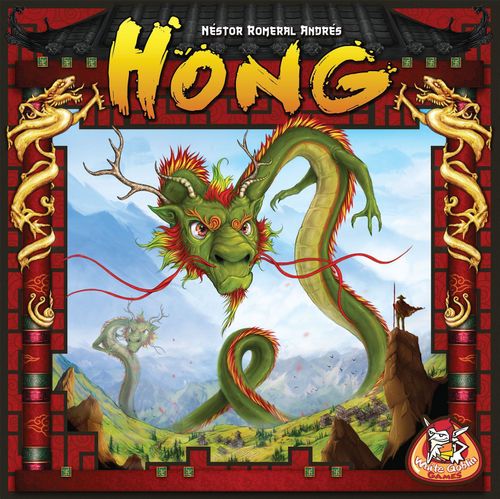
Hong
Hong Rulebook
Table of Contents
Table of Contents
Components
- 1 double-sided game board: "castle" and "garden"
- 1 Lair of the Seven Great Dragons board (used for the expansion)
- 15 Hong counters
- 70 Hong tiles: dragon side and stone side
- 7 different Great Dragon tiles
Goal of the Game
Hong is an asymmetrical tile-laying game with different goals for each player. The dragon master wins if a certain number of Hongs are on the board, while the emperor has to prevent this from happening.
A Hong is a straight line of one or more segments with a dragon head on each end.
Standard Game
Setup
Place the board between both players. Choose either side to play with.
Note: for your first game we advise playing with the castle board.
Place all Hong tiles in a supply next to the board.
Place three Hong tiles with their stone side up on three random spaces on the board.
Decide who will play the emperor and who will play the dragon master.
Gameplay
Starting with the emperor, players take alternate turns by placing one Hong tile on the board so that it matches the grid.
All tiles must be placed with their dragon side up on an empty space and can be rotated in any direction. Spaces already containing another tile (either dragon side or stone side up) are occupied. Players can't place another tile on these spaces.
End of the Game
The game ends when all spaces are occupied. At the end of the game, count all Hongs.
When playing the castle board, the dragon master wins if the number of Hongs is 15 or higher.
When playing the garden board, the dragon master wins if the number of Hongs is 13 or higher.
If the number of Hongs isn't sufficient, the emperor wins the game.
Hint: to determine the number of Hongs at the end of the game, first count all horizontal Hongs from top to bottom and then all vertical Hongs from left to right. You can also use the Hong counters and place one on each Hong.
Variant
For your first games, or for a shorter game, you can play using only the inner area (7×7) of the castle board. With this variant the dragon master needs at least 11 Hongs to win the game.
Expansion: Lair of the Seven Great Dragons
Somewhere in the empire seven dragons with mystic powers wait to be summoned by either side. Their powers can be used to turn the tide in favour of their summoner.
The Lair of the Seven Great Dragons is a small expansion to the standard game. The rules of the standard game remain the same, with the following additions.
Setup
Place the Lair of the Seven Great Dragons board next to the game board.
Randomly place a Great Dragon tile on each space of the lair board with its action symbol facing up.
Gameplay
Each time a player completes the first Hong of any size (1 to 7), he summons the corresponding Great Dragon by taking that tile from the lair board and executes the corresponding action. After executing the action, that Great Dragon tile is removed from the game.
This Great Dragon can't be summoned anymore, even if a player creates a Hong of that particular size again later in the game.
If several Hongs are created at the same time as a result of a tile placement or a rotation action, and multiple Great Dragons can be summoned, the player must choose only one dragon to be summoned and execute that action.
It is possible to summon more dragons as the result of executing further actions, but only one dragon per action.
Important: to determine the size of a Hong, count the number of segments of the Hong.
The Seven Great Dragons
- Rotate one dragon tile of your choice on the game board.
- Immediately place another dragon tile.
- Move one stone tile of your choice to any empty space.
- Flip a dragon tile to its stone side.
- Move a dragon tile to an adjacent empty space.
- Place a stone tile on any empty space on the board.
- Swap a dragon tile with a stone tile. The dragon tile must already have been placed on the board and can be rotated in any direction before replacing.