Hong Kong
Hong Kong Rulebook
Table of Contents
Table of Contents
Game Principle
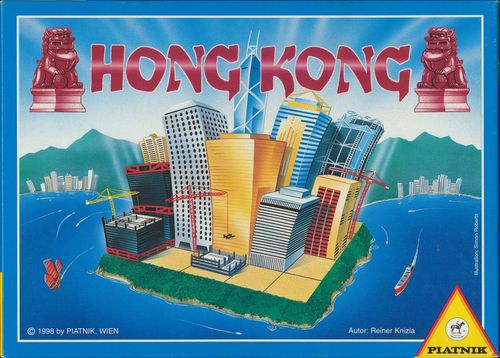
Hong Kong is booming with construction. The skyscrapers rise higher and higher. A new zone of 25 building sites has opened. Can you take control of more buildings than your opponent?
Contents
- 1 board of 25 spaces (building sites)
- 60 pieces (in two colours):
- 40 standard blocks
- 10 quick blocks (marked with a white dot)
- 10 roofs
- 1 rulebook
Objective
The objective of the game is to control more buildings than your opponent, when all spaces are occupied, or when all standard blocks and all roofs have been used. A building is controlled by the player whose piece (block or roof) is on top of it.
Course of Play
One player begins, then the players take turns alternately.
Options for a Player
On their turn, a player chooses one of the following options:
- Place a standard block
- Place a roof
- Place a quick block, then a standard block
- Place a quick block, then a roof
A player who has five quick blocks has five opportunities during the game to make a double move.
Placement Rules
When placing pieces, the following rules apply:
- The first player, on their first turn, cannot place a block on the central space.
- If a player places two pieces during a turn, they may place them on the same space or on two different spaces.
- On an empty space, any piece may be placed, including a roof.
- No piece may be placed on a roof (try it, you will see that it does not stay).
- The maximum height of a building is five pieces.
- Players may always place a piece on a building they control, that is, a building whose top piece is of their own colour.
- To place a piece on a building controlled by the opponent, a player must control a building on an adjacent space (that is, touching the targeted space along an edge), such that the piece to be placed does not create a building that is higher than the adjacent building.
- In this regard, note that blocks are considered higher than roofs.
Examples
The source rulebook shows diagrams here (images only, not reproduced).
End of Game
The game can end in two ways:
- When, at the end of a turn, all 25 spaces are occupied, or
- When, at the end of a turn, all standard blocks (but not necessarily all quick blocks) and all roofs have been used.
Victory goes to the player who controls the most buildings. If both players control the same number of buildings, the player who controls the building on the central space wins.