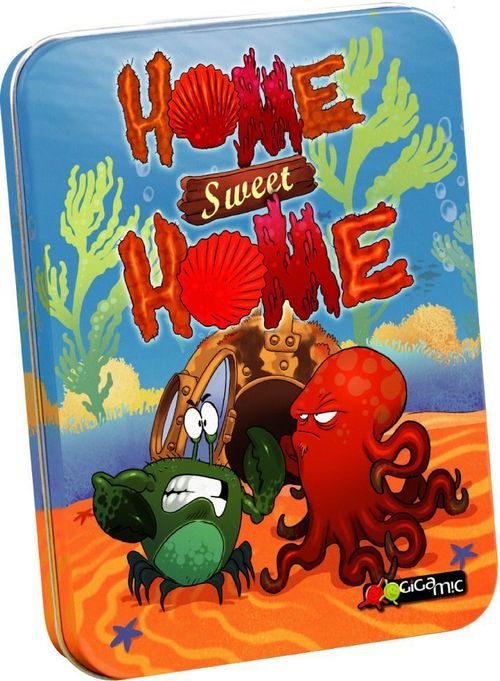
Home Sweet Home
Home Sweet Home Rulebook
Table of Contents
Table of Contents
Contents
- 60 Animal cards: 30 Octopuses and 30 Crabs
- 20 Scaphandre (diving suit) cards, numbered 1 to 5
- Rulebook
Goal of the Game
During the game, the players bring sea animals into their Scaphandres (diving suits). The winner is the player who has the greatest number of crabs and octopuses when all the cards have been played.
Setup
Each player receives 5 Scaphandre cards, numbered 1 to 5, which they lay out in front of them, face up and in ascending order (fig. 1).
The Animal cards are shuffled, and 4 are dealt to each player, who keeps them in hand. The remaining cards form the draw pile, placed face down.
Playing the Game
The player who imitates an octopus best starts, then play proceeds clockwise.
On their turn, a player chooses one of their 4 Animal cards and places it face up in the centre of the table. They then announce the total number of visible animals (Crabs and Octopuses combined).
Example (see fig. 2):
- Arthur plays a 1 Crab card and announces 1.
- Nina plays a 2 Octopuses card and announces 3 (1+2).
- Maël plays a 2 Crabs card and announces 5 (3+2).
- Louisa plays a 3 Crabs card and announces 8 (5+3).
At the end of their turn, the player draws a card to complete their hand. Then it is the next player's turn.
As soon as a player announces 12 or more, they must collect all the cards in the centre of the table and place them in their Scaphandres according to the number of animals shown on the cards. Then it is the next player's turn.
Careful, there can only be one type of animal in each Scaphandre: Octopuses and Crabs cannot stand each other! When a player collects a card while already having, in their Scaphandre, a card of the same number but with the other animal, they must then discard both cards!
Scaphandre cards, by number of animals:
- Card 1: 1 Crab or 1 Octopus in Scaphandre No. 1
- Card 2: 2 Crabs or 2 Octopuses in Scaphandre No. 2
- Card 3: 3 Crabs or 3 Octopuses in Scaphandre No. 3
- Card 4: 4 Crabs or 4 Octopuses in Scaphandre No. 4
- Card 5: 5 Crabs or 5 Octopuses in Scaphandre No. 5
(Translator's note: the French text says "du même type" (of the same type). The fig. 4 example shows that this means a card with the same number, the other animal.)
Example (fig. 4): a player collects a 3 Crabs card while already having a 3 Octopuses card in their Scaphandre No. 3. They must immediately discard this 3 Crabs card and one of their 3 Octopuses cards.
End of the Game
When the draw pile is exhausted, the current round is completed and the game ends.
(If, after the last turn, the total of the cards in the centre of the table does not reach 12, those cards are not counted and the game ends.)
Each player then totals the number of animals in their Scaphandres: the player with the most animals wins!
Scoring example (see fig. 5):
The player has the following in their Scaphandres:
- 3 x 1 Crab
-
- 1 x 2 Crabs
-
- 2 x 3 Octopuses
-
- 1 x 4 Octopuses
-
- 1 x 5 Octopuses
- = 20 animals.
(3 x 1) + (1 x 2) + (2 x 3) + (1 x 4) + (1 x 5) = 20
Variant: "Memory"
The rules above remain the same, but instead of placing the Animal cards face up next to one another, the players stack them in the centre of the table, so that the top card hides the cards previously played. Each player must then remember the animals present in the pile, or risk an unpleasant surprise when collecting it! (fig. 6)